Tag Archives: fraud

Protect Yourself from Scams

Your retirement account can be an attractive target for scammers who continue to find new ways to try to impersonate government agencies, such as NYSLRS or the Social Security Administration. Protect yourself from scams by learning to distinguish fake messages from official NYSLRS communications.

How Scams Work

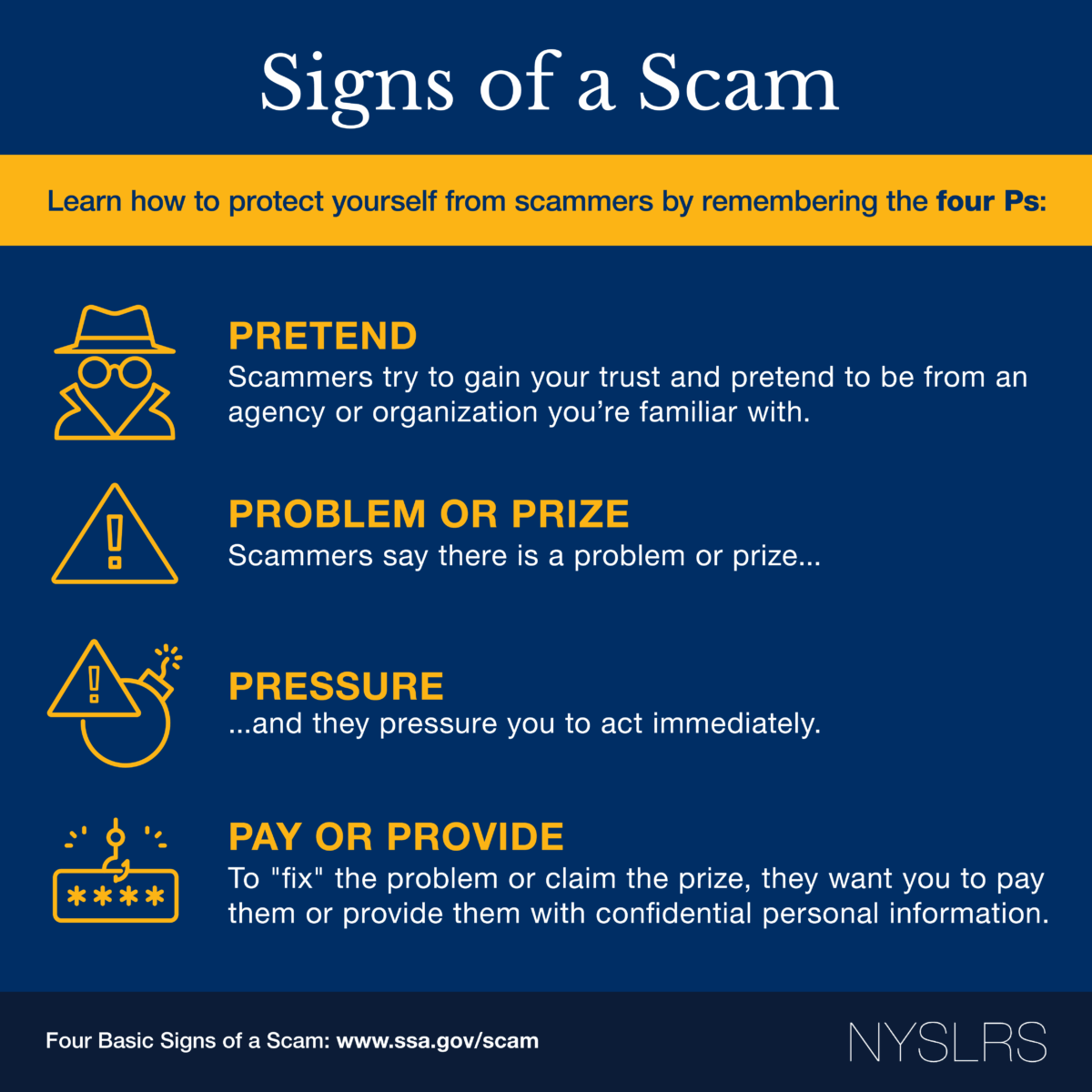
Scammers pretend to be an agency or organization you already know to gain your trust. They use similar logos or imagery in correspondence. They may contact you from an email address that mimics—but isn’t identical to—those used by employees of the actual organization. Some can even make a real agency’s phone number appear on caller ID (known as spoofing).

Usually, once they contact you, they claim there is a problem (or a prize or a new benefit available) requiring your immediate attention. But here’s the catch: to fix the problem or receive the reward, the imposter needs you to pay them a fee or provide personal data, such as your Social Security number or bank account information. They may even threaten you with legal action, a suspension of your benefits or arrest if you fail to act.
protect yourself from scams

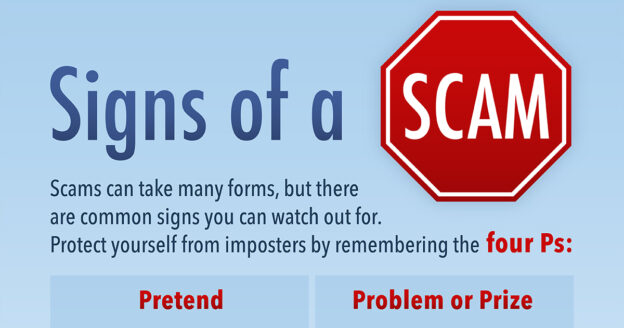
If someone contacts you and you notice these signs of a scam, remain calm. Hang up the phone or delete the message if you feel like something is off. It’s the easiest way to avoid accidentally giving away personal information.

Scammers have also attempted to create a fake mobile app or website, which looks similar to Retirement Online, aimed to trick users and capture login credentials. Please be aware, we currently do not have a mobile app. Protect yourself from these scams by accessing Retirement Online from the NYSLRS website and avoid using search engines to find a link for the login page.

AI: A New Tool for Scams

You should also be aware of an emerging threat—artificial intelligence (AI), which allows computers to mimic certain human behaviors, such as speech and writing. Using AI, scammers can personalize phishing emails, making it harder to recognize a fraudulent communication. AI may even be able to impersonate the voice of a family member or friend, making you think they are in trouble or need money.

Here are some things you can do to protect yourself from AI-enhanced scams.

  • Don’t share sensitive information through text or social media.
  • Don’t send or transfer money to unknown locations.
  • Consider designating a safe word for your family to use to identify themselves and share that word with family members and close contacts.
  • When in doubt, hang up and call your loved one back.

Doing Business With NYSLRS

To protect yourself from potential scams and keep your personal information secure, use your NYSLRS ID to verify your identity when doing business with NYSLRS, instead of providing your Social Security number. You can find your NYSLRS ID by signing in to your Retirement Online account, or by checking your annual statement or other correspondence from NYSLRS.

Generally, NYSLRS will only call you if we are following up on a previous communication from you—a phone call, secure email message, Retirement Online request, form or letter. If you haven’t completed a transaction or submitted changes recently, be wary of unexpected calls or requests for your NYSLRS information.

Make sure you review the communications you receive from NYSLRS. We send you letters or emails (depending on your delivery preference in Retirement Online) whenever you update your Retirement Online account or benefit information. If you receive a letter or email about an account change you did not make, contact us immediately.

Keep Your Retirement Online Account Secure

Retirement Online is the fastest and most convenient way to access your retirement account information and conduct business with NYSLRS. And it’s safe to use—it has the same security safeguards used for online banking and by other financial institutions. Here are steps you can take to help ensure your Retirement Online account stays secure:

  • First, if you don’t have an account, learn more about Retirement Online and click Register Now.
  • Choose a strong password.
  • Once you have an account, keep your username and password in a safe place, and don’t share them with anyone. NYSLRS will never ask for your password.
  • Sign in to Retirement Online at least once a year and update your password so it doesn’t expire. If you forgot your user ID or password, don’t worry—from the customer login page, you can:
    • Click the Forgot ID link to look up your user ID.
    • Click the Forgot Password link to reset your password.

You’ll need to identify yourself and answer security questions you set when you signed in for the first time.

For step-by-step instructions, read our Forgot User ID and Forgot Password guides.

  • Update your delivery preference to receive an email notifying you when you have correspondence to view in Retirement Online. That way, when there are changes to your account, you’ll receive an email notifying you instead of waiting for printed notices through the mail.

For more information, read our Retirement Online Tools and Tips blog post.
Fighting Fraud and Protecting Pension Benefits

Fighting Fraud and Protecting Pension Benefits

Since taking office, New York State Comptroller Thomas P. DiNapoli has fought the abuse of public funds. One of his top priorities is protecting NYSLRS and its retirees from pension fraud.

The Comptroller’s Division of Investigations regularly partners with federal, state and local law enforcement in New York and across the country to bring corrupt individuals to justice and recoup stolen NYSLRS money. Over the past several years, pension fraud investigations have led to 57 arrests and the recovery of over $5.8 million.

Here are some cases from earlier this year:

Joint Investigation Uncovers Caretaking Scheme

In May 2024, a joint investigation between the Comptroller’s office, the Rensselaer County District Attorney and the New York State Police led to the arrest of an Albany woman and man for allegedly stealing more than $200,000 in pension and Social Security payments from an 86-year-old retiree.

The defendants engaged in a caretaking scheme that left the elderly victim in deplorable living conditions and resulted in home foreclosure. They persuaded the victim to let them pay his bills, however, they did not pay the victim’s mortgage, property taxes or other bills for several years. This caused the foreclosure of the victim’s home, the repossession of his vehicle, and his electricity to be turned off.

As a result of the investigation, the victim was removed from the home and received necessary treatment.

In November 2024, one of the defendants pleaded guilty to grand larceny in the second degree and is awaiting sentencing. The second defendant was indicted by a Rensselaer County Grand Jury on charges of grand larceny in the second degree and the matter is currently pending in court.

Son Impersonates Father to Continue Receiving Pension

In 2017, a NYSLRS pensioner who had retired from the Nassau County Clerk’s Office in 1992, moved to Wyoming with his son. The retiree was never heard from again, and it is believed he died in Wyoming. His pension payments should have stopped when he died, but his son never reported his death.

In fact, the son went to great lengths to conceal his father’s death and continue receiving his pension and social security payments. He even whitened his hair and eyebrows to impersonate his deceased father.

But a call to the Comptroller’s Fraud Hotline prompted an investigation, which included the U.S. Attorney’s Office, the Social Security Administration, the U.S. Postal Inspection Service and the FBI.

The son was arrested on federal fraud charges in 2023. In February 2024, the son was sentenced to five years in prison and ordered to repay the $194,000 he stole in NYSLRS pension and Social Security benefits.

Man Steals Deceased Sister-in-Law’s Pension Payments

In October 1986, a stenographer from the Supreme Court, Appellate Division, retired with a disability retirement and the Single Life Allowance pension payment option. That means, when she died in January 2019, her monthly pension payments should have ended. Once NYSLRS discovered her death in July 2022, payments were stopped, and an investigation was launched.

A forensic analysis was completed on the bank account where the pension payments were being deposited, which was a joint account in the name of the retiree and her brother-in-law. The investigation found that the brother-in-law diverted over $50,000 in pension payments made after his sister-in-law’s death and used the money to pay credit card bills, travel and make online purchases.

The brother-in-law was arraigned on a charge of grand larceny in Albany County Court. The matter is pending in court.

You Can Help Fight Fraud

If you are aware of potential pension fraud, visit the Comptroller’s Fighting Public Corruption page to file a complaint online, or call the Fraud Hotline at 888-672-4555.

Protecting Yourself from Scams

Your retirement account can be an attractive target for scammers, and imposters continue to find new ways to try to impersonate government agencies, such as NYSLRS or the Social Security Administration. Learn to distinguish fake messages from official NYSLRS communications and protect yourself from scams.

protecting yourself from scams

How Scams Work

Imposters pretend to be an agency or organization you already know to gain your trust. They use similar logos or imagery in correspondence. They may contact you from an email address that mimics—but isn’t identical to—those used by employees of the actual organization. Some can even make a real agency’s phone number appear on caller ID (known as spoofing).

Usually, once they contact you, they claim there is a problem (or a prize or a new benefit available) requiring your immediate attention. But here’s the catch: to fix the problem or receive the reward, the imposter needs you to pay them a fee or provide personal data, such as your Social Security number or bank account information. They may even threaten you with legal action, a suspension of your benefits or arrest if you fail to act in time.

If someone contacts you and you notice these signs of a scam, remain calm. Hang up the phone or delete the message if you feel like something is off. It’s the easiest way to avoid accidentally giving away personal information.

AI: A New Tool for Scams

You should also be aware of an emerging threat—artificial intelligence (AI), which allows computers to mimic certain human behaviors, such as speech and writing. Using AI, scammers can personalize phishing emails, making it harder to recognize a fraudulent communication. AI may even be able to impersonate the voice of a family member or friend, making you think they are in trouble or need money.

Here are some things you can do to protect yourself from AI-enhanced scams:

  • Don’t share sensitive information through text or social media;
  • Don’t send or transfer money to unknown locations;
  • Consider designating a “safe word” for your family to use to identify themselves and share that word with family members and close contacts; and
  • When in doubt, hang up and call your loved one back.

Doing Business With NYSLRS

Generally, NYSLRS will only call you if we are following up on a previous communication from you, such as a phone call, secure email message, Retirement Online request, form or letter. For security, you can use your NYSLRS ID to identify yourself instead of providing your Social Security number. To find your NYSLRS ID, sign in to Retirement Online, or check your annual statement or other correspondence from NYSLRS.

It’s important to review the communications you receive from NYSLRS. We send you letters or emails (depending on your delivery preference in Retirement Online) whenever you update your Retirement Online account or benefit information.

Keep Your Retirement Online Account Secure

Retirement Online is the fastest and most convenient way to review your retirement account details and conduct business with NYSLRS. And it’s safe to use—it has the same security safeguards used for online banking and by other financial institutions. Please note, it is currently only available from the NYSLRS website; there is no mobile app.

Here are steps you can take to help make sure your Retirement Online account stays secure:

  • Once you have an account, keep your username and password in a safe place, and don’t share them with anyone. NYSLRS will never ask for your password.
  • Sign in to Retirement Online at least once a year and update your password so it doesn’t expire. If you haven’t signed in recently and forgot your user ID or password, don’t worry—from the customer login page, you can:
    • Click the Forgot ID link to look up your user ID.
    • Click the Forgot Password link to reset your password.

You’ll need to identify yourself and answer security questions you set when you signed in for the first time. Read our Forgot User ID and Forgot Password guides for step-by-step instructions.

  • Update your delivery preference to receive an email notifying you when you have correspondence to view in Retirement Online. That way, when there are changes to your account, you’ll receive an email notifying you instead of waiting for printed notices through the mail.

If you receive a notification of an account change you did not make, contact us immediately.