Tag Archives: Vested

10 Things Members Should Know

NYSLRS is one of the largest retirement systems in the world, administering benefits for more than 1.2 million members, retirees and beneficiaries. Take a look inside NYSLRS and brush up on your NYSLRS knowledge—here are 10 things members should know.

Retired? Check out 10 Things Retirees Should Know.

1. Retirement Online is the Fastest, Most Convenient Way to Do Business With NYSLRS

10 Things Members Should Know Retirement Online is the fastest way to manage your NYSLRS account. Skip printing forms, having them notarized and sending them through the mail. When you submit your requests through Retirement Online, NYSLRS has them immediately, and your changes will be completed more quickly. It’s convenient and secure. Check out what members can do in Retirement Online.

If you don’t have an account or for help signing in to an existing account, check out our Retirement Online tools and tips for step-by-step instructions to register, reset your password, unlock your account and more.

2. Your Pension is a Lifetime Benefit—And Your Pension Benefits are Secure

NYSLRS pensions are defined benefit plans, also known as traditional pension plans. When you retire, you will receive a monthly pension payment for the rest of your life. Your pension will be calculated using a preset formula based on your earnings and years of service—it will not be based on the individual contributions you paid into the system. Member contributions support the benefits earned by current and future retirees and are an important asset of the Common Retirement Fund, which holds and invests the money used to pay NYSLRS benefits. The Fund is widely recognized as one of the best-funded and best-managed public pension plans in the nation. Comptroller Thomas P. DiNapoli is administrator of NYSLRS and trustee of the Common Retirement Fund.

3. ‘Go Green’ and Get Your Important Documents Sooner

You can help us ‘go green’ and reduce paper waste by choosing email as your delivery preference for correspondence and other important documents, such as your Member Annual Statement. When you have something to view, we’ll send an email notifying you to sign in to Retirement Online. And it will save time—you’ll get access to your important documents sooner than printed copies are mailed. Learn how to get email notifications for important documents.

4. Your Tier Determines Your Benefits

Your tier, which is based on your date of membership, determines your benefits, such as eligibility for death benefits or taking a NYSLRS loan and the formula used in the calculation of your benefits.

5. Vested Means You Qualify for a Retirement Benefit

Becoming vested is a crucial milestone for NYSLRS members. It means you have earned enough service to qualify for a retirement benefit once you meet the minimum age or service requirements established by your retirement plan. All members who have at least five years of service credit are vested.

6. Review Your Beneficiaries Periodically

NYSLRS retirement plans provide death benefits for beneficiaries of eligible members who die before retiring. It’s a good idea to review your beneficiaries from time to time to make sure they reflect your current wishes. The beneficiary you named before might not be the one you would choose today. You should also review the contact information for your named beneficiaries so we can find them when needed.

7. Request Additional Service Credit as Early in Your Career as Possible

Service credit is a major factor in calculating your pension benefit. You earn a year of service credit for each year of full-time employment with a participating employer. You may also be able to request additional credit if you worked for your current or another public employer before joining NYSLRS or if you served in the U.S. Armed Forces and received an honorable discharge from active military duty. You must submit your request before retirement, and you should do it as early in your career as possible.

8. Estimate Your Pension

Finding out how much you can expect to receive is an important part of retirement planning. Most members can estimate their pension using Retirement Online in just a few quick and easy steps. Retirement Online uses your current earnings and service information to calculate your estimate, including your final average earnings (FAE) and the amounts for the pension payment options available to you. You can fine-tune your estimate or see how different choices would affect your benefit by entering different retirement dates or a beneficiary’s date of birth.

9. Supplement Your Pension with Retirement Savings

Think of retirement security as a three-legged stool. Each leg is a source of income to help support you when your working days are done. It’s important to understand all your potential sources of income to effectively plan for the future and boost your retirement confidence. Your pension can provide a significant part of your retirement income, but it’s a good idea to supplement your pension with retirement savings and start saving early so your money has time to grow.

10. Your Retirement Plan Publication is an Essential Resource

Your retirement plan publication is an essential resource that explains your NYSLRS benefits in detail—how long you’ll need to work to receive a pension, how your benefit is determined, what death and disability retirement benefits may be available, and more. You should consult it throughout your career, but it’s especially important to read as you prepare for retirement.

NYSLRS – One Tier at a Time: ERS Tiers 3 and 4

(We know that’s two, but let us explain.) When you join the New York State and Local Retirement System (NYSLRS), you’re assigned a tier based on your date of membership. There are six tiers in the Employees’ Retirement System (ERS) and five in the Police and Fire Retirement System (PFRS). Your tier determines such things as your eligibility for benefits, the calculation of those benefits, death benefit coverage and whether you need to contribute toward your benefits.

Our series, NYSLRS – One Tier at a Time, walks through each tier and gives you a quick look at the benefits in both ERS and PFRS. Today’s post looks at ERS Tiers 3 and 4. Of our current 650,251 ERS members, 263,561 are in Tiers 3 and 4, representing 40.5 percent of ERS membership.

Most ERS Tier 3 and Tier 4 members (unless they are in special retirement plans) retire under the Article 15 retirement plan. Check out the graphic below for the basic retirement information for Tiers 3 and 4 members in this plan.

ERS Tiers 3 and 4 - Article 15

Membership Milestones for ERS Tiers 3 and 4

ERS members in Tiers 3 or 4 need five years of service credit to become vested. Once vested, they’re eligible for a lifetime pension benefit as early as age 55. However, if they retire before the full retirement age of 62 with fewer than 30 years of service credit, their benefit will be reduced. Some Tier 3 and 4 members, such as sheriffs or correction officers, can retire with 20 or 25 years of service, regardless of age and without penalty.

You can check your service credit total and estimate your pension using Retirement Online. Most members can use our online pension calculator to create an estimate based on the salary and service information NYSLRS has on file for them. You can enter different retirement dates to see how your choices would affect your potential benefit.

For more information about Tier 3 and 4 membership, find your NYSLRS retirement plan publication. It’s a comprehensive description of the benefits provided by your specific plan.

NYSLRS – One Tier at a Time: PFRS Tier 5

When you join the New York State and Local Retirement System (NYSLRS), you’re assigned a tier based on the date of your membership. There are six tiers in the Employees’ Retirement System (ERS) and five in the Police and Fire Retirement System (PFRS). Each tier has a different benefit structure established by New York State legislation.

Our series, NYSLRS — One Tier at a Time, walks through each tier to give you a quick look at the benefits in both ERS and PFRS. Today’s post looks at PFRS Tier 5. Anyone who joined PFRS from January 9, 2010 through March 31, 2012 is in Tier 5. There were 1,967 PFRS Tier 5 members as of March 31, 2021, making up 5.6 percent of PFRS membership.

About Special Plans

Under a regular plan, you need to reach certain age and service requirements to receive your NYSLRS pension. If you’re covered by a special plan, there is no age requirement, and you can receive your pension after completing 20 or 25 years of service.

Nearly 80 percent of PFRS members are in plans covered under Sections 384, 384-d, 384-e or 384-f of the Retirement and Social Security Law. Read our Police and Fire Retirement System blog post for information about different PFRS plans.

Check out the graphic below for the basic retirement information for PFRS Tier 5.

PFRS Tier 5

If you’re a PFRS Tier 5 member, you can find detailed information about your benefits in the retirement plan booklets listed below:

For special plans under miscellaneous titles, please visit our Publications page.

Check out other posts in the PFRS series:

Tier 3 & 4 Members: When Is The Right Time To Retire?

Tier 3 and 4 members in the Article 15 retirement plan qualify for retirement benefits after they’ve earned five years of credited service. Once you’re vested, you have a right to a NYSLRS retirement benefit — even if you leave public employment. Though your pension is guaranteed, the amount of your pension depends on several factors, including when you retire. Here is some information that can help you determine the right time to retire.

Three Reasons to Keep Working

  1. Tier 3 and 4 members can claim their benefits as early as age 55, but they’ll face a significant penalty for early retirement – up to a 27 percent reduction in their pension. Early retirement reductions are prorated by month, so the penalty is reduced as you get closer to full retirement age. At 62, you can retire with full benefits. (Tier 3 and 4 Employees’ Retirement System (ERS) members who are in the Article 15 retirement plan and can retire between the ages of 55 and 62 without penalty once they have 30 years of service credit.)
  2. Your final average earnings (FAE) are a significant factor in the calculation of your pension benefit. Since working longer usually means a higher FAE, continued public employment can increase your pension.
  3. The other part of your retirement calculation is your service credit. More service credit can earn you a larger pension benefit, and, after 20 years, it also gets you a better pension formula. For Tier 3 and 4 members, if you retire with less than 20 years of service, the formula is FAE × 1.66% × years of service. Between 20 and 30 years, the formula becomes FAE × 2.00% × years of service. After 30 years of service, your pension benefit continues to increase at a rate of 1.5 percent of FAE for each year of service.

When is the Right Time to Retire infographic


If You’re Not Working, Here’s Something to Consider

Everyone’s situation is unique. For example, if you’re vested and no longer work for a public employer, and you don’t think you will again, taking your pension at 55 might make sense. When you do the math, full benefits at age 62 will take 19 years to match the money you’d have received retiring at age 55 — even with the reduction.

An Online Tool to Help You Make Your Decision

Most members can use Retirement Online to estimate their pensions.

A Retirement Online estimate is based on the most up-to-date information we have on file for you. You can enter different retirement dates to see how those choices would affect your benefit, which could help you determine the right time to retire. When you’re done, you can print your pension estimate or save it for future reference.

If you are unable to use our online pension calculator, please contact us to request a pension estimate.

This post has focused on Tier 3 and 4 members. To see how retirement age affects members in other tiers, visit our About Benefit Reductions page.

ERS Tiers 1 and 2: The New Career Plan

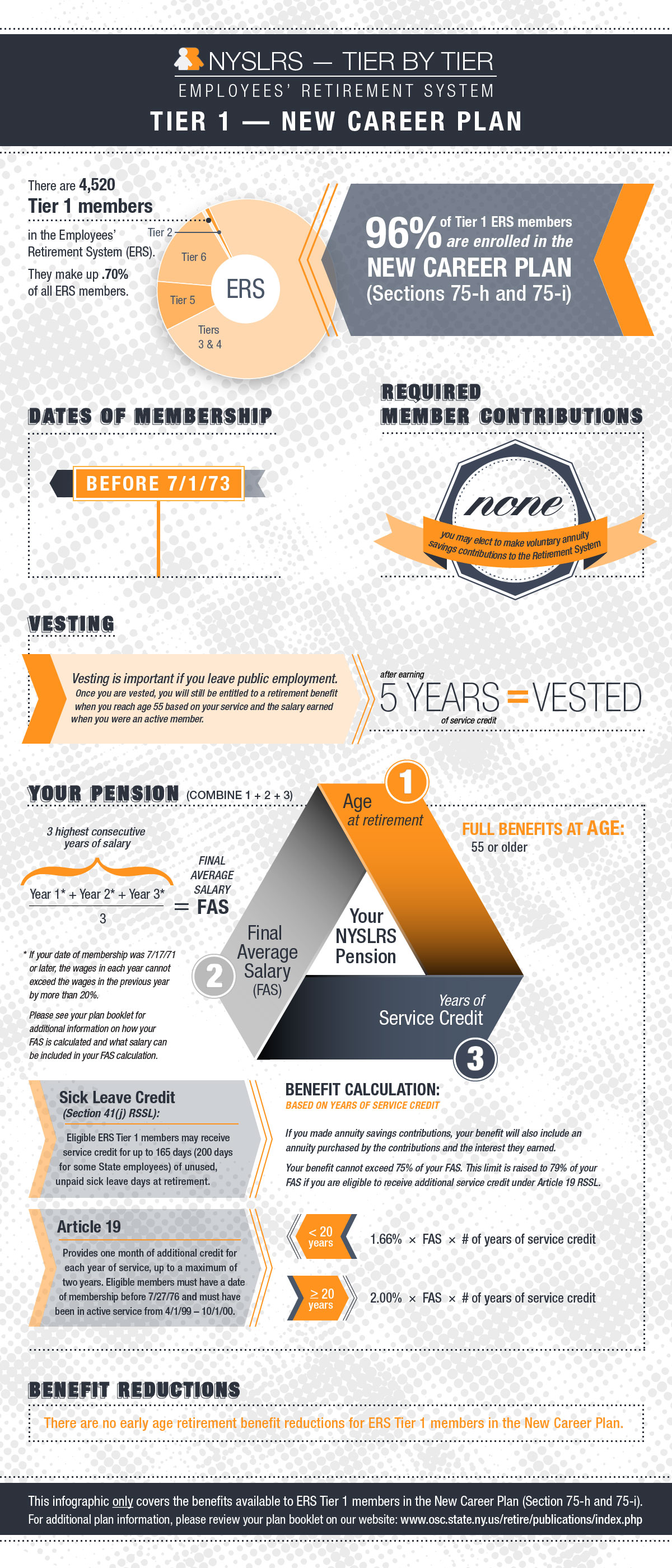
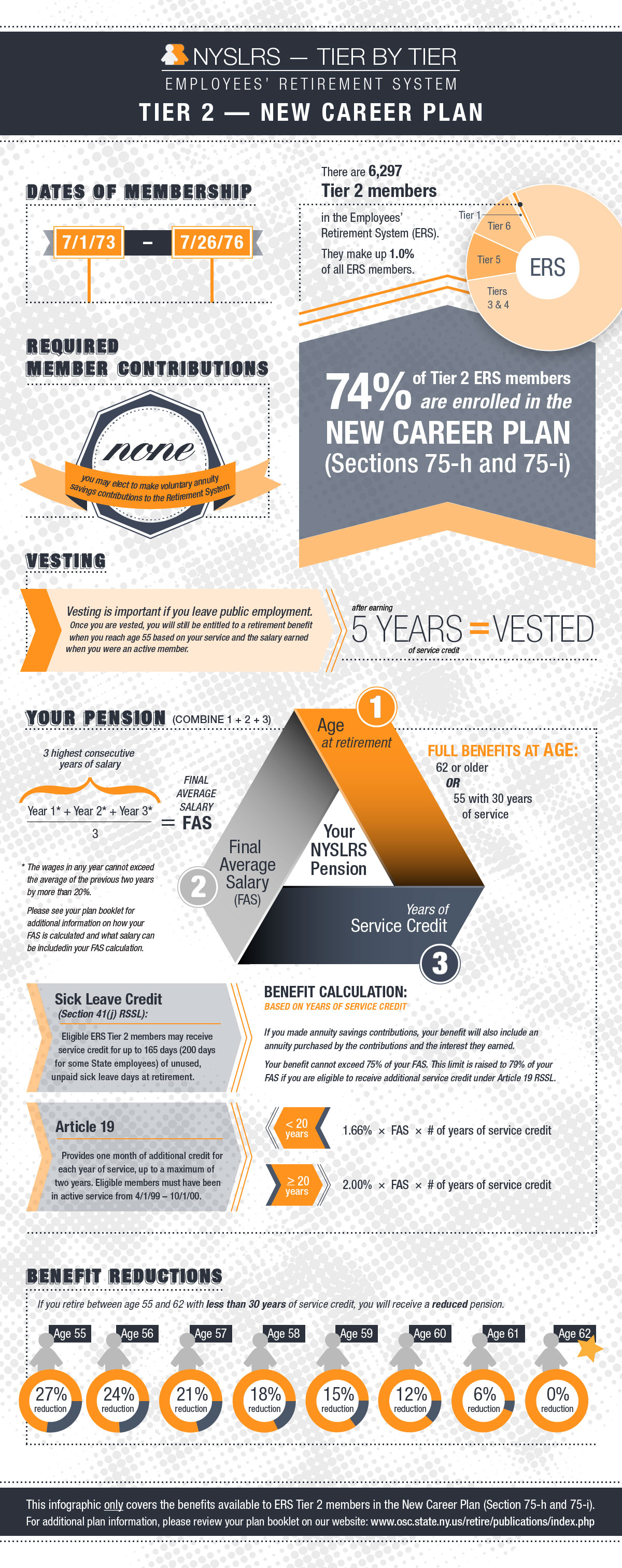
Did you become a member of the Employees’ Retirement System (ERS) before July 1, 1973? If you’re still working in public service, you’re one of the 3,508 active members in Tier 1. If you joined after July 1, 1973 but before July 27, 1976, then you’re one of 4,127 active members in Tier 2.

Most ERS Tier 1 and Tier 2 members are in the New Career Plan (Section 75-h or 75-i). Currently, 96 percent of active Tier 1 members and almost 95 percent of active Tier 2 members are covered by this plan. Here’s a quick look at the benefits in the New Career Plan:

Benefit Eligibility

Tier 1

  • Members must be at least age 55 to be eligible to collect a retirement benefit.
  • There are no minimum service requirements — they may collect full benefits at age 55.
New Career Plan — ERS Tier 1

Tier 2

  • Members must have five years of service and be at least age 55 to be eligible to collect a retirement benefit.
  • The full benefit age is 62.
  • Almost 95 percent of active Tier 2 members are covered by the New Career Plan (Section 75-h or 75-i).
New Career Plan — ERS Tier 2

Final Average Salary

Final average salary (FAS) is the average of the wages earned in the three highest consecutive years of employment. For Tier 1 members who joined NYSLRS June 17, 1971 or later, each year used in the FAS calculation is limited to no more than 20 percent above the previous year’s earnings. For Tier 2 members, each year of earnings is limited to no more than 20 percent above the average of the previous two years’ earnings.

Benefit Calculations

  • For Tier 1 and 2 members, the benefit is 1.66 percent of the FAS for each year of service if the member retires with less than 20 years. If the member retires with 20 or more years of service, the benefit is 2 percent of the FAS for each year of service.
  • Tier 1 members and Tier 2 members with 30 or more years of service can retire as early as age 55 with no reduction in benefits.
  • Both Tier 1 and Tier 2 members who worked continuously from April 1, 1999 through October 1, 2000 receive an extra month of service credit for each year of credited service they have at retirement, up to a maximum of 24 additional months.

If you have questions about the New Career Plan, please read the Tier 1 plan publication or the Tier 2 plan publication. You can find other plan publications on our website.

NYSLRS – One Tier at a Time: ERS Tier 2

When you joined the New York State and Local Retirement System (NYSLRS), you were assigned to a tier based on the date of your membership. There are six tiers in the Employees’ Retirement System (ERS) and five in the Police and Fire Retirement System (PFRS) – so there are many different ways to determine benefits for our members. Our series, NYSLRS – One Tier at a Time, walks through each tier and gives you a quick look at the benefits members are eligible for before and at retirement.

NYSLRS created Tier 2 on July 1, 1973, marking the first time NYSLRS created any new member group. Today’s post looks at one of the major Tier 2 retirement plans in ERS. ERS Tier 2 as a whole represents less than one percent of NYSLRS’ total membership.

ERS-Tier-2-Benefits_001aIf you’re an ERS Tier 2 member in an alternate plan, you can find your retirement plan publication below for more detailed information about your benefits:

Be on the lookout for more NYSLRS – One Tier at a Time posts. Next time, we’ll take a look at another ERS tier. Want to learn more about the different NYSLRS retirement tiers? Check out some earlier posts in the series:

NYSLRS – One Tier at a Time: PFRS Tier 1

When you joined the New York State and Local Retirement System (NYSLRS), you were assigned to a tier based on the date of your membership. There are six tiers in the Employees’ Retirement System (ERS) and five in the Police and Fire Retirement System (PFRS) – so there are many different ways to determine benefits for our members. Our series, NYSLRS – One Tier at a Time, walks through each tier and gives you a quick look at the benefits members are eligible for before and at retirement.

Today’s post looks at Tier 1 in the Police and Fire Retirement System, which has only 123 members. PFRS Tier 1 represents the smallest percentage – 0.4 percent – of NYSLRS’ total membership.

PFRS-Tier-1-Benefits_002

If you’re a PFRS Tier 1 member, you can find your retirement plan publication below for more detailed information about your benefits:

Be on the lookout for more NYSLRS – One Tier at a Time posts. Next time, we’ll take a look at another one of our ERS tiers. Want to learn more about the different NYSLRS retirement tiers? Check out some earlier posts in the series: