Tag Archives: Retirement Online

Protect Yourself from Scams

Your retirement account can be an attractive target for scammers who continue to find new ways to try to impersonate government agencies, such as NYSLRS or the Social Security Administration. Protect yourself from scams by learning to distinguish fake messages from official NYSLRS communications.

How Scams Work

Scammers pretend to be an agency or organization you already know to gain your trust. They use similar logos or imagery in correspondence. They may contact you from an email address that mimics—but isn’t identical to—those used by employees of the actual organization. Some can even make a real agency’s phone number appear on caller ID (known as spoofing).

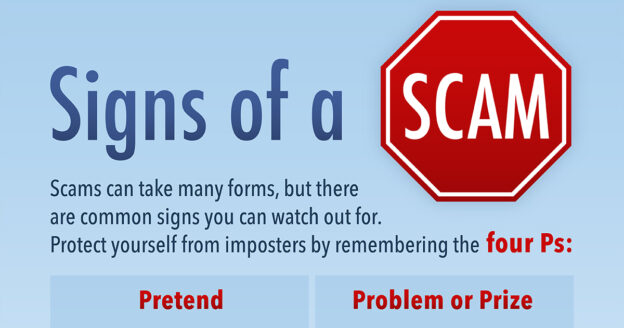
Usually, once they contact you, they claim there is a problem (or a prize or a new benefit available) requiring your immediate attention. But here’s the catch: to fix the problem or receive the reward, the imposter needs you to pay them a fee or provide personal data, such as your Social Security number or bank account information. They may even threaten you with legal action, a suspension of your benefits or arrest if you fail to act.

protect yourself from scams

If someone contacts you and you notice these signs of a scam, remain calm. Hang up the phone or delete the message if you feel like something is off. It’s the easiest way to avoid accidentally giving away personal information.

Scammers have also attempted to create a fake mobile app or website, which looks similar to Retirement Online, aimed to trick users and capture login credentials. Please be aware, we currently do not have a mobile app. Protect yourself from these scams by accessing Retirement Online from the NYSLRS website and avoid using search engines to find a link for the login page.

AI: A New Tool for Scams

You should also be aware of an emerging threat—artificial intelligence (AI), which allows computers to mimic certain human behaviors, such as speech and writing. Using AI, scammers can personalize phishing emails, making it harder to recognize a fraudulent communication. AI may even be able to impersonate the voice of a family member or friend, making you think they are in trouble or need money.

Here are some things you can do to protect yourself from AI-enhanced scams.

  • Don’t share sensitive information through text or social media.
  • Don’t send or transfer money to unknown locations.
  • Consider designating a safe word for your family to use to identify themselves and share that word with family members and close contacts.
  • When in doubt, hang up and call your loved one back.

Doing Business With NYSLRS

To protect yourself from potential scams and keep your personal information secure, use your NYSLRS ID to verify your identity when doing business with NYSLRS, instead of providing your Social Security number. You can find your NYSLRS ID by signing in to your Retirement Online account, or by checking your annual statement or other correspondence from NYSLRS.

Generally, NYSLRS will only call you if we are following up on a previous communication from you—a phone call, secure email message, Retirement Online request, form or letter. If you haven’t completed a transaction or submitted changes recently, be wary of unexpected calls or requests for your NYSLRS information.

Make sure you review the communications you receive from NYSLRS. We send you letters or emails (depending on your delivery preference in Retirement Online) whenever you update your Retirement Online account or benefit information. If you receive a letter or email about an account change you did not make, contact us immediately.

Keep Your Retirement Online Account Secure

Retirement Online is the fastest and most convenient way to access your retirement account information and conduct business with NYSLRS. And it’s safe to use—it has the same security safeguards used for online banking and by other financial institutions. Here are steps you can take to help ensure your Retirement Online account stays secure:

  • First, if you don’t have an account, learn more about Retirement Online and click Register Now.
  • Choose a strong password.
  • Once you have an account, keep your username and password in a safe place, and don’t share them with anyone. NYSLRS will never ask for your password.
  • Sign in to Retirement Online at least once a year and update your password so it doesn’t expire. If you forgot your user ID or password, don’t worry—from the customer login page, you can:
    • Click the Forgot ID link to look up your user ID.
    • Click the Forgot Password link to reset your password.

You’ll need to identify yourself and answer security questions you set when you signed in for the first time.

For step-by-step instructions, read our Forgot User ID and Forgot Password guides.

  • Update your delivery preference to receive an email notifying you when you have correspondence to view in Retirement Online. That way, when there are changes to your account, you’ll receive an email notifying you instead of waiting for printed notices through the mail.

For more information, read our Retirement Online Tools and Tips blog post.

Estimate Your Pension in Retirement Online

Most NYSLRS members can create their own pension estimates in minutes using Retirement Online. Your estimate will be based on the most up-to-date account information we have on file for you. You can enter different retirement dates and beneficiaries to see how those choices would affect your benefit. When you’re done, print your pension estimate or save it for future reference.

Estimate Your Pension in Retirement Online

How to Create a Pension Estimate

To get started:

  • Sign in to Retirement Online.
  • Look under My Account Summary.
  • Click Estimate My Pension Benefit button.
  • Enter Retirement Date or Your Age at Retirement.

You can fine tune your estimate with:

If you enter your beneficiary’s birthdate, you’ll see the estimated monthly amounts for the pension payment options that provide a lifetime benefit for a single beneficiary and the pension payment options that provide a limited benefit for multiple beneficiaries.

Remember, the amounts are estimates, not a guarantee of what you’ll receive when you retire.

Most Tier 2 through 6 members (more than 90 percent of all NYSLRS members) can use the Retirement Online pension calculator. However, some members may not be able to—for example, members who recently transferred to NYSLRS and some PFRS members. The system will let you know if your estimate cannot be completed. In that case, please send us a message using our secure contact form (select Estimates from the Topic dropdown).

Do More With Retirement Online

In Retirement Online, you can view your account details—date of membership, tier, retirement plan, estimated total service credit and more. Check out what else members can do in Retirement Online.

If you don’t have an account, learn more about Retirement Online and click Register Now. If you need help with Retirement Online, read our Retirement Online Tools and Tips blog post.

Your Death Benefit Beneficiaries

NYSLRS retirement plans provide death benefits for beneficiaries of eligible members who die before retiring.

It’s important to name beneficiaries and review them periodically. Life circumstances change and a beneficiary you named before might not be one you would choose today. For instance, you may have a new partner or you may have children now. And NYSLRS can only pay a death benefit to the beneficiaries you’ve named.

If you are retired or planning to retire soon, read our blog post, Can You Change Your Beneficiary After You Retire?

2 Types of Beneficiaries

  • Your primary beneficiary will receive your death benefit. You can list more than one primary beneficiary. If you do, they will share the benefit equally. Or, you can choose different percentages for each beneficiary, which must total 100 percent. (Example: John Doe, 50 percent; Jane Doe, 25 percent; and Mary Doe, 25 percent.)
  • contingent beneficiary will only receive a benefit if all your primary beneficiaries die before you do. If you list multiple contingent beneficiaries, they will share the benefit equally unless you choose different percentages.

Special Beneficiary Designations

Your beneficiary doesn’t have to be a person. You can name your estate, a trust or a charity as your beneficiary.

Special Designations for Your NYSLRS Death Benefit Beneficiaries
  • Estate. When you die, your estate is the money and property you owned. Your death benefit will be given to the executor of your estate to be distributed according to the terms of your will. You can name your estate as the primary or contingent beneficiary of your death benefit. If you name your estate as the primary beneficiary, do not name a contingent beneficiary.
  • Trust. You can name a trust as a primary or contingent beneficiary if you have a trust agreement or provided for a trust in your will. The trust itself would be your beneficiary, not the individuals for whom you established the trust. (Speak with your attorney if you’re thinking about making your trust a beneficiary.)
  • Entity. You can also name any charitable, civic, religious, educational or health-related organization as a beneficiary.
  • Minor children. If your beneficiary is under the age of 18 at the time of your death, your benefit will be paid to the child’s court-appointed guardian. You may instead choose a custodian to receive the benefit on the child’s behalf under the Uniform Transfers to Minors Act (UTMA). Custodians can be designated in Retirement Online, or you can contact us for more information and the appropriate form before making this type of designation.

For more information, read our publication, Life Changes: Why Should I Designate a Beneficiary?

Keep Your Beneficiaries Up to Date with Retirement Online

You can change your beneficiaries at any time. In addition to adding or removing them to reflect your current wishes, you should review the contact information for your named beneficiaries so we can find them when needed.

The fastest way to view or update your beneficiaries is in Retirement Online.

Protecting Yourself from Scams

Your retirement account can be an attractive target for scammers, and imposters continue to find new ways to try to impersonate government agencies, such as NYSLRS or the Social Security Administration. Learn to distinguish fake messages from official NYSLRS communications and protect yourself from scams.

protecting yourself from scams

How Scams Work

Imposters pretend to be an agency or organization you already know to gain your trust. They use similar logos or imagery in correspondence. They may contact you from an email address that mimics—but isn’t identical to—those used by employees of the actual organization. Some can even make a real agency’s phone number appear on caller ID (known as spoofing).

Usually, once they contact you, they claim there is a problem (or a prize or a new benefit available) requiring your immediate attention. But here’s the catch: to fix the problem or receive the reward, the imposter needs you to pay them a fee or provide personal data, such as your Social Security number or bank account information. They may even threaten you with legal action, a suspension of your benefits or arrest if you fail to act in time.

If someone contacts you and you notice these signs of a scam, remain calm. Hang up the phone or delete the message if you feel like something is off. It’s the easiest way to avoid accidentally giving away personal information.

AI: A New Tool for Scams

You should also be aware of an emerging threat—artificial intelligence (AI), which allows computers to mimic certain human behaviors, such as speech and writing. Using AI, scammers can personalize phishing emails, making it harder to recognize a fraudulent communication. AI may even be able to impersonate the voice of a family member or friend, making you think they are in trouble or need money.

Here are some things you can do to protect yourself from AI-enhanced scams:

  • Don’t share sensitive information through text or social media;
  • Don’t send or transfer money to unknown locations;
  • Consider designating a “safe word” for your family to use to identify themselves and share that word with family members and close contacts; and
  • When in doubt, hang up and call your loved one back.

Doing Business With NYSLRS

Generally, NYSLRS will only call you if we are following up on a previous communication from you, such as a phone call, secure email message, Retirement Online request, form or letter. For security, you can use your NYSLRS ID to identify yourself instead of providing your Social Security number. To find your NYSLRS ID, sign in to Retirement Online, or check your annual statement or other correspondence from NYSLRS.

It’s important to review the communications you receive from NYSLRS. We send you letters or emails (depending on your delivery preference in Retirement Online) whenever you update your Retirement Online account or benefit information.

Keep Your Retirement Online Account Secure

Retirement Online is the fastest and most convenient way to review your retirement account details and conduct business with NYSLRS. And it’s safe to use—it has the same security safeguards used for online banking and by other financial institutions. Please note, it is currently only available from the NYSLRS website; there is no mobile app.

Here are steps you can take to help make sure your Retirement Online account stays secure:

  • Once you have an account, keep your username and password in a safe place, and don’t share them with anyone. NYSLRS will never ask for your password.
  • Sign in to Retirement Online at least once a year and update your password so it doesn’t expire. If you haven’t signed in recently and forgot your user ID or password, don’t worry—from the customer login page, you can:
    • Click the Forgot ID link to look up your user ID.
    • Click the Forgot Password link to reset your password.

You’ll need to identify yourself and answer security questions you set when you signed in for the first time. Read our Forgot User ID and Forgot Password guides for step-by-step instructions.

  • Update your delivery preference to receive an email notifying you when you have correspondence to view in Retirement Online. That way, when there are changes to your account, you’ll receive an email notifying you instead of waiting for printed notices through the mail.

If you receive a notification of an account change you did not make, contact us immediately.
NYSLRS – One Tier at a Time: PFRS Tier 2

When you join the New York State and Local Retirement System (NYSLRS), you’re assigned a tier based on the date of your membership. This post looks at Tier 2 members of the Police and Fire Retirement System (PFRS).

Your tier determines such things as your eligibility for benefits, the calculation of those benefits, death benefit coverage and whether you need to contribute toward your benefits.

PFRS has five tiers. Almost half of PFRS members are in Tier 2, which began on July 31, 1973, and ended on June 30, 2009. Most are in special retirement plans that allow for retirement after 20 or 25 years, regardless of age, without penalty.

The special plans that cover most police officers and firefighters fall under Sections 384, 384(f), 384-d, and 384-e of Retirement and Social Security Law. You can sign in to Retirement Online to find your benefit plan, which is listed under ‘My Account Summary.’

PFRS Tier 2

Where to Find PFRS Tier 2 Information

Whether you’re in one of the retirement plans described in this post or another retirement plan, we encourage you to visit our website to find your NYSLRS retirement plan publication. It’s a comprehensive description of the benefits you’re entitled to receive as a PFRS member.

You can check your service credit total and estimate your pension using Retirement Online. Most members can use our online pension calculator to create an estimate based on the salary and service information NYSLRS has on file for them. You can enter different retirement dates to see how your choices would affect your potential benefit.

Members may not be able to use the Retirement Online calculator in certain circumstances, for example, if they have recently transferred a membership to NYSLRS, if they are a Tier 6 member with between five and ten years of service, or if they have worked for multiple employers and were covered by different retirement plans. These members can contact us to request an estimate or use the “Quick Calculator” on our website. The Quick Calculator generates estimates based on information you provide.  

NYSLRS – One Tier at a Time: ERS Tier 6

When you join the New York State and Local Retirement System (NYSLRS), you’re assigned a tier based on the date of your membership. This post looks at Tier 6 members of the Employees’ Retirement System (ERS).

Your tier determines such things as your eligibility for benefits, the calculation of those benefits, death benefit coverage and whether you need to contribute toward your benefits.

ERS has six tiers. Anyone who joined ERS on or after April 1, 2012 is in Tier 6. There were 350,986 ERS Tier 6 members as of March 31, 2022. At 54 percent of membership, Tier 6 is the largest ERS tier.

Most ERS Tier 6 members (unless they are in special retirement plans) retire under the Article 15 retirement plan. Check out the graphic below for the basic retirement information for Tier 6 members in this plan.

ERS Tier 6

Membership Milestones

As of April 9, 2022, Tier 6 members only need five years of service credit to become vested. If you are a vested member in the Article 15 retirement plan, you are eligible for a lifetime pension benefit as early as age 55, but if you retire before the full retirement age of 63, your benefit will be reduced.

If you retire with fewer than 20 years, the benefit is 1.66 percent of your final average earnings (FAE) for each year of service. If you retire with exactly 20 years of service, the benefit is 1.75 percent of your FAE for each year of service (35 percent of your FAE).

If you retire with more than 20 years of service, you’ll receive 35 percent for the first 20 years, plus 2 percent for each additional year. For example, with 35 years of service you can retire at age 63 with 65 percent of your FAE.

Where to Find More ERS Tier 6 Information

For more information about ERS Tier 6 membership, find your NYSLRS retirement plan publication. It’s a comprehensive description of the benefits provided by your specific plan.

You can check your service credit total and estimate your pension using Retirement Online. Most members can use our online pension calculator to create an estimate based on the salary and service information NYSLRS has on file for them. You can enter different retirement dates to see how your choices would affect your potential benefit.

Members may not be able to use the Retirement Online calculator in certain circumstances, for example, if they have recently transferred a membership to NYSLRS, or if they are a Tier 6 member with between five and ten years of service. These members can contact us to request an estimate or use the “Quick Calculator” on our website. The Quick Calculator generates estimates based on information you provide.  

NYSLRS – One Tier at a Time: PFRS Tier 6

When you join the New York State and Local Retirement System (NYSLRS), you’re assigned a tier based on the date of your membership. This post looks at Tier 6 members of the Police and Fire Retirement System (PFRS).

Your tier determines such things as your eligibility for benefits, the calculation of those benefits, death benefit coverage and whether you need to contribute toward your benefits.

PFRS has five tiers. Anyone who joined PFRS on or after April 1, 2012 is in Tier 6. There are 16,027 Tier 6 members, which accounts for more than 45 percent of PFRS membership, making it the second largest PFRS tier.

About Regular Plans and Special Plans

Under a regular retirement plan, you need to reach certain age and service requirements to receive your NYSLRS pension. If you’re covered by a special retirement plan, there is no age requirement, and you can receive your pension after completing 20 or 25 years of service.

Eighty percent of PFRS members are in plans covered under Sections 384, 384-d, 384-e or 384-f of the New York State Retirement and Social Security Law. Read our Police and Fire Retirement System blog post for information about different PFRS plans.

Check out the graphic below for the basic retirement information for PFRS Tier 6 members.

PFRS Tier 6

Where to Find PFRS Tier 6 Information

For more information about PFRS Tier 6 membership, find your NYSLRS retirement plan publication. It’s a comprehensive description of the benefits provided by your specific plan.

You can check your service credit total and estimate your pension using Retirement Online. Most members can use our online pension calculator to create an estimate based on the salary and service information NYSLRS has on file for them. You can enter different retirement dates to see how your choices would affect your potential benefit.

As of April 9, 2022, Tier 5 and 6 members only need five years of service credit to be vested. Tier 5 members with five or more years of service can estimate their pension benefit in Retirement Online. If you are a Tier 6 member with between five and ten years of service credit, you can contact us to request a benefit estimate.

How Full-Time and Part-Time Service Credit Works

Service credit plays a vital part in your pension calculation and your eligibility for other NYSLRS benefits. As a NYSLRS member, you earn service credit by working for an employer who participates in the Retirement System. Your paid public employment is creditable. You would not, however, earn credit for any period when you are not receiving a salary, such as an unpaid leave of absence. You would earn credit for both full-time and part-time employment, but if you work part-time, the service you earn is pro-rated.

Earning Service Credit When You Work Full Time

When you work on a full-time, continuous basis throughout your career, we’ll calculate your total service credit from your date of employment up until the date you leave paid employment. Most full-time workers earn a year of service credit for working 260 workdays a year. For a full-time, 12-month employee, 260 workdays equal a full year. (If you work in an educational setting, you can read about earning service credit in our blog post, How School Employees Earn NYSLRS Service Credit.)

Earning Service Credit When You Work Part Time

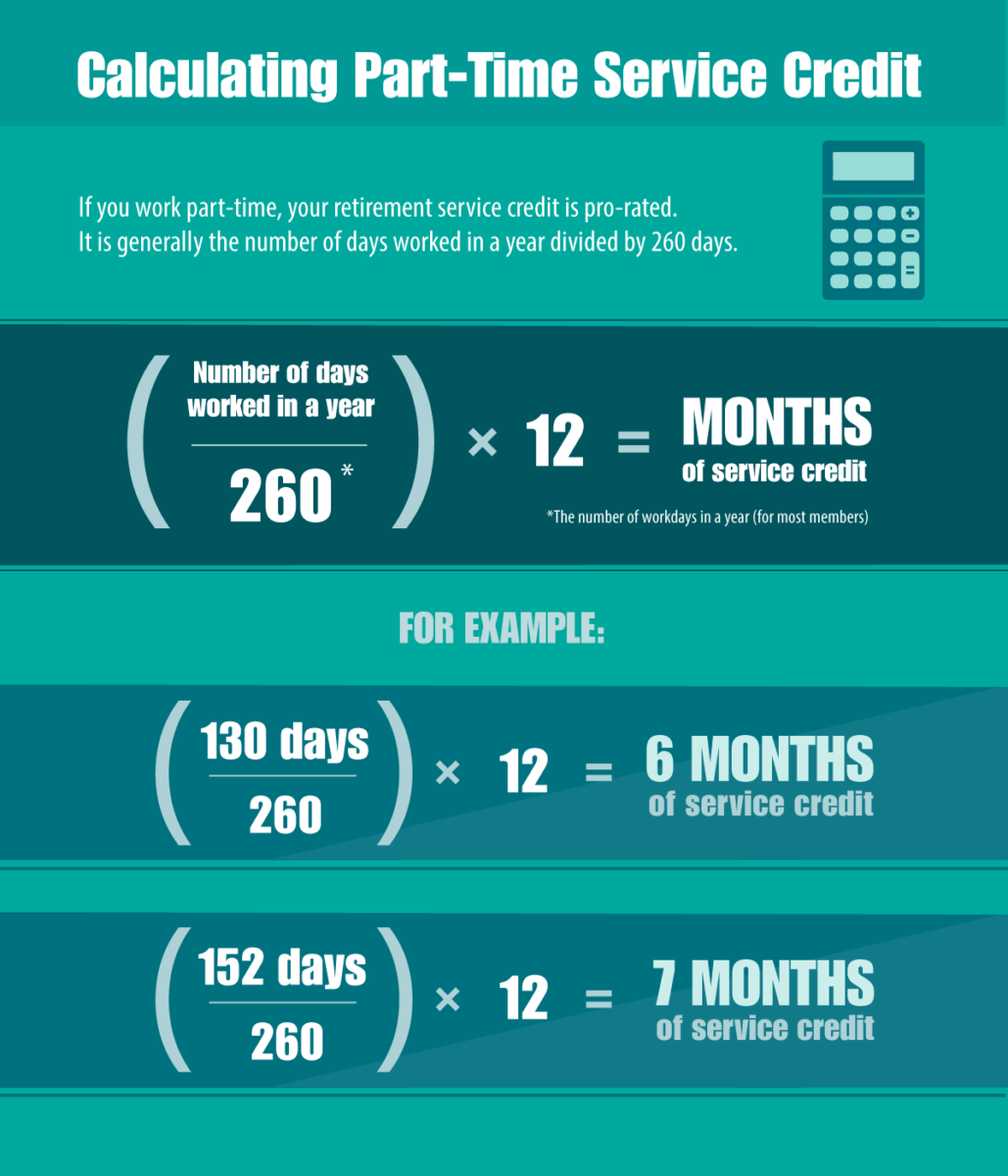
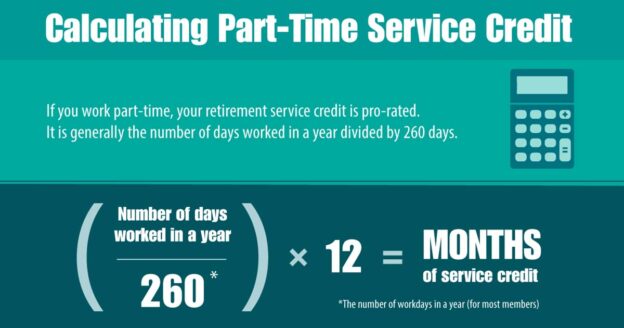
Your service credit is prorated if you work part time. Part-time employment is credited as the lesser of:

the number of days worked ÷ 260 days

or

your reported annual salary ÷ (the State’s hourly minimum wage × 2,000)

You can think of it like this: let’s say you work 130 days in a year. If a year’s worth of service credit is earned for working 260 days full time, you’d earn half a year (0.5) of service credit for your part-time work.

How Part-Time Service Credit Works

Check Your Service Credit in Retirement Online

Retirement Online is the fastest way to check your current total estimated service credit. Once you sign in, go to the ‘My Account Summary’ section of your Account Homepage and look under “Account Information.”

You can also use Retirement Online to request credit for public employment from before you joined NYSLRS. If you’re eligible to purchase previous service credit, it’s a good idea to file your request as early in your career as possible because:

  • Records we need to verify your service will be more readily available.
  • If there is a cost, it will be less expensive than if you wait to purchase credit before retirement.
  • Your retirement benefit will be processed more quickly if your service credit request has been reviewed or processed prior to retirement.

For more information, please read our publication Service Credit for Tiers 2 through 6. You may also wish to refer to your specific retirement plan booklet, available on our Publications page.

From Ledgers to Databases: A Look at NYSLRS’ Technology

The years since 1921 have witnessed unprecedented advances in technology. Not surprisingly, NYSLRS has taken advantage of many of these innovations to manage a complex and growing retirement system.

NYSLRS technology through the years

The Early Years

The IBM 407 Accounting Machine, mid-1950s
Typewriters and comptometers (adding machines), mid-1950s

When NYSLRS was established a century ago, the business world was still in the age of paper, as it had been for centuries. Individual member information was logged in paper ledger books. A punch card was prepared for each member and retiree, and this data was mechanically tabulated to record statistical information (date of birth, gender, years of service, etc.) about them.

An employee’s desk also looked radically different. Instead of laptops and computer monitors, office technology was limited to adding machines and typewriters, and the use of carbon paper for making copies of documents. Large accounting machines, like the IBM 407, read member punch cards and could print out results.

The Computer Era

In 1963, NYSLRS entered the computer age with its first computer, an IBM 1401. The 1401 was considered revolutionary in its day, offering businesses an affordable general-purpose computer. At the time, it also had 16KB of memory – about as much as a pocket calculator today – and was the length of a minivan. NYSLRS’ early computers were programmed and coded through the use of punch cards, until the late 1970s, when they could be coded through terminals. The first personal computers wouldn’t appear on staff desks until 1984.

NYSLRS accounting machine.
The IBM 407 Accounting Machine, mid-1950s

In the mid-1980s, NYSLRS launched a major database conversion project, which would result in a computer system that would serve NYSLRS for decades. But that system eventually became outdated. Recently, after years of meticulous research, NYSLRS launched a multi-year project to replace its information technology systems and streamline core services.

Retirement Online is the public face of that project. Launched in 2017, Retirement Online provides members and retirees with convenient, secure access to their account information. Members can update contact and beneficiary information, apply for a loan, generate a pension estimate, apply for a service retirement benefit and more. Retirees can view pension payment and tax withholding information, and additional features will be added in the near future.

The Future

Technology has served NYSLRS well over the years. Certainly, technology will continue to evolve, and NYSLRS will continue to adopt innovations that help us better serve our members, retirees, beneficiaries, and employers.