Tag Archives: Part-time

join NYSLRS

Join NYSLRS

Most State and municipal employees are required to join the New York State and Local Retirement System (NYSLRS) when they are hired. But for some employees, membership is optional, meaning you are not automatically enrolled. To join NYSLRS, you must submit a membership application to your employer, who will then enroll you in NYSLRS. It’s important to understand the valuable benefits of NYSLRS membership and why you should join as soon as possible.
join NYSLRS

Whose Membership is Optional or Mandatory

Membership is optional if:

  • You work less than 12 months per year, including 10-month school employees working full-time;
  • You work less than 30 hours per week or less than the number of hours for full-time employment, as established by your employer for your position;
  • You are in a temporary or provisional position (under Civil Service Law); or
  • Your annual compensation is less than New York State’s minimum wage multiplied by 2,000 hours.

Membership is mandatory if:

  • You are in a permanent, full-time, 12-month position of an employer who participates in NYSLRS; and
  • You are in a full- or part-time position covered by the Police and Fire Retirement System (PFRS), such as police officers and firefighters.

If you aren’t sure whether you’re a member, your employer should be able to let you know. Contact us if you have questions.

Benefits of Joining NYSLRS

NYSLRS is one of the largest retirement systems in the world, administering benefits for more than 1.2 million members, retirees and beneficiaries.

If you aren’t sure whether to join NYSLRS, here are the advantages:

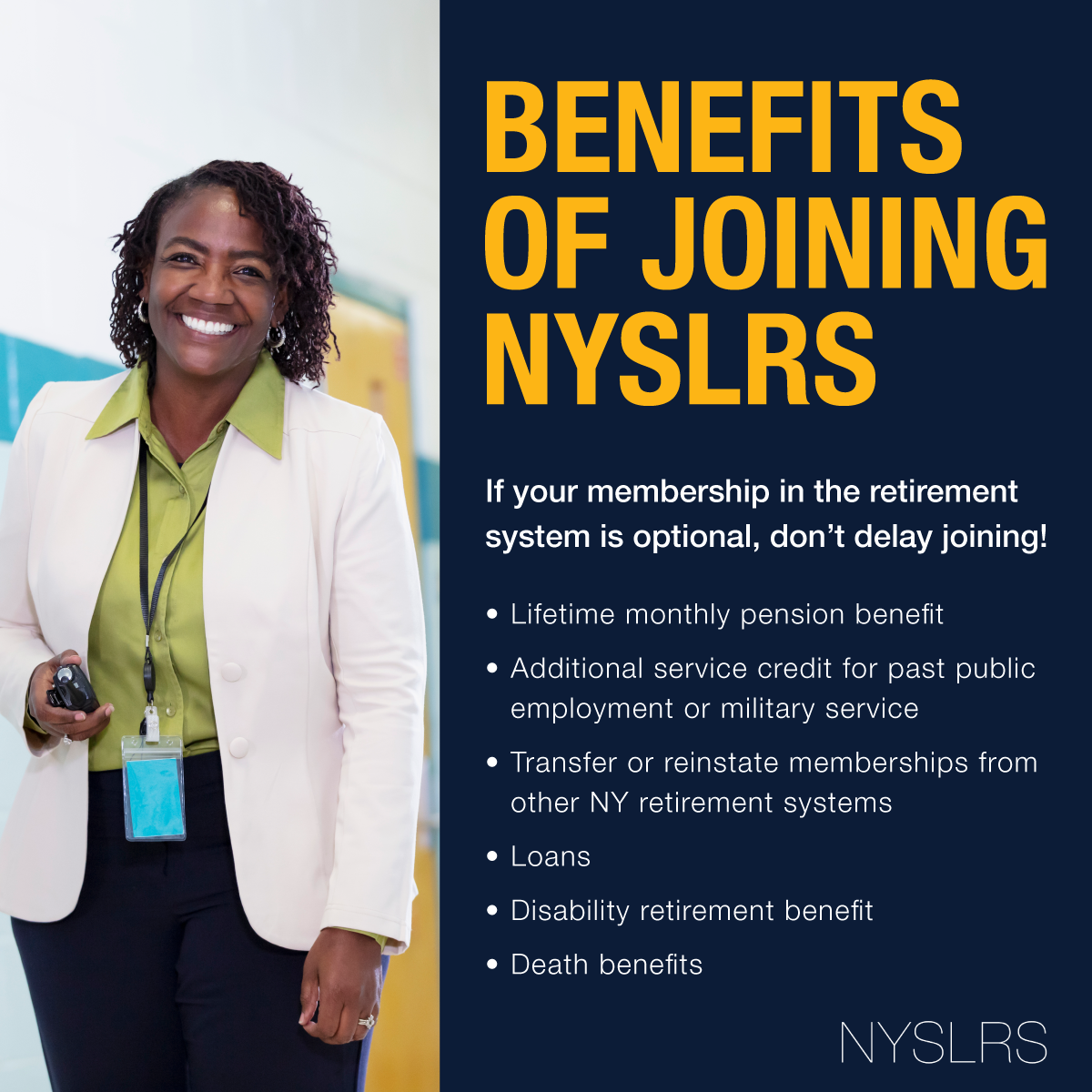
  • Your NYSLRS pension is a defined benefit plan. When you retire, you will receive a monthly pension payment for the rest of your life. Once you reach retirement age, you can retire with as few as five years of service credit (part-time service is pro-rated).
  • You can request additional service credit for your public employment before joining NYSLRS or if you served in the U.S. Armed Forces and received an honorable discharge from active military duty.
  • You can transfer service if you are still a member of another public retirement system in New York State.
  • You can reinstate service if you withdrew your membership in NYSLRS or another public retirement system in New York State.
  • You can take a loan against your retirement contributions once you meet eligibility requirements.
  • NYSLRS retirement plans provide death and disability retirement benefits.

Nearly 3,000 employers participate in NYSLRS, allowing you to continue your membership if you take a job at another New York State public employer. And if you decide to leave public employment before you have ten years of service credit, you can withdraw your contributions plus interest or roll over your contributions into another retirement savings plan.

NYSLRS Membership Basics

Once you join and become a NYSLRS member:

Don’t Delay Joining

It’s important to join NYSLRS at the start of your employment. If you don’t join right away, you can purchase service credit for your public employment from before you became a member, but it will cost more—6% of your earnings plus interest rather than contributing a percentage based on your earnings. Also, while you can request previous service credit and pay for the cost at any time, you must earn two years of service credit as a NYSLRS member before your purchased service can be credited.

Get Credit for All Your Public Service

Because service credit is a major factor in calculating your pension benefit, it’s important to make sure you get credit for all your public service. Once you join NYSLRS, you should request any additional service as early in your career as possible.

  • NYSLRS will need time to request records from your previous employer or retirement system.
  • The sooner you purchase your credit, the less it will generally cost.
  • Requesting early gives you time to pay for additional service.

Your request will be reviewed to determine your eligibility. We will send you a letter with the amount of service credit you are eligible to receive if you choose to purchase it, the cost and payment options. There are certain situations where purchasing additional service credit will not increase your pension. For more information, read about whether should you purchase additional service credit.
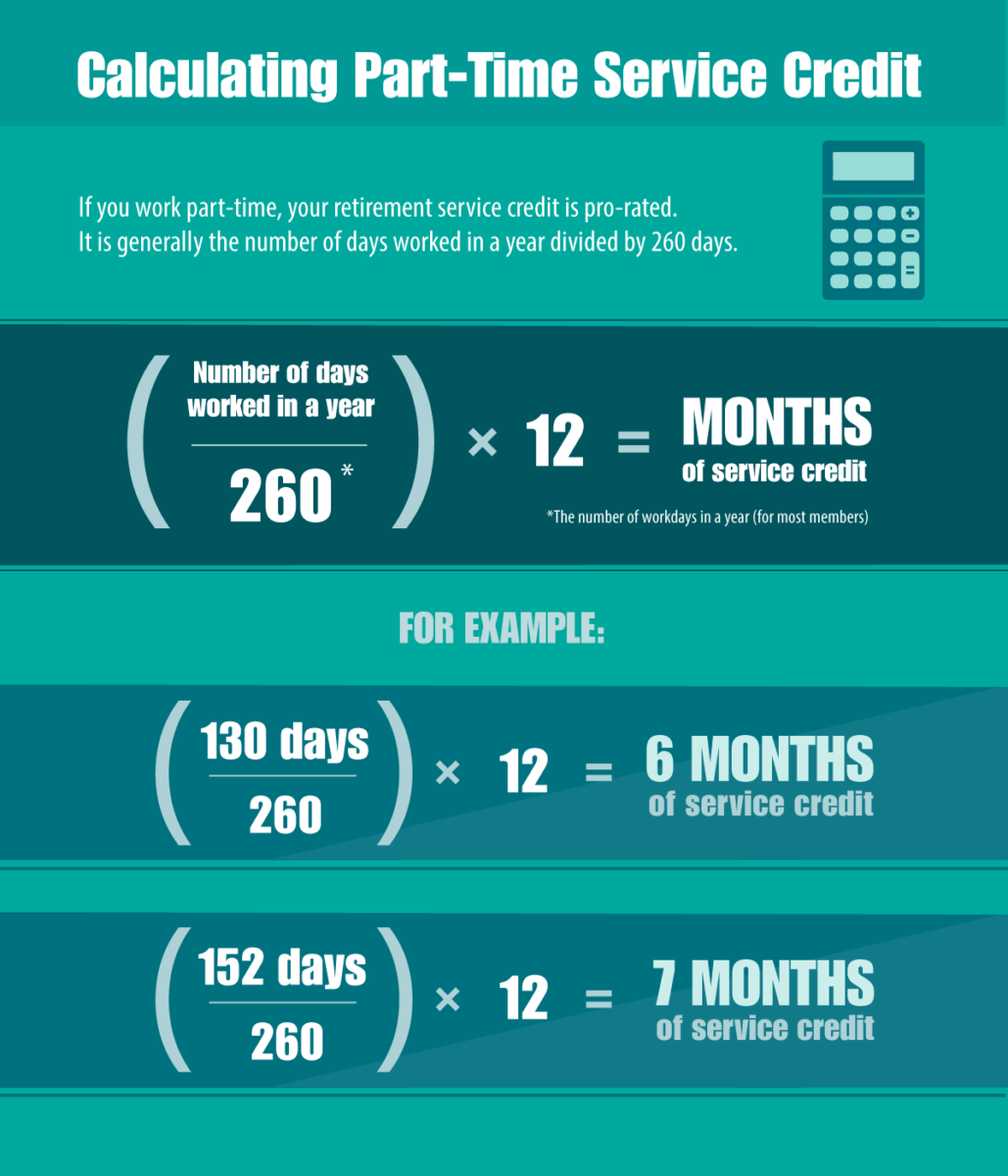
Calculating Service Credit for Part-Time Employees

How School Employees Earn NYSLRS Service Credit

How School Employees Earn NYSLRS Service Credit While most New York teachers and administrators are in the New York State Teachers’ Retirement System, other school employees are members of the New York State and Local Retirement System (NYSLRS). In fact, 1 out of 5 NYSLRS members works for a school district. Their employment is tied to the school year, which is usually 10 months long. So how do we determine service credit for school employees?

You earn service credit for your paid employment with a public employer in New York State. That credit is based on the number of days you work, which your employer reports to us.

Calculating Service Credit for Full-Time School Employees

If you work full-time, you receive one year of service credit per school year, which usually refers to the 10-month period from September through June.

You cannot earn more than one year of service credit, so if you work full-time during the school year, you will not earn additional service credit if you also work during the summer.

Calculating Service Credit for Part-Time School Employees

Your employer determines how many hours are in a full-time day for your position and reports the number of days you work to NYSLRS. Your service credit for the year is then calculated by dividing the number of days worked by the number of days in a school year. Usually, a school year refers to the 10-month period from September through June, which is 180 days. However, depending on your employer, an academic year can be 170 or 200 days.

For employees of school districts and BOCES,
as well as teachers working at New York State schools for the deaf and blind:

Number of days worked ÷ 180 days

For college employees:
Number of days worked ÷ 170 days

For institutional teachers:
Number of days worked ÷ 200 days

Calculating Service Credit for Part-Time Employees

Check Your Service Credit in Retirement Online

To find your current estimated service credit:

Get Credit for All Your Public Service

Service credit is one of the major factors in calculating your pension benefit, so it’s important to make sure you get credit for all your public service.

You may be able to request additional credit if you:

  • Worked for your current or another public employer before joining NYSLRS; or
  • Served in the U.S. Armed Forces and received an honorable discharge from active military duty.

Or you may be able to:

  • Transfer service: If you are still a member of another New York State public retirement system.
  • Reinstate service: If you withdrew your membership in NYSLRS or another New York State public retirement system.

In most cases, you have to pay for additional service or to reinstate service. But because service credit is a factor in the calculation of your retirement benefits, it will usually increase your pension.

If you choose to purchase the additional service, you should submit your request as early in your career as possible. Records we need to verify your service will be more readily available. And the sooner you purchase your credit, the less it will generally cost. 

How Full-Time and Part-Time Service Credit Works

Service credit plays a vital part in your pension calculation and your eligibility for other NYSLRS benefits. As a NYSLRS member, you earn service credit by working for an employer who participates in the Retirement System. Your paid public employment is creditable. You would not, however, earn credit for any period when you are not receiving a salary, such as an unpaid leave of absence. You would earn credit for both full-time and part-time employment, but if you work part-time, the service you earn is pro-rated.

Earning Service Credit When You Work Full Time

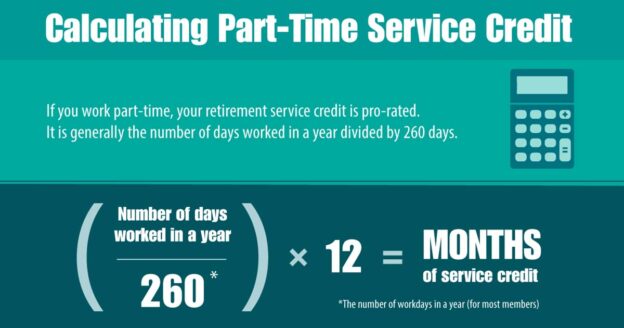
When you work on a full-time, continuous basis throughout your career, we’ll calculate your total service credit from your date of employment up until the date you leave paid employment. Most full-time workers earn a year of service credit for working 260 workdays a year. For a full-time, 12-month employee, 260 workdays equal a full year. (If you work in an educational setting, you can read about earning service credit in our blog post, How School Employees Earn NYSLRS Service Credit.)

Earning Service Credit When You Work Part Time

Your service credit is prorated if you work part time. Part-time employment is credited as the lesser of:

the number of days worked ÷ 260 days

or

your reported annual salary ÷ (the State’s hourly minimum wage × 2,000)

You can think of it like this: let’s say you work 130 days in a year. If a year’s worth of service credit is earned for working 260 days full time, you’d earn half a year (0.5) of service credit for your part-time work.

How Part-Time Service Credit Works

Check Your Service Credit in Retirement Online

Retirement Online is the fastest way to check your current total estimated service credit. Once you sign in, go to the ‘My Account Summary’ section of your Account Homepage and look under “Account Information.”

You can also use Retirement Online to request credit for public employment from before you joined NYSLRS. If you’re eligible to purchase previous service credit, it’s a good idea to file your request as early in your career as possible because:

  • Records we need to verify your service will be more readily available.
  • If there is a cost, it will be less expensive than if you wait to purchase credit before retirement.
  • Your retirement benefit will be processed more quickly if your service credit request has been reviewed or processed prior to retirement.

For more information, please read our publication Service Credit for Tiers 2 through 6. You may also wish to refer to your specific retirement plan booklet, available on our Publications page.