Striving to maintain a good credit score is just as important in retirement as it is during your working years. You may be retired, but financial necessities continue. You may need to get a car loan or refinance a mortgage, and good credit ensures you can borrow money at a decent interest rate. In fact, bad credit could prevent you from renting an apartment, or you may be required to pay higher insurance premiums. Fortunately, it seems maintaining good credit is just a matter of continuing what you’ve already been doing.
What is a Credit Score?
Your credit score is a three-digit number used by lenders to judge how likely you are to pay back money you’re loaned. It’s based on your past payment history and other interactions with lenders. These three digits affect you more than you might realize.
According to the Consumer Financial Protection Bureau (CFPB), “Companies use credit scores to make decisions on whether to offer you a mortgage, credit card, auto loan, and other credit products, as well as for tenant screening and insurance. They are also used to determine the interest rate and credit limit you receive.”
How to Maintain a Good Credit Score
The best way to maintain your credit score is to borrow responsibly and manage debt effectively. That means:
Pay your bills on time. Pay more than the minimum payments if you can. Your payment history accounts for about a third of your credit score.
Avoid using all or most of your available credit. The ratio of debt to available credit is another factor in your credit. If all your credit cards have balances near the limit, your credit score will suffer.
Keep longstanding credit lines open. These accounts show your long history of being responsible with credit and help to boost your score.
Don’t accumulate excessive debt. You especially want to avoid opening several lines of credit in a short amount of time.
Things like age and salary are not part of the credit score equation, so being retired does not hurt your score. However, lenders do take income into account when you apply for a loan, so you may find it harder to borrow after retirement, even if you have good credit.
Check Your Credit Reports Annually
Even if you’re doing everything right, misinformation in the files of credit rating companies could hurt your credit. So, check your credits scores regularly.
Under federal law, the three nationwide credit reporting companies are required to provide a free credit report once every 12 months. But you must request it. You can request your credit report online at AnnualCreditReport.com or by calling 877-322-8228. AnnualCreditReport.com is a website maintained by the three major credit reporting agencies—Equifax, Experian and TransUnion. It is the only free credit report site authorized by the federal government. Beware of impostor sites.
Your retirement account can be an attractive target for scammers who continue to find new ways to try to impersonate government agencies, such as NYSLRS or the Social Security Administration. Protect yourself from scams by learning to distinguish fake messages from official NYSLRS communications.
How Scams Work
Scammers pretend to be an agency or organization you already know to gain your trust. They use similar logos or imagery in correspondence. They may contact you from an email address that mimics—but isn’t identical to—those used by employees of the actual organization. Some can even make a real agency’s phone number appear on caller ID (known as spoofing).
Usually, once they contact you, they claim there is a problem (or a prize or a new benefit available) requiring your immediate attention. But here’s the catch: to fix the problem or receive the reward, the imposter needs you to pay them a fee or provide personal data, such as your Social Security number or bank account information. They may even threaten you with legal action, a suspension of your benefits or arrest if you fail to act.
If someone contacts you and you notice these signs of a scam, remain calm. Hang up the phone or delete the message if you feel like something is off. It’s the easiest way to avoid accidentally giving away personal information.
Scammers have also attempted to create a fake mobile app or website, which looks similar to Retirement Online, aimed to trick users and capture login credentials. Please be aware, we currently do not have a mobile app. Protect yourself from these scams by accessing Retirement Online from the NYSLRS website and avoid using search engines to find a link for the login page.
AI: A New Tool for Scams
You should also be aware of an emerging threat—artificial intelligence (AI), which allows computers to mimic certain human behaviors, such as speech and writing. Using AI, scammers can personalize phishing emails, making it harder to recognize a fraudulent communication. AI may even be able to impersonate the voice of a family member or friend, making you think they are in trouble or need money.
Here are some things you can do to protect yourself from AI-enhanced scams.
Don’t share sensitive information through text or social media.
Don’t send or transfer money to unknown locations.
Consider designating a safe word for your family to use to identify themselves and share that word with family members and close contacts.
When in doubt, hang up and call your loved one back.
Doing Business With NYSLRS
To protect yourself from potential scams and keep your personal information secure, use your NYSLRS ID to verify your identity when doing business with NYSLRS, instead of providing your Social Security number. You can find your NYSLRS ID by signing in to your Retirement Online account, or by checking your annual statement or other correspondence from NYSLRS.
Generally, NYSLRS will only call you if we are following up on a previous communication from you—a phone call, secure email message, Retirement Online request, form or letter. If you haven’t completed a transaction or submitted changes recently, be wary of unexpected calls or requests for your NYSLRS information.
Make sure you review the communications you receive from NYSLRS. We send you letters or emails (depending on your delivery preference in Retirement Online) whenever you update your Retirement Online account or benefit information. If you receive a letter or email about an account change you did not make, contact us immediately.
Keep Your Retirement Online Account Secure
Retirement Online is the fastest and most convenient way to access your retirement account information and conduct business with NYSLRS. And it’s safe to use—it has the same security safeguards used for online banking and by other financial institutions. Here are steps you can take to help ensure your Retirement Online account stays secure:
Once you have an account, keep your username and password in a safe place, and don’t share them with anyone. NYSLRS will never ask for your password.
Sign in to Retirement Online at least once a year and update your password so it doesn’t expire. If you forgot your user ID or password, don’t worry—from the customer login page, you can:
Click the Forgot ID link to look up your user ID.
Click the Forgot Password link to reset your password.
You’ll need to identify yourself and answer security questions you set when you signed in for the first time.
Update your delivery preference to receive an email notifying you when you have correspondence to view in Retirement Online. That way, when there are changes to your account, you’ll receive an email notifying you instead of waiting for printed notices through the mail.
Most NYSLRS members can create their own pension estimates in minutes using Retirement Online. Your estimate will be based on the most up-to-date account information we have on file for you. You can enter different retirement dates and beneficiaries to see how those choices would affect your benefit. When you’re done, print your pension estimate or save it for future reference.
Remember, the amounts are estimates, not a guarantee of what you’ll receive when you retire.
Most Tier 2 through 6 members (more than 90 percent of all NYSLRS members) can use the Retirement Online pension calculator. However, some members may not be able to—for example, members who recently transferred to NYSLRS and some PFRS members. The system will let you know if your estimate cannot be completed. In that case, please send us a message using our secure contact form (select Estimates from the Topic dropdown).
Do More With Retirement Online
In Retirement Online, you can view your account details—date of membership, tier, retirement plan, estimated total service credit and more. Check out what else members can do in Retirement Online.
NYSLRS retirement plans provide death benefits for beneficiaries of eligible members who die before retiring.
It’s important to name beneficiaries and review them periodically. Life circumstances change and a beneficiary you named before might not be one you would choose today. For instance, you may have a new partner or you may have children now. And NYSLRS can only pay a death benefit to the beneficiaries you’ve named.
Your primary beneficiary will receive your death benefit. You can list more than one primary beneficiary. If you do, they will share the benefit equally. Or, you can choose different percentages for each beneficiary, which must total 100 percent. (Example: John Doe, 50 percent; Jane Doe, 25 percent; and Mary Doe, 25 percent.)
A contingent beneficiary will only receive a benefit if all your primary beneficiaries die before you do. If you list multiple contingent beneficiaries, they will share the benefit equally unless you choose different percentages.
Special Beneficiary Designations
Your beneficiary doesn’t have to be a person. You can name your estate, a trust or a charity as your beneficiary.
Estate. When you die, your estate is the money and property you owned. Your death benefit will be given to the executor of your estate to be distributed according to the terms of your will. You can name your estate as the primary or contingent beneficiary of your death benefit. If you name your estate as the primary beneficiary, do not name a contingent beneficiary.
Trust. You can name a trust as a primary or contingent beneficiary if you have a trust agreement or provided for a trust in your will. The trust itself would be your beneficiary, not the individuals for whom you established the trust. (Speak with your attorney if you’re thinking about making your trust a beneficiary.)
Entity. You can also name any charitable, civic, religious, educational or health-related organization as a beneficiary.
Minor children. If your beneficiary is under the age of 18 at the time of your death, your benefit will be paid to the child’s court-appointed guardian. You may instead choose a custodian to receive the benefit on the child’s behalf under the Uniform Transfers to Minors Act (UTMA). Custodians can be designated in Retirement Online, or you can contact us for more information and the appropriate form before making this type of designation.
Keep Your Beneficiaries Up to Date with Retirement Online
You can change your beneficiaries at any time. In addition to adding or removing them to reflect your current wishes, you should review the contact information for your named beneficiaries so we can find them when needed.
The fastest way to view or update your beneficiaries is in Retirement Online.
When it comes to managing your NYSLRS account, Retirement Online is the fastest way to do it. Skip printing forms, having them notarized and sending them through the mail. When you submit your requests online, NYSLRS has them immediately, and your changes will be completed more quickly. It’s convenient, and it’s secure.
Get Email Notifications for Important Documents and Help Us ‘Go Green’
You can help us ‘go green’ and reduce paper waste by choosing email as your delivery preference for correspondence and other important documents. When you have something to view, we’ll send an email notifying you to sign in to Retirement Online. And it’ll save time—you’ll get access to your important documents sooner than printed copies are mailed.
To update your delivery preferences:
Look under My Profile Information.
Click update next to ‘Contact by’ or ‘Member Annual Statement by.’
Choose Email from dropdown.
Be sure the email address listed in your profile is current.
If you choose email as your delivery preference, you will not receive a printed copy in the mail.
Update Your Contact Information
It’s important we have your current contact information so you receive the news, correspondence and statements we send you.
To update your contact information:
Look under My Profile Information.
Click update next to email address, mailing address or phone number.
If you don’t already have an email address on file, please provide it so we can contact you quickly with important information, such as a change to your benefits. Use a personal email address you will have access to before and after you retire, not a work email address.
Manage Your Beneficiaries
NYSLRS retirement plans provide death benefits for beneficiaries of eligible members who die before retiring. It’s a good idea to review your beneficiaries from time to time to make sure they reflect your current wishes. The beneficiary you named before might not be the one you would choose today. You should also review the contact information for your named beneficiaries so we can find them when needed.
To add or remove beneficiaries or update their contact information:
Look under My Account Summary.
Click View and Update My Beneficiaries button.
Estimate Your Pension
How much will your pension be? It’s an important question as you plan for retirement. In just a few steps, most members can use Retirement Online to estimate their pension based on the most up-to-date account information we have on file, then save or print the estimate. You can enter different retirement dates and beneficiaries to see how those choices would affect your benefit and help you choose the retirement date that’s right for you.
Look under My Account Summary.
Click Estimate My Pension Benefit button.
Apply for a Loan and Manage Loan Payments
The fastest way to apply for a loan is in Retirement Online. You can see how much you are eligible to borrow, what the repayment amount would be and whether your loan will be taxable—all before you apply.
Look under My Account Summary.
Click Apply for a Loan button.
If you have an existing loan, you can check your current loan balance and adjust your payment amount or make an additional one-time payment.
Look under My Account Summary.
Click Manage My Loans button.
Request Additional Service Credit
You may be able to request additional service credit if you worked for your current or another public employer before joining NYSLRS or if you served in the U.S. Armed Forces and received an honorable discharge from active military duty. In most cases, you have to pay for additional service credit. But because service credit is a factor in the calculation of your retirement benefits, purchasing additional service credit will usually increase your pension. You must submit your request before retirement, and you should do it as early in your career as possible—the sooner you purchase your credit, the less it will generally cost.
To submit your request online:
Look under My Account Summary.
Click Manage My Service Credit Purchases button.
Click Request Additional Service Credit link.
Get Your Member Annual Statement
Your Member Annual Statement is a valuable snapshot of your NYSLRS membership and benefits as of March 31, the end of the state fiscal year. You can access Statements dating back to 2020 online.
Look under My Account Summary.
Click View MyMember Annual Statement button.
Statements are made available online each year in early May, sooner than printed copies are mailed—update your delivery preference to get notified.
Generate a Mortgage Verification Letter
If you are applying for a mortgage and need a summary of your NYSLRS account information, you can quickly generate a mortgage verification letter online. The document will show your contribution balance, the date and amount of your last loan, and if you have an existing loan, the current balance, the payroll deduction amount and the interest rate.
Look under I want to… (located at the top right).
Click Generate Mortgage Verification Letter link.
Apply for Retirement
When you are ready to retire, avoid the hassle of paper forms and apply online. You’ll be able to see an estimate of your pension, select your payment option, enter federal tax withholding information, sign up for direct deposit, submit required documents and much more. Learn more about the advantages and how to apply for retirement in Retirement Online.
If you leave public employment with less than ten years of service credit, you can withdraw your membership online and request a refund of your contributions. However, this will end your NYSLRS membership. Before you submit a withdrawal application, we recommend speaking with a customer service representative by sending a message using our secure contact form.
Many financial experts cite a common rule of thumb when discussing income in retirement. They say you need 70 to 80 percent of your pre-retirement income to maintain your standard of living once you retire. This is meant to account for the range of expenses you’ll no longer have in retirement, such as payroll taxes, commuting costs or saving for retirement. As a NYSLRS member, your plan for income in retirement likely includes your NYSLRS pension and Social Security benefits. However, for greater financial stability and flexibility, you may want to supplement with retirement savings. For example, you might start investing in a savings plan like the New York State Deferred Compensation Plan (NYSDCP).
What is Deferred Compensation?
Deferred compensation plans are voluntary retirement savings plans like 401(k) or 403(b) plans—but designed and managed with public employees in mind. NYSDCP is the 457(b) plan created for New York State employees and employees of other participating public employers in New York.
Just like with other retirement savings plans, you have options for how you make your NYSDCP contributions. You might choose a tax-deferred account where you make contributions with pre-tax money. With this option, you won’t pay State or federal taxes on the earnings you contribute until you start making withdrawals. Your employer may also offer the option for a Roth account where you make contributions with after-tax money. With this option, you do pay taxes now, but you won’t pay taxes on the withdrawals you make in retirement. Learn more about how traditional retirement savings and Roth accounts compare.
If your employer is not an NYSDCP participating employer, check with your human resources or personnel office about other retirement savings options.
What Does Deferred Compensation Mean for Me?
Deferring income from your take-home pay may mean less money to spend in the short-term, but you’re planning ahead for your financial future.
As a NYSLRS member, you are enrolled in something increasingly rare these days: a defined benefit plan. If you are vested and retire from NYSLRS, you will receive monthly pension payments for the rest of your life based on your years of service and earnings. Your NYSLRS pension can provide a significant part of your retirement income, but it’s a good idea to supplement your pension and Social Security with a retirement savings account.
Additional retirement savings can give you flexibility to travel, continue your education, pursue a hobby or start a business. It can be a resource in case of an emergency or act as a hedge against inflation.
Your Retirement Savings Goal
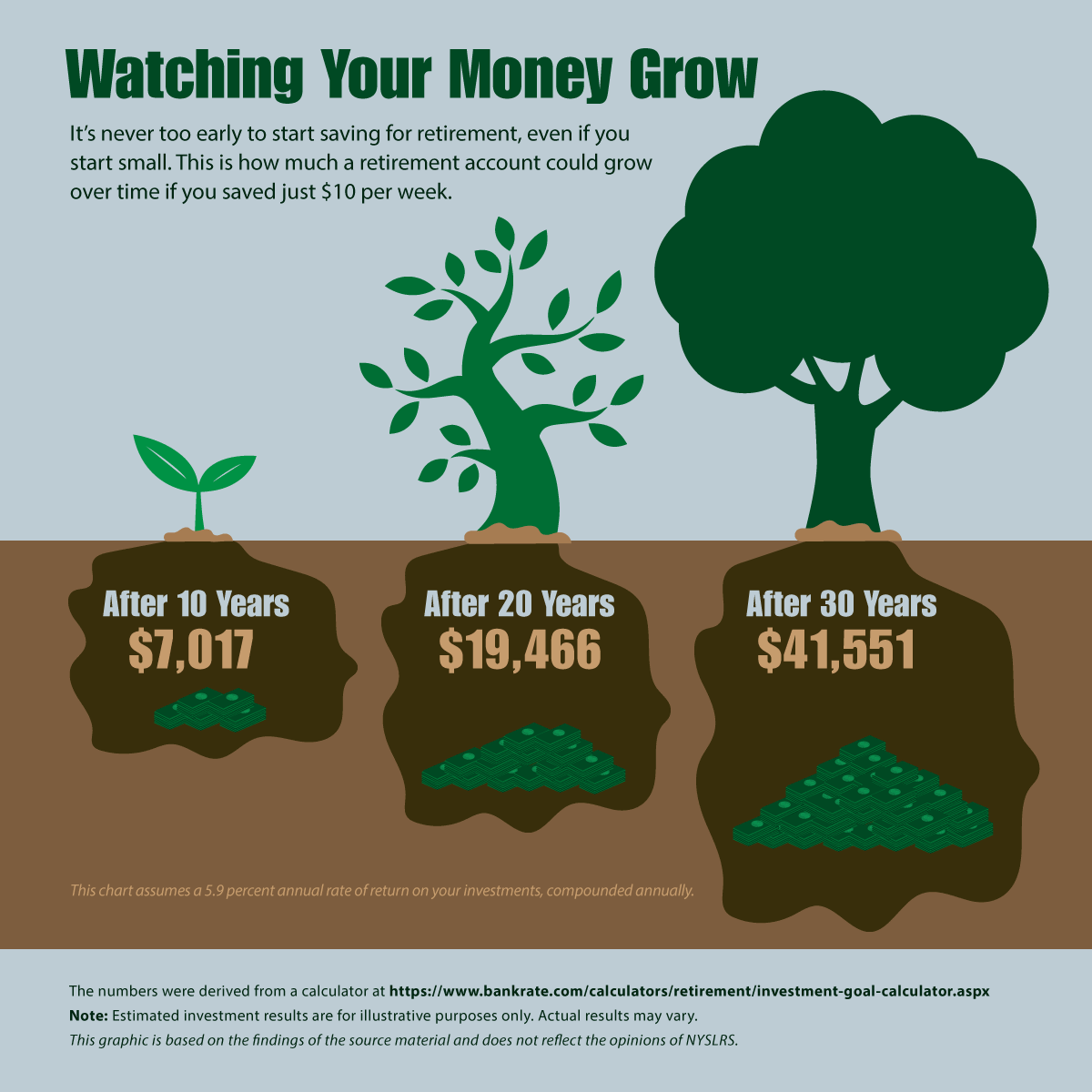
How much you save is a personal decision. You can estimate your pension in Retirement Online to get an idea of the income it will provide in retirement. Use a retirement savings calculator to see how much a retirement savings plan could yield over time. Test the results with different savings amounts.
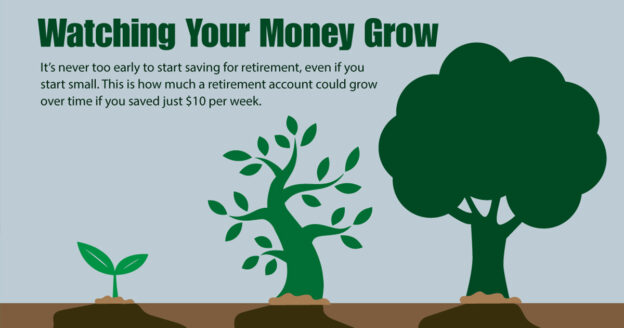
Below you can see the potential savings of someone who invests 50 dollars every two weeks for 30 years. While the stock market can be turbulent in the short term, in the long term, it returns on average about 10 percent a year as measured by the S&P 500 index.
As you get closer to retirement, you should develop a plan to withdraw money from your savings. That will give you a better idea of the income you might expect from your nest egg and a sense of how long it will last.
Here is one possible withdrawal strategy, which provides retirement income for 20 years. Please note, if your retirement is far in the future, the money you withdraw may not have the same value that it would have today.
If you find you’ll need to save more to meet your goal, you can make adjustments to help ensure you’ll have enough savings in retirement.
Note: Generally, whatever your withdrawal strategy, federal law will eventually require you withdraw a certain amount each year from any tax-deferred retirement plan account. These are called required minimum distributions.
New York State Deferred Compensation Plan
One way State employees and many municipal employees can save for retirement is through the New York State Deferred Compensation Plan (NYSDCP). Once you’ve signed up, your retirement savings—which may be tax-deferred depending on the plan you choose—will be automatically deducted from your paycheck.
Check with your employer’s human resources or personnel office to see whether they participate in NYSDCP or if they offer other savings options. (NYSDCP is not affiliated with NYSLRS.)
Read More About Retirement Savings
When it comes to saving for retirement, there’s a lot to consider. You can find more information in these posts:
NYSLRS provides pension benefits to more than 520,000 retirees and beneficiaries. You can find our retirees in every state in the US and in countries all around the world. However, most live right here in New York State.
Nearly 79% of NYSLRS Retirees Stay in New York
The vast majority of NYSLRS retirees—nearly 79 percent—stay in New York State, and their pension dollars flow right back into our communities. Retirees in New York pay local property and sales taxes. Their spending supports local businesses, generates thousands of jobs and stimulates the economy.
Where in New York do these retirees call home?
Long Island is home to more than 66,000 retirees and beneficiaries. Suffolk County has the most and Nassau County has the third most benefit recipients of the counties outside of New York City. (The City, which has its own separate retirement systems for municipal employees, police and firefighters, has more than 24,000 retirees and beneficiaries.)
Erie County, which includes Buffalo, has the second most retirees—nearly 34,000. Albany County, home to the State capitol, is ranked fourth, with more than 20,000. Monroe, Westchester, Onondaga, Saratoga, Dutchess and Oneida Counties round out the top ten.
All told, retirees and beneficiaries in the top ten counties received $7 billion in retirement benefits in the fiscal year ending March 31, 2024.
Hamilton County has the fewest retirees. But, in this sparsely populated county in the heart of the Adirondacks, those 545 retirees represent about 10 percent of the county’s population and received $12.9 million in retirement benefits in the fiscal year ending March 31, 2024.
NYSLRS Retirees in the United States
NYSLRS retirees are found in every state. Florida, not surprisingly, is the second choice for retirees after New York. Roughly 41,000 call the Sunshine State home. North Carolina is third, followed by New Jersey and South Carolina. North Dakota has the fewest retirees and beneficiaries—only 23.
NYSLRS Retirees Around the World
There are 649 NYSLRS retirees and beneficiaries living around the world but the most common countries are:
Since taking office, New York State Comptroller Thomas P. DiNapoli has fought the abuse of public funds. One of his top priorities is protecting NYSLRS and its retirees from pension fraud.
The Comptroller’s Division of Investigations regularly partners with federal, state and local law enforcement in New York and across the country to bring corrupt individuals to justice and recoup stolen NYSLRS money. Over the past several years, pension fraud investigations have led to 57 arrests and the recovery of over $5.8 million.
Here are some cases from earlier this year:
Joint Investigation Uncovers Caretaking Scheme
In May 2024, a joint investigation between the Comptroller’s office, the Rensselaer County District Attorney and the New York State Police led to the arrest of an Albany woman and man for allegedly stealing more than $200,000 in pension and Social Security payments from an 86-year-old retiree.
The defendants engaged in a caretaking scheme that left the elderly victim in deplorable living conditions and resulted in home foreclosure. They persuaded the victim to let them pay his bills, however, they did not pay the victim’s mortgage, property taxes or other bills for several years. This caused the foreclosure of the victim’s home, the repossession of his vehicle, and his electricity to be turned off.
As a result of the investigation, the victim was removed from the home and received necessary treatment.
In November 2024, one of the defendants pleaded guilty to grand larceny in the second degree and is awaiting sentencing. The second defendant was indicted by a Rensselaer County Grand Jury on charges of grand larceny in the second degree and the matter is currently pending in court.
Son Impersonates Father to Continue Receiving Pension
In 2017, a NYSLRS pensioner who had retired from the Nassau County Clerk’s Office in 1992, moved to Wyoming with his son. The retiree was never heard from again, and it is believed he died in Wyoming. His pension payments should have stopped when he died, but his son never reported his death.
In fact, the son went to great lengths to conceal his father’s death and continue receiving his pension and social security payments. He even whitened his hair and eyebrows to impersonate his deceased father.
But a call to the Comptroller’s Fraud Hotline prompted an investigation, which included the U.S. Attorney’s Office, the Social Security Administration, the U.S. Postal Inspection Service and the FBI.
The son was arrested on federal fraud charges in 2023. In February 2024, the son was sentenced to five years in prison and ordered to repay the $194,000 he stole in NYSLRS pension and Social Security benefits.
Man Steals Deceased Sister-in-Law’s Pension Payments
In October 1986, a stenographer from the Supreme Court, Appellate Division, retired with a disability retirement and the Single Life Allowance pension payment option. That means, when she died in January 2019, her monthly pension payments should have ended. Once NYSLRS discovered her death in July 2022, payments were stopped, and an investigation was launched.
A forensic analysis was completed on the bank account where the pension payments were being deposited, which was a joint account in the name of the retiree and her brother-in-law. The investigation found that the brother-in-law diverted over $50,000 in pension payments made after his sister-in-law’s death and used the money to pay credit card bills, travel and make online purchases.
The brother-in-law was arraigned on a charge of grand larceny in Albany County Court. The matter is pending in court.
You Can Help Fight Fraud
If you are aware of potential pension fraud, visit the Comptroller’s Fighting Public Corruption page to file a complaint online, or call the Fraud Hotline at 888-672-4555.
Your retirement account can be an attractive target for scammers, and imposters continue to find new ways to try to impersonate government agencies, such as NYSLRS or the Social Security Administration. Learn to distinguish fake messages from official NYSLRS communications and protect yourself from scams.
How Scams Work
Imposters pretend to be an agency or organization you already know to gain your trust. They use similar logos or imagery in correspondence. They may contact you from an email address that mimics—but isn’t identical to—those used by employees of the actual organization. Some can even make a real agency’s phone number appear on caller ID (known as spoofing).
Usually, once they contact you, they claim there is a problem (or a prize or a new benefit available) requiring your immediate attention. But here’s the catch: to fix the problem or receive the reward, the imposter needs you to pay them a fee or provide personal data, such as your Social Security number or bank account information. They may even threaten you with legal action, a suspension of your benefits or arrest if you fail to act in time.
If someone contacts you and you notice these signs of a scam, remain calm. Hang up the phone or delete the message if you feel like something is off. It’s the easiest way to avoid accidentally giving away personal information.
AI: A New Tool for Scams
You should also be aware of an emerging threat—artificial intelligence (AI), which allows computers to mimic certain human behaviors, such as speech and writing. Using AI, scammers can personalize phishing emails, making it harder to recognize a fraudulent communication. AI may even be able to impersonate the voice of a family member or friend, making you think they are in trouble or need money.
Here are some things you can do to protect yourself from AI-enhanced scams:
Don’t share sensitive information through text or social media;
Don’t send or transfer money to unknown locations;
Consider designating a “safe word” for your family to use to identify themselves and share that word with family members and close contacts; and
When in doubt, hang up and call your loved one back.
Doing Business With NYSLRS
Generally, NYSLRS will only call you if we are following up on a previous communication from you, such as a phone call, secure email message, Retirement Online request, form or letter. For security, you can use your NYSLRS ID to identify yourself instead of providing your Social Security number. To find your NYSLRS ID, sign in to Retirement Online, or check your annual statement or other correspondence from NYSLRS.
It’s important to review the communications you receive from NYSLRS. We send you letters or emails (depending on your delivery preference in Retirement Online) whenever you update your Retirement Online account or benefit information.
Keep Your Retirement Online Account Secure
Retirement Online is the fastest and most convenient way to review your retirement account details and conduct business with NYSLRS. And it’s safe to use—it has the same security safeguards used for online banking and by other financial institutions. Please note, it is currently only available from the NYSLRS website; there is no mobile app.
Here are steps you can take to help make sure your Retirement Online account stays secure:
First, if you don’t have an account, learn more about Retirement Online and click Register Now to sign up. (For help, check out our Retirement Online Tools and Tips blog post.) By creating an account, you can prevent scammers who get a hold of your personal information from impersonating you and registering for a Retirement Online account in your name.
Once you have an account, keep your username and password in a safe place, and don’t share them with anyone. NYSLRS will never ask for your password.
Sign in to Retirement Online at least once a year and update your password so it doesn’t expire. If you haven’t signed in recently and forgot your user ID or password, don’t worry—from the customer login page, you can:
Click the Forgot ID link to look up your user ID.
Click the Forgot Password link to reset your password.
You’ll need to identify yourself and answer security questions you set when you signed in for the first time. Read our Forgot User ID and Forgot Password guides for step-by-step instructions.
Update your delivery preference to receive an email notifying you when you have correspondence to view in Retirement Online. That way, when there are changes to your account, you’ll receive an email notifying you instead of waiting for printed notices through the mail.