Tag Archives: know your benefits

NYSLRS – One Tier at a Time: PFRS Tier 5

When you join the New York State and Local Retirement System (NYSLRS), you’re assigned a tier based on the date of your membership. There are six tiers in the Employees’ Retirement System (ERS) and five in the Police and Fire Retirement System (PFRS). Each tier has a different benefit structure established by New York State legislation.

Our series, NYSLRS — One Tier at a Time, walks through each tier to give you a quick look at the benefits in both ERS and PFRS. Today’s post looks at PFRS Tier 5. Anyone who joined PFRS from January 9, 2010 through March 31, 2012 is in Tier 5. There were 1,967 PFRS Tier 5 members as of March 31, 2021, making up 5.6 percent of PFRS membership.

About Special Plans

Under a regular plan, you need to reach certain age and service requirements to receive your NYSLRS pension. If you’re covered by a special plan, there is no age requirement, and you can receive your pension after completing 20 or 25 years of service.

Nearly 80 percent of PFRS members are in plans covered under Sections 384, 384-d, 384-e or 384-f of the Retirement and Social Security Law. Read our Police and Fire Retirement System blog post for information about different PFRS plans.

Check out the graphic below for the basic retirement information for PFRS Tier 5.

PFRS Tier 5

If you’re a PFRS Tier 5 member, you can find detailed information about your benefits in the retirement plan booklets listed below:

For special plans under miscellaneous titles, please visit our Publications page.

Check out other posts in the PFRS series:

How Full-Time and Part-Time Service Credit Works

Service credit plays a vital part in your pension calculation and your eligibility for other NYSLRS benefits. As a NYSLRS member, you earn service credit by working for an employer who participates in the Retirement System. Your paid public employment is creditable. You would not, however, earn credit for any period when you are not receiving a salary, such as an unpaid leave of absence. You would earn credit for both full-time and part-time employment, but if you work part-time, the service you earn is pro-rated.

Earning Service Credit When You Work Full Time

When you work on a full-time, continuous basis throughout your career, we’ll calculate your total service credit from your date of employment up until the date you leave paid employment. Most full-time workers earn a year of service credit for working 260 workdays a year. For a full-time, 12-month employee, 260 workdays equal a full year. (If you work in an educational setting, you can read about earning service credit in our blog post, How School Employees Earn NYSLRS Service Credit.)

Earning Service Credit When You Work Part Time

Your service credit is prorated if you work part time. Part-time employment is credited as the lesser of:

the number of days worked ÷ 260 days

or

your reported annual salary ÷ (the State’s hourly minimum wage × 2,000)

You can think of it like this: let’s say you work 130 days in a year. If a year’s worth of service credit is earned for working 260 days full time, you’d earn half a year (0.5) of service credit for your part-time work.

How Part-Time Service Credit Works

Check Your Service Credit in Retirement Online

Retirement Online is the fastest way to check your current total estimated service credit. Once you sign in, go to the ‘My Account Summary’ section of your Account Homepage and look under “Account Information.”

You can also use Retirement Online to request credit for public employment from before you joined NYSLRS. If you’re eligible to purchase previous service credit, it’s a good idea to file your request as early in your career as possible because:

  • Records we need to verify your service will be more readily available.
  • If there is a cost, it will be less expensive than if you wait to purchase credit before retirement.
  • Your retirement benefit will be processed more quickly if your service credit request has been reviewed or processed prior to retirement.

For more information, please read our publication Service Credit for Tiers 2 through 6. You may also wish to refer to your specific retirement plan booklet, available on our Publications page.

Tier 3 & 4 Members: When Is The Right Time To Retire?

Tier 3 and 4 members in the Article 15 retirement plan qualify for retirement benefits after they’ve earned five years of credited service. Once you’re vested, you have a right to a NYSLRS retirement benefit — even if you leave public employment. Though your pension is guaranteed, the amount of your pension depends on several factors, including when you retire. Here is some information that can help you determine the right time to retire.

Three Reasons to Keep Working

  1. Tier 3 and 4 members can claim their benefits as early as age 55, but they’ll face a significant penalty for early retirement – up to a 27 percent reduction in their pension. Early retirement reductions are prorated by month, so the penalty is reduced as you get closer to full retirement age. At 62, you can retire with full benefits. (Tier 3 and 4 Employees’ Retirement System (ERS) members who are in the Article 15 retirement plan and can retire between the ages of 55 and 62 without penalty once they have 30 years of service credit.)
  2. Your final average earnings (FAE) are a significant factor in the calculation of your pension benefit. Since working longer usually means a higher FAE, continued public employment can increase your pension.
  3. The other part of your retirement calculation is your service credit. More service credit can earn you a larger pension benefit, and, after 20 years, it also gets you a better pension formula. For Tier 3 and 4 members, if you retire with less than 20 years of service, the formula is FAE × 1.66% × years of service. Between 20 and 30 years, the formula becomes FAE × 2.00% × years of service. After 30 years of service, your pension benefit continues to increase at a rate of 1.5 percent of FAE for each year of service.

When is the Right Time to Retire infographic


If You’re Not Working, Here’s Something to Consider

Everyone’s situation is unique. For example, if you’re vested and no longer work for a public employer, and you don’t think you will again, taking your pension at 55 might make sense. When you do the math, full benefits at age 62 will take 19 years to match the money you’d have received retiring at age 55 — even with the reduction.

An Online Tool to Help You Make Your Decision

Most members can use Retirement Online to estimate their pensions.

A Retirement Online estimate is based on the most up-to-date information we have on file for you. You can enter different retirement dates to see how those choices would affect your benefit, which could help you determine the right time to retire. When you’re done, you can print your pension estimate or save it for future reference.

If you are unable to use our online pension calculator, please contact us to request a pension estimate.

This post has focused on Tier 3 and 4 members. To see how retirement age affects members in other tiers, visit our About Benefit Reductions page.

Planning for an Unplanned Retirement

Retirement comes too soon for some people. Poor health, an injury, family situations, layoffs and other unforeseen circumstances could force you into an unplanned retirement.

unplanned retirement

You may already have a plan based on the date you would like to retire, but do you have a backup plan if that date comes a few years earlier than expected?

Know Your Benefits

As a NYSLRS member, you’re entitled to benefits that may help. Most vested members can begin collecting a lifetime pension as early as age 55, though your benefit may be permanently reduced if you retire before full retirement age. (Full retirement age for NYSLRS members is either 62 or 63, depending on your tier. Full retirement age for Social Security benefits depends on your year of birth.)

If you can no longer do your job because of a physical and mental condition, you may be eligible for a Social Security Disability, or a NYSLRS disability benefit if your disability is permanent.

You may also want to look into Workers’ Compensation if you are injured on the job or Unemployment Insurance if you have been laid off from a position.

Other Ways to Plan for the Unexpected

Doing your homework is important. The more you understand the potential benefits available to you, the better you can estimate your income if you are forced to retire early. Unfortunately, the numbers you come up with may not be enough when dealing with an unplanned retirement.

But one potential source of income can make a big difference: retirement savings. Your savings could help you get by until you are eligible to collect your NYSLRS pension or another retirement benefit. If you are not saving for retirement, consider starting now. And if you are saving, consider increasing your savings. It could become a lifeline if the unexpected happens.

New York State employees and some municipal employees can also save for retirement through the New York State Deferred Compensation Plan. Ask your employer if you are eligible.

For more information about the benefits offered by your NYSLRS retirement plan, visit our website to read your plan publication.

Firefighters Deserve A Salute Every Day

Recognizing Firefighters

It’s National Fire Prevention Week this week and, while attention is properly focused on promoting fire prevention, we also think it’s a great time to recognize all the firefighters who are members of the New York State and Local Retirement System (NYSLRS).

Of the 533,415 members in NYSLRS, 32,470 are in the Police and Fire Retirement System (PFRS). More than 6,000 of these brave men and women are firefighters.

NYSLRS Firefighters data

NYSLRS Membership and Firefighters

All firefighters working for participating employers are PFRS members. With that membership comes a variety of benefits, including certain death and disability benefits as well as a pension. As firefighters and other PFRS members progress through their careers they become eligible for these benefits. For example, from day one, PFRS members are covered by job-related death and disability benefits. However, with ten years of service credit, most members are also eligible for a non-job-related disability benefit.

In addition, most PFRS employers offer their employees special retirement plans. A special plan lets members retire after completing 20 or 25 years of credited service in specific job titles rather than reaching a certain age. Most firefighters — and, in fact, nearly 80 percent of all PFRS members (25,784) — are enrolled in a set of special 20- and 25-year plans. Whether members need 20 or 25 years depends on their retirement plan.

Firefighters are Heroes

To the members of the New York State Professional Fire Fighters Association, the Firemen’s Association of the State of New York and the New York State Association of Fire Chiefs; to the county fire marshals, supervising fire marshals, fire marshals, assistant fire marshals, assistant chief fire marshals and chief fire marshals: Thank you for your service to New York and its citizens. We are grateful for the valuable service you provide all of us.

Top Five Pre-Retirement Goals for NYSLRS Members in 2018

January is a great time to set goals for the coming year. And setting pre-retirement goals is crucial in planning for a successful retirement. Here are five goals to consider for 2018:

Plan ahead for retirement

1. Choose a sensible savings plan that works for you.There are several ways to save for retirement, including starting a deferred compensation plan like the New York State Deferred Compensation Plan. An important part of developing a savings plan is to start early. The sooner you start saving, the more time your money has to grow. Check out our Weekly Investment Plan chart to see how a weekly investment can grow by age 65.

2. Track your expenses and income. Tracking your current expenses for a month or two will give you a better idea of how much you’re likely to spend in retirement and how much you’ll need to supplement your pension. Use the expense and income worksheets on our website to create a retirement budget. Be sure to include periodic expenses, such as car insurance and property taxes.

3. Request a pension estimate. If you’re within 18 months of your anticipated retirement date, it’s a good idea to request an estimate of what your retirement benefit will be. You can do this by sending us an email using our secure contact form or by calling 1-866-805-0990 (518-474-7736 in the Albany, NY area). If you are not certain that you’ve received credit for all your public service in New York State, you can submit a Request for Estimate form (RS6030) and be sure to provide detailed information about your public employment in section eight of the form. If your planned retirement date is farther away, you may want to use our online Benefit Calculator. This estimates your pension based on information you provide, so have your Member Annual Statement handy before you start, or sign in to your Retirement Online account to check your current service credit.

4. Pay off any NYSLRS loans. An outstanding loan balance at retirement will permanently reduce your NYSLRS retirement benefit. You cannot make loan payments after you retire, and the pension reduction does not go away after we recover the balance of the loan. Visit the Loans page on our website for information about making additional payments or increasing your loan payment amount.

5. Consider seeking the advice of a financial planner. Financial planners don’t manage your money, but can help you assess your present financial condition and develop a practical plan to meet your specific goals and needs. Also consider doing your own research by seeking Do-It-Yourself financial planning guides on the web.

If you ever have any retirement-related questions, please contact us.

ERS Tiers 1 and 2: The New Career Plan

Did you become a member of the Employees’ Retirement System (ERS) before July 1, 1973? If you’re still working in public service, you’re one of the 3,508 active members in Tier 1. If you joined after July 1, 1973 but before July 27, 1976, then you’re one of 4,127 active members in Tier 2.

Most ERS Tier 1 and Tier 2 members are in the New Career Plan (Section 75-h or 75-i). Currently, 96 percent of active Tier 1 members and almost 95 percent of active Tier 2 members are covered by this plan. Here’s a quick look at the benefits in the New Career Plan:

Benefit Eligibility

Tier 1

  • Members must be at least age 55 to be eligible to collect a retirement benefit.
  • There are no minimum service requirements — they may collect full benefits at age 55.

New Career Plan — ERS Tier 1

Tier 2

  • Members must have five years of service and be at least age 55 to be eligible to collect a retirement benefit.
  • The full benefit age is 62.
  • Almost 95 percent of active Tier 2 members are covered by the New Career Plan (Section 75-h or 75-i).

New Career Plan — ERS Tier 2

Final Average Salary

Final average salary (FAS) is the average of the wages earned in the three highest consecutive years of employment. For Tier 1 members who joined NYSLRS June 17, 1971 or later, each year used in the FAS calculation is limited to no more than 20 percent above the previous year’s earnings. For Tier 2 members, each year of earnings is limited to no more than 20 percent above the average of the previous two years’ earnings.

Benefit Calculations

  • For Tier 1 and 2 members, the benefit is 1.66 percent of the FAS for each year of service if the member retires with less than 20 years. If the member retires with 20 or more years of service, the benefit is 2 percent of the FAS for each year of service.
  • Tier 1 members and Tier 2 members with 30 or more years of service can retire as early as age 55 with no reduction in benefits.
  • Both Tier 1 and Tier 2 members who worked continuously from April 1, 1999 through October 1, 2000 receive an extra month of service credit for each year of credited service they have at retirement, up to a maximum of 24 additional months.

If you have questions about the New Career Plan, please read the Tier 1 plan publication or the Tier 2 plan publication. You can find other plan publications on our website.

NYSLRS – One Tier at a Time: ERS Tier 2

When you joined the New York State and Local Retirement System (NYSLRS), you were assigned to a tier based on the date of your membership. There are six tiers in the Employees’ Retirement System (ERS) and five in the Police and Fire Retirement System (PFRS) – so there are many different ways to determine benefits for our members. Our series, NYSLRS – One Tier at a Time, walks through each tier and gives you a quick look at the benefits members are eligible for before and at retirement.

NYSLRS created Tier 2 on July 1, 1973, marking the first time NYSLRS created any new member group. Today’s post looks at one of the major Tier 2 retirement plans in ERS. ERS Tier 2 as a whole represents less than one percent of NYSLRS’ total membership.
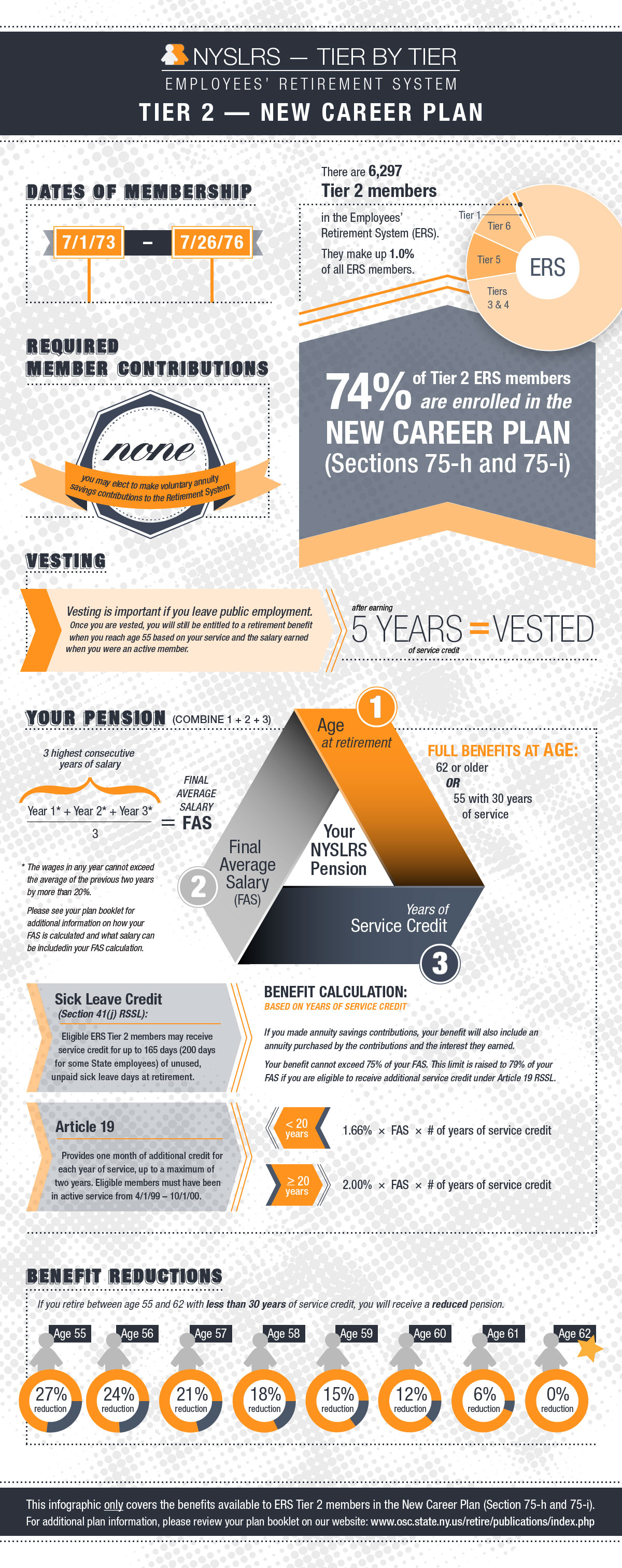
ERS-Tier-2-Benefits_001aIf you’re an ERS Tier 2 member in an alternate plan, you can find your retirement plan publication below for more detailed information about your benefits:

Be on the lookout for more NYSLRS – One Tier at a Time posts. Next time, we’ll take a look at another ERS tier. Want to learn more about the different NYSLRS retirement tiers? Check out some earlier posts in the series:
NYSLRS – One Tier at a Time: PFRS Tier 1

When you joined the New York State and Local Retirement System (NYSLRS), you were assigned to a tier based on the date of your membership. There are six tiers in the Employees’ Retirement System (ERS) and five in the Police and Fire Retirement System (PFRS) – so there are many different ways to determine benefits for our members. Our series, NYSLRS – One Tier at a Time, walks through each tier and gives you a quick look at the benefits members are eligible for before and at retirement.

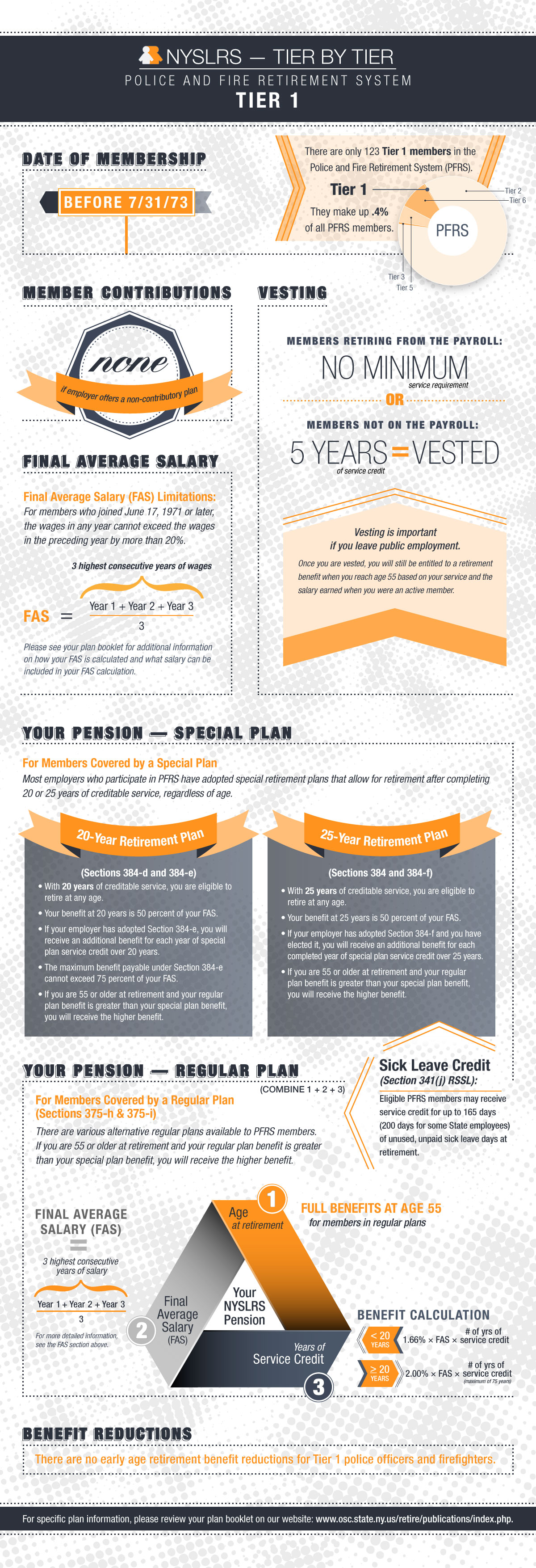
Today’s post looks at Tier 1 in the Police and Fire Retirement System, which has only 123 members. PFRS Tier 1 represents the smallest percentage – 0.4 percent – of NYSLRS’ total membership.

PFRS-Tier-1-Benefits_002

If you’re a PFRS Tier 1 member, you can find your retirement plan publication below for more detailed information about your benefits:

Be on the lookout for more NYSLRS – One Tier at a Time posts. Next time, we’ll take a look at another one of our ERS tiers. Want to learn more about the different NYSLRS retirement tiers? Check out some earlier posts in the series: