Tag Archives: defined benefit plan

National Retirement Security Month

National Retirement Security Month

October is National Retirement Security Month. It’s a time to consider the importance of saving and to think about potential sources of income in retirement. Financial security doesn’t just happen—it takes preparation and time. Even if retirement seems far off, it’s never too early to start planning.

National Retirement Security Month

NYSLRS and Retirement Security

Check out these blog posts to learn more about how your NYSLRS pension and other sources of retirement income can provide retirement security.

Your NYSLRS Pension—A Defined Benefit Plan

As a NYSLRS member, you are enrolled in a defined benefit plan, also known as a traditional pension plan. When you retire, you will receive a monthly pension payment for the rest of your life. Your pension will be calculated using a preset formula based on your earnings and years of service—it will not be based on the individual contributions you paid into the system.

The 3-Legged Stool Approach to Retirement Confidence

Your NYSLRS pension is a good reason to be optimistic about your finances in retirement. But there is more to a financially secure retirement than having a pension. Think of retirement security as a three-legged stool. Each leg is a source of income to help support you when your working days are done.

Compounding: Use Time to Grow Your Money More

If you want to improve your chances of a financially secure retirement, your plan should include retirement savings. It’s important to start saving early so your money has time to grow. When you invest your savings in an individual retirement account (IRA) or a 401(k)-style retirement savings plan, you earn a return on your investment, and those returns are compounded.

Deferred Compensation: Another Source of Retirement Income

For greater financial stability and flexibility, you may want to invest in a deferred compensation savings plan. The New York State Deferred compensation plans are voluntary retirement savings plans like a 401(k), created for New York State employees and employees of other participating public employers.

Debt and Retirement

As you get close to retirement, it’s a good idea to take inventory of any debt you owe. Paying down your debt—including any NYSLRS loans—will help avoid a pension reduction and can give you more flexibility in retirement.

10 Things Members Should Know

NYSLRS is one of the largest retirement systems in the world, administering benefits for more than 1.2 million members, retirees and beneficiaries. Take a look inside NYSLRS and brush up on your NYSLRS knowledge—here are 10 things members should know.

Retired? Check out 10 Things Retirees Should Know.

1. Retirement Online is the Fastest, Most Convenient Way to Do Business With NYSLRS

10 Things Members Should Know Retirement Online is the fastest way to manage your NYSLRS account. Skip printing forms, having them notarized and sending them through the mail. When you submit your requests through Retirement Online, NYSLRS has them immediately, and your changes will be completed more quickly. It’s convenient and secure. Check out what members can do in Retirement Online.

If you don’t have an account or for help signing in to an existing account, check out our Retirement Online tools and tips for step-by-step instructions to register, reset your password, unlock your account and more.

2. Your Pension is a Lifetime Benefit—And Your Pension Benefits are Secure

NYSLRS pensions are defined benefit plans, also known as traditional pension plans. When you retire, you will receive a monthly pension payment for the rest of your life. Your pension will be calculated using a preset formula based on your earnings and years of service—it will not be based on the individual contributions you paid into the system. Member contributions support the benefits earned by current and future retirees and are an important asset of the Common Retirement Fund, which holds and invests the money used to pay NYSLRS benefits. The Fund is widely recognized as one of the best-funded and best-managed public pension plans in the nation. Comptroller Thomas P. DiNapoli is administrator of NYSLRS and trustee of the Common Retirement Fund.

3. ‘Go Green’ and Get Your Important Documents Sooner

You can help us ‘go green’ and reduce paper waste by choosing email as your delivery preference for correspondence and other important documents, such as your Member Annual Statement. When you have something to view, we’ll send an email notifying you to sign in to Retirement Online. And it will save time—you’ll get access to your important documents sooner than printed copies are mailed. Learn how to get email notifications for important documents.

4. Your Tier Determines Your Benefits

Your tier, which is based on your date of membership, determines your benefits, such as eligibility for death benefits or taking a NYSLRS loan and the formula used in the calculation of your benefits.

5. Vested Means You Qualify for a Retirement Benefit

Becoming vested is a crucial milestone for NYSLRS members. It means you have earned enough service to qualify for a retirement benefit once you meet the minimum age or service requirements established by your retirement plan. All members who have at least five years of service credit are vested.

6. Review Your Beneficiaries Periodically

NYSLRS retirement plans provide death benefits for beneficiaries of eligible members who die before retiring. It’s a good idea to review your beneficiaries from time to time to make sure they reflect your current wishes. The beneficiary you named before might not be the one you would choose today. You should also review the contact information for your named beneficiaries so we can find them when needed.

7. Request Additional Service Credit as Early in Your Career as Possible

Service credit is a major factor in calculating your pension benefit. You earn a year of service credit for each year of full-time employment with a participating employer. You may also be able to request additional credit if you worked for your current or another public employer before joining NYSLRS or if you served in the U.S. Armed Forces and received an honorable discharge from active military duty. You must submit your request before retirement, and you should do it as early in your career as possible.

8. Estimate Your Pension

Finding out how much you can expect to receive is an important part of retirement planning. Most members can estimate their pension using Retirement Online in just a few quick and easy steps. Retirement Online uses your current earnings and service information to calculate your estimate, including your final average earnings (FAE) and the amounts for the pension payment options available to you. You can fine-tune your estimate or see how different choices would affect your benefit by entering different retirement dates or a beneficiary’s date of birth.

9. Supplement Your Pension with Retirement Savings

Think of retirement security as a three-legged stool. Each leg is a source of income to help support you when your working days are done. It’s important to understand all your potential sources of income to effectively plan for the future and boost your retirement confidence. Your pension can provide a significant part of your retirement income, but it’s a good idea to supplement your pension with retirement savings and start saving early so your money has time to grow.

10. Your Retirement Plan Publication is an Essential Resource

Your retirement plan publication is an essential resource that explains your NYSLRS benefits in detail—how long you’ll need to work to receive a pension, how your benefit is determined, what death and disability retirement benefits may be available, and more. You should consult it throughout your career, but it’s especially important to read as you prepare for retirement.

The 3-Legged Stool Approach to Retirement Confidence

Your NYSLRS pension is a good reason to be optimistic about your finances in retirement. Once you retire, your pension will provide monthly payments for the rest of your life. But there is more to a financially secure retirement than having a pension.

Think of retirement security as a three-legged stool. Each leg is a source of income to help support you when your working days are done. It’s important to understand all your potential sources of income to effectively plan for the future and boost your retirement confidence.

Leg 1: Your NYSLRS Pension

The 3-Legged Stool Approach to Retirement Confidence NYSLRS pensions are defined benefit plans, also known as traditional pension plans. When you retire, you will receive a monthly pension payment for the rest of your life. Your pension will be calculated using a preset formula based on your earnings and years of service—it will not be based on the individual contributions you paid into the system. Unlike workers who rely on 401(k)-style retirement plans, you won’t have to worry about this income running out.

Most members can estimate their pension in Retirement Online. But, if you’re a long way from retirement, it may be better to think in terms of earnings replacement. Financial advisers estimate you’ll need to replace 70 to 80 percent of your income to retire with confidence. Your pension can help get you there. For example, if you retire with 30 years of service, your NYSLRS pension could replace more than half of your earnings. (Pension benefits depend on your tier and retirement plan. Find your retirement plan publication for comprehensive information about your retirement benefits and how your pension will be calculated.)

Leg 2: Social Security

Your Social Security benefit is another source of income to help support you in retirement. At Social Security’s full retirement age, your benefit can replace from about 75 percent for lower income earners to about 27 percent for higher income earners. Learn more about Social Security benefits and visit the Social Security’s Plan for Retirement page to estimate your income.

Leg 3: Retirement Savings Can Boost Your Confidence

A lifetime pension and Social Security income will be substantial financial assets, but it’s still important to save for retirement. Healthy retirement savings will give you more flexibility to do the things you want to do in retirement. It can also help in case of an emergency and act as a hedge against inflation.

Your personal savings is the factor you have the most control over. You decide when to start, how much to save and how to invest your money. The key is to start saving early so your money has time to grow, even if you can only afford to save a small amount in the beginning.

Eligible employees might consider saving with the New York State Deferred Compensation Plan (NYSDCP). Money gets deducted from your paycheck, so you won’t even have to think about it. NYSDCP is not affiliated with NYSLRS, but New York State employees and some municipal employees can participate. If you’re a municipal employee, ask your employer whether you’re eligible for NYSDCP or another retirement savings plan.

Tier 6 Member Contribution Rate Changes

Most NYSLRS members contribute a percentage of their earnings toward their retirement. For Tier 6 members (those who joined NYSLRS on or after April 1, 2012), your contribution rate is based on your earnings and is subject to change each year on April 1.

The minimum contribution rate is 3 percent, and the maximum is 6 percent.

Tier 6 contribution rates

How Your Tier 6 Contribution Rate is Calculated

If you are a new Tier 6 member, your contribution rate is based on a projected annualized wage provided by your employer. For new part-time employees, your employer calculates a projected annualized wage by using your part-time rate to determine what your annual wage would be if you worked full-time.

Once you have been a member for more than two full state fiscal years, your contribution rate is calculated using actual earnings reported to us by your employer(s) from two state fiscal years prior. So, contribution rates for April 1, 2025 through March 31, 2026 are based on what you actually earned in all public employment from April 1, 2023 through March 31, 2024.

Earnings include:

Overtime Pay Temporarily Excluded from Tier 6 Contribution Rates

A new law temporarily excludes overtime pay earned from April 1, 2022 through March 31, 2024 from the calculation of Tier 6 contribution rates. This may lower contribution rates for some Tier 6 members from April 1, 2024 through March 31, 2026.

For more information, read our blog post, Overtime Pay Temporarily Excluded from Tier 6 Contribution Rates.

Contribution rates are set at the beginning of each fiscal year on April 1. If your contribution rate changes, we notify your employer in March so they can update their payroll system to withhold the proper amount.

For more information, visit our Member Contributions webpage.

Understanding Your NYSLRS Pension

NYSLRS pensions are defined benefit plans, also known as traditional pension plans. When you retire, you will receive a monthly pension payment for the rest of your life. Your pension will be calculated using a preset formula based on your earnings and years of service—it will not be based on the individual contributions you paid into the system. Member contributions support the benefits earned by current and future retirees and are an important asset of the Common Retirement Fund, which holds and invests the money used to pay NYSLRS benefits.

Find your NYSLRS retirement plan publication for comprehensive information about your retirement benefits and how your pension will be calculated.

NYSLRS Retirees Contribute to New York State’s Economy

NYSLRS benefits provide a lifetime monthly pension retirees can count on. And, in turn, NYSLRS retirees contribute to our local economies in both good times and bad.

Nearly 79 percent of NYSLRS retirees live right here in New York State, and they can be found in every region and county. That means, in every corner of the Empire State, NYSLRS retirees are there—patronizing local businesses and helping to create jobs. Retirees also pay a significant share of State, local and property taxes.

As of the State fiscal year ending, March 31, 2024, Suffolk County on Long Island is home to 39,837 retirees and beneficiaries—the most benefit recipients of the counties outside of New York City. They make up about 2.6 percent of the county’s residents, and they bring some $1.5 billion in pension payments to their region’s economy.

On the other hand, Hamilton County has the fewest NYSLRS benefit recipients—just 545. But, for this sparsely populated county in the heart of the Adirondacks, those retirees represent about 10 percent of the county’s population, and they inject more than $12.9 million of pension payments into their communities.

As the number of NYSLRS retirees in our State grows, you can count on their help in building a stronger New York for years to come. Visit our website to see more about how retirees contribute to every region in the State.

Retirees Contribute to New York State’s Economy

How Retirees Contribute to Economic Stability

A NYSLRS pension is a defined benefit plan, which provides guaranteed monthly pension payments to retirees for life. With a defined benefit plan, your pension will be calculated based on a preset formula. That means—unlike with 401(k)-style defined contribution plans, which are essentially retirement savings accounts—your contributions won’t affect the amount you receive in retirement. NYSLRS retirees don’t have to worry about their pension running out during retirement, and there’s no danger of a drop in monthly income based on the whims of the stock market.

A study by the National Institute on Retirement Security (NIRS) suggests retirees with steady sources of income such as Social Security and monthly pensions are better able to maintain their spending during economic downturns, which may play a stabilizing role in local economies. That stability is particularly important in rural parts of the State. These areas often lack the economic diversity of more densely populated regions, which can make them more susceptible to downturns.

Defined benefit pension plans don’t just help New York State. Across the nation, pension benefits support millions of retirees who in turn contribute to their communities. In 2020, defined benefit pension plans paid $612.6 billion to 24.6 million retired Americans. According to the same NIRS study, their spending supported 6.8 million jobs and generated $1.3 trillion in economic activity.

Your NYSLRS Pension—A Defined Benefit Plan

As a NYSLRS member, you are enrolled in a defined benefit plan, also known as a traditional pension plan.

If you are vested and retire from NYSLRS, you will receive a monthly pension payment for the rest of your life. Your pension will be calculated using a preset formula based on your earnings and years of service—it will not be based on the individual contributions you paid into the system.

Member contributions support the benefits earned by current and future retirees and are an important asset of the Common Retirement Fund.

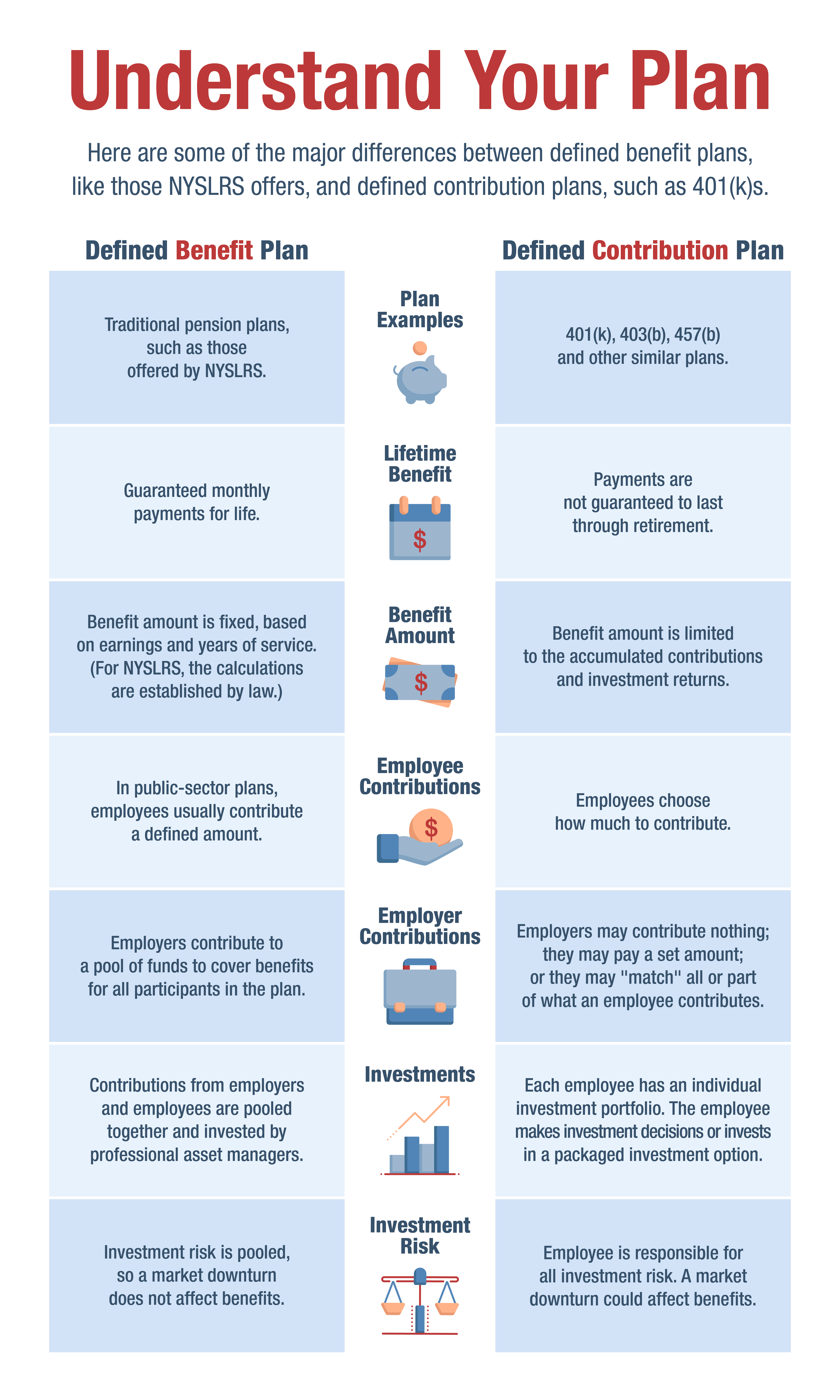
Defined benefit plans are supported by contributions from both members and employers. With defined benefit plans, retirement assets are pooled and the investment risk is shared. These plans are usually administered by professional managers, whose long-term investment strategies help to reduce the impact of market turmoil. NYSLRS employs an experienced group of investment managers.

The New York State Common Retirement Fund, which holds and invests the assets of NYSLRS, is one of the largest public pension plans in the United States, providing retirement security for over 1.2 million NYSLRS members, retirees and beneficiaries. The Fund has consistently been ranked as one of the best managed and best funded plans in the nation.
understand your defined benefit plan

Defined Contribution Plans—And Their Risks

Defined benefit plans are often confused with 401(k)-style retirement savings plans, which are known as defined contribution plans.

With a defined contribution plan, the employee, the employer or both contribute to an individual retirement account for the employee, and the money in the account is invested. In most cases, the employee decides how and where the money is invested (or the plan may offer pre-packaged investment options). At retirement, the employee will be able to draw from the accumulated value of contributions and investment returns, minus any fees.

The amount of money the employee has at retirement often relies on the investment returns of the individual account. So, market downturns, especially near retirement, can negatively affect the value of the benefit. Employees depending on defined contribution plans run the risk of outliving their savings.

NYSLRS’ Defined Benefit Plans

We administer nearly 300 retirement plan combinations. NYSLRS retirement plans:

  • Provide a guaranteed benefit for life.
  • Offer a pension based on final average earnings and years of service.
  • Provide a right to pension benefits (vesting) with five years of service credit.
  • Build a cost-of-living adjustment (COLA) into pensions to help offset the effect of inflation.
  • Include disability retirement and death benefits.

We strongly encourage you to review your retirement plan publication for a complete description of your benefits. Visit our Find Your NYSLRS Retirement Plan Publication page and follow the steps listed.
Calculating Your Final Average Earnings

As a NYSLRS member, you have a defined benefit plan that provides a lifetime pension when you retire. Your NYSLRS pension benefit amount will be determined by several factors, including your tier, service credit, and final average earnings (FAE).

When we calculate your pension, we find the consecutive years when your earnings were highest. These are usually your years of employment immediately before retirement, but they can be anytime in your career and do not need to match up with calendar years or fiscal years.

Update: Tier 6 Final Average Earnings Based on Highest Three Years

A new law improves the pension benefits of NYSLRS Tier 6 members. When you retire, your FAE will be based on the average of your three highest consecutive years of earnings, the same as members in other tiers.

These improvements apply to members who retire on or after:

  • April 1, 2024, for Police and Fire Retirement System (PFRS) Tier 6.
  • April 20, 2024, for Employees’ Retirement System (ERS) Tier 6.

Previously, your FAE was the average of your highest five consecutive years of earnings.

If you recently retired and the change applies to you, we have updated your pension calculation — you don’t need to contact us. The new law does not apply to members who retired before the dates above.

Understanding Final Average Earnings Limits

If your earnings increase significantly through the years used in your FAE, some of those earnings may not be used toward your pension.

Your limit depends on whether you’re an ERS or PFRS member and your tier. For most members, if the earnings in any 12-month period in your FAE exceed the average of the previous two years by more than 10 percent, the amount above 10 percent will not be included in your FAE calculation.

Calculating Your Final Average Earnings

For more information, including limits for other tiers, visit our Final Average Earnings page.

Types of Earnings Included in Your FAE

The specific types of earnings included in your FAE calculation depend on your retirement plan and tier. Please check your plan publication for details.

In most cases, your FAE will include the payments listed below, if they are earned in the FAE period. (In some cases, restrictions may apply.)

In most cases, the following payments will not be included in your FAE calculation:

  • Unused sick leave;
  • Payments made as a result of working your vacation;
  • Any form of termination pay;
  • Payments made in anticipation of retirement; and
  • Any payments made for time not worked.

Age Milestones for Retirement Planning

age milestones

Whether you’re 22 or 52, you should be planning for retirement. Your NYSLRS retirement benefits will be based on your tier, years of service and final average earnings. For most members, age is also an important factor in your NYSLRS benefits and it’s a factor for Social Security and retirement savings strategies as well. So, as you plan for retirement, consider these age milestones.

Age Milestones

Under 50: It’s never too early to start saving for retirement. Even modest savings can add up over time as investment returns grow and interest compounds.

50: The Age 50 and Over Catch-Up provision allows you to save more pre-tax dollars in a retirement account starting in the calendar year in which you turn 50.

55: The earliest age most NYSLRS members can begin collecting a service retirement benefit. (This does not apply to members in special retirement plans.) Your pension may be permanently reduced if you retire before your full retirement age.

59½: The age you can start withdrawing money from a tax-deferred retirement savings plan, such as an IRA, without facing a potential federal tax penalty. (The penalty does not apply to New York State Deferred Compensation Plan savings if you are retired or have left public service.)

62: Full retirement age for your NYSLRS benefit if you are in Tier 2, 3, 4 and 5 or PFRS Tier 6. Earliest age you can begin collecting a Social Security pension, but the benefit would be reduced. For more information about Social Security, read When to Start Receiving Retirement Benefits.

63: Full retirement age for your NYSLRS benefit if you are in ERS Tier 6.

65: Age most people are eligible for Medicare benefits.

66: Full retirement age for Social Security if you were born from 1943 through 1954. Add two months for each year from 1955 through 1959.

67: Full retirement age for Social Security if you were born in 1960 or later.

70: If you do not take your Social Security benefit, your benefit will increase each year until you reach age 70. Delaying Social Security after 70 will not increase your benefit.

73: Generally, if you have tax-deferred retirement savings and are no longer working, you must begin withdrawing some of this money when you reach a certain age. Under a recent change in federal law, you must start taking “minimum required distributions” at age 73. The minimum age had been 72, and the change does not affect those who turned 72 before the end of 2022. This age milestone will increase to 75 in 2033. Required minimum distributions do not apply to your NYSLRS retirement benefits.

One Last Number: Having a rough idea of your life expectancy is essential to retirement planning.

Public Pensions Give Economic Boost to Small Towns, Rural Areas

Small towns and rural areas in New York and across the United States get an important economic boost from public pensions, a recent study concludes.

Public Pensions Give Economic Boost to Small Towns and Rural Areas Across New York

Why Public Pensions Give an Economic Boost

Because of their smaller economies, less-populated counties benefit more from pension dollars than larger, urban counties, according to Fortifying Main Street: The Economic Benefit Of Public Pension Dollars In Rural America.

In many small towns and rural communities, the report notes, school districts and local governments are the largest employers. Those public employees typically remain in their communities after retirement, and the authors attribute the economic boosts they found to pension dollars spent locally on goods and services.

Across New York State, public pensions were responsible for 1.6 percent of gross domestic product (GDP) in 2018. (GDP, the total value of goods and services produced during a specific period, is a common gauge of economic activity.) However, during the same period:

  • Wyoming County in western New York, where a handful of villages dot a rural landscape, saw public pensions generate 4.6 percent of GDP.
  • Hamilton County, with fewer than 5,000 people, received an economic boost from public pensions that accounted for 6.3 percent of GDP.

The study’s findings are in line with data showing the impact NYSLRS retirees have on local economies and other studies about the economic benefits of pensions.

Notes on the Data

Fortifying Main Street, which was released in July by the National Institute on Retirement Security (NIRS), examines pension data from 2,922 counties in 43 states. Based on criteria used by the federal Office of Budget Management, it divides counties into three main categories: metropolitan, small-town (or micropolitan) and rural. The study also analyzes data from counties that are home to the state capital, because these places tend to have higher numbers of public retirees. In Albany County, public pensions generated 2.7 percent of GDP.

Hamilton County is the only county in New York defined as rural in the study, but 16 counties, including Wyoming County, fit the “small town” criteria. You can read the full report on the NIRS website.

The study uses pensions paid by NYSLRS, the New York State Teachers’ Retirement System, the Teachers’ Retirement System of New York City and the New York City Employees’ Retirement System in its data for New York State.

NYSLRS – One Tier at a Time: PFRS Tier 5

When you join the New York State and Local Retirement System (NYSLRS), you’re assigned a tier based on the date of your membership. There are six tiers in the Employees’ Retirement System (ERS) and five in the Police and Fire Retirement System (PFRS). Each tier has a different benefit structure established by New York State legislation.

Our series, NYSLRS — One Tier at a Time, walks through each tier to give you a quick look at the benefits in both ERS and PFRS. Today’s post looks at PFRS Tier 5. Anyone who joined PFRS from January 9, 2010 through March 31, 2012 is in Tier 5. There were 1,967 PFRS Tier 5 members as of March 31, 2021, making up 5.6 percent of PFRS membership.

About Special Plans

Under a regular plan, you need to reach certain age and service requirements to receive your NYSLRS pension. If you’re covered by a special plan, there is no age requirement, and you can receive your pension after completing 20 or 25 years of service.

Nearly 80 percent of PFRS members are in plans covered under Sections 384, 384-d, 384-e or 384-f of the Retirement and Social Security Law. Read our Police and Fire Retirement System blog post for information about different PFRS plans.

Check out the graphic below for the basic retirement information for PFRS Tier 5.

PFRS Tier 5

If you’re a PFRS Tier 5 member, you can find detailed information about your benefits in the retirement plan booklets listed below:

For special plans under miscellaneous titles, please visit our Publications page.

Check out other posts in the PFRS series: