Tag Archives: membership

join NYSLRS

Join NYSLRS

Most State and municipal employees are required to join the New York State and Local Retirement System (NYSLRS) when they are hired. But for some employees, membership is optional, meaning you are not automatically enrolled. To join NYSLRS, you must submit a membership application to your employer, who will then enroll you in NYSLRS. It’s important to understand the valuable benefits of NYSLRS membership and why you should join as soon as possible.
join NYSLRS

Whose Membership is Optional or Mandatory

Membership is optional if:

  • You work less than 12 months per year, including 10-month school employees working full-time;
  • You work less than 30 hours per week or less than the number of hours for full-time employment, as established by your employer for your position;
  • You are in a temporary or provisional position (under Civil Service Law); or
  • Your annual compensation is less than New York State’s minimum wage multiplied by 2,000 hours.

Membership is mandatory if:

  • You are in a permanent, full-time, 12-month position of an employer who participates in NYSLRS; and
  • You are in a full- or part-time position covered by the Police and Fire Retirement System (PFRS), such as police officers and firefighters.

If you aren’t sure whether you’re a member, your employer should be able to let you know. Contact us if you have questions.

Benefits of Joining NYSLRS

NYSLRS is one of the largest retirement systems in the world, administering benefits for more than 1.2 million members, retirees and beneficiaries.

If you aren’t sure whether to join NYSLRS, here are the advantages:

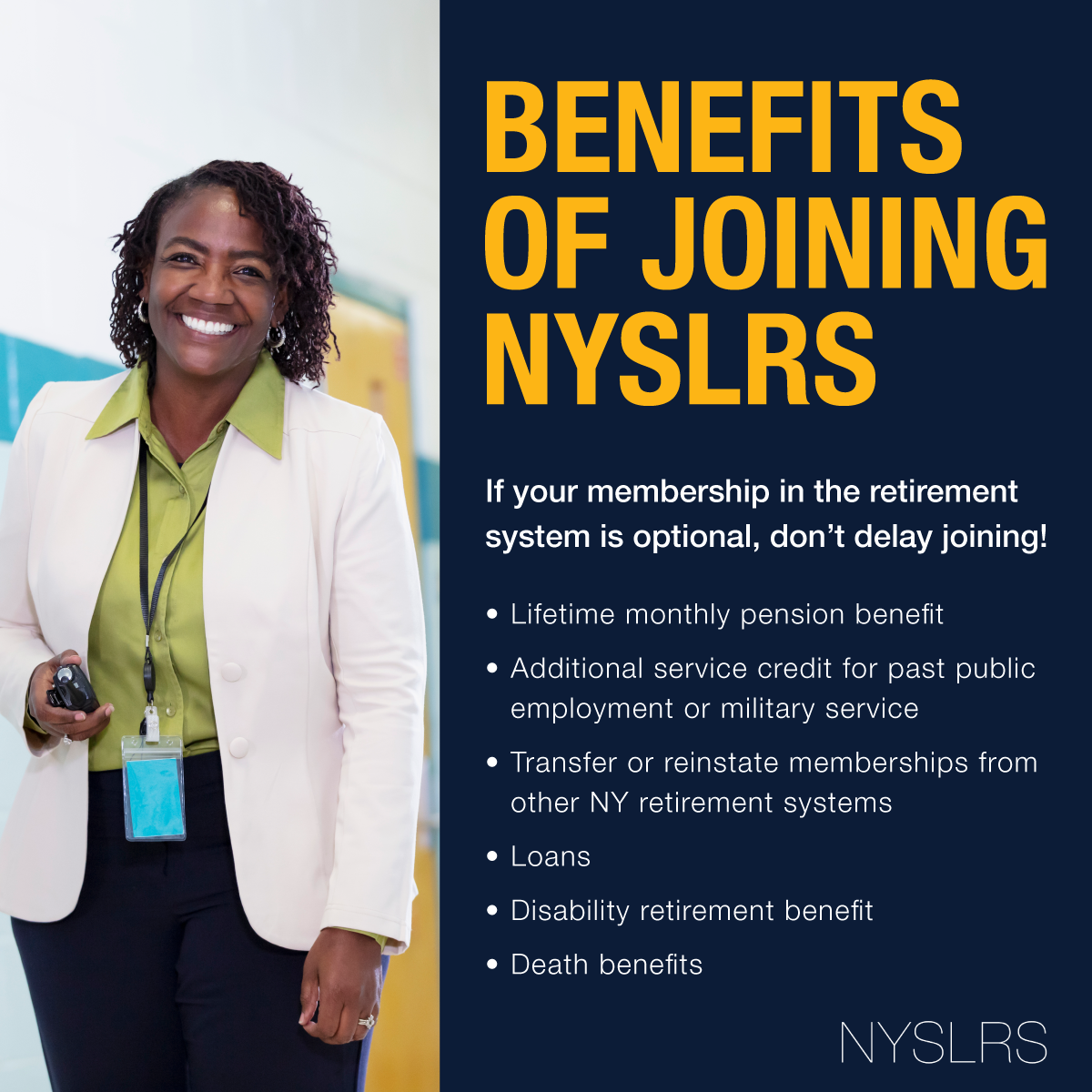
  • Your NYSLRS pension is a defined benefit plan. When you retire, you will receive a monthly pension payment for the rest of your life. Once you reach retirement age, you can retire with as few as five years of service credit (part-time service is pro-rated).
  • You can request additional service credit for your public employment before joining NYSLRS or if you served in the U.S. Armed Forces and received an honorable discharge from active military duty.
  • You can transfer service if you are still a member of another public retirement system in New York State.
  • You can reinstate service if you withdrew your membership in NYSLRS or another public retirement system in New York State.
  • You can take a loan against your retirement contributions once you meet eligibility requirements.
  • NYSLRS retirement plans provide death and disability retirement benefits.

Nearly 3,000 employers participate in NYSLRS, allowing you to continue your membership if you take a job at another New York State public employer. And if you decide to leave public employment before you have ten years of service credit, you can withdraw your contributions plus interest or roll over your contributions into another retirement savings plan.

NYSLRS Membership Basics

Once you join and become a NYSLRS member:

Don’t Delay Joining

It’s important to join NYSLRS at the start of your employment. If you don’t join right away, you can purchase service credit for your public employment from before you became a member, but it will cost more—6% of your earnings plus interest rather than contributing a percentage based on your earnings. Also, while you can request previous service credit and pay for the cost at any time, you must earn two years of service credit as a NYSLRS member before your purchased service can be credited.

Get Credit for All Your Public Service

Because service credit is a major factor in calculating your pension benefit, it’s important to make sure you get credit for all your public service. Once you join NYSLRS, you should request any additional service as early in your career as possible.

  • NYSLRS will need time to request records from your previous employer or retirement system.
  • The sooner you purchase your credit, the less it will generally cost.
  • Requesting early gives you time to pay for additional service.

Your request will be reviewed to determine your eligibility. We will send you a letter with the amount of service credit you are eligible to receive if you choose to purchase it, the cost and payment options. There are certain situations where purchasing additional service credit will not increase your pension. For more information, read about whether should you purchase additional service credit.

ERS Tier 5 Milestones

If you joined the Employees’ Retirement System (ERS) on or after January 1, 2010, but before April 1, 2012, you are a Tier 5 member. Let’s look at the ERS Tier 5 milestones you will reach over the course of your public service career and how they will affect your benefits.

Why Milestones Matter

As a NYSLRS member, you earn service credit for your paid public employment. Generally, one year of full-time work equals one year of service credit. As you earn service credit, you’ll reach career milestones that will make you eligible for certain benefits or for increases to your existing benefits. Understanding these milestones will help you plan for retirement.

Your ERS Tier 5 milestones and pension calculation depend on your retirement plan, so it is important to familiarize yourself with the details of your plan. Most ERS Tier 5 members are in the Article 15 retirement plan (named for a section of the New York State Retirement and Social Security Law). If you see Plan A15 listed in the ‘My Account Summary’ section of your Retirement Online account, you’re in this plan. For members not covered by the Article 15 retirement plan, visit our website to Find Your NYSLRS Retirement Plan Publication.

Important ERS Tier 5 Milestones

ERS Tier 5 milestones

Here are some additional important milestones for Tier 5 members in the Article 15 retirement plan:

  • With ten years of service credit, you can apply for a non-job-related disability benefit if you are permanently disabled and cannot perform your duties because of a physical or mental condition.
  • With ten years of service credit, your beneficiaries may be eligible for an out-of-service death benefit if you leave public employment and die before retirement.
  • Ten years also marks the point when you are no longer able to withdraw your membership and receive a refund of your contributions if you leave public employment.
  • You are eligible to retire once you are age 55 and have at least five years of service credit. However, for most Tier 5 members, there would be reductions to your benefit if you retire before age 62.
  • You can retire with full benefits at age 62.
    • If you retire with less than 20 years of service, your pension will equal 1.66 percent of your final average earnings (FAE) for each year of service.
    • If you retire with 20 to 30 years of service, your pension will equal 2 percent of your FAE for each year of service.
    • For each year of service beyond 30 years, you will receive 1.5 percent of your FAE.

Note: When you retire, your FAE will be based on the average of your three highest consecutive years of earnings. The law limits the FAE of all members who joined on or after June 17, 1971. Read our blog post, Calculating Your Final Average Earnings, for more information, including how your FAE will be calculated and limitations.

Most members can estimate their pension in Retirement Online. You can fine tune your estimate by entering your annual earnings and expected pay increases. You can also include any service credit you plan to purchase.

PFRS Milestones

The Police and Fire Retirement System (PFRS) covers more than 35,000 police officers and firefighters across New York State. Let’s look at the PFRS milestones you will reach over the course of your public service career and how they will affect your benefits.

Why Milestones Matter

As a NYSLRS member, you earn service credit for your paid public employment. Generally, one year of full-time work equals one year of service credit. As you earn service credit, you’ll reach career milestones which make you eligible for certain benefits or for increases to your existing benefits.

Some milestones are common to most PFRS members; others are shared by members in a particular tier or retirement plan. For example, your plan determines when you would be eligible to apply for a non-job-related disability benefit. Understanding these milestones will help you plan for retirement.

Important PFRS Milestones

PFRS milestones

Special Retirement Plans

Most PFRS members are in special retirement plans, which allow you to retire after 20 or 25 years of service regardless of age.

If you retire at your 20- or 25-year milestone, your pension will be 50 percent of your final average earnings (FAE). Depending on your retirement plan, you may earn 1.66 percent of your FAE for each year you work beyond the 20 or 25 years, however for most PFRS members, a maximum of 32 years of service can be used in your pension calculation.

Final Average Earnings

A new law improves the pension benefits of NYSLRS Tier 6 members. When you retire, your FAE will be based on the average of your three highest consecutive years of earnings, the same as members in other tiers. Read our blog post, Calculating Your Final Average Earnings, for more information, including how your FAE will be calculated and limitations which apply.

Eligible Service

PFRS members in special plans should be aware not all public employment counts towards reaching the 20- or 25-year milestone. Service usually must be in specific job titles to be creditable toward your pension benefit. For example, if you are in the New York State Police Plan, service with a city police department would be creditable, but service as a sheriff’s deputy or corrections officer would not be. PFRS members may be eligible to purchase credit for military service to reach 20 or 25 years.

More Information About Your Benefits

Most members can estimate their pension in Retirement Online. You can fine tune your estimate by entering your annual earnings and expected pay increases. You can also include any service credit you plan to purchase.

Your specific PFRS milestones, along with your eligible service and pension calculation, are determined by your retirement plan, so it is important to familiarize yourself with the details of your plan. You can visit our website to Find Your NYSLRS Retirement Plan Publication.

ERS Tier 6 Milestones

If you joined the Employees’ Retirement System (ERS) on or after April 1, 2012, you are a Tier 6 member. Let’s look at the ERS Tier 6 milestones you will reach over the course of your public service career and how they will affect your benefits.

Why Milestones Matter

As a NYSLRS member, you earn service credit for your paid public employment. Generally, one year of full-time work equals one year of service credit. As you earn service credit, you’ll reach career milestones that will make you eligible for certain benefits or for increases to your existing benefits. Understanding these milestones will help you plan for retirement.

Your ERS Tier 6 milestones and pension calculation depend on your retirement plan, so it is important to familiarize yourself with the details of your plan. Most ERS Tier 6 members are in the Article 15 retirement plan (named for a section of the New York State Retirement and Social Security Law). If you see Plan A15 listed in the ‘My Account Summary’ section of your Retirement Online account, you’re in this plan. For members not covered by the Article 15 retirement plan, visit our website to Find Your NYSLRS Retirement Plan Publication.

Important ERS Tier 6 Milestones

ERS Tier 6 milestones

Here are some additional important milestones for Tier 6 members in the Article 15 retirement plan:

  • With ten years of service credit, you can apply for a non-job-related disability benefit if you are permanently disabled and cannot perform your duties because of a physical or mental condition.
  • With ten years of service credit, your beneficiaries may be eligible for an out-of-service death benefit if you leave public employment and die before retirement.
  • Ten years also marks the point when you are no longer able to withdraw your membership and receive a refund of your contributions if you leave public employment.
  • You are eligible to retire once you are age 55 and have at least five years of service credit. However, for most Tier 6 members, there would be reductions to your benefit if you retire before age 63.
  • You can retire with full benefits at age 63.
    • If you retire with less than 20 years of service, your pension will equal 1.66 percent of your final average earnings (FAE) for each year of service.
    • If you retire with 20 years of service, your pension will equal 1.75 percent of your FAE for each year of service.
    • For each year of service beyond 20 years, you will receive 2 percent of your FAE.

Note: A new law improves your pension benefits. When you retire, your final average earnings (FAE) will be based on the average of your three highest consecutive years of earnings, the same as members in other tiers. Read our blog post, Calculating Your Final Average Earnings, for more information, including how your FAE will be calculated and limitations.

Most members can estimate their pension in Retirement Online. You can fine tune your estimate by entering your annual earnings and expected pay increases. You can also include any service credit you plan to purchase.

Vested: Qualifying for a Retirement Benefit

Becoming vested is a crucial milestone for NYSLRS members. It means you have earned enough service to qualify for a retirement benefit once you meet the age or service requirements established by your retirement plan. Vesting is automatic — you don’t have to fill out any paperwork to become vested.

Vested: Qualifying for a Retirement Benefit

Years of Service Credit to Become Vested

NYSLRS members in Tiers 2 – 6 need five years of service credit to be vested.  

If you work part-time, or if you have an unpaid leave of absence, it will take longer to become vested. For example, if you work half-time, you earn six months of credit toward vesting for each year on the job.

Sign in to your Retirement Online account to check your total estimated service credit and whether you are vested.

If you work for a school district, read our How School Employees Earn NYSLRS Service Credit blog post for information about how your service credit is determined. 

Note: Previously, Tier 5 and 6 members needed ten years of service to be eligible for a service retirement benefit. However, as of April 9, 2022, these members only need five years of service credit to be vested. The new law did not change benefit rules such as how long members must contribute, pension benefit calculations, the full retirement age, reductions to retire early or the cost to purchase previous service.

Applying for Retirement

Vesting is automatic, but you will need to apply for retirement to receive your pension — NYSLRS will not pay out your pension benefit unless you apply for it.

Pension eligibility requirements and benefit calculations depend on your tier and retirement plan. To find your tier and retirement plan, sign in to your Retirement Online account and go to the ‘My Account Summary’ section. Once you know your tier and retirement plan, you can find your retirement plan publication for comprehensive information about your benefits and filing instructions.

And when you’re ready, you can apply for a service retirement benefit quickly and easily using Retirement Online.

If you leave public employment, read about the age requirements for filing for a vested retirement benefit as well as other important information that you should know about your NYSLRS membership and benefits.

Transferring Your Membership to NYSLRS

transferring membership

A lot can change in our lives, and sometimes people switch jobs or professions during their career. Perhaps you were a teacher, and you recently began working for New York State. Or maybe you had a job with New York City, and you took a position with a municipality outside of the city. If you are an active member of more than one public retirement system in New York State, you may have the option of transferring that membership to NYSLRS and receiving credit for that service.

Considering Service Credit

Service credit is a factor in calculating a NYSLRS pension benefit, so increasing your service credit will generally increase your pension benefit.

In some cases, transferring membership may not be beneficial. For example, if you are in a retirement plan that allows for retirement after 20 or 25 years of service (regardless of age), your service usually must be in specific job titles to be creditable toward your pension benefit. If you are in one of these plans, find your retirement plan publication to learn what service is creditable.

If you have questions, contact a customer service representative before you apply to transfer a membership. You can message them using our secure contact form.

Transferring Membership

Members who are transferring membership to NYSLRS must:

  • Be on the payroll in a job that is covered by NYSLRS;
  • No longer work in the job that was covered by the other retirement system; and
  • Still be an active member of the other system (off payroll for that job, but your membership in the other system has not been terminated or withdrawn).

To transfer a membership to NYSLRS, you first must submit a transfer request to your other retirement system. When we receive your membership information from the other retirement system, we will compare your date of membership in NYSLRS with your date of membership in the other system. When the transfer is complete, your date of membership will be the earlier of the two dates. If applicable, your tier will change.

If You Need to Transfer to Another System

You can submit an online request to NYSLRS to transfer your membership from NYSLRS to another New York State public retirement system:

  • Sign in to Retirement Online.
  • In the ‘My Account Summary’ section of your Account Homepage, under ‘I want to…,’ click the “Transfer My Membership” button.

Whether you are transferring in or out of NYSLRS, the transfer is effective when we receive your application, and it may be permanent.

You can find more information about transferring membership on our website.

Sex Identification and Your NYSLRS Membership

As of January 1, 2023, when new members are enrolled in NYSLRS, they can choose “x” as their sex identification instead of “male” or “female.”

sex identification

Updating Your Sex Identification With NYSLRS

If you’re already a member or a retiree, you can update your sex identification with us at any time.

Sign in to Retirement Online to check what information we have on file for you. You can find your current sex identifier on your Account Homepage under ‘My Profile Information.’

If you need to change or correct your sex identification, send us a signed letter requesting the change. Please include your NYSLRS ID on the letter. No additional documentation is required to change your sex identifier.

You can send us the letter by attaching it to our secure contact form, or by mailing it to:

NYSLRS
110 State Street
Albany, NY 12244-0001

We are working to update Retirement Online so members and retirees can sign in and update their sex identification on their own. This feature is expected to be available sometime in 2023. (Need help accessing Retirement Online in the meantime? See our Tools and Tips post for more information.)

Need a Name Change Too?

If you’re changing your last name, you can make the update, and upload copies of the documentation showing the change, in Retirement Online. Sign in to your account, go to the ‘My Profile Information’ section of your Account Homepage and click the “update” link next to your name. A list of acceptable documentation will be provided.

To update your first or last name, send us a Name Change Notice (RS5483) form. You will need to provide original documentation, such as a court order, if the name change is for a reason other than a change in marital status. We can also accept a certified copy of the documentation.

Why Your Retirement Plan Publication Is So Important

Your plan publication is an essential resource that you should consult throughout your career. It will help you plan for retirement and guide you when your retirement date draws near.

Reminder: you can use this tool to help you find your retirement plan publication.

Let’s explore the information you’ll find in your plan publication and what it means.

retirement plan publication

About Your Membership

This section has basic information about your membership, including your tier, contributions, when you will be eligible for a pension and how to withdraw your membership if you leave public employment.

Service Credit

Service credit is one of the main factors in determining your pension benefit amount. If you work full-time for the State or a participating municipal employer for 12 months, you’ll earn a year of service credit. If you work part-time, your service credit is prorated.

You’ll also find information about how your service credit is calculated, how to purchase credit for previous public employment or military service, how leaves of absence affect service credit, and how sick leave can be used for extra service credit at retirement.

Final Average Earnings

Final average earnings (FAE) are another major factor in determining the amount of your pension. Your FAE is the average earnings during the set of consecutive years (three or five years, depending on your tier and retirement plan) when your earnings were highest.

This section describes what types of payments are used in calculating your FAE and any limitations that may apply.

Service Retirement Benefits

This section describes your retirement eligibility and how your benefit is calculated. If you have questions about how much your pension will be, you should read this section.

Choosing a Pension Payment Option

You can choose from several options for the payment of your pension. Some payment options allow you to provide for your spouse or other beneficiary after you die in exchange for a reduction in your monthly payment. Consider each payment option carefully, as you’ll only have at most 30 days to change it after you retire.

Items That May Affect Your Pension

This section describes factors that can change the amount of your pension. For example, if you retire with an outstanding loan, your pension will be permanently reduced. Also, if you get a divorce, your ex-spouse may be entitled to a portion of your benefit.

A cost-of-living adjustment (COLA), on the other hand, would increase your benefit once you become eligible.

Vested Retirement Benefits

If you leave public employment before retirement age but have met the minimum service requirement to receive a pension, you can apply for a vested retirement benefit when you become eligible.

Disability and Death Benefits

Your NYSLRS benefits include more than a pension. If you are no longer able to perform your job because of a medical condition, you may be eligible for a disability retirement. If you die before retirement, your survivors may be eligible for a death benefit.

Receiving Your Benefits

Before you can receive your pension, you must file an application with the Office of the State Comptroller. This section describes the process of applying for your retirement benefits, including information about filing online.

Firefighters Deserve A Salute Every Day

Recognizing Firefighters

It’s National Fire Prevention Week this week and, while attention is properly focused on promoting fire prevention, we also think it’s a great time to recognize all the firefighters who are members of the New York State and Local Retirement System (NYSLRS).

Of the 533,415 members in NYSLRS, 32,470 are in the Police and Fire Retirement System (PFRS). More than 6,000 of these brave men and women are firefighters.

NYSLRS Firefighters data

NYSLRS Membership and Firefighters

All firefighters working for participating employers are PFRS members. With that membership comes a variety of benefits, including certain death and disability benefits as well as a pension. As firefighters and other PFRS members progress through their careers they become eligible for these benefits. For example, from day one, PFRS members are covered by job-related death and disability benefits. However, with ten years of service credit, most members are also eligible for a non-job-related disability benefit.

In addition, most PFRS employers offer their employees special retirement plans. A special plan lets members retire after completing 20 or 25 years of credited service in specific job titles rather than reaching a certain age. Most firefighters — and, in fact, nearly 80 percent of all PFRS members (25,784) — are enrolled in a set of special 20- and 25-year plans. Whether members need 20 or 25 years depends on their retirement plan.

Firefighters are Heroes

To the members of the New York State Professional Fire Fighters Association, the Firemen’s Association of the State of New York and the New York State Association of Fire Chiefs; to the county fire marshals, supervising fire marshals, fire marshals, assistant fire marshals, assistant chief fire marshals and chief fire marshals: Thank you for your service to New York and its citizens. We are grateful for the valuable service you provide all of us.

More Than One Million Strong: The Growth of NYSLRS

When NYSLRS formed in 1921, it started with a total of 4,721 participants (4,672 members and 43 retirees). Today, NYSLRS provides retirement security to 643,178 members and 430,308 retirees and beneficiaries (the most recent data available).

To say we’ve grown would be an understatement. But no matter how large we get, NYSLRS will continue to provide its members and retirees with lifetime retirement benefits and help them to plan for a financially secure future.

A look back at membership growth through the years.

NYSLRS Membership growth through the years

NYSLRS: Retirement Security Before Social Security

Before NYSLRS began in 1921, many New York public employees who were no longer able to work would fall into poverty. At the time, Social Security didn’t exist to help supplement post-retirement income. While Social Security was created in 1935, it wasn’t made available to public employees until 1950 and didn’t start in New York until 1953.

NYSLRS in 1950

Under State Comptroller Frank C. Moore, NYSLRS was comprised of 161,686 participants in 1950. Of those, 151,326 were Employees’ Retirement System (ERS) members and 10,360 were retirees and beneficiaries.

You may have noticed that there were no Police and Fire Retirement System (PFRS) members in 1950. We had police and fire members – a little more than 12,000, in fact – but they were considered ERS members until 1967. On April 1, 1967, ERS split into the two systems you know today: ERS and PFRS.

NYSLRS in 1970

Participation in NYSLRS grew to 525,763 in 1970. Of these, 463,939 were members and 51,824 were retirees and beneficiaries. The State Comptroller at the time was Arthur Levitt Sr. Comptroller Levitt is known for having the longest tenure as State Comptroller, serving a total of 24 years from 1955 to 1978.

The 1970s also saw the creation of a new member group. Tier 2 began on July 1, 1973. The creation of Tier 2, and the other tiers that followed, were designed to provide members equitable benefits at a reasonable cost.

NYSLRS in 1990

From 1979 to 1993, Edward V. “Ned” Regan served as State Comptroller. During his time in office, participation in NYSLRS continued to climb, growing to 882,410 in 1990. Of these, 649,847 were members and 232,563 were retirees and beneficiaries.

NYSLRS in 2010

Between 2006 and 2007, participation in NYSLRS broke the one-million-participant mark. In 2010, during current Comptroller Thomas P. DiNapoli’s administration, participation rose to 1,055,020. Of these, 679,217 were members and 375,803 were retirees and beneficiaries.

NYSLRS in 2015

In 2015, overall membership in the System reached 1,073,486. This includes 643,178 members and 430,308 retirees and beneficiaries (the most recent data available). The number of retirees is increasing more quickly than members. For example, in 1995, retirees represented 30 percent of the System’s members. By 2015, that number had increased to approximately 40 percent.

What does 2016 hold for NYSLRS? Keep an eye out in future blog posts for the latest NYSLRS demographics.