Tag Archives: Loans

join NYSLRS

Join NYSLRS

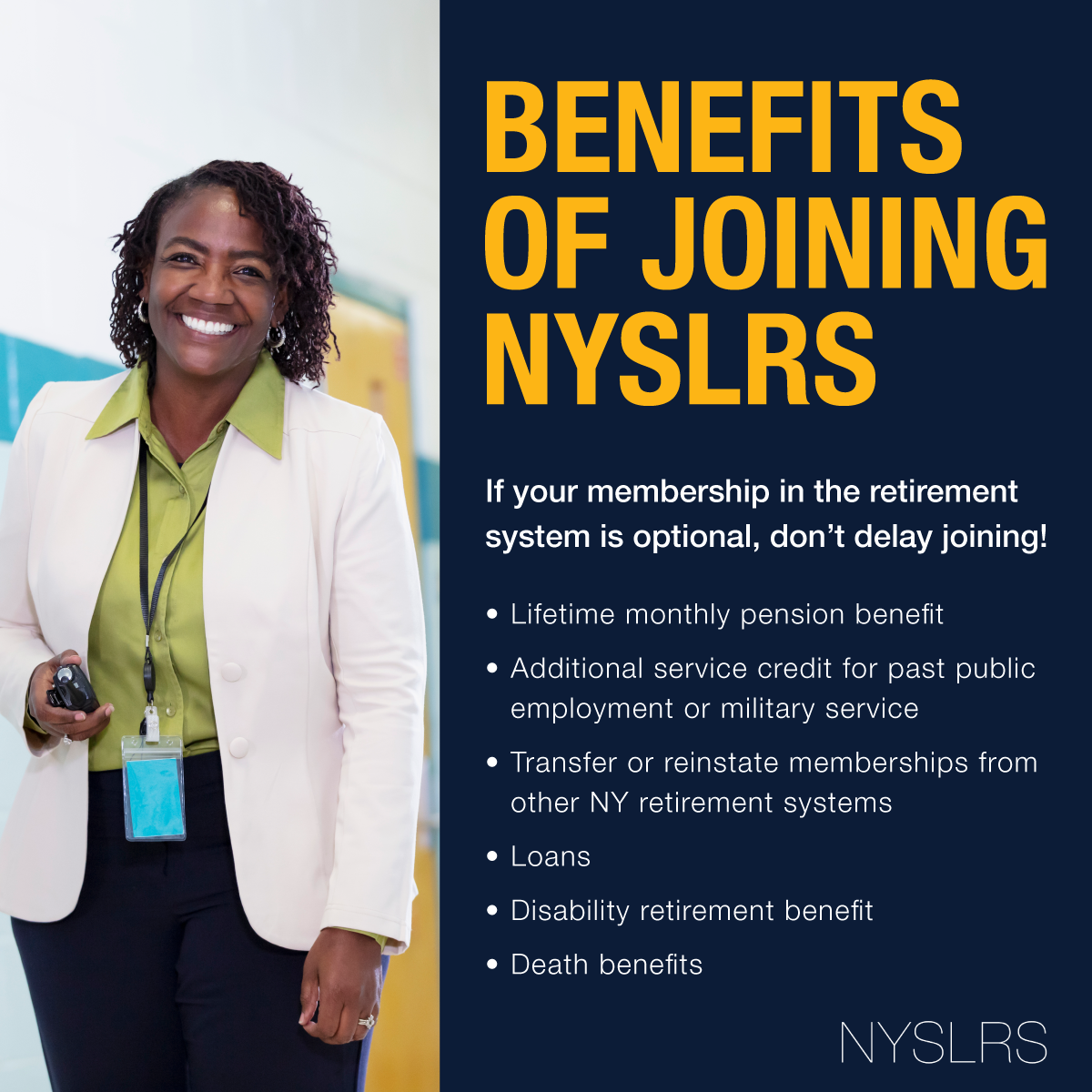
Most State and municipal employees are required to join the New York State and Local Retirement System (NYSLRS) when they are hired. But for some employees, membership is optional, meaning you are not automatically enrolled. To join NYSLRS, you must submit a membership application to your employer, who will then enroll you in NYSLRS. It’s important to understand the valuable benefits of NYSLRS membership and why you should join as soon as possible.
join NYSLRS

Whose Membership is Optional or Mandatory

Membership is optional if:

  • You work less than 12 months per year, including 10-month school employees working full-time;
  • You work less than 30 hours per week or less than the number of hours for full-time employment, as established by your employer for your position;
  • You are in a temporary or provisional position (under Civil Service Law); or
  • Your annual compensation is less than New York State’s minimum wage multiplied by 2,000 hours.

Membership is mandatory if:

  • You are in a permanent, full-time, 12-month position of an employer who participates in NYSLRS; and
  • You are in a full- or part-time position covered by the Police and Fire Retirement System (PFRS), such as police officers and firefighters.

If you aren’t sure whether you’re a member, your employer should be able to let you know. Contact us if you have questions.

Benefits of Joining NYSLRS

NYSLRS is one of the largest retirement systems in the world, administering benefits for more than 1.2 million members, retirees and beneficiaries.

If you aren’t sure whether to join NYSLRS, here are the advantages:

  • Your NYSLRS pension is a defined benefit plan. When you retire, you will receive a monthly pension payment for the rest of your life. Once you reach retirement age, you can retire with as few as five years of service credit (part-time service is pro-rated).
  • You can request additional service credit for your public employment before joining NYSLRS or if you served in the U.S. Armed Forces and received an honorable discharge from active military duty.
  • You can transfer service if you are still a member of another public retirement system in New York State.
  • You can reinstate service if you withdrew your membership in NYSLRS or another public retirement system in New York State.
  • You can take a loan against your retirement contributions once you meet eligibility requirements.
  • NYSLRS retirement plans provide death and disability retirement benefits.

Nearly 3,000 employers participate in NYSLRS, allowing you to continue your membership if you take a job at another New York State public employer. And if you decide to leave public employment before you have ten years of service credit, you can withdraw your contributions plus interest or roll over your contributions into another retirement savings plan.

NYSLRS Membership Basics

Once you join and become a NYSLRS member:

Don’t Delay Joining

It’s important to join NYSLRS at the start of your employment. If you don’t join right away, you can purchase service credit for your public employment from before you became a member, but it will cost more—6% of your earnings plus interest rather than contributing a percentage based on your earnings. Also, while you can request previous service credit and pay for the cost at any time, you must earn two years of service credit as a NYSLRS member before your purchased service can be credited.

Get Credit for All Your Public Service

Because service credit is a major factor in calculating your pension benefit, it’s important to make sure you get credit for all your public service. Once you join NYSLRS, you should request any additional service as early in your career as possible.

  • NYSLRS will need time to request records from your previous employer or retirement system.
  • The sooner you purchase your credit, the less it will generally cost.
  • Requesting early gives you time to pay for additional service.

Your request will be reviewed to determine your eligibility. We will send you a letter with the amount of service credit you are eligible to receive if you choose to purchase it, the cost and payment options. There are certain situations where purchasing additional service credit will not increase your pension. For more information, read about whether should you purchase additional service credit.

Taxes and Your NYSLRS Loan

If you’re thinking about borrowing against your retirement contributions, it’s important to understand whether your NYSLRS loan will be subject to taxes before you apply. Once you submit a loan application and we issue a check, you cannot return an uncashed check, and the loan fee is nonrefundable.

Determining the Taxability of Your NYSLRS Loan

When you apply for a NYSLRS loan, all your existing NYSLRS loans and any loans against other retirement plans will be used in calculating the taxability of a new NYSLRS loan. If you participate in another retirement plan offered through your employer, you must disclose existing loans and the contribution balances for the following types of plans:

  • Deferred compensation plan (457)
  • Tax sheltered annuity plan (403-b)
  • Qualified annuity plan (403-a)
  • Qualified trust (401)

If You Have Existing NYSLRS Loans

If you have one or more NYSLRS loans and are considering another loan, you’ll have two options:

  1. Multiple loans. With multiple loans, you would take out a new loan in addition to your existing loan(s). Each loan would have separate 5-year terms and minimum payments. The minimum payments for all your loans would be combined into one total repayment amount, which would be higher than the minimum payment for a refinanced loan. However, your total minimum payment would decrease as you pay off each loan.
  2. Refinance your existing loan. With refinancing, your new loan would be consolidated with the balance of your existing loan(s) into a single loan for the entire amount. The total loan amount would be spread over a new 5-year term with one minimum payment, which would be lower than the total minimum payment for multiple loans. However, refinancing would increase how much of your loan is considered a taxable distribution, which would either subject the loan to federal taxes or significantly reduce the amount of the loan to avoid any tax implications.

Understanding the Impact on Your Taxes

While a NYSLRS loan is exempt from New York State and local income taxes, it may be subject to federal taxes. If your loan exceeds certain limits, the Internal Revenue Service (IRS) will consider all or part of it as a “deemed distribution from a qualified retirement plan.” In other words, you will have to claim all or part of your loan as taxable income when you file your taxes the next year.

NYSLRS is also required to withhold a percentage of the loan for federal taxes, which will reduce the amount you receive. The tax withholding depends on your citizenship, so the loan application asks if you are a U.S. citizen, resident alien or non-resident alien. However, the amount withheld may not cover the total amount you will owe the IRS. For example, if you take a taxable loan before you turn 59½, the IRS may charge an additional 10 percent tax penalty.

If you take a taxable loan, we’ll mail a 1099-R by January 31 of the following year to file with your taxes.

Remember: Even if a portion of your loan goes to the IRS, you’ll still have to repay the entire amount, plus interest, to NYSLRS.

We recommend that you speak to a tax advisor or a NYSLRS customer service representative before taking a taxable loan. For more information about taking a loan from NYSLRS, visit our Loans: Applying and Repaying page.

Ready to Apply for a NYSLRS Loan?

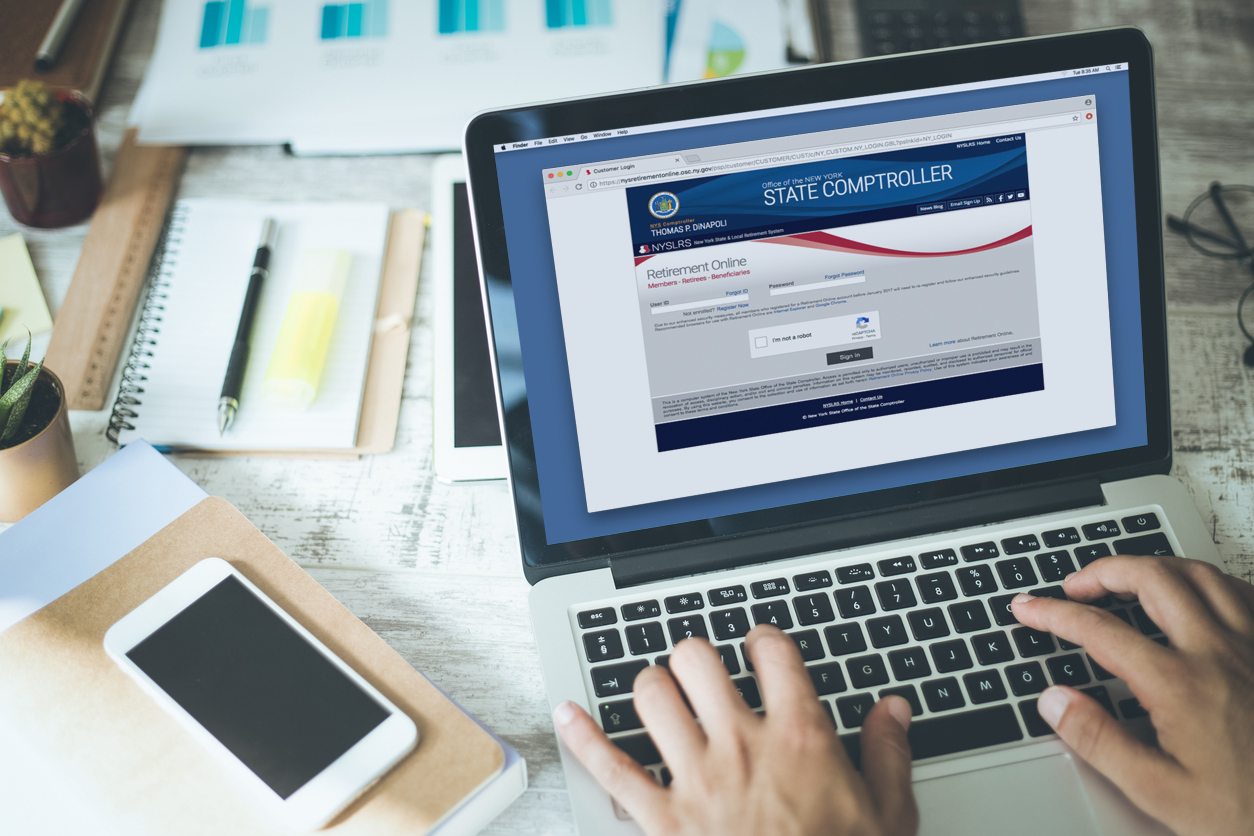
Taxes and Your NYSLRS LoanRetirement Online is the fastest and most convenient way to apply for a NYSLRS loan. When you use Retirement Online, NYSLRS receives your application immediately and can process your loan more quickly. Retirement Online will also let you know how much you can borrow, your repayment options and whether your loan is taxable.

If you don’t have an account or for help signing in to an existing account, check out our Retirement Online tools and tips for step-by-step instructions to register, reset your password, unlock your account and more.

Applying for a NYSLRS Loan in Retirement Online

If you are eligible to borrow against your retirement contributions, Retirement Online is the fastest and most convenient way to apply for a NYSLRS loan.

Eligibility is based on your tier. Generally, you’ll need to be on the payroll of a participating employer, have at least one year of service credit and have the required minimum contributions in your account. (Note: Retirees are not eligible for NYSLRS loans.)

Applying for a NYSLRS Loan in Retirement Online

Retirement Online is the Fastest Way to Apply

When you use Retirement Online, NYSLRS receives your application immediately and can process your loan more quickly.

To get started:

If you don’t have an account or for help signing in to an existing account, check out our Retirement Online tools and tips for step-by-step instructions to register, reset your password, unlock your account and more.

As you work your way through the online application, you’ll see:

  • How much you are eligible to borrow with or without tax implications;
  • The minimum repayment amount; and
  • The expected payoff date.

For Tier 3–6 members, there’s a service charge of $45, which is deducted from your loan check when it is issued.

The current interest rate, which is fixed for the term of your loan, is 5 percent.

NYSLRS loans are exempt from New York State and local income taxes. However, a NYSLRS loan would be subject to federal taxes if it exceeds certain limits. Retirement Online will show you the maximum you can borrow without tax implications.

If you apply for a loan and already have one or more existing loans, you’ll have two options:

  1. Multiple loans. With multiple loans, you would take out a new loan in addition to your existing loan(s). Each loan would have separate 5-year terms and minimum payments. The minimum payments for all your loans would be combined into one total repayment amount, which would be higher than the minimum payment for a refinanced loan. However, your total minimum payment would decrease as you pay off each loan.
  2. Refinance your existing loan. With refinancing, your new loan would be consolidated with the balance of your existing loan(s) into a single loan for the entire amount. The total loan amount would be spread over a new 5-year term with one minimum payment, which would be lower than the total minimum payment for multiple loans. However, refinancing would increase how much of your loan is considered a taxable distribution. To avoid any tax implications when refinancing, the amount of your new loan would be significantly less than taking out multiple loans.

When Will I Receive My Loan Check?

NYSLRS mails loan checks once a week. To check the status of your loan application:

If your case status is Closed before close of business on Wednesday, your check will be in the mail that Friday.

You will also receive a confirmation letter when your loan case is complete. In your Retirement Online account, click the Find Documents link to search for correspondence.

Repaying Your NYSLRS Loan

Loan payments are deducted from your paycheck. After you receive your loan check, you should review your pay stub to confirm that your employer has started payroll deductions and is deducting the correct repayment amount.

If you choose to repay the minimum amount, the payment may increase periodically to ensure you repay the loan within the required 5-year period.

You can increase your payroll deduction amount, make additional payments or pay your loan in full at any time with no prepayment penalties. Repaying your loan sooner will reduce the total amount of interest you’ll pay on the loan. 

Retirement Online is the fastest and most convenient way to manage your loan payments.

If you go off payroll, you must continue to make loan payments directly to NYSLRS and pay off your loan within the 5-year period. Otherwise, you will default on your loan. For more information, read our blog post about making loan payments if you leave public employment.

Retiring With an Outstanding NYSLRS Loan

If you retire with an outstanding loan, your pension will be permanently reduced. In most cases, you’ll need to report at least some portion of the loan balance as income to the Internal Revenue Service (IRS). If you retire before age 59½, the IRS may also charge an additional 10 percent penalty.

If you are close to retirement, use Retirement Online to check your loan balance and make sure you’re on track to repay your loan before you retire.

Note: Employees’ Retirement System (ERS) members can repay their loan after retiring. If you choose to pay back your loan after you retire, you must pay the full amount of the outstanding balance that was due when you retired in a single lump sum payment. Following full repayment, the reduction would be removed, and your pension benefit would increase going forward—the adjustment would not be retroactive to your date of retirement.

For More Information

For more information about NYSLRS loans, visit our Loans: Applying and Repaying page.

Divorce and Your Other NYSLRS Benefits—Part 2

divorce and your other nyslrs benefitsWe’ve written about how divorce may affect your pension. However, divorce can also impact your other retirement benefits.

If your ex-spouse will receive a share of your pension and other retirement benefits, NYSLRS must have an approved Domestic Relations Order (DRO) on file. A DRO is a court order specifying how benefits should be divided. It’s important to complete and file the DRO with NYSLRS well before your retirement date to avoid changes or delays in payments. Questions about the consequences of not filing a DRO on time should be addressed to an attorney.

Death Benefits and Your Beneficiaries

As of July 7, 2008, beneficiary designations for certain death benefits are automatically revoked when a divorce, annulment or judicial separation becomes final.

Ordinary Death Benefit

If you die in active service (before retiring), your beneficiaries may be entitled to an ordinary death benefit.

Accidental Death Benefit

If you die as a result of an on-the-job accident, an accidental death benefit may be payable to certain beneficiaries. The beneficiaries of this benefit are designated by law, and only those beneficiaries may receive this benefit—even if there is a DRO.

Post-Retirement Death Benefit

If you die after retiring, you may be covered by a post-retirement death benefit, which provides a one-time, lump sum payment to your beneficiaries.

Your Beneficiaries

If you are divorced, it is especially important to review your beneficiary designations to ensure your benefits will be distributed according to your wishes and your divorce agreement.  

If your ex-spouse is awarded a portion of your death benefits, a DRO will specify how much your ex-spouse will receive and direct you to name your ex-spouse as a beneficiary. You should update your beneficiaries and choose additional beneficiaries for the remainder of any benefits. However, if you do not update your beneficiary designations or if your beneficiary designations conflict with the terms of the DRO, the DRO will take precedence.

Retirement Online is the fastest and most convenient way to view and update your beneficiaries.

For more information about death benefit beneficiaries, read our blog post—Your Death Benefit Beneficiaries. Or, if you are retired or planning to retire soon, read Can You Change Your Beneficiary After You Retire?

Loans

Eligible NYSLRS members may take out a NYLSRS loan against their retirement contributions. However, even if you are eligible, a DRO may be written to prohibit you from taking future loans.

If you retire with an outstanding loan balance, your pension will be reduced. The ex-spouse’s share of the pension will also be reduced unless the DRO specifically states the ex-spouse’s share should be calculated without reference to outstanding loans.

Contribution Refunds

Occasionally, NYSLRS may refund a member’s contributions because of a tier reinstatement, membership withdrawal or membership transfer. Some members are eligible to make voluntary contributions and withdraw them as excess contributions. Generally, if a DRO doesn’t mention a contribution refund, the member will receive the full amount.

For More Divorce Information

Visit our Divorce and Your Benefits page for more information, including how divorce can affect your service credit, disability benefits or annual cost-of-living adjustment.

Debt and Retirement

If you’re planning to retire soon, it’s a good idea to take inventory of any debt you owe. Paying down your debt can give you flexibility to enjoy the type of retirement you want.

NYSLRS Loan Debt

If you have an outstanding NYSLRS loan balance when you retire, it will reduce your pension. The amount of the reduction is based on:

  • Your retirement system—Employees’ Retirement System (ERS) or Police and Fire Retirement System (PFRS);
  • Your tier;
  • Your age at retirement; and
  • Whether you retire with a service retirement benefit or a disability retirement benefit.
Debt and Retirement: How a NYSLRS Loan Balance Could Affect Your Pension

It is important to understand:

  • The reduction does not go toward repaying the outstanding loan balance—it’s a permanent reduction to your pension.
  • At least part of the loan balance at retirement will be subject to federal income taxes.

When you apply for retirement in Retirement Online and have an outstanding NYSLRS loan balance, the system will provide a specific pension reduction amount for you. The loan applications on our Forms page also list general pension reduction information.

If you are close to retirement, be sure to check your loan balance. If it looks like you won’t repay your loan before you retire, you can increase your loan payments, make additional lump sum payments or both (see the Change Your Payroll Deductions or Make Lump Sum Payments section of our Loans: Applying and Repaying page).

ERS members may repay a loan after retiring. They must pay the full balance that was due at retirement in a single lump sum payment. Once they repay the loan, their pension will increase to the amount it would have been without the loan reduction. It will not increase retroactively back to the date of retirement.

Other Debt to Check

Credit Cards

Another priority should be paying off credit cards before retirement. Credit card statements include a warning telling you how long it will take—and how much it will cost—to pay off your balance making only minimum payments.

If you have more than one credit card balance, many financial advisors recommend paying as much as you can on the card with the highest interest rate, while still making at least the minimum payments on your lower-interest cards. Once you’ve paid off your highest-interest card, focus on the one with the next-highest rate, and so on. Other advisors say it might be better to pay off the card with the smallest balance first. The idea there is to gain a sense of accomplishment, and make the process seem less daunting.

Mortgages

Advice varies on whether you should try to pay off your mortgage before you retire. It would eliminate a major expenditure and let you spend your retirement income on other things. On the other hand, if your mortgage interest rate is relatively low, you may want to focus on paying off other high-interest debt or boosting your retirement savings. What works best for you will depend on your situation.

Top Five Pre-Retirement Goals for NYSLRS Members in 2018

January is a great time to set goals for the coming year. And setting pre-retirement goals is crucial in planning for a successful retirement. Here are five goals to consider for 2018:

Plan ahead for retirement

1. Choose a sensible savings plan that works for you.There are several ways to save for retirement, including starting a deferred compensation plan like the New York State Deferred Compensation Plan. An important part of developing a savings plan is to start early. The sooner you start saving, the more time your money has to grow. Check out our Weekly Investment Plan chart to see how a weekly investment can grow by age 65.

2. Track your expenses and income. Tracking your current expenses for a month or two will give you a better idea of how much you’re likely to spend in retirement and how much you’ll need to supplement your pension. Use the expense and income worksheets on our website to create a retirement budget. Be sure to include periodic expenses, such as car insurance and property taxes.

3. Request a pension estimate. If you’re within 18 months of your anticipated retirement date, it’s a good idea to request an estimate of what your retirement benefit will be. You can do this by sending us an email using our secure contact form or by calling 1-866-805-0990 (518-474-7736 in the Albany, NY area). If you are not certain that you’ve received credit for all your public service in New York State, you can submit a Request for Estimate form (RS6030) and be sure to provide detailed information about your public employment in section eight of the form. If your planned retirement date is farther away, you may want to use our online Benefit Calculator. This estimates your pension based on information you provide, so have your Member Annual Statement handy before you start, or sign in to your Retirement Online account to check your current service credit.

4. Pay off any NYSLRS loans. An outstanding loan balance at retirement will permanently reduce your NYSLRS retirement benefit. You cannot make loan payments after you retire, and the pension reduction does not go away after we recover the balance of the loan. Visit the Loans page on our website for information about making additional payments or increasing your loan payment amount.

5. Consider seeking the advice of a financial planner. Financial planners don’t manage your money, but can help you assess your present financial condition and develop a practical plan to meet your specific goals and needs. Also consider doing your own research by seeking Do-It-Yourself financial planning guides on the web.

If you ever have any retirement-related questions, please contact us.