Category Archives: Members

News for members of the New York State & Local Retirement System

Retirement Myths—Part 2

Sometimes a small misunderstanding can have a big impact on your retirement benefits. Here are the facts you should know behind five more retirement myths.

Retirement Myths vs Facts


myth

I don’t need to update my contact information with NYSLRS because my employer already has it.

fact

Your employer does not provide updated member contact information to NYSLRS. You must update your contact information with both your employer and NYSLRS. Retirement Online is the fastest way to review the mailing address, phone number and email we have on file for you and update them, if needed.


myth

I have to wait until I’m close to retirement to estimate my pension benefit.

fact

Understanding your pension and finding out how much you can expect to receive is an important part of retirement planning. Even if you are years away from retiring, you can estimate your pension in minutes using Retirement Online. You can enter the percentage your earnings will increase each year and additional service credit if you plan to purchase service credit for a previous membership, prior employment or military service.

Note: Some members may not be able to estimate their pension using Retirement Online—for example, members who recently transferred to NYSLRS and some Police and Fire Retirement System (PFRS) members. If you receive a notification that the system cannot generate your estimate, you can request an estimate using our secure contact form (select Estimates from the Topic dropdown).


myth

If I retire with an outstanding loan, my pension payment will be reduced but only until the loan is paid off.

fact

If you retire with an outstanding loan, your pension will be permanently reduced. We do not apply the amount of the reduction toward the outstanding balance. Also, all or part of your outstanding loan balance may be subject to federal income tax. If you retire before age 59½, the IRS may charge an additional 10 percent penalty.

Note: Employees’ Retirement System (ERS) members can repay their NYSLRS loan after they retire. However, you need to pay the full balance of the loan in a one-time lump sum payment. Your pension would then be recalculated to increase your monthly payment going forward, but it would not be retroactive to your date of retirement.


myth

I have to complete a bunch of paper forms and get them notarized to file for retirement and begin receiving my pension.

fact

You can apply for retirement in Retirement Online. It’s faster and more convenient than printing and mailing forms, and there’s nothing to have notarized. And, when you apply online, you can also make changes up to your date of retirement—for example, if you need to change your banking or tax information. Watch our video for more information.


myth

I can change my pension beneficiary after I retire.

fact

That depends. If you choose the Single Life Allowance option, monthly pension payments will stop upon your death and there will be no continuing payments to a beneficiary, even if you die soon after retiring. If you choose a pension payment option that provides a lifetime benefit for a single beneficiary, you cannot change your beneficiary even if they die before you do. However, if you choose a pension payment option that provides a limited benefit (for a certain period of time after retirement), you can change your beneficiary after you retire.

Note: Most retirement plans also provide a post-retirement death benefit, which is a one-time lump sum payment to your beneficiaries. You can change your beneficiaries for this benefit any time.


Use Retirement Online

Retirement Online is the fastest and most convenient way to access your retirement account information and conduct business with NYSLRS. If you don’t have an account or for help signing in to an existing account, check out our Retirement Online tools and tips for step-by-step instructions to register, reset your password, unlock your account and more.


For More Information

Check out Retirement Myths—Part 1 where we debunk five other retirement myths. You can also find answers to the most common questions we receive from members and retirees on our Contact NYSLRS page.

Retirement Myths—Part 1

The laws governing your NYSLRS retirement benefits can be confusing. Sometimes a small misunderstanding can have a big impact. So, let’s get prepared to make decisions based on facts, not common retirement myths.

Retirement Myths vs Facts


myth

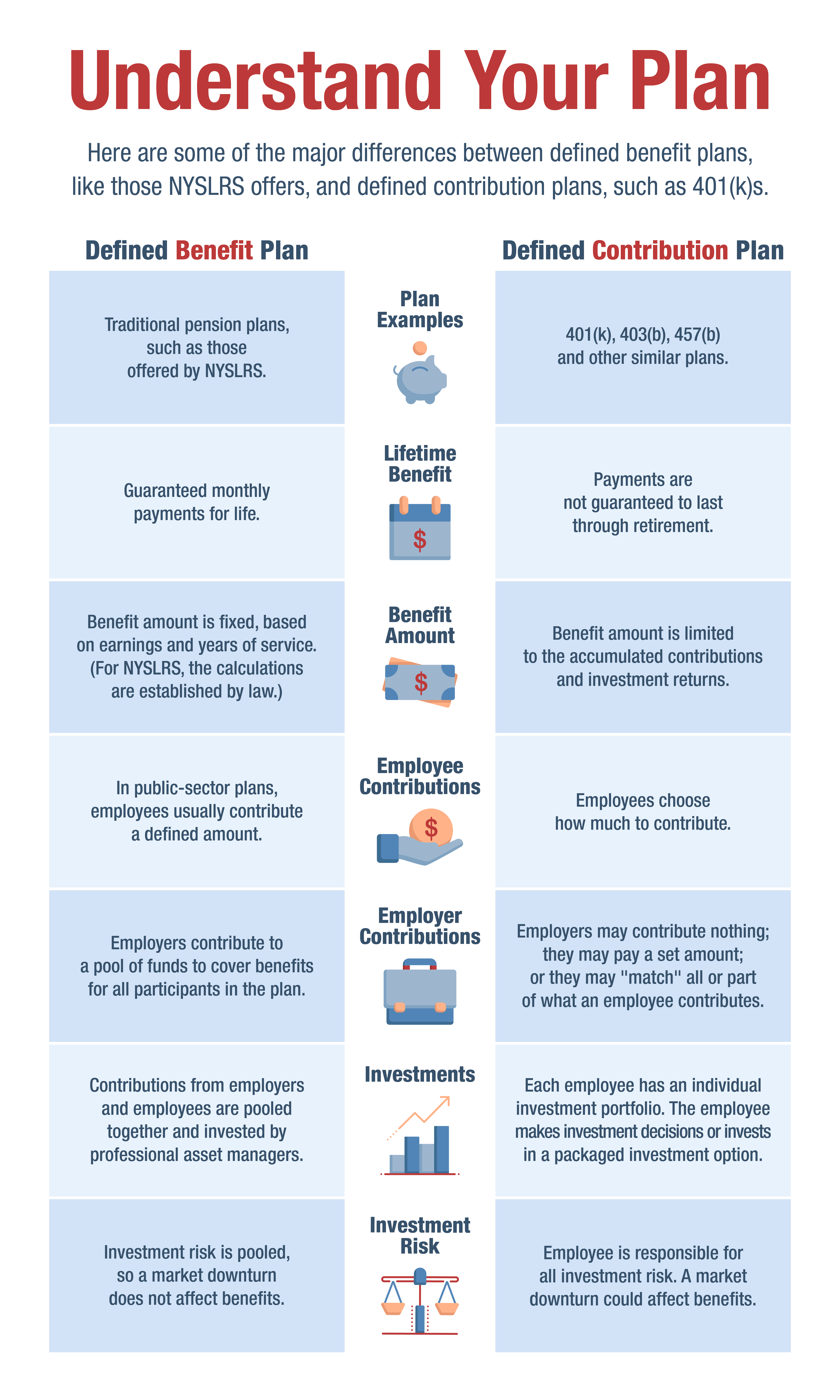
My NYSLRS pension is like a 401(k)-style retirement savings account, and I will get my contributions back when I retire.

fact

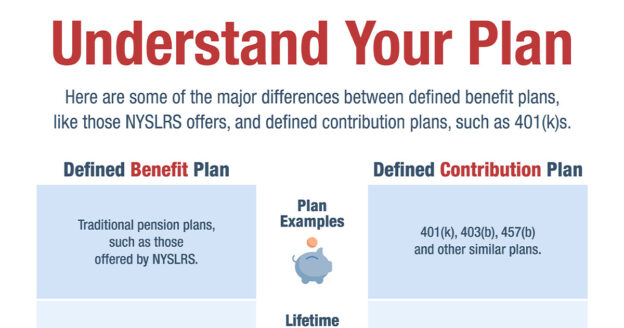
Your NYSLRS pension is a defined benefit plan, also known as a traditional pension plan. When you retire, you will receive a monthly pension payment for the rest of your life. Your pension will be calculated using a preset formula based on your earnings and years of service—it will not be based on the individual contributions you paid into the system.


myth

If I work for more than one NYSLRS participating employer at the same time, the service credit from both jobs will count toward my pension benefit.

fact

You can only earn one year of service credit in a 12-month period. If you work part-time for two participating employers, you would receive service credit from both, up to the maximum of one year. However, if you work full-time for one NYSLRS employer and part-time for another, you would only receive one year of service credit.

For full-time employees of a school district, you receive one year of service credit per school year, even if you only work 10 months of the year. So, you won’t receive additional service credit for working over the summer.


myth

NYSLRS administers health insurance coverage for its retirees.

fact

NYSLRS does not administer health insurance programs. We may deduct premiums from a retiree’s monthly pension benefit to pay for health insurance coverage if their former employer instructs us to do so, but we can’t answer questions about coverage or changes in premium amounts.

If you are planning to retire soon, your employer’s human resources or personnel office should be able to answer your questions about post-retirement health insurance coverage. If you retired from a New York State agency, the New York State Department of Civil Service administers the New York State Health Insurance Program (NYSHIP). If you retired from a county, city, town, village or school district, contact your former employer.


myth

I can take out a NYSLRS loan after I retire.

fact

To be eligible for a NYSLRS loan, you must be a NYSLRS member and actively working for a NYSLRS participating employer. Once you retire, you cannot take out a NYSLRS loan.


myth

NYSLRS will automatically start paying my pension as soon as I’m eligible.

fact

Your pension is not automatic. To begin collecting your pension, you must meet the minimum age or service requirements established by your retirement plan and apply for retirement 15 to 90 days before your chosen date of retirement.


Use Retirement Online

Retirement Online is the fastest and most convenient way to access your retirement account information and conduct business with NYSLRS. If you don’t have an account or for help signing in to an existing account, check out our Retirement Online tools and tips for step-by-step instructions to register, reset your password, unlock your account and more.


For More Information

Check out Retirement Myths—Part 2 where we debunk five other retirement myths. You can also find answers to the most common questions we receive from members and retirees on our Contact NYSLRS page.

10 Things Members Should Know

NYSLRS is one of the largest retirement systems in the world, administering benefits for more than 1.2 million members, retirees and beneficiaries. Take a look inside NYSLRS and brush up on your NYSLRS knowledge—here are 10 things members should know.

Retired? Check out 10 Things Retirees Should Know.

1. Retirement Online is the Fastest, Most Convenient Way to Do Business With NYSLRS

10 Things Members Should Know Retirement Online is the fastest way to manage your NYSLRS account. Skip printing forms, having them notarized and sending them through the mail. When you submit your requests through Retirement Online, NYSLRS has them immediately, and your changes will be completed more quickly. It’s convenient and secure. Check out what members can do in Retirement Online.

If you don’t have an account or for help signing in to an existing account, check out our Retirement Online tools and tips for step-by-step instructions to register, reset your password, unlock your account and more.

2. Your Pension is a Lifetime Benefit—And Your Pension Benefits are Secure

NYSLRS pensions are defined benefit plans, also known as traditional pension plans. When you retire, you will receive a monthly pension payment for the rest of your life. Your pension will be calculated using a preset formula based on your earnings and years of service—it will not be based on the individual contributions you paid into the system. Member contributions support the benefits earned by current and future retirees and are an important asset of the Common Retirement Fund, which holds and invests the money used to pay NYSLRS benefits. The Fund is widely recognized as one of the best-funded and best-managed public pension plans in the nation. Comptroller Thomas P. DiNapoli is administrator of NYSLRS and trustee of the Common Retirement Fund.

3. ‘Go Green’ and Get Your Important Documents Sooner

You can help us ‘go green’ and reduce paper waste by choosing email as your delivery preference for correspondence and other important documents, such as your Member Annual Statement. When you have something to view, we’ll send an email notifying you to sign in to Retirement Online. And it will save time—you’ll get access to your important documents sooner than printed copies are mailed. Learn how to get email notifications for important documents.

4. Your Tier Determines Your Benefits

Your tier, which is based on your date of membership, determines your benefits, such as eligibility for death benefits or taking a NYSLRS loan and the formula used in the calculation of your benefits.

5. Vested Means You Qualify for a Retirement Benefit

Becoming vested is a crucial milestone for NYSLRS members. It means you have earned enough service to qualify for a retirement benefit once you meet the minimum age or service requirements established by your retirement plan. All members who have at least five years of service credit are vested.

6. Review Your Beneficiaries Periodically

NYSLRS retirement plans provide death benefits for beneficiaries of eligible members who die before retiring. It’s a good idea to review your beneficiaries from time to time to make sure they reflect your current wishes. The beneficiary you named before might not be the one you would choose today. You should also review the contact information for your named beneficiaries so we can find them when needed.

7. Request Additional Service Credit as Early in Your Career as Possible

Service credit is a major factor in calculating your pension benefit. You earn a year of service credit for each year of full-time employment with a participating employer. You may also be able to request additional credit if you worked for your current or another public employer before joining NYSLRS or if you served in the U.S. Armed Forces and received an honorable discharge from active military duty. You must submit your request before retirement, and you should do it as early in your career as possible.

8. Estimate Your Pension

Finding out how much you can expect to receive is an important part of retirement planning. Most members can estimate their pension using Retirement Online in just a few quick and easy steps. Retirement Online uses your current earnings and service information to calculate your estimate, including your final average earnings (FAE) and the amounts for the pension payment options available to you. You can fine-tune your estimate or see how different choices would affect your benefit by entering different retirement dates or a beneficiary’s date of birth.

9. Supplement Your Pension with Retirement Savings

Think of retirement security as a three-legged stool. Each leg is a source of income to help support you when your working days are done. It’s important to understand all your potential sources of income to effectively plan for the future and boost your retirement confidence. Your pension can provide a significant part of your retirement income, but it’s a good idea to supplement your pension with retirement savings and start saving early so your money has time to grow.

10. Your Retirement Plan Publication is an Essential Resource

Your retirement plan publication is an essential resource that explains your NYSLRS benefits in detail—how long you’ll need to work to receive a pension, how your benefit is determined, what death and disability retirement benefits may be available, and more. You should consult it throughout your career, but it’s especially important to read as you prepare for retirement.

Compounding: Use Time to Grow Your Money More

Financial security doesn’t just happen; it takes planning and time. You know you can count on your NYSLRS pension in retirement. But, if you want to improve your chances of a financially secure retirement, your plan should include retirement savings. It’s important to start saving early so your money has time to grow.

When you invest your savings in an individual retirement account (IRA) or a 401(k)-style retirement savings plan, you earn a return on your investment, and those returns are compounded. That means your money increases in value by earning returns on both the original amount and your accumulated profits. This is different than earning simple interest. Let’s see how they both work.

How Simple Interest Works

In banking, simple interest is a certain percentage you are paid on the money you put into your account. With simple interest, the amount of interest you earn is based on the original (or principal) amount of the deposit.

Let’s say you open a certificate of deposit (CD), which pays 5 percent simple interest if you agree to keep your money in the CD for a year. If you deposit $1,000 in January, you’ll have $1,050 at the end of the year. That’s $50 more than you started with, so you might decide to keep your money there for another year. With simple interest, the interest you earn the second year and every year after would still be based on the principal amount of $1,000—no compounding.

How Compounding Works

With compounding, your initial investment is reinvested along with your earnings. If you earn the same 5 percent, with compounding, it’s applied to the full balance of your account. So, you would still have that $1,050 at the end of the first year, but by the end of the second year you’d have $1,102.50 in your account instead of $1,100.

In this example, that’s just a difference of $2.50, but, over time, compounding can mean a difference of hundreds or thousands of dollars.

The Power of Compounding

If you’re already building retirement savings, think about giving your savings a boost. If you haven’t started saving yet, right now is the best time to start. The New York State Deferred Compensation Plan (NYSDCP) is available to New York State employees and some municipal employees. Once you’ve signed up, your retirement savings—which may be tax-deferred depending on the plan you choose—will be automatically deducted from your paycheck. Remember, the sooner you start saving, the more time your money has to grow.

The 3-Legged Stool Approach to Retirement Confidence

Your NYSLRS pension is a good reason to be optimistic about your finances in retirement. Once you retire, your pension will provide monthly payments for the rest of your life. But there is more to a financially secure retirement than having a pension.

Think of retirement security as a three-legged stool. Each leg is a source of income to help support you when your working days are done. It’s important to understand all your potential sources of income to effectively plan for the future and boost your retirement confidence.

Leg 1: Your NYSLRS Pension

The 3-Legged Stool Approach to Retirement Confidence NYSLRS pensions are defined benefit plans, also known as traditional pension plans. When you retire, you will receive a monthly pension payment for the rest of your life. Your pension will be calculated using a preset formula based on your earnings and years of service—it will not be based on the individual contributions you paid into the system. Unlike workers who rely on 401(k)-style retirement plans, you won’t have to worry about this income running out.

Most members can estimate their pension in Retirement Online. But, if you’re a long way from retirement, it may be better to think in terms of earnings replacement. Financial advisers estimate you’ll need to replace 70 to 80 percent of your income to retire with confidence. Your pension can help get you there. For example, if you retire with 30 years of service, your NYSLRS pension could replace more than half of your earnings. (Pension benefits depend on your tier and retirement plan. Find your retirement plan publication for comprehensive information about your retirement benefits and how your pension will be calculated.)

Leg 2: Social Security

Your Social Security benefit is another source of income to help support you in retirement. At Social Security’s full retirement age, your benefit can replace from about 75 percent for lower income earners to about 27 percent for higher income earners. Learn more about Social Security benefits and visit the Social Security’s Plan for Retirement page to estimate your income.

Leg 3: Retirement Savings Can Boost Your Confidence

A lifetime pension and Social Security income will be substantial financial assets, but it’s still important to save for retirement. Healthy retirement savings will give you more flexibility to do the things you want to do in retirement. It can also help in case of an emergency and act as a hedge against inflation.

Your personal savings is the factor you have the most control over. You decide when to start, how much to save and how to invest your money. The key is to start saving early so your money has time to grow, even if you can only afford to save a small amount in the beginning.

Eligible employees might consider saving with the New York State Deferred Compensation Plan (NYSDCP). Money gets deducted from your paycheck, so you won’t even have to think about it. NYSDCP is not affiliated with NYSLRS, but New York State employees and some municipal employees can participate. If you’re a municipal employee, ask your employer whether you’re eligible for NYSDCP or another retirement savings plan.

Financial Literacy and Retirement

April is National Financial Literacy Month, a time dedicated to helping people make informed financial decisions and manage money effectively. Financial literacy means understanding and applying various skills of personal finance management, including budgeting, planning, saving and investing.

Financial literacy is essential for effective retirement planning. When you understand your NYSLRS benefits, your other sources of retirement income and your current financial situation, you’ll be in a better position to plan for retirement.

Key Components for Financial Literacy

Components of Financial Literacy

Assessing Finances and Budgeting

Whatever your goals, wherever you are in life, a clear-eyed assessment of your finances and effective budgeting are necessary. The 50/30/20 budget rule is one framework that can help you with both. It’s a popular way to start and stick to a budget that can work whether you’re just out of school looking at your first paycheck or retired and trying to make your savings last.

Divide Your Expenses

The idea is to divide your expenses into three categories: needs, wants and savings.

Needs are things you have to pay and can’t avoid—for example, housing costs, food, healthcare, childcare and utilities.

Wants are optional expenses. They may be fun or convenient, but they aren’t essential—for example, dining out, shopping, entertainment and vacations.

Savings & Managing Debt can help you grow your retirement assets (see more under Retirement Planning and Saving and Investing below) or build an emergency fund. This category also includes paying down debt—such as student loans or credit card balances—beyond minimum payments.

Budget Your Spending

Then, you allocate your after-tax income, with 50 percent going to needs, 30 percent to wants and 20 percent to savings. As you budget, make sure you include expenses that occur periodically, such as car and life insurance, and property and school taxes.

For more information, read The 50/30/20 Budget Rule Explained With Examples. If you decide to employ the rule, you can use a 50/30/20 budget calculator.

Managing Debt

Managing debt is an important aspect of financial literacy. Throughout your life, you’ll need to maintain good credit, borrow responsibly and repay your debt diligently.

Credit Scores

Your credit score is a three-digit number used by lenders to judge how likely you are to pay back money you’re loaned. It’s based on your past payment history and other interactions with lenders. These three digits affect you more than you might realize.

According to the Consumer Financial Protection Bureau (CFPB), “Companies use credit scores to make decisions on whether to offer you a mortgage, credit card, auto loan, and other credit products, as well as for tenant screening and insurance. They are also used to determine the interest rate and credit limit you receive.”

Even if you’re doing everything right, misinformation in the files of credit rating companies can hurt your credit. So, check your credits scores regularly. You can do it online at AnnualCreditReport, the free-credit-report site authorized by the federal government and maintained by the three major credit reporting agencies.

Responsible Borrowing

The best way to maintain your credit score is to borrow responsibly and manage debt effectively. That means:

  • Pay your bills on time; pay more than the minimum payments if you can.
  • Avoid using all or most of your available credit.
  • Keep longstanding credit lines open (like a credit card you’ve had for many years).
  • Avoid accumulating excessive debt—especially opening several lines of credit in a short amount of time.

Pay Down Your Debt

It’s a good idea to take inventory of any debt you owe and have a plan for paying it off.

If you have more than one credit card balance, many financial advisors recommend paying as much as you can on the card with the highest interest rate, while still making at least the minimum payments on your lower-interest cards.

Debt is not necessarily bad, but if you’re planning to retire soon, paying it down can give you more flexibility to enjoy the type of retirement you want.

Retirement Planning

Retirement is a big step. In many ways, confidence in a comfortable retirement is the reason saving and building financial literacy throughout our lives is so important.

Understand Your Sources of Income in Retirement

As a NYSLRS member, you are enrolled in something increasingly rare these days: a defined benefit plan. If you are vested and retire from NYSLRS, you will receive a monthly pension payment for the rest of your life based on your years of service and earnings. 

However, your pension is just one of three main sources of income in retirement. Think of retirement security as a three-legged stool. Each leg is a source of income, and you need all three for a stable retirement.

  1. Your NYSLRS pension is a guaranteed lifetime benefit. Find your retirement plan publication for comprehensive information about your pension and the other benefits you are entitled to receive.
    Most NYSLRS members can estimate their pension benefit in minutes using Retirement Online. Your estimate will be based on the most up-to-date account information we have on file for you. You can enter different retirement dates and beneficiaries to see how those choices would affect your benefit.
  2. Your Social Security benefit is another source of income to help support you in retirement. At Social Security’s full retirement age, your benefit can replace a significant portion of your pre-retirement income, depending on how much you earned while working. You can estimate your benefit on the Social Security Administration website.
  3. In addition to your NYSLRS and Social Security benefits, retirement savings can be an important financial asset when you retire. Savings can give you flexibility to travel, continue your education, pursue a hobby or start a business. It can be a resource in case of an emergency, act as a hedge against inflation and boost your retirement confidence.

Determine How Much You’ll Need in Retirement

Many financial experts cite a common rule of thumb when discussing income in retirement. They say you need 70 to 80 percent of your pre-retirement income to maintain your standard of living once you retire. This is meant to account for the range of expenses you’ll no longer have in retirement, such as payroll taxes, commuting costs or saving for retirement.

Use our Monthly Income & Expenses Worksheets to help you track your current spending habits and project your future needs. Remember to account for non-monthly expenses, such as car insurance, property taxes and school taxes.

Saving and Investing

If you aren’t saving already, right now is the best time to start. If your retirement is a long way off, that means you’ll have more time for your savings to grow. But even if you’re close to retirement, it is never too late to start saving.

If you’re already building your retirement savings, think about giving your savings a boost. Even a small increase could make a big difference over time.

For New York State employees and many other NYSLRS members, there’s an easy way to get started. If you work for a participating employer, you can join the New York State Deferred Compensation Plan. If you don’t work for New York State, check with your employer to see if you are eligible. If you are not eligible, your employer may be able to direct you to an alternative retirement savings program.

Estimate Your Pension in Retirement Online

Most NYSLRS members can create their own pension estimates in minutes using Retirement Online. Your estimate will be based on the most up-to-date account information we have on file for you. You can enter different retirement dates and beneficiaries to see how those choices would affect your benefit. When you’re done, print your pension estimate or save it for future reference.

Estimate Your Pension in Retirement Online

How to Create a Pension Estimate

To get started:

  • Sign in to Retirement Online.
  • Look under My Account Summary.
  • Click Estimate My Pension Benefit button.
  • Enter Retirement Date or Your Age at Retirement.

You can fine tune your estimate with:

If you enter your beneficiary’s birthdate, you’ll see the estimated monthly amounts for the pension payment options that provide a lifetime benefit for a single beneficiary and the pension payment options that provide a limited benefit for multiple beneficiaries.

Remember, the amounts are estimates, not a guarantee of what you’ll receive when you retire.

Most Tier 2 through 6 members (more than 90 percent of all NYSLRS members) can use the Retirement Online pension calculator. However, some members may not be able to—for example, members who recently transferred to NYSLRS and some PFRS members. The system will let you know if your estimate cannot be completed. In that case, please send us a message using our secure contact form (select Estimates from the Topic dropdown).

Do More With Retirement Online

In Retirement Online, you can view your account details—date of membership, tier, retirement plan, estimated total service credit and more. Check out what else members can do in Retirement Online.

If you don’t have an account, learn more about Retirement Online and click Register Now. If you need help with Retirement Online, read our Retirement Online Tools and Tips blog post.

Your Death Benefit Beneficiaries

NYSLRS retirement plans provide death benefits for beneficiaries of eligible members who die before retiring.

It’s important to name beneficiaries and review them periodically. Life circumstances change and a beneficiary you named before might not be one you would choose today. For instance, you may have a new partner or you may have children now. And NYSLRS can only pay a death benefit to the beneficiaries you’ve named.

If you are retired or planning to retire soon, read our blog post, Can You Change Your Beneficiary After You Retire?

2 Types of Beneficiaries

  • Your primary beneficiary will receive your death benefit. You can list more than one primary beneficiary. If you do, they will share the benefit equally. Or, you can choose different percentages for each beneficiary, which must total 100 percent. (Example: John Doe, 50 percent; Jane Doe, 25 percent; and Mary Doe, 25 percent.)
  • contingent beneficiary will only receive a benefit if all your primary beneficiaries die before you do. If you list multiple contingent beneficiaries, they will share the benefit equally unless you choose different percentages.

Special Beneficiary Designations

Your beneficiary doesn’t have to be a person. You can name your estate, a trust or a charity as your beneficiary.

Special Designations for Your NYSLRS Death Benefit Beneficiaries
  • Estate. When you die, your estate is the money and property you owned. Your death benefit will be given to the executor of your estate to be distributed according to the terms of your will. You can name your estate as the primary or contingent beneficiary of your death benefit. If you name your estate as the primary beneficiary, do not name a contingent beneficiary.
  • Trust. You can name a trust as a primary or contingent beneficiary if you have a trust agreement or provided for a trust in your will. The trust itself would be your beneficiary, not the individuals for whom you established the trust. (Speak with your attorney if you’re thinking about making your trust a beneficiary.)
  • Entity. You can also name any charitable, civic, religious, educational or health-related organization as a beneficiary.
  • Minor children. If your beneficiary is under the age of 18 at the time of your death, your benefit will be paid to the child’s court-appointed guardian. You may instead choose a custodian to receive the benefit on the child’s behalf under the Uniform Transfers to Minors Act (UTMA). Custodians can be designated in Retirement Online, or you can contact us for more information and the appropriate form before making this type of designation.

For more information, read our publication, Life Changes: Why Should I Designate a Beneficiary?

Keep Your Beneficiaries Up to Date with Retirement Online

You can change your beneficiaries at any time. In addition to adding or removing them to reflect your current wishes, you should review the contact information for your named beneficiaries so we can find them when needed.

The fastest way to view or update your beneficiaries is in Retirement Online.

Deferred Compensation: Another Source of Retirement Income

Many financial experts cite a common rule of thumb when discussing income in retirement. They say you need 70 to 80 percent of your pre-retirement income to maintain your standard of living once you retire. This is meant to account for the range of expenses you’ll no longer have in retirement, such as payroll taxes, commuting costs or saving for retirement. As a NYSLRS member, your plan for income in retirement likely includes your NYSLRS pension and Social Security benefits. However, for greater financial stability and flexibility, you may want to supplement with retirement savings. For example, you might start investing in a savings plan like the New York State Deferred Compensation Plan (NYSDCP).

Deferred Compensation: Another Source of Retirement Income

What is Deferred Compensation?

Deferred compensation plans are voluntary retirement savings plans like 401(k) or 403(b) plans—but designed and managed with public employees in mind. NYSDCP is the 457(b) plan created for New York State employees and employees of other participating public employers in New York.

Once you sign up for NYSDCP, you can build your own investment portfolio or invest in established investment funds. Your contributions can be automatically deducted from your paycheck, and you can contribute as little as 1 percent of your earnings.

Just like with other retirement savings plans, you have options for how you make your NYSDCP contributions. You might choose a tax-deferred account where you make contributions with pre-tax money. With this option, you won’t pay State or federal taxes on the earnings you contribute until you start making withdrawals. Your employer may also offer the option for a Roth account where you make contributions with after-tax money. With this option, you do pay taxes now, but you won’t pay taxes on the withdrawals you make in retirement. Learn more about how traditional retirement savings and Roth accounts compare.

If your employer is not an NYSDCP participating employer, check with your human resources or personnel office about other retirement savings options.

What Does Deferred Compensation Mean for Me?

Deferring income from your take-home pay may mean less money to spend in the short-term, but you’re planning ahead for your financial future.

You can enroll in a deferred compensation plan anytime—whether you’re close to retirement or you just started working. Usually, the sooner you start saving, the better prepared you’ll be for retirement.