Tag Archives: retirement security

National Retirement Security Month

National Retirement Security Month

October is National Retirement Security Month. It’s a time to consider the importance of saving and to think about potential sources of income in retirement. Financial security doesn’t just happen—it takes preparation and time. Even if retirement seems far off, it’s never too early to start planning.

National Retirement Security Month

NYSLRS and Retirement Security

Check out these blog posts to learn more about how your NYSLRS pension and other sources of retirement income can provide retirement security.

Your NYSLRS Pension—A Defined Benefit Plan

As a NYSLRS member, you are enrolled in a defined benefit plan, also known as a traditional pension plan. When you retire, you will receive a monthly pension payment for the rest of your life. Your pension will be calculated using a preset formula based on your earnings and years of service—it will not be based on the individual contributions you paid into the system.

The 3-Legged Stool Approach to Retirement Confidence

Your NYSLRS pension is a good reason to be optimistic about your finances in retirement. But there is more to a financially secure retirement than having a pension. Think of retirement security as a three-legged stool. Each leg is a source of income to help support you when your working days are done.

Compounding: Use Time to Grow Your Money More

If you want to improve your chances of a financially secure retirement, your plan should include retirement savings. It’s important to start saving early so your money has time to grow. When you invest your savings in an individual retirement account (IRA) or a 401(k)-style retirement savings plan, you earn a return on your investment, and those returns are compounded.

Deferred Compensation: Another Source of Retirement Income

For greater financial stability and flexibility, you may want to invest in a deferred compensation savings plan. The New York State Deferred compensation plans are voluntary retirement savings plans like a 401(k), created for New York State employees and employees of other participating public employers.

Debt and Retirement

As you get close to retirement, it’s a good idea to take inventory of any debt you owe. Paying down your debt—including any NYSLRS loans—will help avoid a pension reduction and can give you more flexibility in retirement.

10 Things Retirees Should Know

NYSLRS is one of the largest retirement systems in the world, administering benefits for more than 1.2 million members, retirees and beneficiaries. Take a look inside NYSLRS and brush up on your NYSLRS knowledge—here are 10 things retirees should know.

Not retired yet? Check out 10 Things Members Should Know.

1. Retirement Online is the Fastest, Most Convenient Way to Do Business With NYSLRS

10 Things Retirees Should Know Retirement Online is the fastest way to manage your NYSLRS account. Skip printing forms, having them notarized and sending them through the mail. When you submit your requests through Retirement Online, NYSLRS has them immediately, and your changes will be completed more quickly. It’s convenient and secure. Check out what retirees can do in Retirement Online.

If you don’t have an account or for help signing in to an existing account, check out our Retirement Online tools and tips for step-by-step instructions to register, reset your password, unlock your account and more.

2. Your Pension Benefits Are Secure

The New York State Common Retirement Fund holds and invests the assets of NYSLRS on behalf of members, retirees and their beneficiaries and continues to be one of the best-funded and best-managed public pension funds in the nation. Comptroller Thomas P. DiNapoli is the administrator of NYSLRS and trustee of the Common Retirement Fund.

3. It’s Important to Keep Your Contact Information Up to Date

Wherever retirement takes you, it’s important to keep NYSLRS informed of any changes to your contact information. That way, you’ll be sure to receive the tax information, news, correspondence and statements we send you. If you receive correspondence and statements by mail, it’s vital you review the address we have on file for you. Changing your address with the United States Postal Service (USPS) does not mean your records will automatically be updated with NYSLRS. To ensure you continue receiving mail from NYSLRS, you must submit a change of address directly to us. This is especially important if you receive your pension payment as a paper check.

4. ‘Go Green’ and Get Your Important Documents Sooner

You can help us ‘go green’ and reduce paper waste by choosing email as your delivery preference for correspondence and other important documents, such as your 1099-R tax form and Retiree Annual Statement. When you have something to view, we’ll send an email notifying you to sign in to Retirement Online. And it will save time—you’ll get access to your important documents sooner than printed copies are mailed. Learn how to get email notifications for important documents.

5. There May Be an Earnings Limit for Working After Retirement

As a NYSLRS retiree, you can work and still receive your pension. However, there may be a limit on how much you can earn each year without affecting your NYSLRS pension. An earnings limit of $35,000 generally applies to NYSLRS retirees who are under age 65 and returning to work for a public employer while receiving a service retirement benefit. However, the earnings limit for retirees employed by school districts or Boards of Cooperative Educational Services (BOCES) is suspended through June 30, 2027.

6. You Should Review Your Beneficiaries Periodically

Most NYSLRS retirement plans provide a post-retirement death benefit for beneficiaries of eligible retirees who die after retiring directly from service or within one year of leaving public employment. It’s a good idea to review your beneficiaries from time to time to make sure they reflect your current wishes. The beneficiary you named before might not be the one you would choose today. You should also review the contact information for your named beneficiaries so we can find them when needed and share this information about reporting a retiree’s death to NYSLRS with your survivors.

7. Adjust Your Tax Withholding Online

Most NYSLRS pensions are subject to federal income tax. If your last federal tax bill or return was not what you expected, Retirement Online is the fastest way to update your federal tax withholding. Changes submitted by the middle of the month will generally be applied to that month’s payment.

8. View Your Pay Stubs for Insight Into Your Monthly Pension Payments

Your pension pay stub gives you valuable insight into your monthly pension payment, including a breakdown of credits and deductions for health insurance, union dues, tax withholding or disbursements under a domestic relations order. Throughout the year, you can access your pay stubs online and see year-to-date totals. 

9. Update Your Direct Deposit Information Online if Changing Banks or Accounts

Changing financial institutions or accounts will affect whether you receive your monthly pension payment. It’s important to update your direct deposit information with NYSLRS as soon as possible—and you can update your information quickly and conveniently with Retirement Online. Changes submitted online will generally be applied to your next month’s pension payment. Not using direct deposit yet? Don’t wait to receive a check in the mail—direct deposit is fast, convenient and secure. Sign up for direct deposit now and get your money sooner.

10. Generate a Pension Income Verification Letter Quickly and Easily Online

You may need proof of your retirement income for housing or as part of an application for the Home Energy Assistance Program (HEAP). With Retirement Online, you can quickly and easily generate a pension income verification letter any time you need one.

Compounding: Use Time to Grow Your Money More

Financial security doesn’t just happen; it takes planning and time. You know you can count on your NYSLRS pension in retirement. But, if you want to improve your chances of a financially secure retirement, your plan should include retirement savings. It’s important to start saving early so your money has time to grow.

When you invest your savings in an individual retirement account (IRA) or a 401(k)-style retirement savings plan, you earn a return on your investment, and those returns are compounded. That means your money increases in value by earning returns on both the original amount and your accumulated profits. This is different than earning simple interest. Let’s see how they both work.

How Simple Interest Works

In banking, simple interest is a certain percentage you are paid on the money you put into your account. With simple interest, the amount of interest you earn is based on the original (or principal) amount of the deposit.

Let’s say you open a certificate of deposit (CD), which pays 5 percent simple interest if you agree to keep your money in the CD for a year. If you deposit $1,000 in January, you’ll have $1,050 at the end of the year. That’s $50 more than you started with, so you might decide to keep your money there for another year. With simple interest, the interest you earn the second year and every year after would still be based on the principal amount of $1,000—no compounding.

How Compounding Works

With compounding, your initial investment is reinvested along with your earnings. If you earn the same 5 percent, with compounding, it’s applied to the full balance of your account. So, you would still have that $1,050 at the end of the first year, but by the end of the second year you’d have $1,102.50 in your account instead of $1,100.

In this example, that’s just a difference of $2.50, but, over time, compounding can mean a difference of hundreds or thousands of dollars.

The Power of Compounding

If you’re already building retirement savings, think about giving your savings a boost. If you haven’t started saving yet, right now is the best time to start. The New York State Deferred Compensation Plan (NYSDCP) is available to New York State employees and some municipal employees. Once you’ve signed up, your retirement savings—which may be tax-deferred depending on the plan you choose—will be automatically deducted from your paycheck. Remember, the sooner you start saving, the more time your money has to grow.

Financial Literacy and Retirement

April is National Financial Literacy Month, a time dedicated to helping people make informed financial decisions and manage money effectively. Financial literacy means understanding and applying various skills of personal finance management, including budgeting, planning, saving and investing.

Financial literacy is essential for effective retirement planning. When you understand your NYSLRS benefits, your other sources of retirement income and your current financial situation, you’ll be in a better position to plan for retirement.

Key Components for Financial Literacy

Components of Financial Literacy

Assessing Finances and Budgeting

Whatever your goals, wherever you are in life, a clear-eyed assessment of your finances and effective budgeting are necessary. The 50/30/20 budget rule is one framework that can help you with both. It’s a popular way to start and stick to a budget that can work whether you’re just out of school looking at your first paycheck or retired and trying to make your savings last.

Divide Your Expenses

The idea is to divide your expenses into three categories: needs, wants and savings.

Needs are things you have to pay and can’t avoid—for example, housing costs, food, healthcare, childcare and utilities.

Wants are optional expenses. They may be fun or convenient, but they aren’t essential—for example, dining out, shopping, entertainment and vacations.

Savings & Managing Debt can help you grow your retirement assets (see more under Retirement Planning and Saving and Investing below) or build an emergency fund. This category also includes paying down debt—such as student loans or credit card balances—beyond minimum payments.

Budget Your Spending

Then, you allocate your after-tax income, with 50 percent going to needs, 30 percent to wants and 20 percent to savings. As you budget, make sure you include expenses that occur periodically, such as car and life insurance, and property and school taxes.

For more information, read The 50/30/20 Budget Rule Explained With Examples. If you decide to employ the rule, you can use a 50/30/20 budget calculator.

Managing Debt

Managing debt is an important aspect of financial literacy. Throughout your life, you’ll need to maintain good credit, borrow responsibly and repay your debt diligently.

Credit Scores

Your credit score is a three-digit number used by lenders to judge how likely you are to pay back money you’re loaned. It’s based on your past payment history and other interactions with lenders. These three digits affect you more than you might realize.

According to the Consumer Financial Protection Bureau (CFPB), “Companies use credit scores to make decisions on whether to offer you a mortgage, credit card, auto loan, and other credit products, as well as for tenant screening and insurance. They are also used to determine the interest rate and credit limit you receive.”

Even if you’re doing everything right, misinformation in the files of credit rating companies can hurt your credit. So, check your credits scores regularly. You can do it online at AnnualCreditReport, the free-credit-report site authorized by the federal government and maintained by the three major credit reporting agencies.

Responsible Borrowing

The best way to maintain your credit score is to borrow responsibly and manage debt effectively. That means:

  • Pay your bills on time; pay more than the minimum payments if you can.
  • Avoid using all or most of your available credit.
  • Keep longstanding credit lines open (like a credit card you’ve had for many years).
  • Avoid accumulating excessive debt—especially opening several lines of credit in a short amount of time.

Pay Down Your Debt

It’s a good idea to take inventory of any debt you owe and have a plan for paying it off.

If you have more than one credit card balance, many financial advisors recommend paying as much as you can on the card with the highest interest rate, while still making at least the minimum payments on your lower-interest cards.

Debt is not necessarily bad, but if you’re planning to retire soon, paying it down can give you more flexibility to enjoy the type of retirement you want.

Retirement Planning

Retirement is a big step. In many ways, confidence in a comfortable retirement is the reason saving and building financial literacy throughout our lives is so important.

Understand Your Sources of Income in Retirement

As a NYSLRS member, you are enrolled in something increasingly rare these days: a defined benefit plan. If you are vested and retire from NYSLRS, you will receive a monthly pension payment for the rest of your life based on your years of service and earnings. 

However, your pension is just one of three main sources of income in retirement. Think of retirement security as a three-legged stool. Each leg is a source of income, and you need all three for a stable retirement.

  1. Your NYSLRS pension is a guaranteed lifetime benefit. Find your retirement plan publication for comprehensive information about your pension and the other benefits you are entitled to receive.
    Most NYSLRS members can estimate their pension benefit in minutes using Retirement Online. Your estimate will be based on the most up-to-date account information we have on file for you. You can enter different retirement dates and beneficiaries to see how those choices would affect your benefit.
  2. Your Social Security benefit is another source of income to help support you in retirement. At Social Security’s full retirement age, your benefit can replace a significant portion of your pre-retirement income, depending on how much you earned while working. You can estimate your benefit on the Social Security Administration website.
  3. In addition to your NYSLRS and Social Security benefits, retirement savings can be an important financial asset when you retire. Savings can give you flexibility to travel, continue your education, pursue a hobby or start a business. It can be a resource in case of an emergency, act as a hedge against inflation and boost your retirement confidence.

Determine How Much You’ll Need in Retirement

Many financial experts cite a common rule of thumb when discussing income in retirement. They say you need 70 to 80 percent of your pre-retirement income to maintain your standard of living once you retire. This is meant to account for the range of expenses you’ll no longer have in retirement, such as payroll taxes, commuting costs or saving for retirement.

Use our Monthly Income & Expenses Worksheets to help you track your current spending habits and project your future needs. Remember to account for non-monthly expenses, such as car insurance, property taxes and school taxes.

Saving and Investing

If you aren’t saving already, right now is the best time to start. If your retirement is a long way off, that means you’ll have more time for your savings to grow. But even if you’re close to retirement, it is never too late to start saving.

If you’re already building your retirement savings, think about giving your savings a boost. Even a small increase could make a big difference over time.

For New York State employees and many other NYSLRS members, there’s an easy way to get started. If you work for a participating employer, you can join the New York State Deferred Compensation Plan. If you don’t work for New York State, check with your employer to see if you are eligible. If you are not eligible, your employer may be able to direct you to an alternative retirement savings program.

Your NYSLRS Pension—A Defined Benefit Plan

As a NYSLRS member, you are enrolled in a defined benefit plan, also known as a traditional pension plan.

If you are vested and retire from NYSLRS, you will receive a monthly pension payment for the rest of your life. Your pension will be calculated using a preset formula based on your earnings and years of service—it will not be based on the individual contributions you paid into the system.

Member contributions support the benefits earned by current and future retirees and are an important asset of the Common Retirement Fund.

Defined benefit plans are supported by contributions from both members and employers. With defined benefit plans, retirement assets are pooled and the investment risk is shared. These plans are usually administered by professional managers, whose long-term investment strategies help to reduce the impact of market turmoil. NYSLRS employs an experienced group of investment managers.

The New York State Common Retirement Fund, which holds and invests the assets of NYSLRS, is one of the largest public pension plans in the United States, providing retirement security for over 1.2 million NYSLRS members, retirees and beneficiaries. The Fund has consistently been ranked as one of the best managed and best funded plans in the nation.
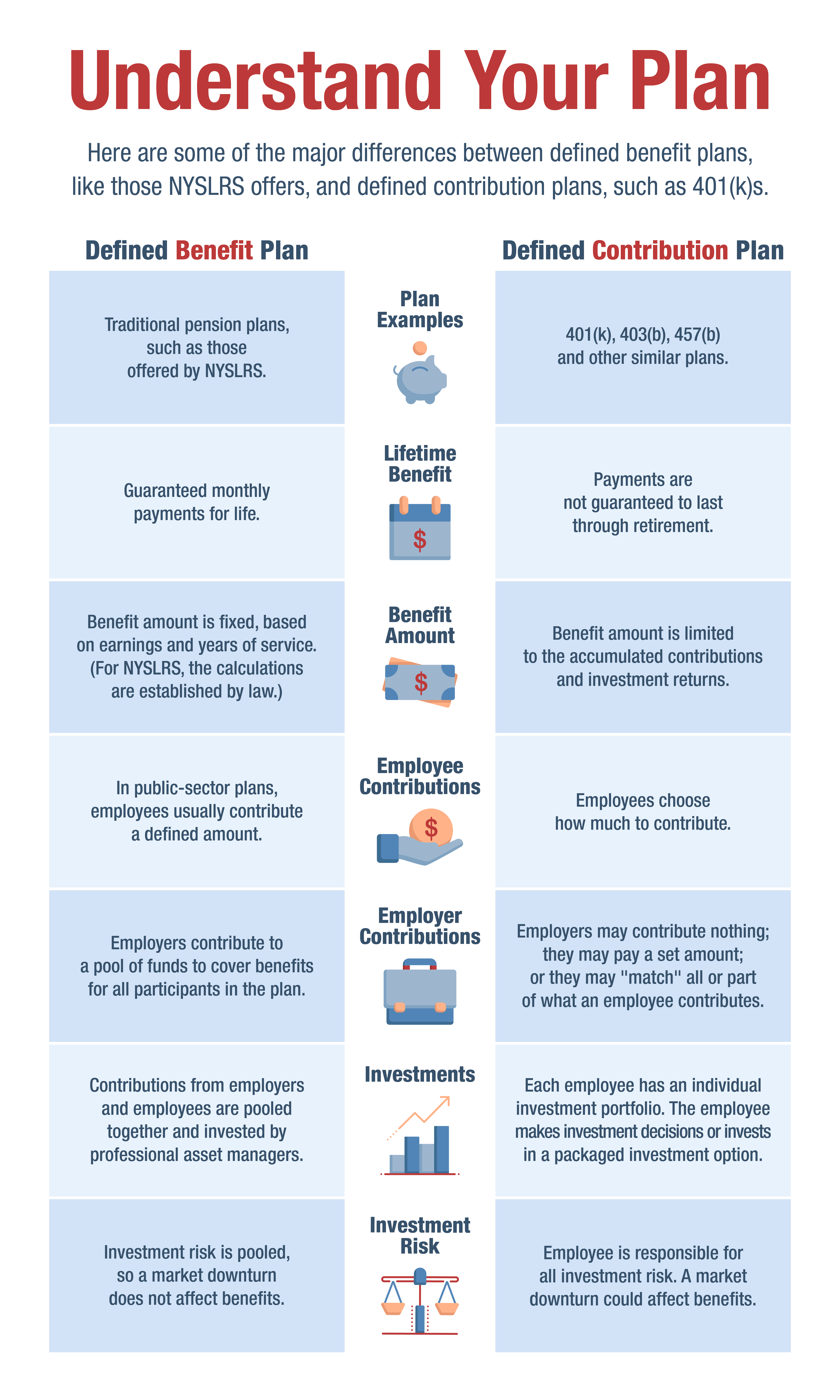
understand your defined benefit plan

Defined Contribution Plans—And Their Risks

Defined benefit plans are often confused with 401(k)-style retirement savings plans, which are known as defined contribution plans.

With a defined contribution plan, the employee, the employer or both contribute to an individual retirement account for the employee, and the money in the account is invested. In most cases, the employee decides how and where the money is invested (or the plan may offer pre-packaged investment options). At retirement, the employee will be able to draw from the accumulated value of contributions and investment returns, minus any fees.

The amount of money the employee has at retirement often relies on the investment returns of the individual account. So, market downturns, especially near retirement, can negatively affect the value of the benefit. Employees depending on defined contribution plans run the risk of outliving their savings.

NYSLRS’ Defined Benefit Plans

We administer nearly 300 retirement plan combinations. NYSLRS retirement plans:

  • Provide a guaranteed benefit for life.
  • Offer a pension based on final average earnings and years of service.
  • Provide a right to pension benefits (vesting) with five years of service credit.
  • Build a cost-of-living adjustment (COLA) into pensions to help offset the effect of inflation.
  • Include disability retirement and death benefits.

We strongly encourage you to review your retirement plan publication for a complete description of your benefits. Visit our Find Your NYSLRS Retirement Plan Publication page and follow the steps listed.

Are You Prepared for a Long Retirement?

As you plan for retirement, you need to think about your sources of income in retirement. However, you should also consider how long your retirement income will need to last.

Longer Life Span, Longer Retirement

These days, a 55-year-old man can expect to live for another 27.4 years, to about 82. A 55-year-old woman can expect to live for more than 30 years. These figures, derived from the Social Security life expectancy calculator, are only averages. They don’t account for factors such as health, lifestyle or family medical history.

life expectancy statistics to help plan for a long retirement

Here are some other statistics worth considering as you plan for retirement (as of the State fiscal year that ended March 31, 2022):

  • More than 37,000 NYSLRS retirees were over 85 years old;
  • More than 3,500 had passed the 95-year mark; and
  • 401 NYSLRS’ retirees were 101 or older.

Considering that many public employees can retire as early as 55, it’s possible that a fair number of them could have retirements that last 45 years or more.

Saving for a Long Retirement

Your NYSLRS pension is one source of income that you can depend on however long your retirement lasts. Employees’ Retirement System (ERS) members who retired in fiscal year 2022 are receiving an average monthly pension of $2,748. Social Security is another long-term source. The average Social Security benefit for a retired worker was $1,837 a month, as of June 2023.

Your retirement savings is a crucial asset that can supplement your pension and Social Security. In a long retirement, savings can help with rising costs and provide a source of cash in an emergency.

It is never too late to start saving for retirement. The New York State Deferred Compensation Plan is one easy way to get started. It’s a program created for New York State employees and employees of participating public agencies. If you’re a municipal employee, ask your employer if you’re eligible for the Deferred Compensation Plan or another retirement savings plan. (The New York State Deferred Compensation Plan is not affiliated with NYSLRS.)

You should also visit our Start Saving for Retirement page. You’ll find an example of how much you can save over a 30-year period, and a sample withdrawal strategy designed to provide retirement income for 20 years.

Your NYSLRS Pension Benefit

Your NYSLRS pension is a lifetime benefit that will provide monthly payments throughout your retirement. Get a head start on your retirement planning and estimate your pension in Retirement Online.

A Century of Security and Stability

A century after its creation, the New York State and Local Retirement System (NYSLRS) is widely recognized as one of the best-managed and best-funded public pension systems in the nation. Comptroller DiNapoli recently announced that the New York State Common Retirement Fund (Fund), which holds and invests the assets of NYSLRS, had an estimated value of $268.3 billion as of June 30, 2021. The security and stability of NYSLRS and the Fund are due, in large part, to the stewardship of Comptroller DiNapoli, as well as a long line of State Comptrollers that came before him. The System has also been bolstered by some key events along the way.

NYSLRS History - key events contributing to the security and stability of the Retirement System and the Fund

In the Beginning

NYSLRS’ security and stability were built in at the start. In 1918, the State Legislature created the Commission on Pensions and charged it with recommending a pension system for State workers.

After surveying pension plans in New York and other states, the Pension Commission recognized the need to calculate the cost of the pension plan through actuarial calculations, which take into account such things as employees’ salaries and how long they are expected to be retired. They also saw the need to make provisions to cover those costs through contributions and other income. They recommended a plan supported by the contributions of employers (New York State and, eventually, local governments) and employees. The improved actuarial calculations the System uses today helps to ensure that member contributions and employer annual contributions are sufficient to keep the System adequately funded.

The Pension Commission also recommended a service retirement benefit be made available to workers who reached a certain age, based on average earnings and years of service. Though they didn’t use the term, their pension plan was very similar to the defined-benefit plan NYSLRS members have now.

Unlike the 401k-style defined-contribution plans common in the private sector today, a defined-benefit plan provides a guaranteed, lifetime benefit. With a defined-benefit plan, you don’t have to worry about your money running out during retirement, and your employer has an excellent tool for recruiting and retaining workers.

Constitutional Protection

In 1938, New York voters approved several amendments to the State Constitution, including Article 5, Section 7, which guarantees that a public pension benefit cannot be “diminished or impaired.” This constitutional language protects the interests of the Fund and its members and beneficiaries, ensuring that the money the Fund holds will be there to pay the pensions for all current and future retirees. The courts have upheld this constitutional provision to protect the Fund several times over the years.

For NYSLRS members and retirees, that means the retirement benefits you were promised when you started your public service career cannot be reduced or taken away.

Sound Investments

Sound investments are crucial to the health of the Fund, but in some cases changes in the law were needed to give Fund managers the flexibility to make the best investments. In 1961, the Fund was allowed to invest in the stock market, opening up the door for growth opportunities. Roughly half of the Fund’s assets are currently invested in stocks.

In 2005, the Legislature expanded the types of investments the Fund could make, allowing the Fund to increase investments in real estate, international stocks and other sectors that had been providing high returns.

Today, under Comptroller DiNapoli’s leadership, the Fund’s investment returns cover the majority of the cost of retirement benefits. After suffering a drop in value at the beginning of the COVID pandemic, the Fund had its best year in history, with estimated investment returns of 33.55 percent for fiscal year 2021.

NYSLRS is well-positioned to face the challenges of the future and provide retirement security for more than 1.1 million members, retirees and beneficiaries.

The Common Retirement Fund: 100 Years of Strength and Security

In 1921, NYSLRS’ pension fund held several million dollars and provided benefits to just a few dozen State employees. Today, the Common Retirement Fund (Fund) provides more than a billion dollars per month to hundreds of thousands of retirees and beneficiaries.

The System’s founders showed foresight in establishing the framework for a sustainable retirement system capable of providing long-term pension security for its members and retirees. Today, one hundred years later, we are considered one of the strongest public pension funds in the country, thanks in large part to the stewardship of Comptroller DiNapoli, trustee of the Common Retirement Fund and administrator of NYSLRS for the past 14 years.

Comptroller DiNapoli’s diligent efforts to maintain the financial well-being of the Fund, the fact that NYSLRS’ participating employers contribute their share into the Fund, and New York’s constitutional requirement that lifetime pension benefits be guaranteed to all NYSLRS retirees — all these elements combine to ensure that NYSLRS retirees will enjoy secure benefits for generations to come.

Common Retirement Fund - A Snapshot of Growth

Investments

The Common Retirement Fund has been widely recognized as one the best-funded and best-managed public pension fund’s in the nation. (In June 2020, the Pew Charitable Trusts ranked NYSLRS as the second-best-funded public retirement system in the nation, based on 2018 data.) The cornerstone of the Fund’s reputation is its sound investment policies. At the direction of Comptroller DiNapoli, Fund managers use a long-term investment strategy designed to take advantage of growth opportunities during good economic times, while helping the Fund weather economic downturns.

The Comptroller seeks the input of a wide range of internal and external advisors, consultants and legal counsel who help to determine the best investment choices and allocation of assets for the Fund. These advisors provide independent advice and oversight of all investment decisions, serve as part of the chain of approval on all investment decisions before they reach the Comptroller for final approval and participate on advisory committees that meet periodically throughout the year.

Fund assets are invested in a diversified portfolio. About 55 percent of the assets are invested in publicly traded stocks. Other investments include bonds, mortgages, real estate and private equity.

The Fund is also strengthened by a forward-looking approach to addressing climate change-related investment risks and capitalizing on the opportunities created by the transition to a low-carbon economy. Comptroller DiNapoli recognizes that climate change poses an enormous threat to the global economy and to the Fund’s investment portfolio. Recently, he announced plans to transition the Fund’s portfolio to net zero greenhouse gas emissions by 2040. This process will include a review of investments in energy companies and, where consistent with his fiduciary responsibility to maintain the long-term financial health of the Fund for NYSLRS members, divestment of companies that don’t meet minimum standards. This policy will help ensure that the Fund adapts to a changing global economy and maintains its growth in coming decades.

The Common Retirement Fund’s Impact on New York Businesses

The Common Retirement Fund’s In-State Private Equity Program invests in new and expanding New York companies and makes capital available to qualifying small businesses. As of March 31, 2020, the Fund’s private equity portfolio included investments in over 330 New York businesses with a total value of $1.9 billion. These investments boost the State’s economy while at the same time generating significant returns for the Fund.

Looking Forward

As the Common Retirement Fund’s assets have grown over the years, so have its obligations. As of March 31, 2020, there were 487,407 NYSLRS retirees and beneficiaries, who were paid $13.4 billion in benefits over the previous year. That’s up from 67,689 retirees and beneficiaries, who were paid $194 million in benefits in 1971. Roughly a third of NYSLRS members are expected to retire over the coming decade.

Comptroller DiNapoli’s focus on continuing the Fund’s record of strong growth ensures that the Retirement System will be ready to meet the challenges of the future. The New York State Common Retirement Fund’s estimated overall investment return was 33.55 percent for the State fiscal year that ended March 31, 2021, reflecting the financial markets’ dramatic rebound from lows reached during the COVID-19 pandemic. The return on investments increased the Fund’s value to an estimated $254.8 billion. More than 1.1 million NYSLRS members, retirees and beneficiaries can continue to rely on the Retirement System for their retirement security.

Celebrating 100 Years of NYSLRS

NYSLRS 100

On January 3, 1921, NYSLRS began helping New York’s public employees achieve financial security in retirement. Now – 100 years later – we continue to fulfill that promise.

NYSLRS’ Origins

Governor Alfred Smith
In 1920, Governor Al Smith signed legislation establishing the New York State Employees’ Retirement System.

In 1920, the State Commission on Pensions presented Governor Al Smith a report they’d been working on for two years. The report showed that though there were already pension plans covering 8,300 banking department employees, teachers, State hospital workers, Supreme Court and other certain judiciary employees and prison employees, 10,175 State employees were not covered. To help ensure the financial security of public employees during their retirement years, the Commission recommended that a system be established to pay benefits to State employees – and the Commission wanted a system that would always have enough money on hand to pay benefits.

On May 11, 1920, Governor Smith signed legislation creating the New York State Employees’ Retirement System. By June 30 1921, 43 retirees were drawing pensions. The total amount of their annual pensions was $17,420.16. The first disability pension benefit of $256 per year was also paid.

Still Fulfilling Our Promise After 100 Years

Today, there are more than one million members, retirees and beneficiaries in our system, and NYSLRS is one of the strongest and best funded retirement systems in the country. Last fiscal year, NYSLRS paid out $13.25 billion in retirement and death benefits.

Members of the Employees' Retirement System, 1921
Members of the Employees’ Retirement System gather on the steps of the State Education Department building in Albany, NY in 1921.

Our core mission for the last 100 years has been to provide our retirees with a secure pension through prudent asset management. This has been our promise since 1921 and will continue far into the future.

Sources: Report of the New York State Commission on Pensions, March 30, 1920; Chapter 741 of the Laws of 1920; and Report of the Actuary on the First Valuation of the Assets and Liabilities of the New York State Retirement System as of June 30, 1921.

Infographic regarding spending habits

Spending Changes in Retirement

Just like starting your first job, getting married or having kids, retirement will change your life. Some changes are small, like sleeping in or shopping during regular business hours. Others, however, are significant and worth examining ahead of time… like how much you’ll be spending in retirement each month or each year.

An Employee Benefit Research Institute (EBRI) study offers some good news for prospective retirees. Household spending generally drops at the beginning of retirement — by 5.5 percent in the first two years, and by 12.5 percent in the third and fourth years. (Although, nearly 46 percent of households actually spend more in the first two years of retirement.)

Analysis from the Bureau of Labor Statistics in the U.S. Department of Labor seems to support the research from EBRI. In “A closer look at spending patterns of older Americans,” the author analyzed data from the 2014 Consumer Expenditure Survey, and she also found a progressive drop in spending as age increases. (Income declines with age as well.)

While data supporting EBRI’s study is helpful, it turns out that the highlight of the Consumer Expenditure Survey results is a detailed look at how the things we spend our money on change as we grow older.

Infographic regarding spending habits

As interesting as that is, it’s just a general look at how older Americans are managing their money. What really matters is: How will you spend your money once you retire?

Prepare a Post-Retirement Budget

Like a fiduciary choir, financial advisors all sing the same refrain: Start young; save and invest regularly to meet your financial goals. If you do, the switch from saving to spending in retirement can be easy.

But, in order to make that transition, you need a budget.

The first step toward a post-retirement budget is a review of what you spend now. For a few months, track how you spend your money. Don’t forget to include periodic costs, like car insurance payments or property taxes. By looking at your current spending patterns, you can get an idea of how you’ll spend money come retirement.

Then, consider your current monthly income, and estimate your post-retirement income. If your post-retirement income is less than your current income, you might want to plan to adjust your expenses or even consider changing your retirement date.

We have monthly expense and income worksheets to help with this exercise. You can print them out and start planning ahead for post-retirement spending.

Monthly budgeting worksheets (PDF)

Monthly Worksheets (PDF)

For those of you who carry smart phones, Forbes put together a list of popular apps for tracking your daily spending. All of them are free, though some do sell extra features. Many of them can automatically pull in information from your bank and credit card accounts, but if you’d rather avoid that exposure or if you use cash regularly, you may prefer an app that lets users enter transactions manually.