Category Archives: General News

Retirement Planning Tip: Required Minimum Distributions

Required Minimum DistributionsIf you have tax-deferred retirement savings (such as certain 457(b) plans offered by NYS Deferred Comp), you will eventually have to start withdrawing that money. After you turn 70½, you’ll be subject to a federal law requiring that you withdraw a certain amount from your account each year. If you don’t make the required withdrawals, called Required Minimum Distributions (RMDs), you could face significant penalties.

RMDs are never eligible for rollover into other retirement accounts. You must take out the money and pay the taxes.

Calculating the Distribution

The RMD amount must be calculated annually. It’s based on the account’s balance at the end of the previous calendar year and the life expectancy of you and your beneficiary. Check out AARP’s Required Minimum Distribution Calculator for an easy way to determine your required distributions. Many retirement plan administrators, including the New York State Deferred Compensation Plan, will inform you of your RMD amount, but it’s your responsibility to take the required distribution.

Potential Penalty

If you don’t take the required distribution, or if you withdraw less than the required amount, you may have to pay a 50 percent tax on the amount that was not distributed. (You must report the undistributed amount on your federal tax return and file IRS Form 5329.)

The IRS may waive the penalty if you can show that your failure was due to a “reasonable error” or that you have taken steps to correct the situation. You can find information about requesting a waiver on page 8 of the Form 5329 instructions.

What Accounts Require Minimum Distributions?

Most retirement accounts you’re familiar with require these annual withdrawals:

  • 457(b) plans
  • IRAs (traditional, SEP and SIMPLE)
  • 401(k) plans
  • 403(b) plans
  • Profit-sharing plans
  • Money purchase plans

Since contributions to Roth IRAs have already been taxed, the IRS does not require distributions from Roth IRAs at any age.

As with most things investment-related, a lot depends on your particular circumstances. If you have questions, contact your financial advisor or your plan administrator.

Firefighters Deserve A Salute Every Day

Recognizing Firefighters

It’s National Fire Prevention Week this week and, while attention is properly focused on promoting fire prevention, we also think it’s a great time to recognize all the firefighters who are members of the New York State and Local Retirement System (NYSLRS).

Of the 533,415 members in NYSLRS, 32,470 are in the Police and Fire Retirement System (PFRS). More than 6,000 of these brave men and women are firefighters.

NYSLRS Firefighters data

NYSLRS Membership and Firefighters

All firefighters working for participating employers are PFRS members. With that membership comes a variety of benefits, including certain death and disability benefits as well as a pension. As firefighters and other PFRS members progress through their careers they become eligible for these benefits. For example, from day one, PFRS members are covered by job-related death and disability benefits. However, with ten years of service credit, most members are also eligible for a non-job-related disability benefit.

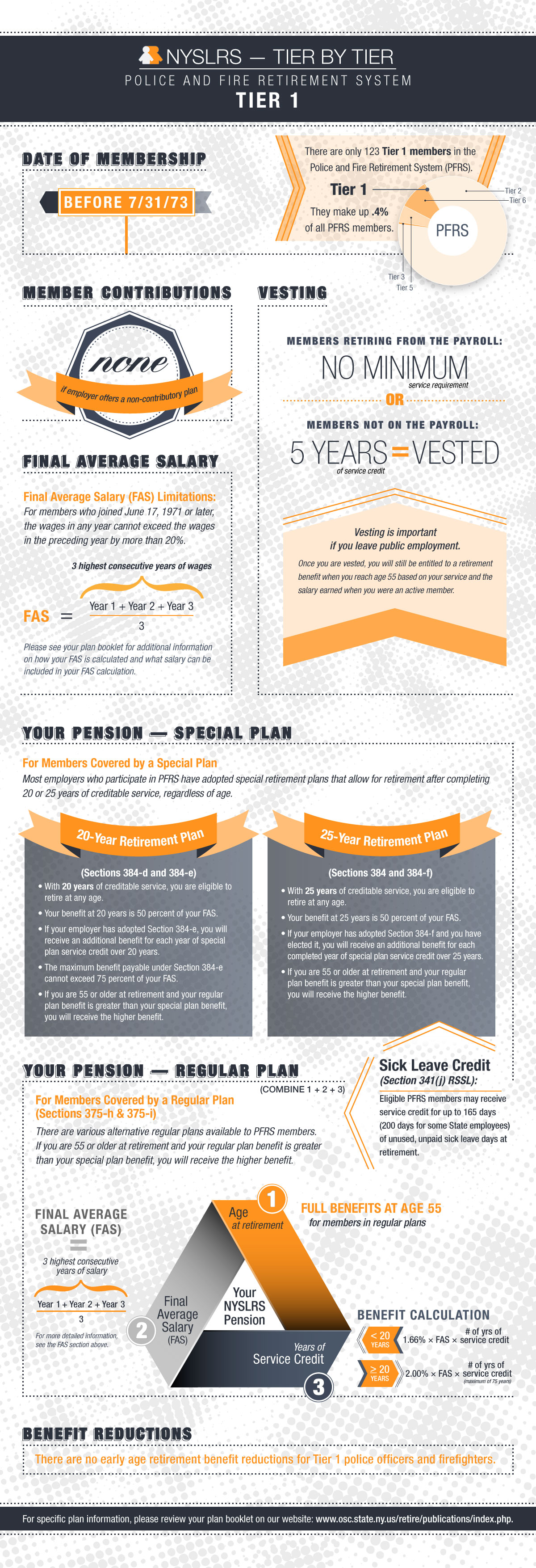
In addition, most PFRS employers offer their employees special retirement plans. A special plan lets members retire after completing 20 or 25 years of credited service in specific job titles rather than reaching a certain age. Most firefighters — and, in fact, nearly 80 percent of all PFRS members (25,784) — are enrolled in a set of special 20- and 25-year plans. Whether members need 20 or 25 years depends on their retirement plan.

Firefighters are Heroes

To the members of the New York State Professional Fire Fighters Association, the Firemen’s Association of the State of New York and the New York State Association of Fire Chiefs; to the county fire marshals, supervising fire marshals, fire marshals, assistant fire marshals, assistant chief fire marshals and chief fire marshals: Thank you for your service to New York and its citizens. We are grateful for the valuable service you provide all of us.

Infographic regarding spending habits

Spending Changes in Retirement

Just like starting your first job, getting married or having kids, retirement will change your life. Some changes are small, like sleeping in or shopping during regular business hours. Others, however, are significant and worth examining ahead of time… like how much you’ll be spending in retirement each month or each year.

An Employee Benefit Research Institute (EBRI) study offers some good news for prospective retirees. Household spending generally drops at the beginning of retirement — by 5.5 percent in the first two years, and by 12.5 percent in the third and fourth years. (Although, nearly 46 percent of households actually spend more in the first two years of retirement.)

Analysis from the Bureau of Labor Statistics in the U.S. Department of Labor seems to support the research from EBRI. In “A closer look at spending patterns of older Americans,” the author analyzed data from the 2014 Consumer Expenditure Survey, and she also found a progressive drop in spending as age increases. (Income declines with age as well.)

While data supporting EBRI’s study is helpful, it turns out that the highlight of the Consumer Expenditure Survey results is a detailed look at how the things we spend our money on change as we grow older.

Infographic regarding spending habits

As interesting as that is, it’s just a general look at how older Americans are managing their money. What really matters is: How will you spend your money once you retire?

Prepare a Post-Retirement Budget

Like a fiduciary choir, financial advisors all sing the same refrain: Start young; save and invest regularly to meet your financial goals. If you do, the switch from saving to spending in retirement can be easy.

But, in order to make that transition, you need a budget.

The first step toward a post-retirement budget is a review of what you spend now. For a few months, track how you spend your money. Don’t forget to include periodic costs, like car insurance payments or property taxes. By looking at your current spending patterns, you can get an idea of how you’ll spend money come retirement.

Then, consider your current monthly income, and estimate your post-retirement income. If your post-retirement income is less than your current income, you might want to plan to adjust your expenses or even consider changing your retirement date.

We have monthly expense and income worksheets to help with this exercise. You can print them out and start planning ahead for post-retirement spending.

Monthly budgeting worksheets (PDF)

Monthly Worksheets (PDF)

For those of you who carry smart phones, Forbes put together a list of popular apps for tracking your daily spending. All of them are free, though some do sell extra features. Many of them can automatically pull in information from your bank and credit card accounts, but if you’d rather avoid that exposure or if you use cash regularly, you may prefer an app that lets users enter transactions manually.

Creditable Service for Police & Fire Members

The New York State and Local Police and Fire Retirement System (PFRS) provides service and disability retirement benefits, as well as death benefits to more than 35,000 police officers and firefighters.

Most PFRS members are covered by a plan that allows for retirement after 20 or 25 years, regardless of age, without penalty. As a member, you earn credit toward that requirement through paid public employment with participating employers. However, not all public service counts toward your 20 or 25 years.

What Credit Counts Towards Retirement?

The public service that can be used toward your 20 or 25 years is determined by the specific retirement plan under which you’re covered. Check your retirement plan booklet for details.

There are booklets for state police , forest rangers , regional state park police , state university police , EnCon police and members covered under Sections 384, 384-d and 384-e of Retirement and Social Security Law (RSSL). More plan booklets are available on our Publications page.

The most common PFRS plan, which covers nearly 50 percent of PFRS members, was established by Section 384-e of RSSL. With this plan, you earn creditable service:

  • As a firefighter or police officer under the 384-e plan;
  • As a member or officer of the New York State Police; or
  • In the military, as specified by law.

In the 384-e retirement plan, civilian service, as well as service as a sheriff, corrections officer or volunteer firefighter, is not creditable.

creditable service for police and fire retirement system members

Transferring Membership or Purchasing Service Credit — Contact Us First

If you have worked for multiple New York State public employers and are unsure if all of your service is creditable towards your 20 or 25 year plan, contact us before transferring membership or purchasing service credit . Please note: the public service that can be used toward your 20 or 25 years is determined by legislation and differs among plans offered to PFRS members. You should also be sure to request an estimate from us well before your planned date of retirement if there is any question about your creditable service.

Get an Estimate

PFRS members should request an estimate from us as early as 18 months before you plan to retire. It’s the best way to make sure you have all the credit you’re entitled to. Simply fill out and return a Request for Estimate (RS6030) form.

Health Care Costs Can Be Steep in Retirement

As you plan for your retirement, you may be forgetting one important thing – health care.

NYSLRS does not provide health care coverage for its retirees, and we’re not the experts on this subject. But we do offer advice to members about retirement planning, and how you’ll pay for health care coverage and out-of-pocket medical expenses should be an important consideration as you approach retirement.

Know the Health Care Cost Facts

Medicare premiums, deductibles, co-payments and prescription drug costs all add up. And those expenditures are likely to rise because health costs have been increasing faster than the rate of inflation and people spend more on medical expenses as they age.

Recent reports indicate a typical 65-year-old retiring in 2018 would spend well over $100,000 to cover medical costs over the course of retirement. What’s more, most NYSLRS members can retire as early as 55. That means you may spend a longer time in retirement than the average retiree, and you may not be eligible for Medicare for years.

couple working on their budget together

What You Can Do To Prepare

Before you can budget for retirement medical costs, you’ll need to do your homework. Start by talking to your employer about the health care options available to you after your retire and get an estimate of how much you will need to pay. You should also familiarize yourself with Medicare’s options, benefits and costs.

Once you get an idea of what your monthly health care might be, you can start planning how to pay for it. You may have to increase your retirement savings. If you’re a state employee, or a municipal employee covered by the New York State Health Insurance Program (NYSHIP), you may be able to get credit for unused sick leave that can reduce your NYSHIP premium. This program is managed by the New York State Department of Civil Service, not NYSLRS. Their Planning for Retirement booklet provides some good information.

Getting Credit for Your Military Service

If you served in the U.S. Armed Forces, you may be eligible to buy back up to three years of active service credit. Because service credit is a factor in calculating a NYSLRS pension, in most cases buying military service credit will increase your pension.

Military Service Credit

To be eligible, veterans must:

  • Have been honorably discharged;
  • Have at least five years of credited service in the Retirement System;
  • Have not received credit for this service in any other public retirement system in New York State; and
  • Apply for and purchase military service credit before they retire.

How to Apply for Military Service Credit

To apply and request a cost for military service credit:

1. Fax your name, contact information and a copy of your DD-214 to 518-486-6405 or 518-402-7799;

or

2. Mail a letter with your name and contact information, and a photocopy of your DD-214, to:
    Military Service Unit
    110 State Street
    Albany, NY 12244-0001

If after reviewing your application we determine you are eligible, we will send you a letter that will tell you how much credit you are eligible to purchase and the cost. Most members in Tier 1, 2, 3 or 4 can use our online benefit projection calculator to see how the credit would impact your pension. Tier 5 and 6 members can get that information by calling 1-866-805-0990, or using our secure email form (www.emailNYSLRS.com).

For more information, visit the Military Service Credit page on our website.

Top Five Pre-Retirement Goals for NYSLRS Members in 2018

January is a great time to set goals for the coming year. And setting pre-retirement goals is crucial in planning for a successful retirement. Here are five goals to consider for 2018:

Plan ahead for retirement

1. Choose a sensible savings plan that works for you.There are several ways to save for retirement, including starting a deferred compensation plan like the New York State Deferred Compensation Plan. An important part of developing a savings plan is to start early. The sooner you start saving, the more time your money has to grow. Check out our Weekly Investment Plan chart to see how a weekly investment can grow by age 65.

2. Track your expenses and income. Tracking your current expenses for a month or two will give you a better idea of how much you’re likely to spend in retirement and how much you’ll need to supplement your pension. Use the expense and income worksheets on our website to create a retirement budget. Be sure to include periodic expenses, such as car insurance and property taxes.

3. Request a pension estimate. If you’re within 18 months of your anticipated retirement date, it’s a good idea to request an estimate of what your retirement benefit will be. You can do this by sending us an email using our secure contact form or by calling 1-866-805-0990 (518-474-7736 in the Albany, NY area). If you are not certain that you’ve received credit for all your public service in New York State, you can submit a Request for Estimate form (RS6030) and be sure to provide detailed information about your public employment in section eight of the form. If your planned retirement date is farther away, you may want to use our online Benefit Calculator. This estimates your pension based on information you provide, so have your Member Annual Statement handy before you start, or sign in to your Retirement Online account to check your current service credit.

4. Pay off any NYSLRS loans. An outstanding loan balance at retirement will permanently reduce your NYSLRS retirement benefit. You cannot make loan payments after you retire, and the pension reduction does not go away after we recover the balance of the loan. Visit the Loans page on our website for information about making additional payments or increasing your loan payment amount.

5. Consider seeking the advice of a financial planner. Financial planners don’t manage your money, but can help you assess your present financial condition and develop a practical plan to meet your specific goals and needs. Also consider doing your own research by seeking Do-It-Yourself financial planning guides on the web.

If you ever have any retirement-related questions, please contact us.

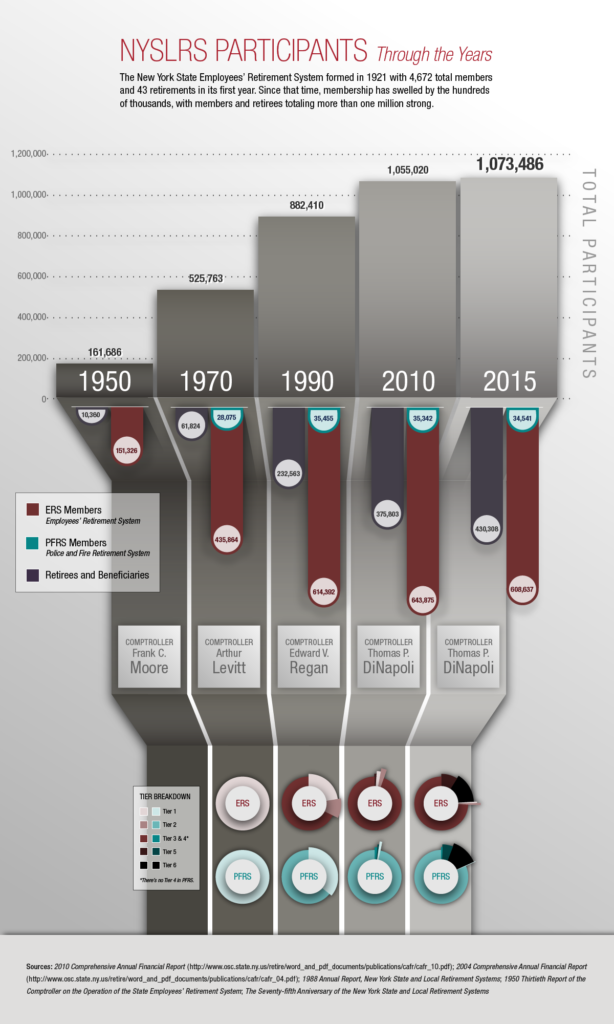
More Than One Million Strong: The Growth of NYSLRS

When NYSLRS formed in 1921, it started with a total of 4,721 participants (4,672 members and 43 retirees). Today, NYSLRS provides retirement security to 643,178 members and 430,308 retirees and beneficiaries (the most recent data available).

To say we’ve grown would be an understatement. But no matter how large we get, NYSLRS will continue to provide its members and retirees with lifetime retirement benefits and help them to plan for a financially secure future.

A look back at membership growth through the years.

NYSLRS Membership growth through the years

NYSLRS: Retirement Security Before Social Security

Before NYSLRS began in 1921, many New York public employees who were no longer able to work would fall into poverty. At the time, Social Security didn’t exist to help supplement post-retirement income. While Social Security was created in 1935, it wasn’t made available to public employees until 1950 and didn’t start in New York until 1953.

NYSLRS in 1950

Under State Comptroller Frank C. Moore, NYSLRS was comprised of 161,686 participants in 1950. Of those, 151,326 were Employees’ Retirement System (ERS) members and 10,360 were retirees and beneficiaries.

You may have noticed that there were no Police and Fire Retirement System (PFRS) members in 1950. We had police and fire members – a little more than 12,000, in fact – but they were considered ERS members until 1967. On April 1, 1967, ERS split into the two systems you know today: ERS and PFRS.

NYSLRS in 1970

Participation in NYSLRS grew to 525,763 in 1970. Of these, 463,939 were members and 51,824 were retirees and beneficiaries. The State Comptroller at the time was Arthur Levitt Sr. Comptroller Levitt is known for having the longest tenure as State Comptroller, serving a total of 24 years from 1955 to 1978.

The 1970s also saw the creation of a new member group. Tier 2 began on July 1, 1973. The creation of Tier 2, and the other tiers that followed, were designed to provide members equitable benefits at a reasonable cost.

NYSLRS in 1990

From 1979 to 1993, Edward V. “Ned” Regan served as State Comptroller. During his time in office, participation in NYSLRS continued to climb, growing to 882,410 in 1990. Of these, 649,847 were members and 232,563 were retirees and beneficiaries.

NYSLRS in 2010

Between 2006 and 2007, participation in NYSLRS broke the one-million-participant mark. In 2010, during current Comptroller Thomas P. DiNapoli’s administration, participation rose to 1,055,020. Of these, 679,217 were members and 375,803 were retirees and beneficiaries.

NYSLRS in 2015

In 2015, overall membership in the System reached 1,073,486. This includes 643,178 members and 430,308 retirees and beneficiaries (the most recent data available). The number of retirees is increasing more quickly than members. For example, in 1995, retirees represented 30 percent of the System’s members. By 2015, that number had increased to approximately 40 percent.

What does 2016 hold for NYSLRS? Keep an eye out in future blog posts for the latest NYSLRS demographics.

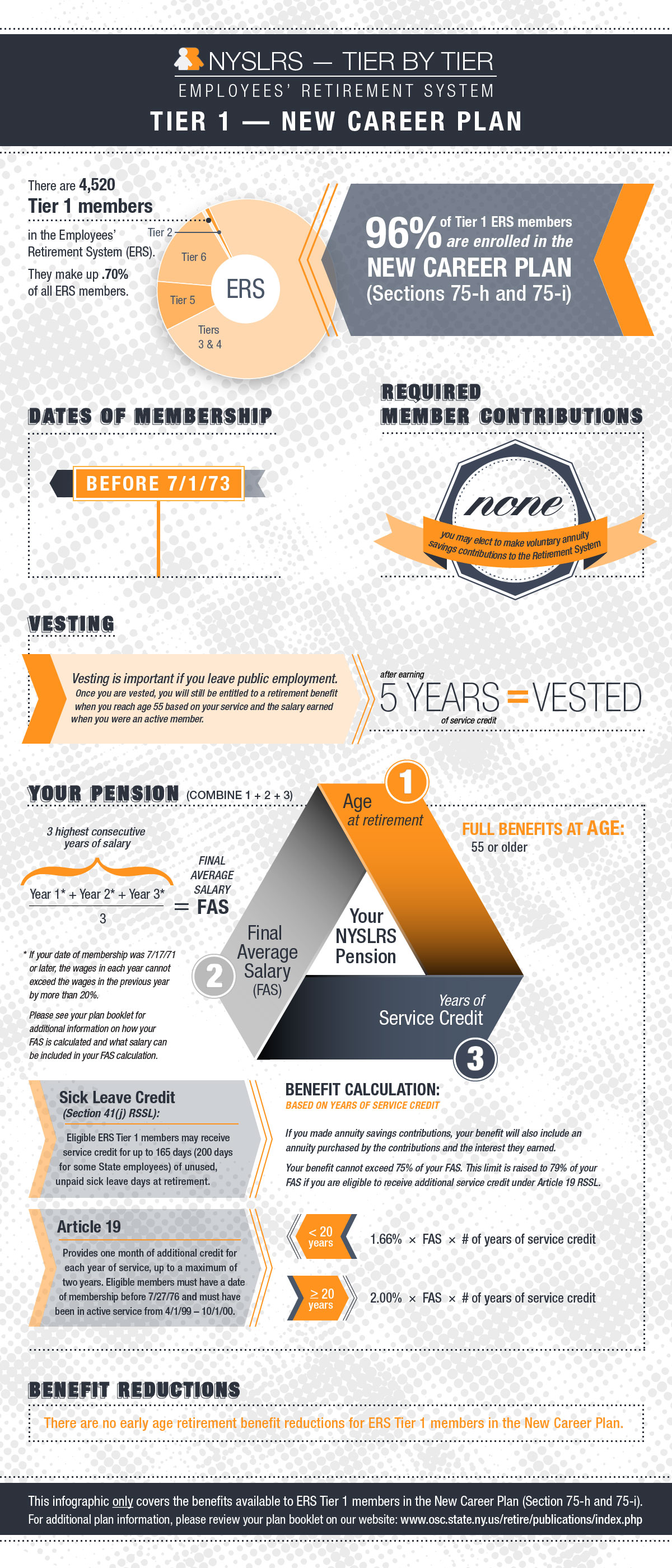
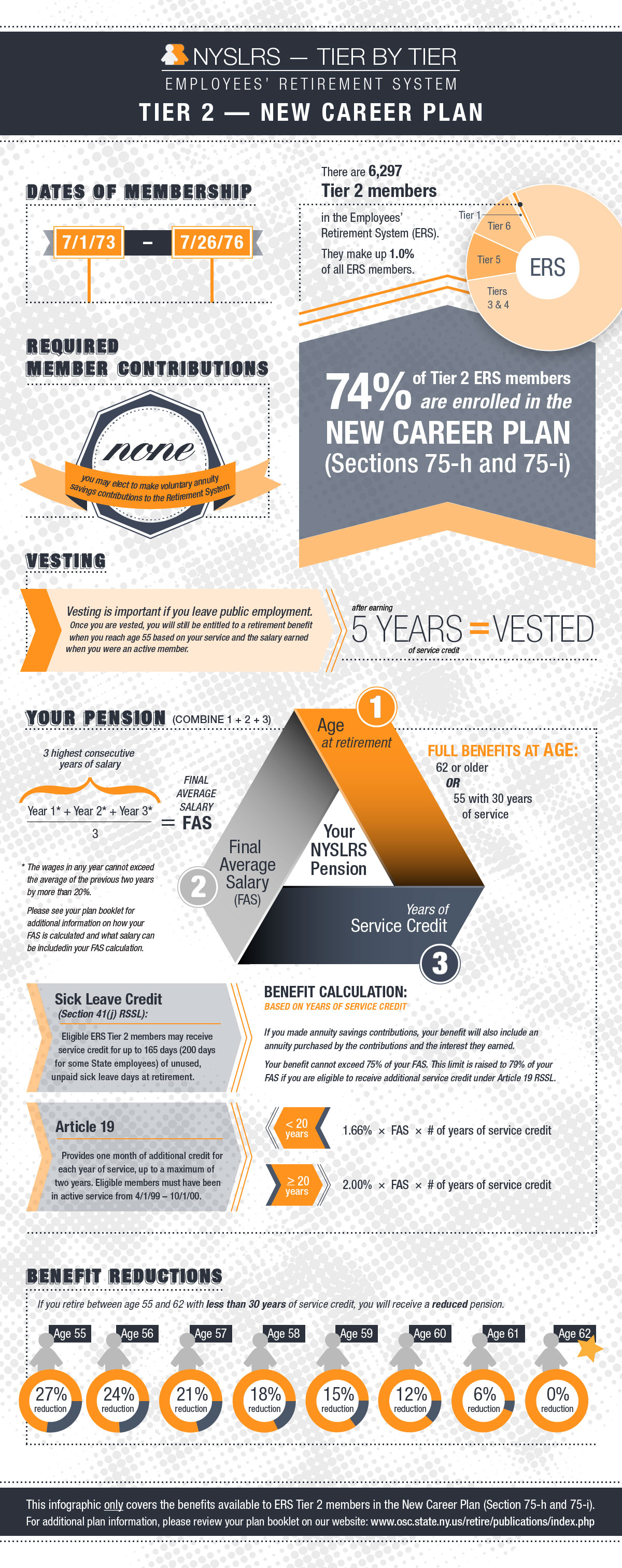
ERS Tiers 1 and 2: The New Career Plan

Did you become a member of the Employees’ Retirement System (ERS) before July 1, 1973? If you’re still working in public service, you’re one of the 3,508 active members in Tier 1. If you joined after July 1, 1973 but before July 27, 1976, then you’re one of 4,127 active members in Tier 2.

Most ERS Tier 1 and Tier 2 members are in the New Career Plan (Section 75-h or 75-i). Currently, 96 percent of active Tier 1 members and almost 95 percent of active Tier 2 members are covered by this plan. Here’s a quick look at the benefits in the New Career Plan:

Benefit Eligibility

Tier 1

  • Members must be at least age 55 to be eligible to collect a retirement benefit.
  • There are no minimum service requirements — they may collect full benefits at age 55.

New Career Plan — ERS Tier 1

Tier 2

  • Members must have five years of service and be at least age 55 to be eligible to collect a retirement benefit.
  • The full benefit age is 62.
  • Almost 95 percent of active Tier 2 members are covered by the New Career Plan (Section 75-h or 75-i).

New Career Plan — ERS Tier 2

Final Average Salary

Final average salary (FAS) is the average of the wages earned in the three highest consecutive years of employment. For Tier 1 members who joined NYSLRS June 17, 1971 or later, each year used in the FAS calculation is limited to no more than 20 percent above the previous year’s earnings. For Tier 2 members, each year of earnings is limited to no more than 20 percent above the average of the previous two years’ earnings.

Benefit Calculations

  • For Tier 1 and 2 members, the benefit is 1.66 percent of the FAS for each year of service if the member retires with less than 20 years. If the member retires with 20 or more years of service, the benefit is 2 percent of the FAS for each year of service.
  • Tier 1 members and Tier 2 members with 30 or more years of service can retire as early as age 55 with no reduction in benefits.
  • Both Tier 1 and Tier 2 members who worked continuously from April 1, 1999 through October 1, 2000 receive an extra month of service credit for each year of credited service they have at retirement, up to a maximum of 24 additional months.

If you have questions about the New Career Plan, please read the Tier 1 plan publication or the Tier 2 plan publication. You can find other plan publications on our website.

NYSLRS – One Tier at a Time: ERS Tier 1

When you joined the New York State and Local Retirement System (NYSLRS), you were assigned to a tier based on the date of your membership. There are six tiers in the Employees’ Retirement System (ERS) and five in the Police and Fire Retirement System (PFRS) — so there are many different ways to determine benefits for our members. Our series, NYSLRS – One Tier at a Time, walks through each tier and gives you a quick look at the benefits members are eligible for before and at retirement.

One of our smallest tiers is ERS Tier 1, which represents 0.7 percent of NYSLRS’ total membership. Overall, there are 4,520 ERS Tier 1 members. Today’s post looks at the major Tier 1 retirement plan in ERS – the New Career Plan (Section 75-h or 75-i).
ERS-Tier-1-Benefits_001
If you’re an ERS Tier 1 member in an alternate plan, you can find your retirement plan publication below for more detailed information about your benefits:

Be on the lookout for more NYSLRS – One Tier at a Time posts. Want to learn more about the different NYSLRS retirement tiers? Check out some earlier posts in the series: