Tag Archives: New York State & Local Retirement System

Creditable Service for Police & Fire Members

The New York State and Local Police and Fire Retirement System (PFRS) provides service and disability retirement benefits, as well as death benefits to more than 35,000 police officers and firefighters.

Most PFRS members are covered by a plan that allows for retirement after 20 or 25 years, regardless of age, without penalty. As a member, you earn credit toward that requirement through paid public employment with participating employers. However, not all public service counts toward your 20 or 25 years.

What Credit Counts Towards Retirement?

The public service that can be used toward your 20 or 25 years is determined by the specific retirement plan under which you’re covered. Check your retirement plan booklet for details.

There are booklets for state police , forest rangers , regional state park police , state university police , EnCon police and members covered under Sections 384, 384-d and 384-e of Retirement and Social Security Law (RSSL). More plan booklets are available on our Publications page.

The most common PFRS plan, which covers nearly 50 percent of PFRS members, was established by Section 384-e of RSSL. With this plan, you earn creditable service:

  • As a firefighter or police officer under the 384-e plan;
  • As a member or officer of the New York State Police; or
  • In the military, as specified by law.

In the 384-e retirement plan, civilian service, as well as service as a sheriff, corrections officer or volunteer firefighter, is not creditable.
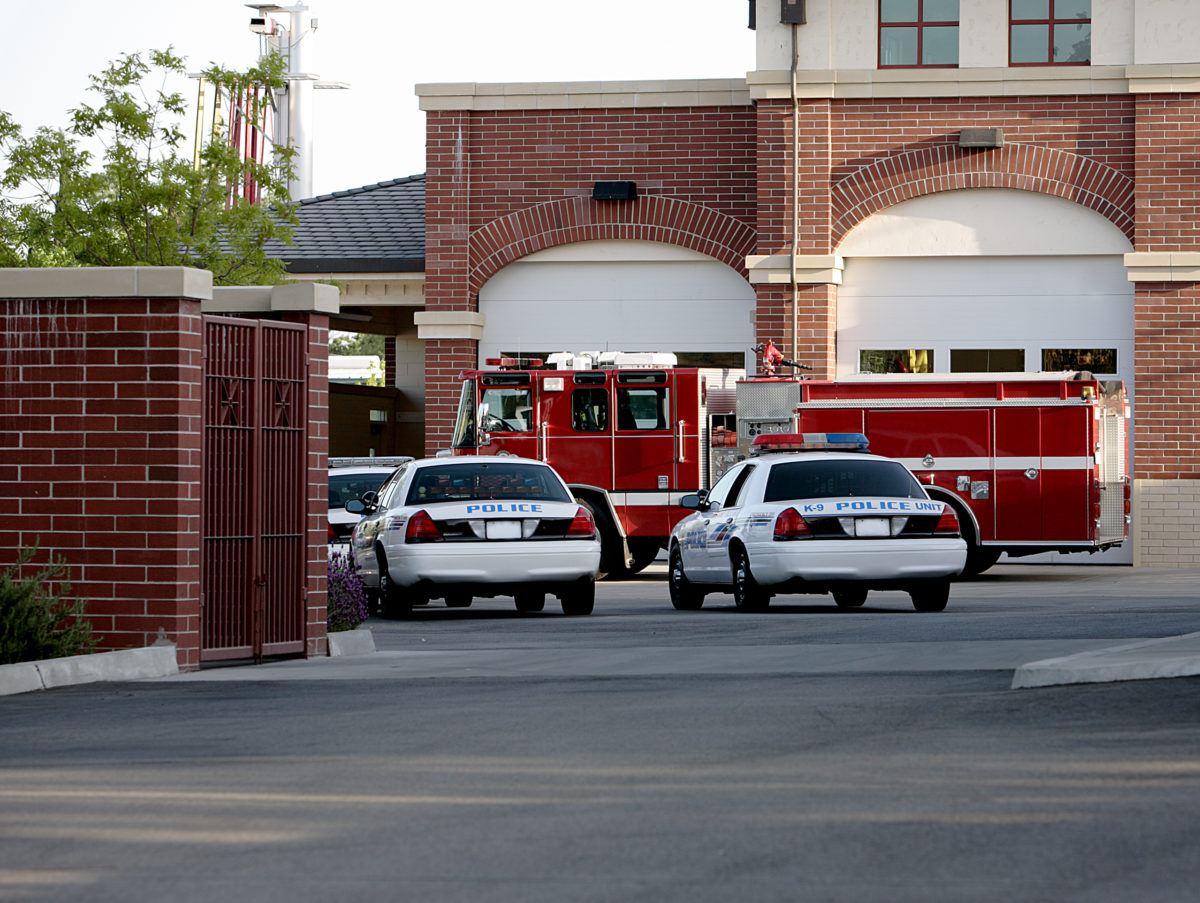
creditable service for police and fire retirement system members

Transferring Membership or Purchasing Service Credit — Contact Us First

If you have worked for multiple New York State public employers and are unsure if all of your service is creditable towards your 20 or 25 year plan, contact us before transferring membership or purchasing service credit . Please note: the public service that can be used toward your 20 or 25 years is determined by legislation and differs among plans offered to PFRS members. You should also be sure to request an estimate from us well before your planned date of retirement if there is any question about your creditable service.

Get an Estimate

PFRS members should request an estimate from us as early as 18 months before you plan to retire. It’s the best way to make sure you have all the credit you’re entitled to. Simply fill out and return a Request for Estimate (RS6030) form.

Health Care Costs Can Be Steep in Retirement

As you plan for your retirement, you may be forgetting one important thing – health care.

NYSLRS does not provide health care coverage for its retirees, and we’re not the experts on this subject. But we do offer advice to members about retirement planning, and how you’ll pay for health care coverage and out-of-pocket medical expenses should be an important consideration as you approach retirement.

Know the Health Care Cost Facts

Medicare premiums, deductibles, co-payments and prescription drug costs all add up. And those expenditures are likely to rise because health costs have been increasing faster than the rate of inflation and people spend more on medical expenses as they age.

Recent reports indicate a typical 65-year-old retiring in 2018 would spend well over $100,000 to cover medical costs over the course of retirement. What’s more, most NYSLRS members can retire as early as 55. That means you may spend a longer time in retirement than the average retiree, and you may not be eligible for Medicare for years.

couple working on their budget together

What You Can Do To Prepare

Before you can budget for retirement medical costs, you’ll need to do your homework. Start by talking to your employer about the health care options available to you after your retire and get an estimate of how much you will need to pay. You should also familiarize yourself with Medicare’s options, benefits and costs.

Once you get an idea of what your monthly health care might be, you can start planning how to pay for it. You may have to increase your retirement savings. If you’re a state employee, or a municipal employee covered by the New York State Health Insurance Program (NYSHIP), you may be able to get credit for unused sick leave that can reduce your NYSHIP premium. This program is managed by the New York State Department of Civil Service, not NYSLRS. Their Planning for Retirement booklet provides some good information.

Top Five Pre-Retirement Goals for NYSLRS Members in 2018

January is a great time to set goals for the coming year. And setting pre-retirement goals is crucial in planning for a successful retirement. Here are five goals to consider for 2018:

Plan ahead for retirement

1. Choose a sensible savings plan that works for you.There are several ways to save for retirement, including starting a deferred compensation plan like the New York State Deferred Compensation Plan. An important part of developing a savings plan is to start early. The sooner you start saving, the more time your money has to grow. Check out our Weekly Investment Plan chart to see how a weekly investment can grow by age 65.

2. Track your expenses and income. Tracking your current expenses for a month or two will give you a better idea of how much you’re likely to spend in retirement and how much you’ll need to supplement your pension. Use the expense and income worksheets on our website to create a retirement budget. Be sure to include periodic expenses, such as car insurance and property taxes.

3. Request a pension estimate. If you’re within 18 months of your anticipated retirement date, it’s a good idea to request an estimate of what your retirement benefit will be. You can do this by sending us an email using our secure contact form or by calling 1-866-805-0990 (518-474-7736 in the Albany, NY area). If you are not certain that you’ve received credit for all your public service in New York State, you can submit a Request for Estimate form (RS6030) and be sure to provide detailed information about your public employment in section eight of the form. If your planned retirement date is farther away, you may want to use our online Benefit Calculator. This estimates your pension based on information you provide, so have your Member Annual Statement handy before you start, or sign in to your Retirement Online account to check your current service credit.

4. Pay off any NYSLRS loans. An outstanding loan balance at retirement will permanently reduce your NYSLRS retirement benefit. You cannot make loan payments after you retire, and the pension reduction does not go away after we recover the balance of the loan. Visit the Loans page on our website for information about making additional payments or increasing your loan payment amount.

5. Consider seeking the advice of a financial planner. Financial planners don’t manage your money, but can help you assess your present financial condition and develop a practical plan to meet your specific goals and needs. Also consider doing your own research by seeking Do-It-Yourself financial planning guides on the web.

If you ever have any retirement-related questions, please contact us.

More Than One Million Strong: The Growth of NYSLRS

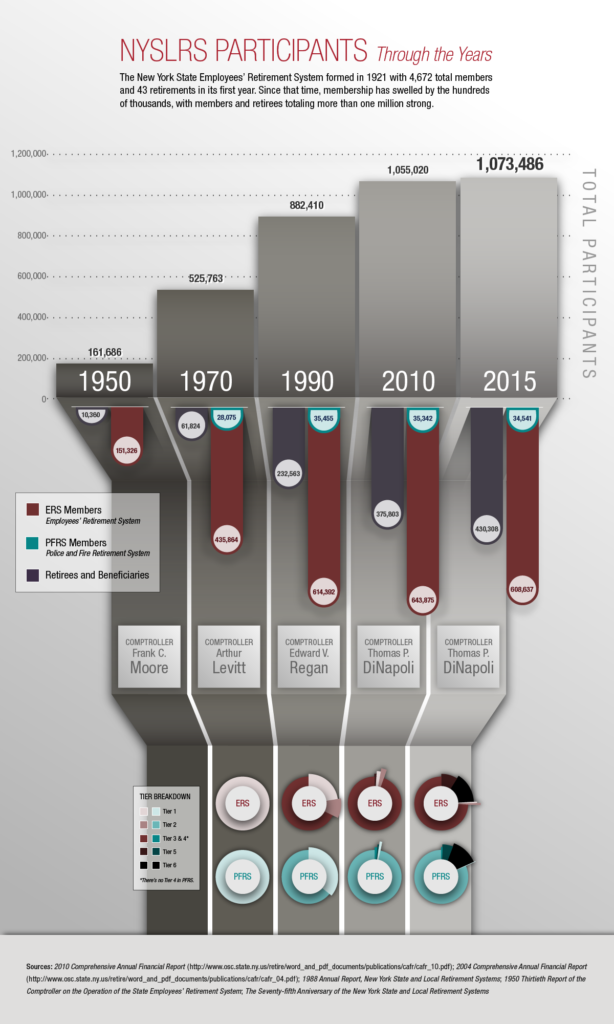
When NYSLRS formed in 1921, it started with a total of 4,721 participants (4,672 members and 43 retirees). Today, NYSLRS provides retirement security to 643,178 members and 430,308 retirees and beneficiaries (the most recent data available).

To say we’ve grown would be an understatement. But no matter how large we get, NYSLRS will continue to provide its members and retirees with lifetime retirement benefits and help them to plan for a financially secure future.

A look back at membership growth through the years.

NYSLRS Membership growth through the years

NYSLRS: Retirement Security Before Social Security

Before NYSLRS began in 1921, many New York public employees who were no longer able to work would fall into poverty. At the time, Social Security didn’t exist to help supplement post-retirement income. While Social Security was created in 1935, it wasn’t made available to public employees until 1950 and didn’t start in New York until 1953.

NYSLRS in 1950

Under State Comptroller Frank C. Moore, NYSLRS was comprised of 161,686 participants in 1950. Of those, 151,326 were Employees’ Retirement System (ERS) members and 10,360 were retirees and beneficiaries.

You may have noticed that there were no Police and Fire Retirement System (PFRS) members in 1950. We had police and fire members – a little more than 12,000, in fact – but they were considered ERS members until 1967. On April 1, 1967, ERS split into the two systems you know today: ERS and PFRS.

NYSLRS in 1970

Participation in NYSLRS grew to 525,763 in 1970. Of these, 463,939 were members and 51,824 were retirees and beneficiaries. The State Comptroller at the time was Arthur Levitt Sr. Comptroller Levitt is known for having the longest tenure as State Comptroller, serving a total of 24 years from 1955 to 1978.

The 1970s also saw the creation of a new member group. Tier 2 began on July 1, 1973. The creation of Tier 2, and the other tiers that followed, were designed to provide members equitable benefits at a reasonable cost.

NYSLRS in 1990

From 1979 to 1993, Edward V. “Ned” Regan served as State Comptroller. During his time in office, participation in NYSLRS continued to climb, growing to 882,410 in 1990. Of these, 649,847 were members and 232,563 were retirees and beneficiaries.

NYSLRS in 2010

Between 2006 and 2007, participation in NYSLRS broke the one-million-participant mark. In 2010, during current Comptroller Thomas P. DiNapoli’s administration, participation rose to 1,055,020. Of these, 679,217 were members and 375,803 were retirees and beneficiaries.

NYSLRS in 2015

In 2015, overall membership in the System reached 1,073,486. This includes 643,178 members and 430,308 retirees and beneficiaries (the most recent data available). The number of retirees is increasing more quickly than members. For example, in 1995, retirees represented 30 percent of the System’s members. By 2015, that number had increased to approximately 40 percent.

What does 2016 hold for NYSLRS? Keep an eye out in future blog posts for the latest NYSLRS demographics.

ERS Tiers 1 and 2: The New Career Plan

Did you become a member of the Employees’ Retirement System (ERS) before July 1, 1973? If you’re still working in public service, you’re one of the 3,508 active members in Tier 1. If you joined after July 1, 1973 but before July 27, 1976, then you’re one of 4,127 active members in Tier 2.

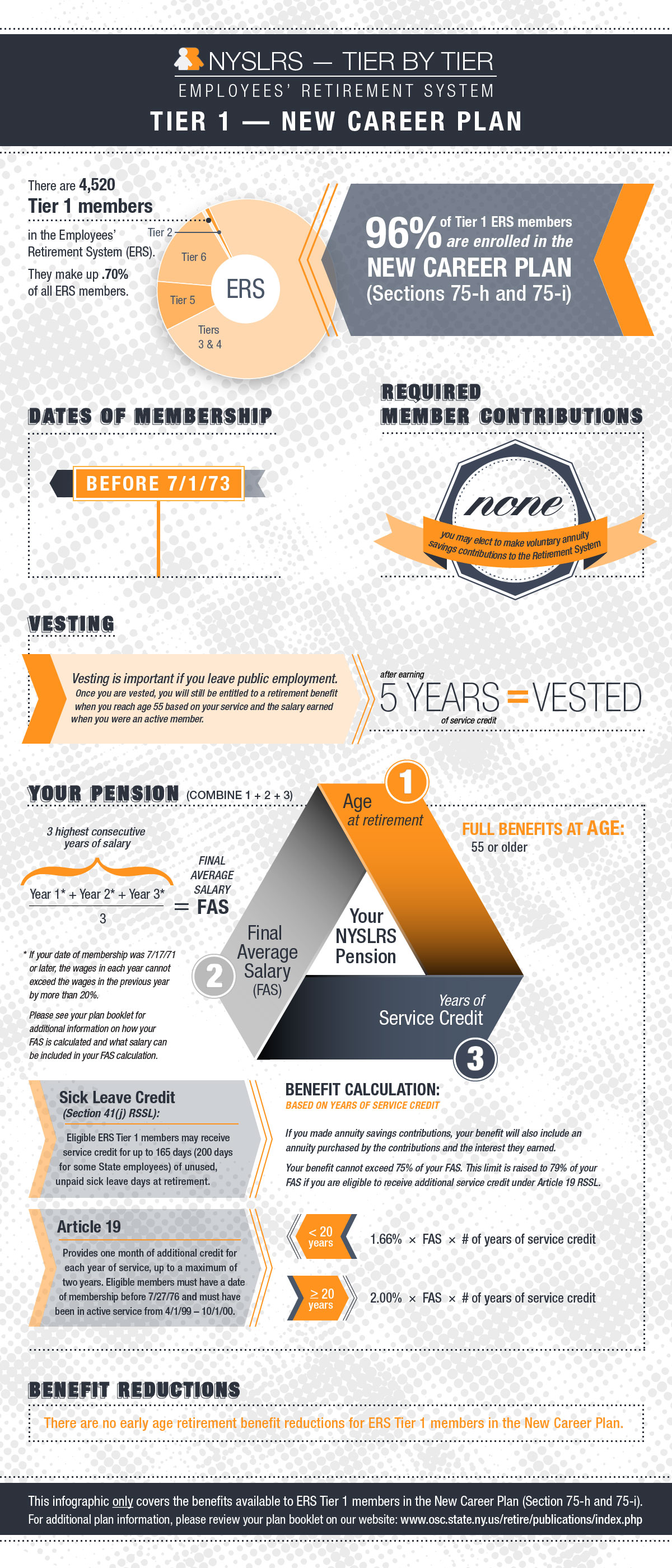
Most ERS Tier 1 and Tier 2 members are in the New Career Plan (Section 75-h or 75-i). Currently, 96 percent of active Tier 1 members and almost 95 percent of active Tier 2 members are covered by this plan. Here’s a quick look at the benefits in the New Career Plan:

Benefit Eligibility

Tier 1

  • Members must be at least age 55 to be eligible to collect a retirement benefit.
  • There are no minimum service requirements — they may collect full benefits at age 55.

New Career Plan — ERS Tier 1

Tier 2

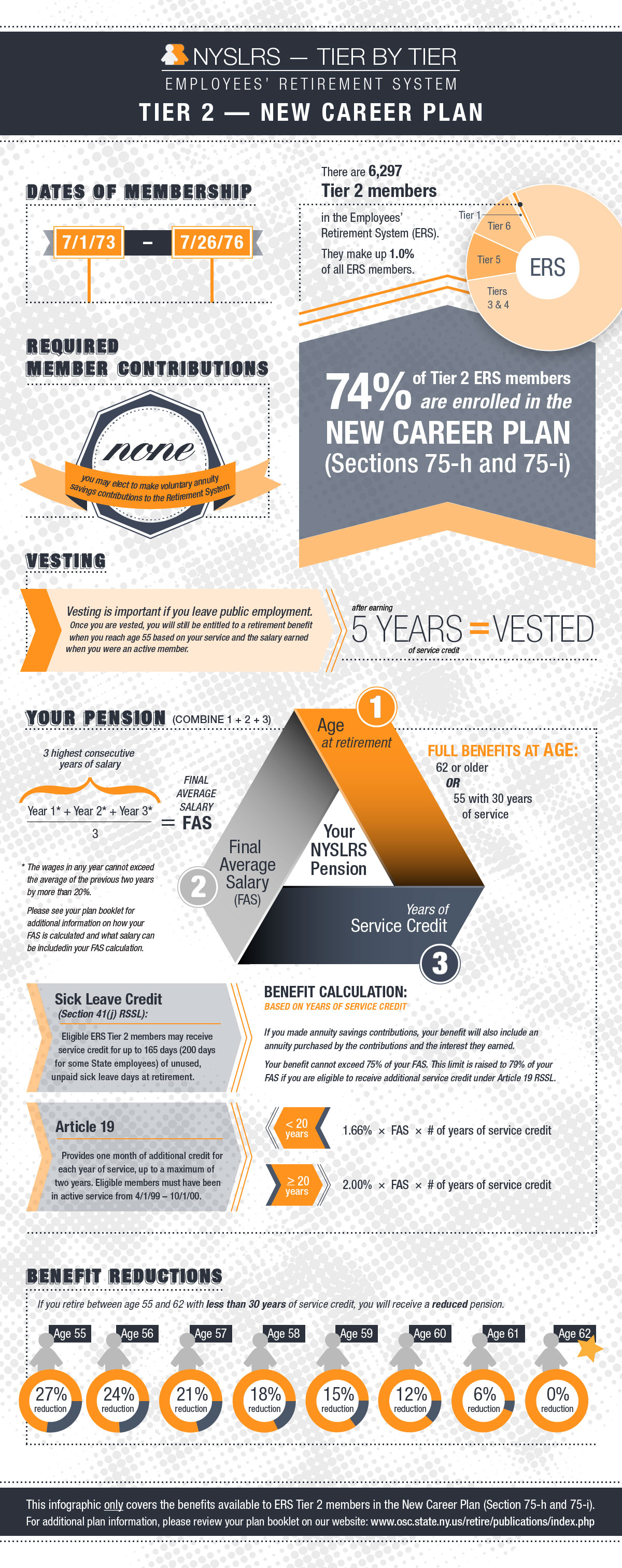
  • Members must have five years of service and be at least age 55 to be eligible to collect a retirement benefit.
  • The full benefit age is 62.
  • Almost 95 percent of active Tier 2 members are covered by the New Career Plan (Section 75-h or 75-i).

New Career Plan — ERS Tier 2

Final Average Salary

Final average salary (FAS) is the average of the wages earned in the three highest consecutive years of employment. For Tier 1 members who joined NYSLRS June 17, 1971 or later, each year used in the FAS calculation is limited to no more than 20 percent above the previous year’s earnings. For Tier 2 members, each year of earnings is limited to no more than 20 percent above the average of the previous two years’ earnings.

Benefit Calculations

  • For Tier 1 and 2 members, the benefit is 1.66 percent of the FAS for each year of service if the member retires with less than 20 years. If the member retires with 20 or more years of service, the benefit is 2 percent of the FAS for each year of service.
  • Tier 1 members and Tier 2 members with 30 or more years of service can retire as early as age 55 with no reduction in benefits.
  • Both Tier 1 and Tier 2 members who worked continuously from April 1, 1999 through October 1, 2000 receive an extra month of service credit for each year of credited service they have at retirement, up to a maximum of 24 additional months.

If you have questions about the New Career Plan, please read the Tier 1 plan publication or the Tier 2 plan publication. You can find other plan publications on our website.

NYSLRS – One Tier at a Time: ERS Tier 1

When you joined the New York State and Local Retirement System (NYSLRS), you were assigned to a tier based on the date of your membership. There are six tiers in the Employees’ Retirement System (ERS) and five in the Police and Fire Retirement System (PFRS) — so there are many different ways to determine benefits for our members. Our series, NYSLRS – One Tier at a Time, walks through each tier and gives you a quick look at the benefits members are eligible for before and at retirement.

One of our smallest tiers is ERS Tier 1, which represents 0.7 percent of NYSLRS’ total membership. Overall, there are 4,520 ERS Tier 1 members. Today’s post looks at the major Tier 1 retirement plan in ERS – the New Career Plan (Section 75-h or 75-i).
ERS-Tier-1-Benefits_001
If you’re an ERS Tier 1 member in an alternate plan, you can find your retirement plan publication below for more detailed information about your benefits:

Be on the lookout for more NYSLRS – One Tier at a Time posts. Want to learn more about the different NYSLRS retirement tiers? Check out some earlier posts in the series:

NYSLRS – One Tier at a Time: ERS Tier 2

When you joined the New York State and Local Retirement System (NYSLRS), you were assigned to a tier based on the date of your membership. There are six tiers in the Employees’ Retirement System (ERS) and five in the Police and Fire Retirement System (PFRS) – so there are many different ways to determine benefits for our members. Our series, NYSLRS – One Tier at a Time, walks through each tier and gives you a quick look at the benefits members are eligible for before and at retirement.

NYSLRS created Tier 2 on July 1, 1973, marking the first time NYSLRS created any new member group. Today’s post looks at one of the major Tier 2 retirement plans in ERS. ERS Tier 2 as a whole represents less than one percent of NYSLRS’ total membership.

ERS-Tier-2-Benefits_001aIf you’re an ERS Tier 2 member in an alternate plan, you can find your retirement plan publication below for more detailed information about your benefits:

Be on the lookout for more NYSLRS – One Tier at a Time posts. Next time, we’ll take a look at another ERS tier. Want to learn more about the different NYSLRS retirement tiers? Check out some earlier posts in the series:

NYSLRS – One Tier at a Time: PFRS Tier 1

When you joined the New York State and Local Retirement System (NYSLRS), you were assigned to a tier based on the date of your membership. There are six tiers in the Employees’ Retirement System (ERS) and five in the Police and Fire Retirement System (PFRS) – so there are many different ways to determine benefits for our members. Our series, NYSLRS – One Tier at a Time, walks through each tier and gives you a quick look at the benefits members are eligible for before and at retirement.

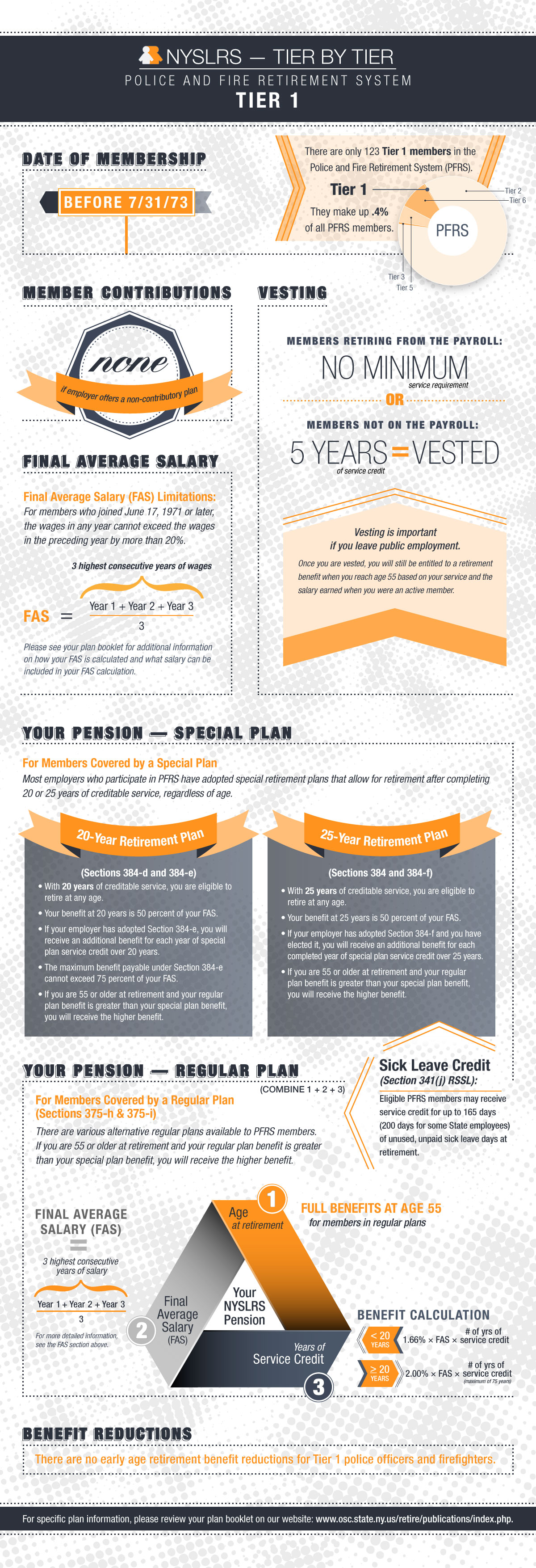
Today’s post looks at Tier 1 in the Police and Fire Retirement System, which has only 123 members. PFRS Tier 1 represents the smallest percentage – 0.4 percent – of NYSLRS’ total membership.

PFRS-Tier-1-Benefits_002

If you’re a PFRS Tier 1 member, you can find your retirement plan publication below for more detailed information about your benefits:

Be on the lookout for more NYSLRS – One Tier at a Time posts. Next time, we’ll take a look at another one of our ERS tiers. Want to learn more about the different NYSLRS retirement tiers? Check out some earlier posts in the series:

Change Your Mind, or Plans? Here’s How to Withdraw a NYSLRS Retirement Application

Even though you’ve been preparing for retirement, sometimes certain life events happen and you may find yourself in a position where you just aren’t ready to retire. In some cases, this can happen right after you’ve already filed your NYSLRS retirement application. Don’t panic – you can pull your retirement application at any time before your retirement date.

How Can I Stop a Retirement Application I’ve Already Submitted?

To withdraw your application, you can either submit the Withdrawal of Application for Service Retirement (RS6354) form or send us a signed letter indicating you wish to withdraw your retirement application. Please include your name, address and registration number and/or the last four digits of your Social Security number in your letter.

Filing Forms with the Comptroller

Filing a form to withdraw your service retirement application is just like filing a form to apply for a service retirement. For any form to be considered “filed with the Comptroller,” it must be received by:

We will consider a form filed on the day you deliver it personally or when the Post Office delivers it to us. If you are concerned about meeting a deadline, you can mail the document via “Certified Mail – Return Receipt Requested” and we will consider it filed on the date it was mailed. You can also send the document to us via fax, but you must still mail us the original to meet the filing requirement. Please see our Contact Us page for more information.

Please keep in mind that if your retirement withdrawal is filed on or after your effective date of retirement, it is invalid and you will be officially retired.

When We Receive Your Retirement Withdrawal

Once we receive your request to withdraw your retirement application, we’ll send you an acknowledgment letter and also notify your employer, but we strongly encourage you to let your employer know immediately of your decision. That will help you and your employer avoid any unnecessary termination processing.

When Your Circumstances Change

When you’re ready to retire, you’ll need to file a new Application for Service Retirement (RS6037) form. Your application must be on file with us at least 15 days, but not more than 90 days, before your new retirement date.

Contact us if you have any questions about withdrawing your retirement application or any other retirement-related topic you might have.

Top Five Pre-Retirement Goals For NYSLRS Members in 2015

This is the time of year when people set goals for themselves. At the New York State & Local Retirement System (NYSLRS), we believe in setting realistic financial goals, especially when it comes to preparing for retirement. Here are five goals we think you can achieve in 2015:

  1. Choose a sensible savings plan that works for you. There are several ways to save for retirement, including starting a deferred compensation plan like the New York State Deferred Compensation Plan. The most important part of developing a savings plan is to start early. The sooner you start saving, the more time your money has to grow. And if you’re nearing retirement age, “binge saving” is always an option worth considering. Check out our Weekly Investment Plan to see how making a weekly investment can grow by age 65.

  2. Track your current and future monthly expenses and income. We feature worksheets to help you prepare a post-retirement budget on our website. Keep track of what you spend now for a month or two to get an idea of how you spend your money. You should include periodic expenses, such as car insurance payments, or property and school taxes as well. Use another of our worksheets to help you summarize your current monthly income and estimate your post-retirement monthly income. Having a post-retirement budget can help you decide how to spend money in retirement, and if you’ll need to supplement your pension.

  3. Request a NYSLRS retirement estimate. A NYSLRS retirement estimate provides you with an estimation of what your pension could be based on the information we have on file for you. You should request an estimate 18 months before your anticipated date of retirement. Many members don’t request an estimate because they don’t know their exact retirement date, but don’t let that stop you. It’s a good way to determine how retirement ready you are. At the very least, you should use our online Benefit Calculator to estimate your pension based on information you enter. Have your Member Annual Statement handy to help fill in key information.

  4. Pay off your NYSLRS loans, if you have any. An outstanding loan balance at retirement will permanently reduce your NYSLRS retirement benefit. You cannot make loan payments after you retire, and the reduction does not go away after we recover the funds. Visit our website for information about making additional payments or increasing your loan payment amount.

  5. Consult a financial planner or accountant. Financial planners don’t manage your money, but will assess your present financial condition and develop a practical plan to meet your specific goal and needs.

If you ever have any retirement-related questions, please contact us. And Happy New Year!