

Tag Archives: Service credit

When Retirees Rejoin NYSLRS

rejoin NYSLRS

If you retire from public employment in New York State and later decide to go back to work in the public sector, you have the option of rejoining NYSLRS. However, if you are considering rejoining the Retirement System, you should understand how rejoining would affect your pension benefits.

Rejoining NYSLRS may increase your total service credit, allowing you to reach certain milestones that would increase your pension. An increase in earnings could also result in a higher pension. However, depending how long you work after rejoining, your new pension may not be higher than your original amount.

Note: This post applies to service retirees of the Employees’ Retirement System (ERS) or the Police and Fire Retirement System (PFRS) who are rejoining the same system. Different rules may apply to retirees of other retirement systems, retirees joining a system other than the one they retired from, and disability retirees.

What Happens to Your Pension When You Rejoin NYSLRS?

If you rejoin NYSLRS, your pension will be suspended. If you are in Tiers 2 through 6 and you earn less than two years of new service credit after you rejoin, your original pension would be reinstated when you retire the second time. Any new service credit and earnings would not affect your pension. (Tier 1 members would receive an additional benefit even if they earn less than two years of service in their new membership.)

If you earn two or more years of new service, you can either receive your original pension or you can receive a recalculated benefit that includes your additional service. If you choose the recalculated benefit, you will have to repay the entire pension amount you have already received, plus interest. (The pension amount you repay would be based on the Single Life Allowance rate.) You may repay that amount in a lump sum or by installments before you retire again — or request a permanent reduction to your new pension.

Other Factors

Here are other things to consider before you rejoin NYSLRS:

  • When you retire again, your new retirement date can delay your eligibility for the annual cost-of-living adjustment (COLA).
  • If you are in Tier 1 or 2, rejoining may affect your death benefit.

Where to Go for Help

If you are considering rejoining NYSLRS, we strongly recommend you speak with a customer service representative to discuss how rejoining would affect your benefits. You can call them at 866-805-0990 or send them a message using our secure contact form.

You may also wish to read our publication Life Changes: What If I Work After Retirement?
ERS Tier 6 Benefits – A Closer Look

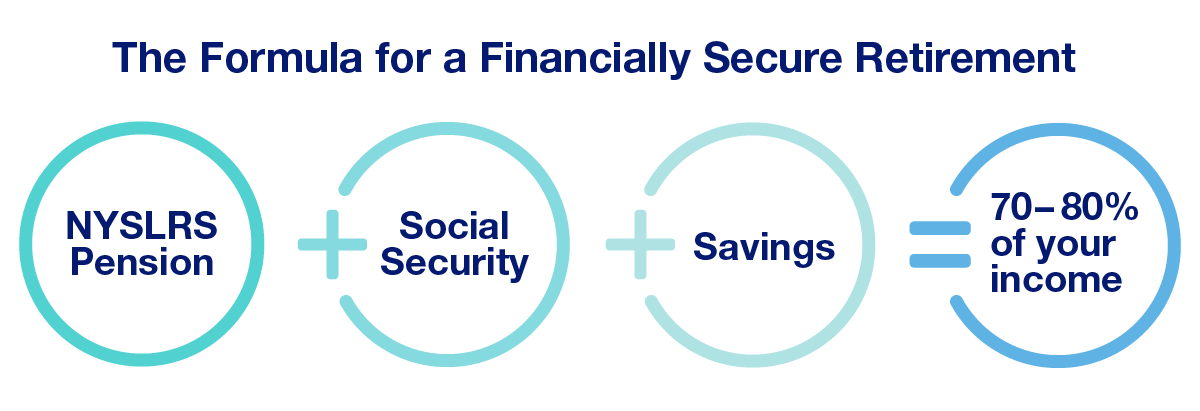
Financial advisers say you will need to replace between 70 and 80 percent of your salary to maintain your lifestyle after retirement. Your NYSLRS pension could go a long way in helping you reach that goal, especially when combined with your Social Security benefit and your own retirement savings. Here’s a look at how Employees’ Retirement System (ERS) members in Tier 6 (who are vested once they’ve earned five years of credited service), can reach that goal. Members who joined NYSLRS since April 1, 2012 are in Tier 6.

formula for a financially secure retirement

Calculating an ERS Tier 6 Member’s Pension

Your NYSLRS pension will be based on your Final Average Earnings (FAE) and the number of years you work in public service. FAE is the average of the five highest-paid consecutive years. Note: The law limits the FAE of all members who joined on or after June 17, 1971. For example, for most members, if your earnings increase significantly through the years used in your FAE, some of those earnings may not be used toward your pension.  

Although ERS members can generally retire as early as age 55 with reduced benefits, the full retirement age for Tier 6 members is age 63.

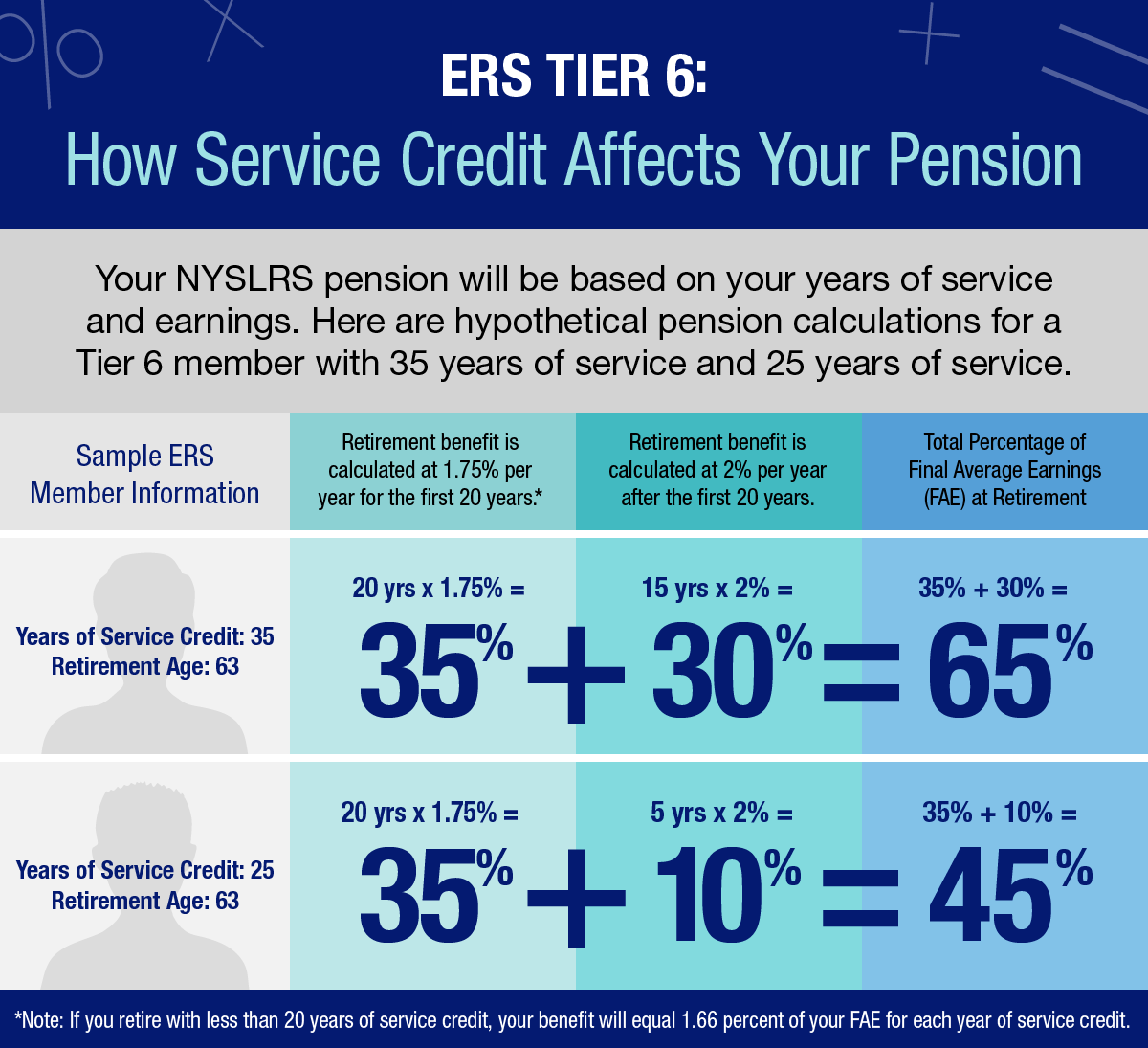
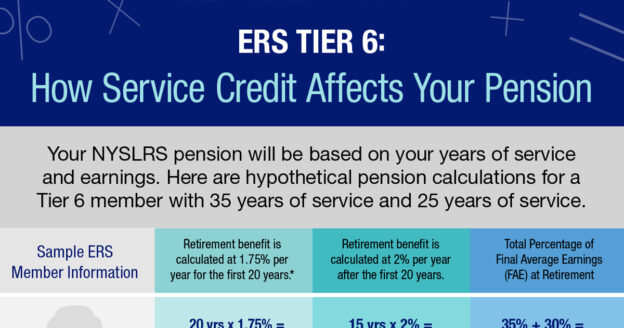
For ERS Tier 6 members in regular plans (Article 15), the benefit is 1.66 percent of your FAE for each full year you work, up to 20 years. At 20 years, the benefit equals 1.75 percent per year for a total of 35 percent. After 20 years, the benefit grows to 2 percent per year for each additional year of service. (Benefit calculations for members of the Police and Fire Retirement System and ERS members in special plans vary based on plan.)

Say you begin your career at age 28 and work full-time until your full retirement age of 63. That’s 35 years of service credit. You’d get 35 percent of your FAE for the first 20 years, plus 30 percent for the last 15 years, for a total benefit that would replace 65 percent of your salary. If you didn’t start until age 38, you’d get 45 percent of your FAE at 63.

Examples of ERS Tier 6 Pension Calculation

So, that’s how your NYSLRS pension can help you get started with your post-retirement income. Now, let’s look at what the addition of Social Security and your own savings can do to help you reach your retirement goal.

Other Sources of Post-Retirement Income

Social Security: According to the Social Security Administration, Social Security currently replaces about 40 percent of the wages of a typical worker who retires at full retirement age. In the future, these percentages may change, but you should still factor it in to your post-retirement income.

Your Savings: Retirement savings can also replace a portion of your income. How much, of course, depends on how much you save. The key is to start saving early so your money has time to grow. New York State employees and some municipal employees can participate in the New York State Deferred Compensation Plan. If you haven’t already looked into Deferred Compensation, you might consider doing so now.

How Full-Time and Part-Time Service Credit Works

Service credit plays a vital part in your pension calculation and your eligibility for other NYSLRS benefits. As a NYSLRS member, you earn service credit by working for an employer who participates in the Retirement System. Your paid public employment is creditable. You would not, however, earn credit for any period when you are not receiving a salary, such as an unpaid leave of absence. You would earn credit for both full-time and part-time employment, but if you work part-time, the service you earn is pro-rated.

Earning Service Credit When You Work Full Time

When you work on a full-time, continuous basis throughout your career, we’ll calculate your total service credit from your date of employment up until the date you leave paid employment. Most full-time workers earn a year of service credit for working 260 workdays a year. For a full-time, 12-month employee, 260 workdays equal a full year. (If you work in an educational setting, you can read about earning service credit in our blog post, How School Employees Earn NYSLRS Service Credit.)

Earning Service Credit When You Work Part Time

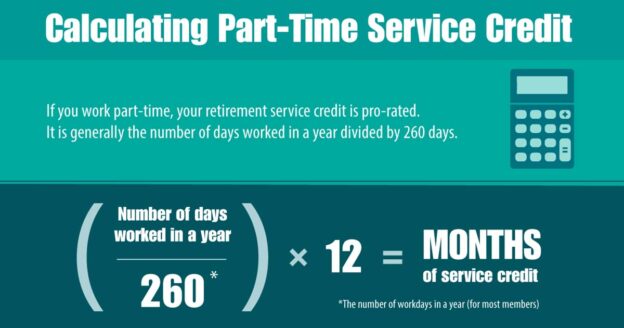
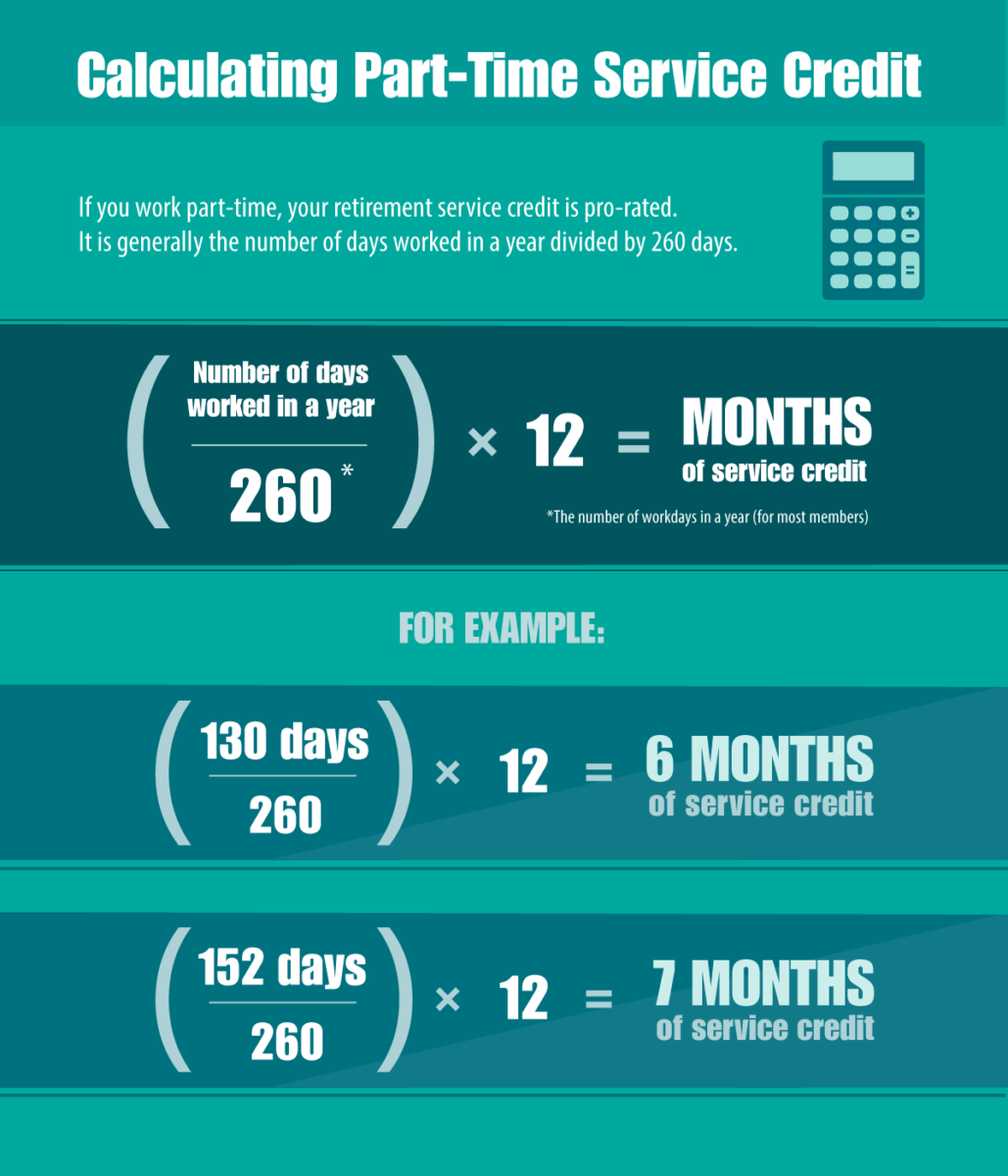
Your service credit is prorated if you work part time. Part-time employment is credited as the lesser of:

the number of days worked ÷ 260 days

or

your reported annual salary ÷ (the State’s hourly minimum wage × 2,000)

You can think of it like this: let’s say you work 130 days in a year. If a year’s worth of service credit is earned for working 260 days full time, you’d earn half a year (0.5) of service credit for your part-time work.

How Part-Time Service Credit Works

Check Your Service Credit in Retirement Online

Retirement Online is the fastest way to check your current total estimated service credit. Once you sign in, go to the ‘My Account Summary’ section of your Account Homepage and look under “Account Information.”

You can also use Retirement Online to request credit for public employment from before you joined NYSLRS. If you’re eligible to purchase previous service credit, it’s a good idea to file your request as early in your career as possible because:

  • Records we need to verify your service will be more readily available.
  • If there is a cost, it will be less expensive than if you wait to purchase credit before retirement.
  • Your retirement benefit will be processed more quickly if your service credit request has been reviewed or processed prior to retirement.

For more information, please read our publication Service Credit for Tiers 2 through 6. You may also wish to refer to your specific retirement plan booklet, available on our Publications page.

The Police and Fire Retirement System

NYSLRS is actually two retirement systems: the Employees’ Retirement System (ERS) and the Police and Fire Retirement System (PFRS).

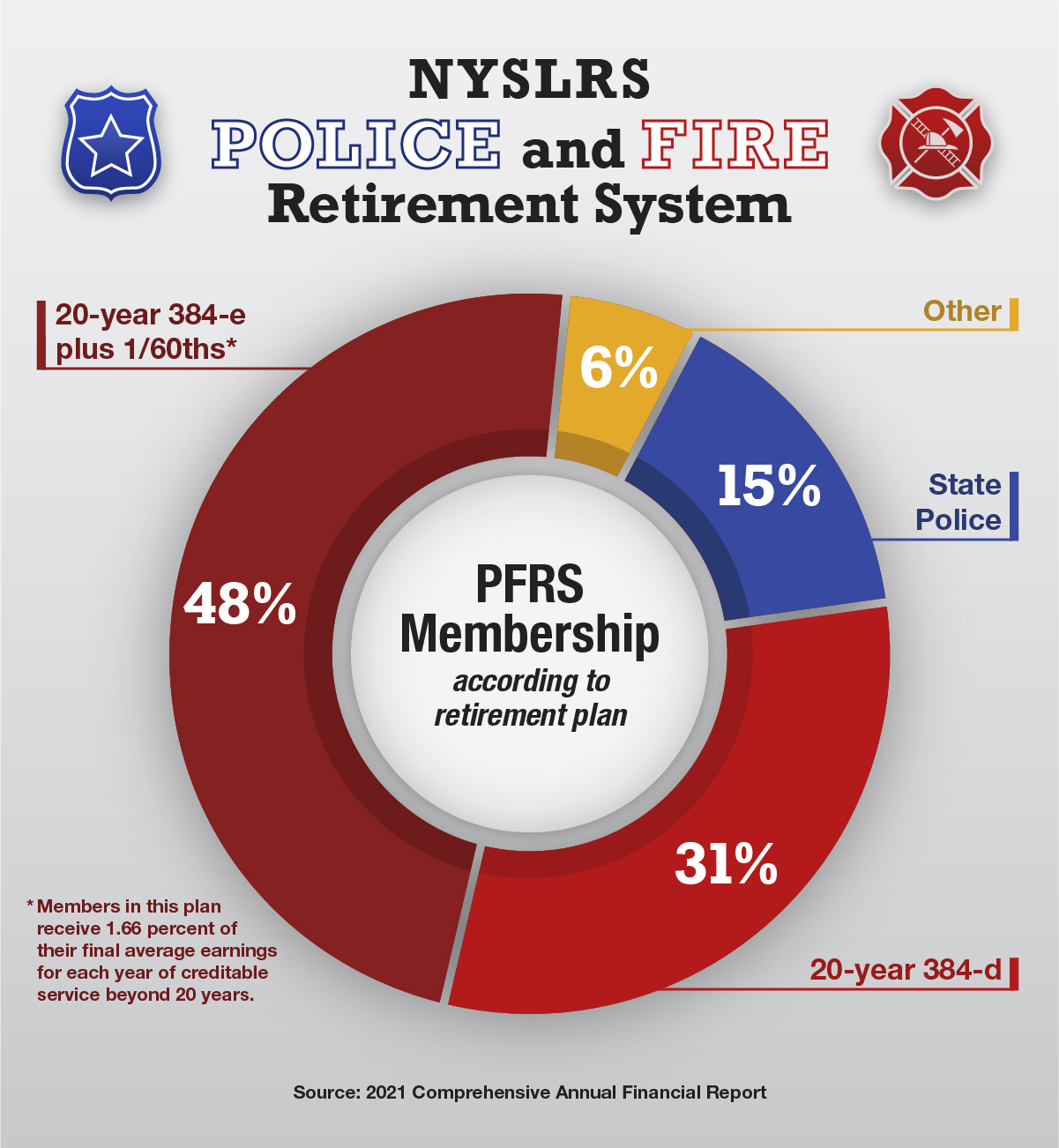
PFRS, which provides retirement benefits for police officers and paid firefighters, is the smaller of the two systems, with about 32,000 active members. A third of PFRS members work for cities, while almost 19 percent work for New York State. The remainder work for towns, counties and villages.

There are five tiers in PFRS, reflecting when the members joined the system: Tiers 1, 2, 3, 5 and 6 (there is no Tier 4 in PFRS). Tier 2, which includes PFRS members who joined the Retirement System from July 31, 1973 through June 30, 2009, is the largest tier, accounting for almost 55 percent of PFRS membership.

If you joined PFRS on or after April 1, 2012, you are in Tier 6.

Ninety-eight percent of PFRS members are in special retirement plans that allow for retirement after 20 or 25 years of creditable service. If you are in one of these plans, once you have the full amount of required service, you can retire at any age.

Some PFRS members are in regular retirement plans, which require a member to reach a certain age before they are eligible for a pension.

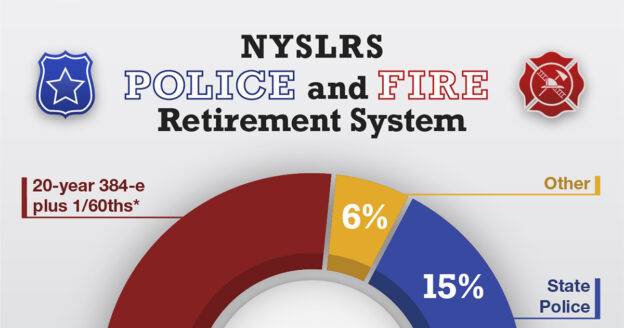
police and fire infographic

As a PFRS member, you’ll pass a series of important milestones throughout your career. Knowing and understanding these milestones will help you better plan for your financial future.

Service Credit

Service credit is a key in determining your eligibility for a pension and other benefits, including the amount of those benefits.

Under most 20- and 25-year plans, not all public employment is creditable. Usually, police and firefighting service can be counted as special-plan service. You may also be able to use military service to help you reach 20 or 25 years. If you have questions about the service that can be used to calculate your pension, please check your retirement plan booklet or contact us.

PFRS Plan Booklets

You can find details about your NYSLRS benefits in your retirement plan booklet.

For the majority of PFRS members, that’s the Special 20- and 25-Year Plans booklet. This booklet is for PFRS Tier 2, 3, 5 and 6 members covered by Sections 384, 384-d and 384-e of the State Retirement and Social Security Law.

If you are a PFRS member who works for New York State, your booklet is based on your specific job. There are separate booklets for State PoliceForest RangersRegional State Park PoliceState University Police and EnCon Police.

If you are not covered by one of the plan booklets listed above, you can find your booklet on our Publications page. If you’re not sure what retirement plan you’re in, you can find that information in the My Account Summary section of your Retirement Online account. You can also check your Member Annual Statement, ask your employer or email us using our secure contact form.

Tier 3 & 4 Members: When Is The Right Time To Retire?

Tier 3 and 4 members in the Article 15 retirement plan qualify for retirement benefits after they’ve earned five years of credited service. Once you’re vested, you have a right to a NYSLRS retirement benefit — even if you leave public employment. Though your pension is guaranteed, the amount of your pension depends on several factors, including when you retire. Here is some information that can help you determine the right time to retire.

Three Reasons to Keep Working

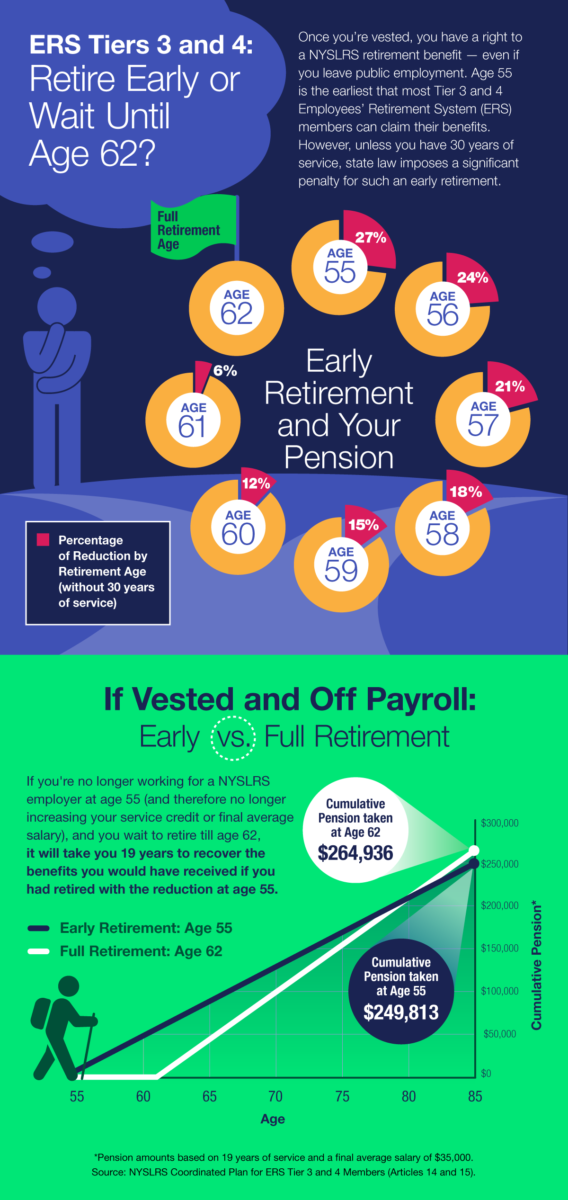
  1. Tier 3 and 4 members can claim their benefits as early as age 55, but they’ll face a significant penalty for early retirement – up to a 27 percent reduction in their pension. Early retirement reductions are prorated by month, so the penalty is reduced as you get closer to full retirement age. At 62, you can retire with full benefits. (Tier 3 and 4 Employees’ Retirement System (ERS) members who are in the Article 15 retirement plan and can retire between the ages of 55 and 62 without penalty once they have 30 years of service credit.)
  2. Your final average earnings (FAE) are a significant factor in the calculation of your pension benefit. Since working longer usually means a higher FAE, continued public employment can increase your pension.
  3. The other part of your retirement calculation is your service credit. More service credit can earn you a larger pension benefit, and, after 20 years, it also gets you a better pension formula. For Tier 3 and 4 members, if you retire with less than 20 years of service, the formula is FAE × 1.66% × years of service. Between 20 and 30 years, the formula becomes FAE × 2.00% × years of service. After 30 years of service, your pension benefit continues to increase at a rate of 1.5 percent of FAE for each year of service.

When is the Right Time to Retire infographic


If You’re Not Working, Here’s Something to Consider

Everyone’s situation is unique. For example, if you’re vested and no longer work for a public employer, and you don’t think you will again, taking your pension at 55 might make sense. When you do the math, full benefits at age 62 will take 19 years to match the money you’d have received retiring at age 55 — even with the reduction.

An Online Tool to Help You Make Your Decision

Most members can use Retirement Online to estimate their pensions.

A Retirement Online estimate is based on the most up-to-date information we have on file for you. You can enter different retirement dates to see how those choices would affect your benefit, which could help you determine the right time to retire. When you’re done, you can print your pension estimate or save it for future reference.

If you are unable to use our online pension calculator, please contact us to request a pension estimate.

This post has focused on Tier 3 and 4 members. To see how retirement age affects members in other tiers, visit our About Benefit Reductions page.

Dual Membership in NYSLRS

The New York State and Local Retirement System (NYSLRS) consists of two retirement systems: the Employees’ Retirement System (ERS) and the Police and Fire Retirement System (PFRS). Your job title determines what system you’re in. In some cases, however, it’s possible to have a dual membership, to be a member of both systems.

How Does Dual Membership Work?

dual membership in NYSLRSLet’s say you work as a firefighter, so you’re a member of PFRS. You decide to take on a part-time job as a bus driver for your local school district. Your school district participates in ERS, so you’re eligible for ERS membership. You fill out the membership application, and now you’re a member of both ERS and PFRS. The date you join each system determines your tier in each membership.

Implications of Dual Membership

As a member of both systems, you’d have separate membership accounts. Let’s look again at our fire-fighting bus driver example. While working as a firefighter, you make any required contributions and earn service credit toward your PFRS pension only. The same is true for your work as a bus driver—your required contributions and earned service credit only go toward your ERS pension, not your PFRS pension.

There are other implications to dual membership. Assuming you’re vested in both memberships and meet the service credit and age requirements, you could retire and collect a pension from both systems. You’d need to file separate retirement applications for ERS and PFRS, and we’d calculate each pension separately. We’d calculate your ERS pension using the final average earnings (FAE) you earned as a bus driver and your PFRS pension using the FAE from your time as a firefighter.

And, since you’d have both an ERS pension and a PFRS pension, you would need to choose a beneficiary for each in the event of your death.

Questions?

You’ll want to make sure to know the details of your retirement plan in each system. If you have questions about dual membership, or want to discuss your particular situation when you decide to retire, please contact us.

NYSLRS’ Special Retirement Plans

NYSLRSCertain PFRS and ERS members are under Special Retirement Plans manages more than 300 retirement plan combinations for its members, which are described in more than 50 plan booklets. But, for all that complexity, they breakdown into just two main types: regular plans and special plans. Under a regular plan, you need to reach certain age and service requirements to receive a pension. For instance, if you’re a Tier 4 member in the Employees’ Retirement System (ERS) with a regular plan, you’re eligible for a benefit when you turn 55 and have five or more years of service credit. Most of our ERS members are in regular plans.
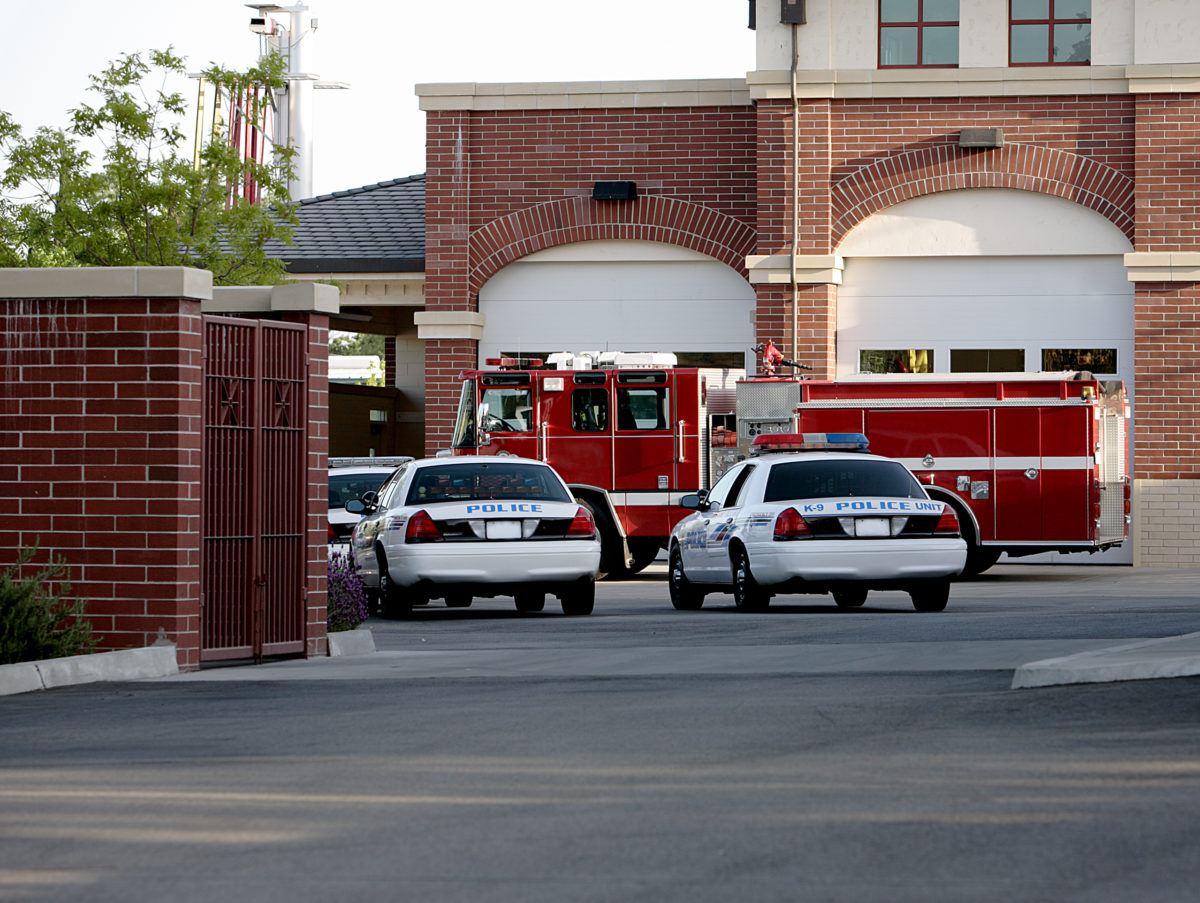

Special plans are a little different. With special plans, NYSLRS members can receive a pension after completing 20 or 25 years of service. There is no age requirement; you can retire at any age once you have the full amount of required service credit. Both ERS and the Police and Fire Retirement System (PFRS) have special plans.

Special Plans for Special Services to the State

As of March 31, 2018, seven percent of active ERS members and 98 percent of active PFRS members are in special plans. These members fill roles such as:

  • Police officer;
  • Firefighter;
  • Correction officer;
  • Sheriffs undersheriff, and deputy sheriff; and
  • Security hospital treatment assistant.

Public employees in jobs like these face dangers and difficulties throughout their careers. They fight fires, patrol our neighborhoods, assist ill patients and more. We’d like to take this opportunity to thank them for the challenging, sometimes life-threatening work they do each day.

If you’d like to learn more about your retirement plan, please visit the Publications page of our website and review your plan publication. If you’re not sure which booklet covers your benefits, you can check your Member Annual Statement, ask your employer or send us an email using our secure contact form.

Creditable Service for Police & Fire Members

The New York State and Local Police and Fire Retirement System (PFRS) provides service and disability retirement benefits, as well as death benefits to more than 35,000 police officers and firefighters.

Most PFRS members are covered by a plan that allows for retirement after 20 or 25 years, regardless of age, without penalty. As a member, you earn credit toward that requirement through paid public employment with participating employers. However, not all public service counts toward your 20 or 25 years.

What Credit Counts Towards Retirement?

The public service that can be used toward your 20 or 25 years is determined by the specific retirement plan under which you’re covered. Check your retirement plan booklet for details.

There are booklets for state police , forest rangers , regional state park police , state university police , EnCon police and members covered under Sections 384, 384-d and 384-e of Retirement and Social Security Law (RSSL). More plan booklets are available on our Publications page.

The most common PFRS plan, which covers nearly 50 percent of PFRS members, was established by Section 384-e of RSSL. With this plan, you earn creditable service:

  • As a firefighter or police officer under the 384-e plan;
  • As a member or officer of the New York State Police; or
  • In the military, as specified by law.

In the 384-e retirement plan, civilian service, as well as service as a sheriff, corrections officer or volunteer firefighter, is not creditable.

creditable service for police and fire retirement system members

Transferring Membership or Purchasing Service Credit — Contact Us First

If you have worked for multiple New York State public employers and are unsure if all of your service is creditable towards your 20 or 25 year plan, contact us before transferring membership or purchasing service credit . Please note: the public service that can be used toward your 20 or 25 years is determined by legislation and differs among plans offered to PFRS members. You should also be sure to request an estimate from us well before your planned date of retirement if there is any question about your creditable service.

Get an Estimate

PFRS members should request an estimate from us as early as 18 months before you plan to retire. It’s the best way to make sure you have all the credit you’re entitled to. Simply fill out and return a Request for Estimate (RS6030) form.

Getting Credit for Your Military Service

If you served in the U.S. Armed Forces, you may be eligible to buy back up to three years of active service credit. Because service credit is a factor in calculating a NYSLRS pension, in most cases buying military service credit will increase your pension.

Military Service Credit

To be eligible, veterans must:

  • Have been honorably discharged;
  • Have at least five years of credited service in the Retirement System;
  • Have not received credit for this service in any other public retirement system in New York State; and
  • Apply for and purchase military service credit before they retire.

How to Apply for Military Service Credit

To apply and request a cost for military service credit:

1. Fax your name, contact information and a copy of your DD-214 to 518-486-6405 or 518-402-7799;

or

2. Mail a letter with your name and contact information, and a photocopy of your DD-214, to:
    Military Service Unit
    110 State Street
    Albany, NY 12244-0001

If after reviewing your application we determine you are eligible, we will send you a letter that will tell you how much credit you are eligible to purchase and the cost. Most members in Tier 1, 2, 3 or 4 can use our online benefit projection calculator to see how the credit would impact your pension. Tier 5 and 6 members can get that information by calling 1-866-805-0990, or using our secure email form (www.emailNYSLRS.com).

For more information, visit the Military Service Credit page on our website.

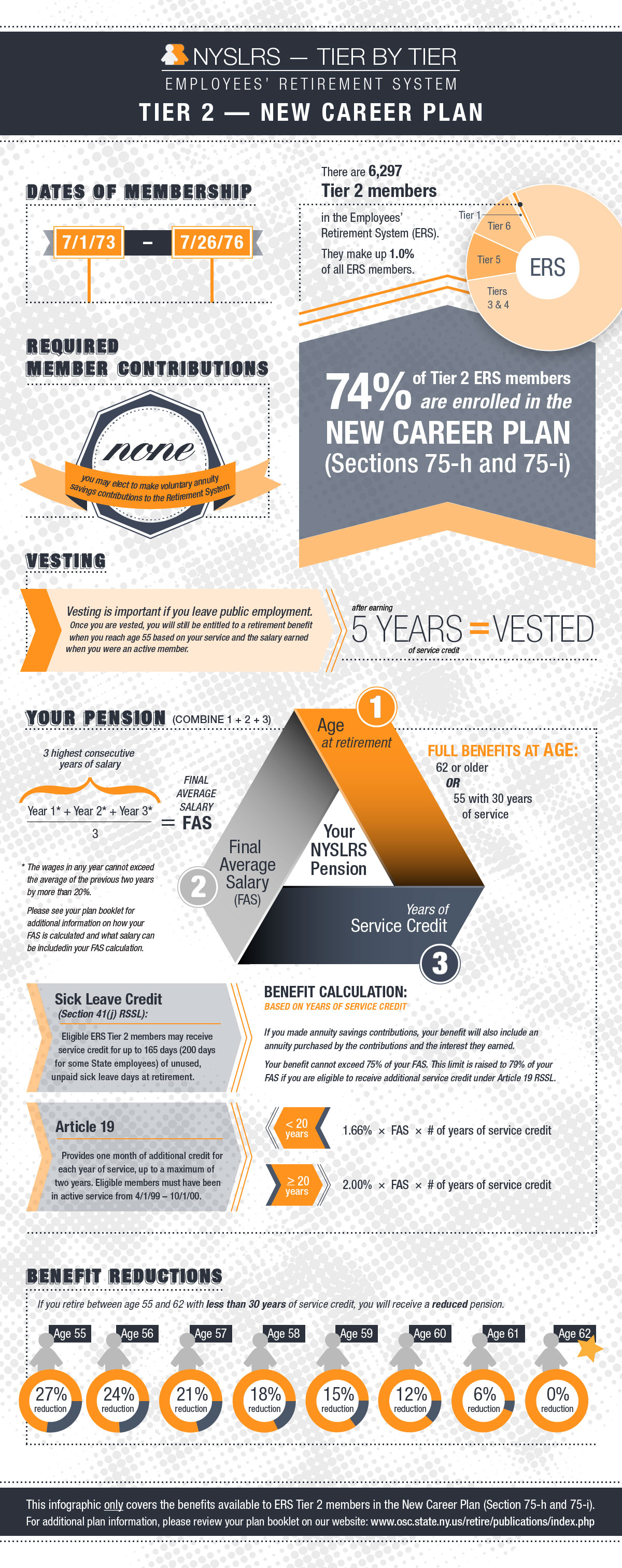
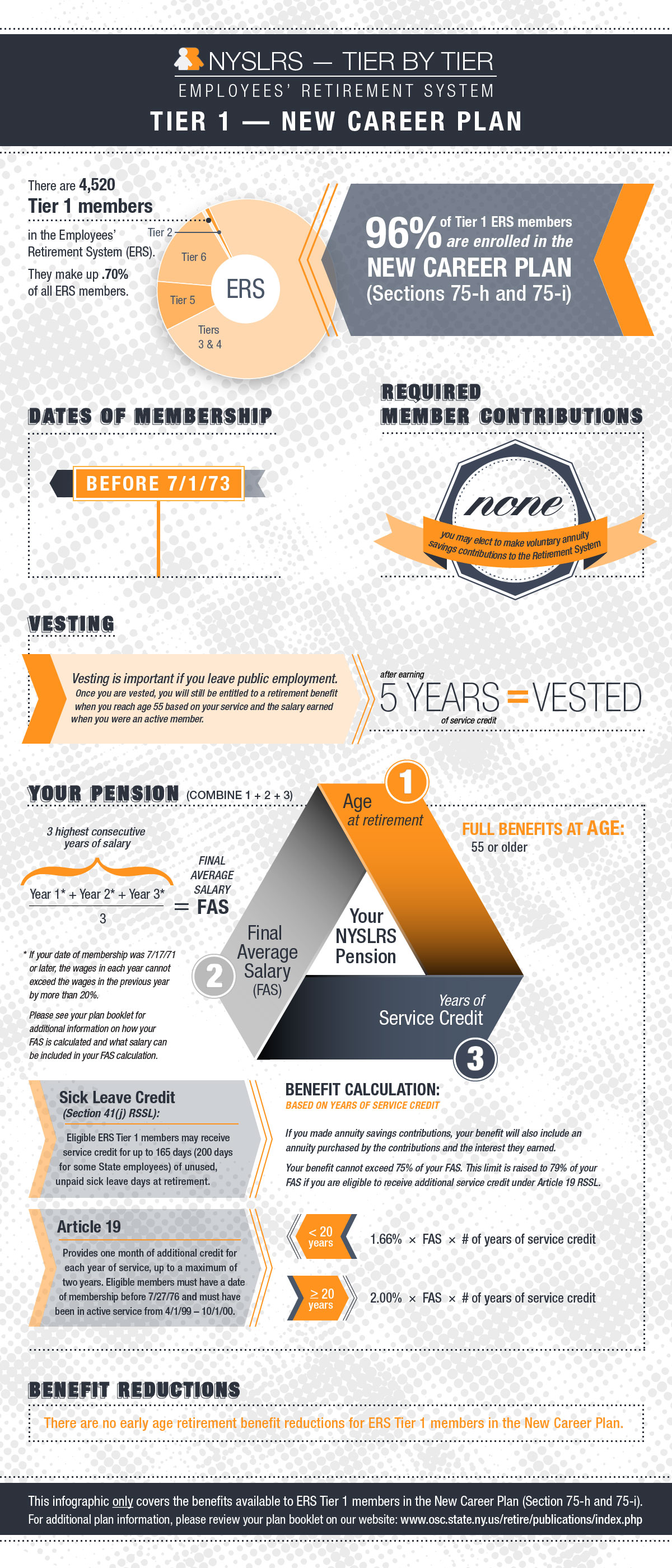
ERS Tiers 1 and 2: The New Career Plan

Did you become a member of the Employees’ Retirement System (ERS) before July 1, 1973? If you’re still working in public service, you’re one of the 3,508 active members in Tier 1. If you joined after July 1, 1973 but before July 27, 1976, then you’re one of 4,127 active members in Tier 2.

Most ERS Tier 1 and Tier 2 members are in the New Career Plan (Section 75-h or 75-i). Currently, 96 percent of active Tier 1 members and almost 95 percent of active Tier 2 members are covered by this plan. Here’s a quick look at the benefits in the New Career Plan:

Benefit Eligibility

Tier 1

  • Members must be at least age 55 to be eligible to collect a retirement benefit.
  • There are no minimum service requirements — they may collect full benefits at age 55.

New Career Plan — ERS Tier 1

Tier 2

  • Members must have five years of service and be at least age 55 to be eligible to collect a retirement benefit.
  • The full benefit age is 62.
  • Almost 95 percent of active Tier 2 members are covered by the New Career Plan (Section 75-h or 75-i).

New Career Plan — ERS Tier 2

Final Average Salary

Final average salary (FAS) is the average of the wages earned in the three highest consecutive years of employment. For Tier 1 members who joined NYSLRS June 17, 1971 or later, each year used in the FAS calculation is limited to no more than 20 percent above the previous year’s earnings. For Tier 2 members, each year of earnings is limited to no more than 20 percent above the average of the previous two years’ earnings.

Benefit Calculations

  • For Tier 1 and 2 members, the benefit is 1.66 percent of the FAS for each year of service if the member retires with less than 20 years. If the member retires with 20 or more years of service, the benefit is 2 percent of the FAS for each year of service.
  • Tier 1 members and Tier 2 members with 30 or more years of service can retire as early as age 55 with no reduction in benefits.
  • Both Tier 1 and Tier 2 members who worked continuously from April 1, 1999 through October 1, 2000 receive an extra month of service credit for each year of credited service they have at retirement, up to a maximum of 24 additional months.

If you have questions about the New Career Plan, please read the Tier 1 plan publication or the Tier 2 plan publication. You can find other plan publications on our website.