Tag Archives: police and fire retirement system

Make Sure You Receive Your Member Annual Statement

NYSLRS distributes Member Annual Statements beginning in May. Don’t wait for a copy in the mail—get your Statement sooner online!

Reminder for Retirees: Your Retiree Annual Statement is available online, and we mailed printed Statements by the end of February.

Get Your Member Annual Statement Sooner and Help Us ‘Go Green’

You can get access to your Member Annual Statement sooner than printed copies are mailed by updating your delivery preference to email. When you choose to get your Statement online, it’ll save you time—and it’ll help us ‘go green’ by reducing paper waste.

To update your delivery preference:

  • Sign in to Retirement Online.
  • Look under My Profile Information.
  • Click update next to ‘Member Annual Statement by.’
  • Choose Email from dropdown.

Be sure the email address listed in your Retirement Online profile is current.

When your Statement is available, we’ll send an email notifying you to sign in to Retirement Online.

Note: If you choose email as your delivery preference, you will not receive a printed copy in the mail.

Get Your Member Annual Statement Faster with Retirement Online

Update Your Contact Information

We distribute Member Annual Statements based on the mailing or email address we have on file, so you should make sure your information is current. Retirement Online is the fastest and most convenient way to review your contact information and update it if needed.

To update your contact information:

If you don’t already have an email address on file, please provide it so we contact you quickly with important information, such as a change to your benefits. Use a personal email address you will have access to after you retire, not a work email address.

Use Retirement Online to Stay Informed

Your Member Annual Statement is a snapshot of your NYSLRS membership and benefits as of March 31, the end of the State fiscal year. For up-to-date account information throughout the year, sign in to Retirement Online. You can manage your beneficiaries, estimate your pension, request additional service credit, apply for retirement and more—without the hassle of printing and mailing forms or calling. Check out what else members can do in Retirement Online.

If you don’t have an account or for help signing in to an existing account, check out our Retirement Online Tools and Tips blog post where you’ll find information to help you register, reset your password, unlock your account and more.

A Look Inside NYSLRS

Let’s take a look inside the New York State and Local Retirement System (NYSLRS) and what makes it one of the largest and best retirement systems in the United States.

NYSLRS administers two distinct systems. They are:

  • The Employees’ Retirement System (ERS) with 677,604 members; and
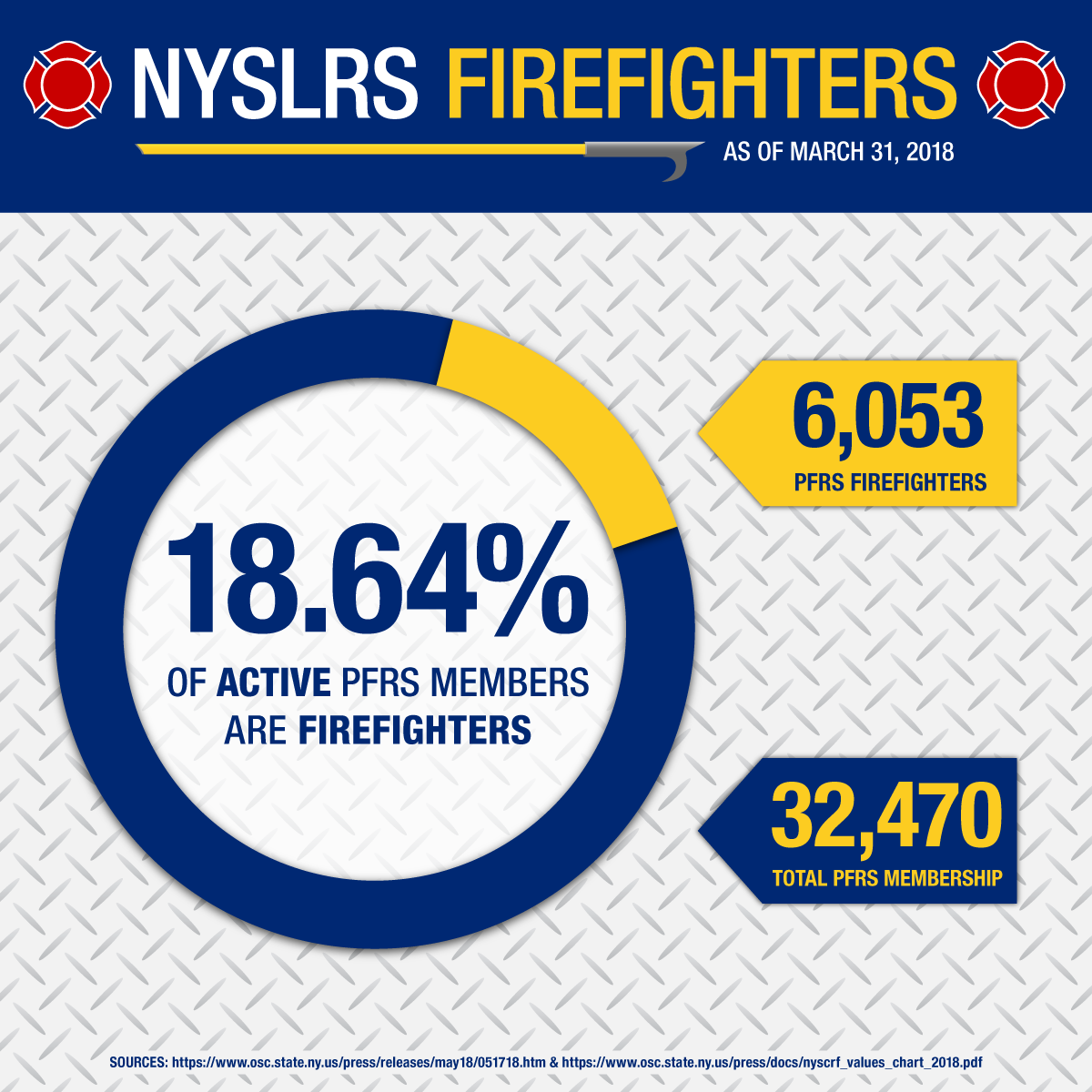
  • The Police and Fire Retirement System (PFRS) with 36,198 members.

In addition, NYSLRS provides pension benefits to more than 520,000 retirees and beneficiaries. Altogether, that’s more than 1.2 million participants!

A Look Inside NYSLRS

New York State Common Retirement Fund

State Comptroller Thomas P. DiNapoli is administrative head of NYSLRS and trustee of the New York State Common Retirement Fund, which was valued at $267.4 billion as of March 31, 2024. The Fund is widely recognized as one of the best-managed and best-funded public pension plans in the nation. Since its establishment in 1921, the Fund’s prudent investment management, solid returns, and constitutionally protected benefits have provided retirement security for generations of hard-working New Yorkers.

NYSLRS Members                                                          

How did NYSLRS earn the distinction of being one of the largest systems? Here are some facts about NYSLRS members:

  • 527,404 active members (that is, members still on the public payroll) work for 2,988 public employers statewide.
  • About one-third of those active members work for New York State. The rest work for counties, cities, towns, villages, school districts and public authorities.
  • Nearly 94 percent of total active members are in ERS while only 6 percent of total active members are in PFRS.
  • Tier 6 is our largest benefit group, with more than 60 percent of all members (62.6 percent in ERS, 56 percent in PFRS).
  • In ERS, Tiers 3 and 4 are the second largest benefit group, with 33.1 percent of members.
  • While, in PFRS, Tier 2 is the second largest benefit group, with 38.7 percent of members.

For more information about our largest ERS tiers, see our blog posts, ERS Tier 6 Milestones and ERS Tiers 3 and 4 Milestones. You can also learn more about the PFRS Milestones our police and fire fighters across New York State will reach over the course of their careers.

NYSLRS Retirees and Beneficiaries

The average pension for an ERS retiree was $27,870; the average for a PFRS retiree was $62,391. But these pension payments don’t just benefit retirees and beneficiaries. During 2022, approximately 78 percent of retirees lived in New York State and were responsible for $17.3 billion in economic activity. By supporting local businesses, helping to create jobs and paying their fair share of taxes, NYSLRS retirees contribute to the economic health of our communities.

Learn More About NYSLRS

Detailed information about NYSLRS members, retirees and beneficiaries as well as the Fund’s position and performance can be found in the 2024 Annual Comprehensive Financial Report.


Note: All data is as of the State fiscal year end, March 31, 2024.

Pension Payment Options: Providing a Lifetime Benefit for a Single Beneficiary

Your NYSLRS pension will provide you with a monthly benefit for the rest of your life. When you apply for retirement, you’ll have the option to choose the maximum amount payable or a reduced benefit in exchange for possibly continuing payments to a beneficiary upon your death. In this post, we’ll explore the Joint Allowance and Pop-Up/Joint Allowance pension payment options which provide a lifetime benefit for a single beneficiary.

Joint Allowance and Pop-Up/Joint Allowance Pension Payment Options

Joint Allowance Pension Payment Options

In exchange for a permanent reduction in your monthly pension payment, the Joint Allowance options provide a lifetime benefit to a beneficiary after you die.

You can select either:

  • Full: Your beneficiary will receive the same monthly pension payment as you were receiving for life.
  • Half: Your beneficiary will receive half of the monthly pension payment you were receiving for life.
  • Partial: Your beneficiary will receive either 75, 50, or 25 percent of the monthly pension payment you were receiving for life.

You can only choose one beneficiary under a Joint Allowance option, and you cannot change your beneficiary after you retire—regardless of the circumstances. If your beneficiary dies before you, all payments will stop when you die.

Pension payment amounts are based on the birth dates of both you and your beneficiary. Because life expectancy is a factor, the reduction to your pension payment amount will be more if you select a child or grandchild than a spouse of a similar age as you.

If you designate your spouse as your beneficiary, they would be eligible to receive 50% of your cost-of-living adjustment.

Pop-Up/Joint Allowance Pension Payment Options

The Pop-Up/Joint Allowance options have all the same terms of the Joint Allowance options with added security—if your beneficiary dies before you, your monthly pension payment will “pop up” or increase to the amount you would have been receiving had you chosen the Single Life Allowance option at retirement. (Note: This only affects future payments. You would not be entitled to retroactive payments.) Therefore, the Pop-up/Joint Allowance options reduce your monthly pension payment a little more than a comparable Joint Allowance option.

Other Pension Payment Options

The Single Life Allowance provides the maximum monthly pension payment to you for the rest of your life. However, this option does not provide a continuing benefit. All payments will stop when you die, and nothing will be paid to a beneficiary.

Some pension payment options provide a limited benefit for multiple beneficiaries.

Things to Consider

When choosing your pension payment option, you may want to consider both your spouse’s and your:

  • Financial needs (for instance, whether you have a mortgage, unpaid loans or other monthly payments).
  • Other sources of retirement income (for example, Social Security or savings).
  • Options for continuing benefits (for example, whether your retirement plan includes a death benefit or if you have life insurance).
  • Age and health at retirement.

You only have 30 days after the last day of your retirement month to change your option. After that date, you cannot change your option for any reason.

Estimate Your Pension in Retirement Online

Most members can use Retirement Online to create a pension estimate based on the most up-to-date salary and service information we have on file. You can enter different retirement dates, beneficiaries and pension payment options to see how they affect your potential benefit.

When you’re done, print your pension estimate or save it for future reference.

Pension Payment Options: Providing a Limited Benefit for Multiple Beneficiaries

Your NYSLRS pension will provide you with a monthly benefit for the rest of your life. When you apply for retirement, you’ll have the option to choose the maximum amount payable or a reduced benefit in exchange for possibly continuing payments to a beneficiary upon your death. In this post, we’ll explore the Five Year Certain and Ten Year Certain pension payment options which provide a limited benefit for multiple beneficiaries.

Five and Ten Year Certain Pension Payment Options

Five and Ten Year Certain Pension Payment Options

In exchange for a permanent reduction in your monthly pension payment, the Five Year Certain and Ten Year Certain options provide a limited benefit to one or more beneficiaries after you die.

If you die within five or ten years after your retirement, payments in the same amount as you were receiving will be paid to your beneficiaries for the remainder of the five- or ten-year period. However, if you live beyond the five- or ten-year period, your beneficiaries will not receive a pension benefit when you die.

For example, let’s say you choose the Five Year Certain option. If you die two years after retiring, your beneficiary will receive your monthly pension payment for three years. Or, if you choose the Ten Year Certain option and die after two years, your beneficiaries will receive your monthly pension payment for eight years. In either case, your beneficiary would receive the same amount you were receiving. If you designate your spouse as your beneficiary, they would be eligible to receive 50% of your cost-of-living adjustment.

While these options don’t provide a lifetime benefit for your beneficiary, they do have advantages you may want to consider. With these options, you can:

  • Name multiple beneficiaries.
  • Change your beneficiaries at any time within the five- or ten-year period.

Other Pension Payment Options

The Single Life Allowance provides the maximum monthly pension payment to you for the rest of your life. However, this option does not provide a continuing benefit. All payments will stop when you die, and nothing will be paid to a beneficiary.

Some pension payment options provide a lifetime benefit for a single beneficiary.

Things to Consider

When choosing your pension payment option, you may want to consider both your spouse’s and your:

  • Financial needs (for instance, whether you have a mortgage, unpaid loans or other monthly payments).
  • Other sources of retirement income (for example, Social Security or savings).
  • Options for continuing benefits (for example, whether your retirement plan includes a death benefit or if you have life insurance).
  • Age and health at retirement.

You only have 30 days after the last day of your retirement month to change your option. After that date, you cannot change your option for any reason.

Estimate Your Pension in Retirement Online

Most members can use Retirement Online to create a pension estimate based on the most up-to-date salary and service information we have on file. You can enter different retirement dates, beneficiaries and pension payment options to see how they affect your potential benefit.

When you’re done, print your pension estimate or save it for future reference.

PFRS Milestones

The Police and Fire Retirement System (PFRS) covers more than 35,000 police officers and firefighters across New York State. Let’s look at the PFRS milestones you will reach over the course of your public service career and how they will affect your benefits.

Why Milestones Matter

As a NYSLRS member, you earn service credit for your paid public employment. Generally, one year of full-time work equals one year of service credit. As you earn service credit, you’ll reach career milestones which make you eligible for certain benefits or for increases to your existing benefits.

Some milestones are common to most PFRS members; others are shared by members in a particular tier or retirement plan. For example, your plan determines when you would be eligible to apply for a non-job-related disability benefit. Understanding these milestones will help you plan for retirement.

Important PFRS Milestones

PFRS milestones

Special Retirement Plans

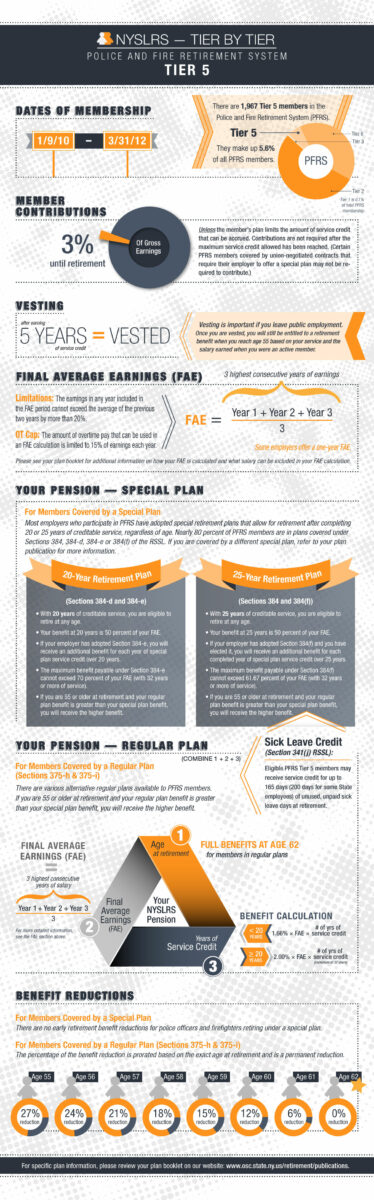
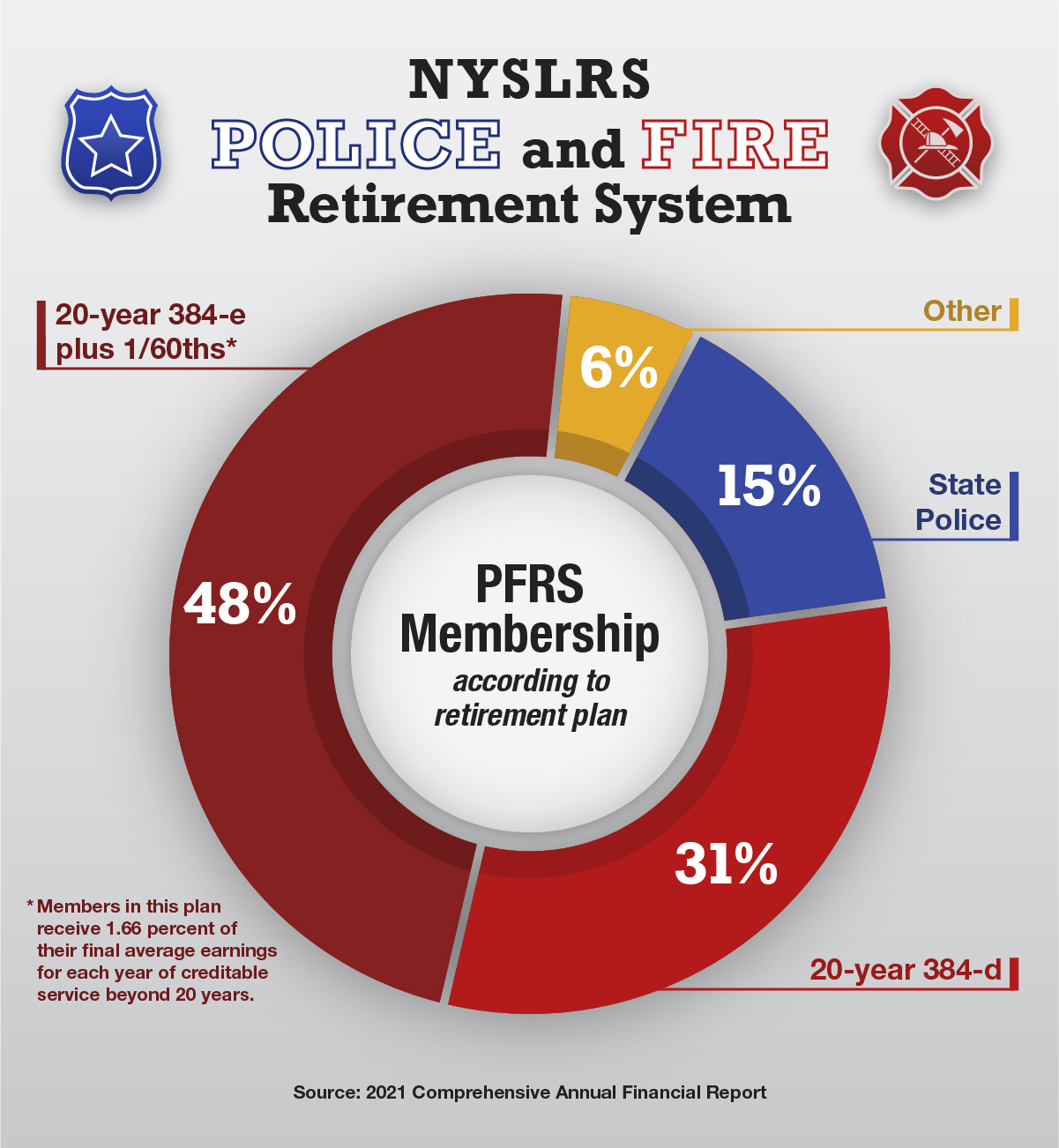
Most PFRS members are in special retirement plans, which allow you to retire after 20 or 25 years of service regardless of age.

If you retire at your 20- or 25-year milestone, your pension will be 50 percent of your final average earnings (FAE). Depending on your retirement plan, you may earn 1.66 percent of your FAE for each year you work beyond the 20 or 25 years, however for most PFRS members, a maximum of 32 years of service can be used in your pension calculation.

Final Average Earnings

A new law improves the pension benefits of NYSLRS Tier 6 members. When you retire, your FAE will be based on the average of your three highest consecutive years of earnings, the same as members in other tiers. Read our blog post, Calculating Your Final Average Earnings, for more information, including how your FAE will be calculated and limitations which apply.

Eligible Service

PFRS members in special plans should be aware not all public employment counts towards reaching the 20- or 25-year milestone. Service usually must be in specific job titles to be creditable toward your pension benefit. For example, if you are in the New York State Police Plan, service with a city police department would be creditable, but service as a sheriff’s deputy or corrections officer would not be. PFRS members may be eligible to purchase credit for military service to reach 20 or 25 years.

More Information About Your Benefits

Most members can estimate their pension in Retirement Online. You can fine tune your estimate by entering your annual earnings and expected pay increases. You can also include any service credit you plan to purchase.

Your specific PFRS milestones, along with your eligible service and pension calculation, are determined by your retirement plan, so it is important to familiarize yourself with the details of your plan. You can visit our website to Find Your NYSLRS Retirement Plan Publication.

Overtime Limits for Tier 5 and 6 Members

Tier 5 and 6 members are subject to limits on the amount of overtime that can be included in their pension. You can earn overtime pay beyond the overtime limit, but it won’t be factored into your pension calculation. And you don’t pay member contributions on overtime pay that is above the limit.

Overtime Limits for Tier 5 and 6 Members

Tier 5 Overtime Limits

The overtime limit for Tier 5 Employees’ Retirement System (ERS) members increases each calendar year by 3 percent. In 2024, the limit for Tier 5 ERS members is $22,688.85.

For Tier 5 Police and Fire Retirement System (PFRS) members, the overtime limit is 15 percent of your regular earnings each calendar year.

For more information, visit our Overtime Limits for Tier 5 page.

Tier 6 Overtime Limits

The overtime limit for Tier 6 ERS members increases each calendar year based on the annual increase of the Consumer Price Index (CPI). In 2024, the limit for Tier 6 ERS members is $20,459.

For Tier 6 PFRS members, the overtime limit is 15 percent of your regular earnings each calendar year.

For more information, visit our Overtime and Earnings Limits for Tier 6 page.

Your Pension Benefit Calculation

Your NYSLRS pension will be based on your service credit and final average earnings (FAE). Your FAE is the average annual earnings you receive during the period when your earnings are highest (36 consecutive months for Tier 5 and 60 consecutive months for Tier 6). Your FAE will include overtime pay you earned up to each annual limit.

Your FAE may be limited in other ways. For example, for most members, if your earnings increase significantly in the years used for your FAE, some of those earnings might not count toward your pension. The specific limits depend on your tier. Visit our Final Average Earnings page for more information about this limit.

For Tier 6 members, the earnings that can be used toward your pension are also limited to the Governor’s salary.

Read Your Plan Publication

Your retirement plan publication provides specific information about the earnings that will be used to calculate your pension. Visit our website to Find Your NYSLRS Retirement Plan Publication.

Estimate Your Pension in Retirement Online

Most members can create their own pension estimate in minutes using Retirement Online. You can enter different retirement dates to see how those choices would affect your benefit. Sign in to Retirement Online and click the “Estimate my Pension Benefit” button to try it.

NYSLRS – One Tier at a Time: PFRS Tier 2

When you join the New York State and Local Retirement System (NYSLRS), you’re assigned a tier based on the date of your membership. This post looks at Tier 2 members of the Police and Fire Retirement System (PFRS).

Your tier determines such things as your eligibility for benefits, the calculation of those benefits, death benefit coverage and whether you need to contribute toward your benefits.

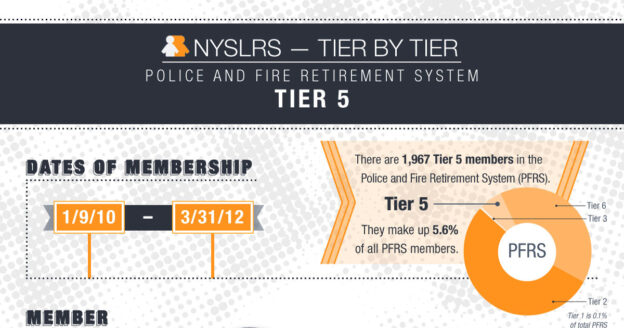
PFRS has five tiers. Almost half of PFRS members are in Tier 2, which began on July 31, 1973, and ended on June 30, 2009. Most are in special retirement plans that allow for retirement after 20 or 25 years, regardless of age, without penalty.

The special plans that cover most police officers and firefighters fall under Sections 384, 384(f), 384-d, and 384-e of Retirement and Social Security Law. You can sign in to Retirement Online to find your benefit plan, which is listed under ‘My Account Summary.’

PFRS Tier 2

Where to Find PFRS Tier 2 Information

Whether you’re in one of the retirement plans described in this post or another retirement plan, we encourage you to visit our website to find your NYSLRS retirement plan publication. It’s a comprehensive description of the benefits you’re entitled to receive as a PFRS member.

You can check your service credit total and estimate your pension using Retirement Online. Most members can use our online pension calculator to create an estimate based on the salary and service information NYSLRS has on file for them. You can enter different retirement dates to see how your choices would affect your potential benefit.

Members may not be able to use the Retirement Online calculator in certain circumstances, for example, if they have recently transferred a membership to NYSLRS, if they are a Tier 6 member with between five and ten years of service, or if they have worked for multiple employers and were covered by different retirement plans. These members can contact us to request an estimate or use the “Quick Calculator” on our website. The Quick Calculator generates estimates based on information you provide.  

NYSLRS – One Tier at a Time: PFRS Tier 6

When you join the New York State and Local Retirement System (NYSLRS), you’re assigned a tier based on the date of your membership. This post looks at Tier 6 members of the Police and Fire Retirement System (PFRS).

Your tier determines such things as your eligibility for benefits, the calculation of those benefits, death benefit coverage and whether you need to contribute toward your benefits.

PFRS has five tiers. Anyone who joined PFRS on or after April 1, 2012 is in Tier 6. There are 16,027 Tier 6 members, which accounts for more than 45 percent of PFRS membership, making it the second largest PFRS tier.

About Regular Plans and Special Plans

Under a regular retirement plan, you need to reach certain age and service requirements to receive your NYSLRS pension. If you’re covered by a special retirement plan, there is no age requirement, and you can receive your pension after completing 20 or 25 years of service.

Eighty percent of PFRS members are in plans covered under Sections 384, 384-d, 384-e or 384-f of the New York State Retirement and Social Security Law. Read our Police and Fire Retirement System blog post for information about different PFRS plans.

Check out the graphic below for the basic retirement information for PFRS Tier 6 members.

PFRS Tier 6

Where to Find PFRS Tier 6 Information

For more information about PFRS Tier 6 membership, find your NYSLRS retirement plan publication. It’s a comprehensive description of the benefits provided by your specific plan.

You can check your service credit total and estimate your pension using Retirement Online. Most members can use our online pension calculator to create an estimate based on the salary and service information NYSLRS has on file for them. You can enter different retirement dates to see how your choices would affect your potential benefit.

As of April 9, 2022, Tier 5 and 6 members only need five years of service credit to be vested. Tier 5 members with five or more years of service can estimate their pension benefit in Retirement Online. If you are a Tier 6 member with between five and ten years of service credit, you can contact us to request a benefit estimate.

A Good Plan Can Ease Your Transition to Retirement

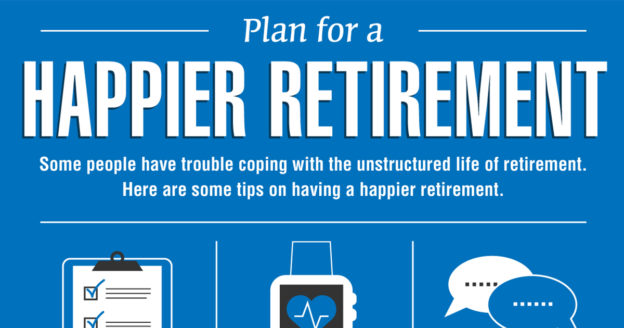
When people talk about retirement planning, they’re usually talking about money. But there’s another aspect that people often forget: what will you do with all that newfound free time? After decades of hard work, the thought of sleeping late and taking it easy is pretty attractive. But the transition to retirement is a big deal, and many retirees don’t consider the psychological aspects of the change. We’ve gleaned some advice from professional sources.

A Good Plan Can Ease Your Transition to Retirement

Create a Plan and Schedule

However you feel about your job right now, it’s an important part of your life. It provides structure, mental stimulation and social interaction. Retiring can leave a void, and streaming the latest shows or making frequent trips to the grocery store may not be enough to fill it. Empty or aimless hours can lead to boredom, disenchantment and even depression.

You may have a long list of things to do, places to go, and hobbies to take up, but if you don’t decide where to begin, it can be hard to get started. You’ll need to actively plan your activities and create a schedule to successfully manage your time in retirement. Write down how you’d like to spend each day of the week, blocking out time for chores, social engagements, hobbies and exercise. Sticking to a schedule can keep your days structured and give you a sense of accomplishment.

Stay Engaged

For many people, staying busy and remaining socially engaged are essential to a satisfying transition to retirement. That’s one reason why some retirees take on part-time or seasonal jobs.

A job in retirement doesn’t necessarily mean continuing to do the same old thing. Retirement is an opportunity to reinvent yourself. Do something you’ve always wanted to do, something fun and challenging.

Maybe the job for you is one that doesn’t pay at all, at least monetarily. There are countless organizations looking for volunteers.

Volunteering just a few hours a week will give you something to look forward to and keep you connected to the outside world, which can improve both your mental and physical well-being.

Exercise Your Body and Brain

Regular exercise not only keeps you physically fit — it also increases your sense of well-being. Whatever you do to exercise, make it part of your regular schedule. Consider taking a fitness class at a local gym, which also adds a social element to your workout. Maybe you can up the ante by trying something new, like a martial arts class.

Don’t forget to exercise your brain. A course or workshop can help you discover a new side to yourself (the painter, the mystery writer, the master of topiary). You may even want to enroll in classes at a local community college or return to school full-time.

Whatever you do, make sure it’s part of a plan — a plan for a happier retirement.
Sex Identification and Your NYSLRS Membership

As of January 1, 2023, when new members are enrolled in NYSLRS, they can choose “x” as their sex identification instead of “male” or “female.”

sex identification

Updating Your Sex Identification With NYSLRS

If you’re already a member or a retiree, you can update your sex identification with us at any time.

Sign in to Retirement Online to check what information we have on file for you. You can find your current sex identifier on your Account Homepage under ‘My Profile Information.’

If you need to change or correct your sex identification, send us a signed letter requesting the change. Please include your NYSLRS ID on the letter. No additional documentation is required to change your sex identifier.

You can send us the letter by attaching it to our secure contact form, or by mailing it to:

NYSLRS
110 State Street
Albany, NY 12244-0001

We are working to update Retirement Online so members and retirees can sign in and update their sex identification on their own. This feature is expected to be available sometime in 2023. (Need help accessing Retirement Online in the meantime? See our Tools and Tips post for more information.)

Need a Name Change Too?

If you’re changing your last name, you can make the update, and upload copies of the documentation showing the change, in Retirement Online. Sign in to your account, go to the ‘My Profile Information’ section of your Account Homepage and click the “update” link next to your name. A list of acceptable documentation will be provided.

To update your first or last name, send us a Name Change Notice (RS5483) form. You will need to provide original documentation, such as a court order, if the name change is for a reason other than a change in marital status. We can also accept a certified copy of the documentation.