Tag Archives: retirement planning

Give Your Retirement Savings a Boost

If you’re already building your retirement savings, you already understand how those savings, along with Social Security, work together with your pension to help provide financial stability in retirement. Financial advisors call this the “three-legged stool.”

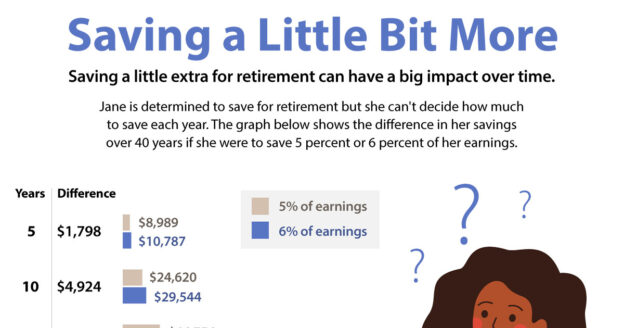
But why not take it a step further and give your retirement savings a boost? Even a small increase could make a big difference over time, while having minimal impact on your take-home pay.

How much of a difference would it make? You can check it out yourself using this online calculator and your own salary and savings information. Calculate the impact of your current savings, then try the same calculation with an additional 1 percent of your earnings. For example, if you’re saving 5 percent of your pay, see what saving 6 percent would do by the time you expect to retire.
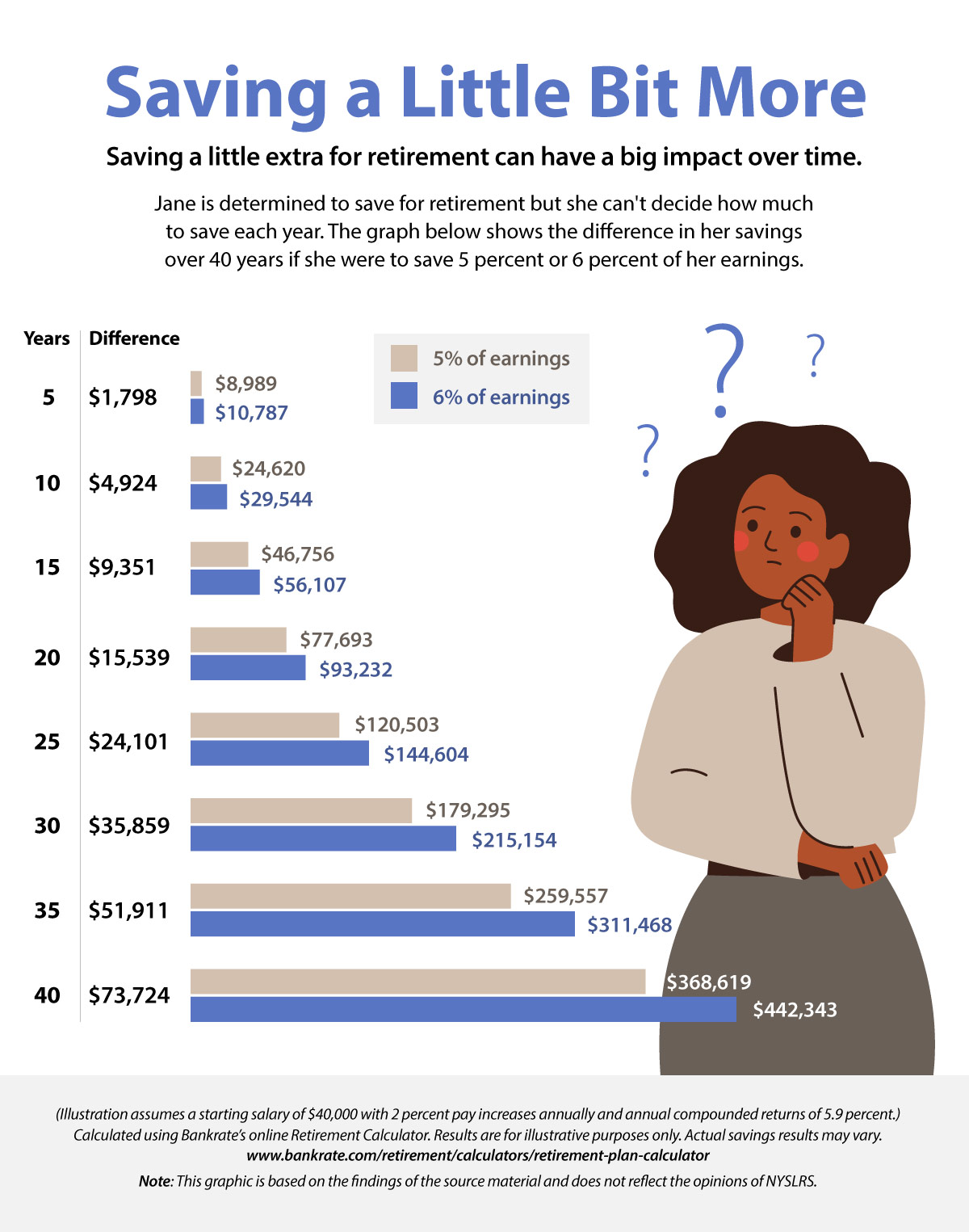
retirement savings

Impact on Your Paycheck

Fortunately, adding a small amount to your retirement savings won’t have a substantial impact on your paycheck. For example, if you’re making $60,000 a year, 1 percent is only $600. That’s just $50 a month or, if you are paid every other week, about $23 per payday.

The impact on your take-home pay would be even less if you save in a tax-deferred plan because you won’t have to pay income tax on those earnings until after you retire. The New York State Deferred Compensation Plan’s paycheck impact calculator can help you estimate how increased savings would affect your paycheck. (You don’t have to have a Deferred Compensation account to use their calculator. The New York State Deferred Compensation Plan is not affiliated with NYSLRS.)

When to Increase Retirement Savings?

The sooner you boost your savings, the better off you’ll be. But if you’re not ready to increase your savings right now, then try this: Schedule your increase to coincide with your next raise. That way, you may not even miss the money.
Tier 3 & 4 Members: When Is The Right Time To Retire?

Tier 3 and 4 members in the Article 15 retirement plan qualify for retirement benefits after they’ve earned five years of credited service. Once you’re vested, you have a right to a NYSLRS retirement benefit — even if you leave public employment. Though your pension is guaranteed, the amount of your pension depends on several factors, including when you retire. Here is some information that can help you determine the right time to retire.

Three Reasons to Keep Working

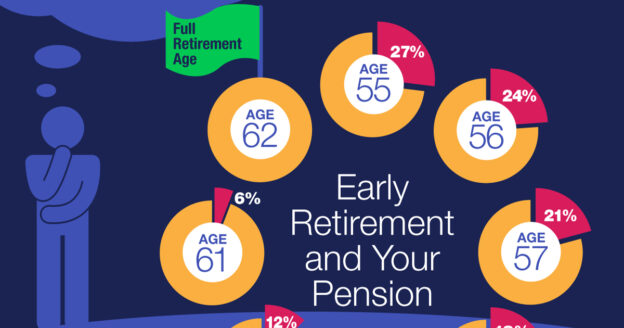
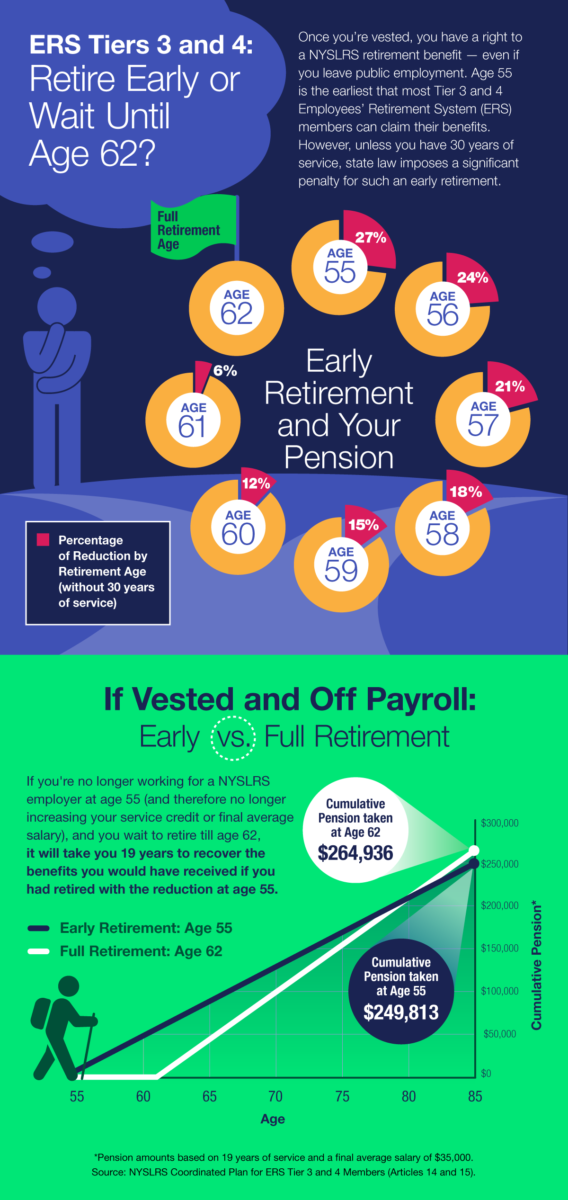
  1. Tier 3 and 4 members can claim their benefits as early as age 55, but they’ll face a significant penalty for early retirement – up to a 27 percent reduction in their pension. Early retirement reductions are prorated by month, so the penalty is reduced as you get closer to full retirement age. At 62, you can retire with full benefits. (Tier 3 and 4 Employees’ Retirement System (ERS) members who are in the Article 15 retirement plan and can retire between the ages of 55 and 62 without penalty once they have 30 years of service credit.)
  2. Your final average earnings (FAE) are a significant factor in the calculation of your pension benefit. Since working longer usually means a higher FAE, continued public employment can increase your pension.
  3. The other part of your retirement calculation is your service credit. More service credit can earn you a larger pension benefit, and, after 20 years, it also gets you a better pension formula. For Tier 3 and 4 members, if you retire with less than 20 years of service, the formula is FAE × 1.66% × years of service. Between 20 and 30 years, the formula becomes FAE × 2.00% × years of service. After 30 years of service, your pension benefit continues to increase at a rate of 1.5 percent of FAE for each year of service.

When is the Right Time to Retire infographic


If You’re Not Working, Here’s Something to Consider

Everyone’s situation is unique. For example, if you’re vested and no longer work for a public employer, and you don’t think you will again, taking your pension at 55 might make sense. When you do the math, full benefits at age 62 will take 19 years to match the money you’d have received retiring at age 55 — even with the reduction.

An Online Tool to Help You Make Your Decision

Most members can use Retirement Online to estimate their pensions.

A Retirement Online estimate is based on the most up-to-date information we have on file for you. You can enter different retirement dates to see how those choices would affect your benefit, which could help you determine the right time to retire. When you’re done, you can print your pension estimate or save it for future reference.

If you are unable to use our online pension calculator, please contact us to request a pension estimate.

This post has focused on Tier 3 and 4 members. To see how retirement age affects members in other tiers, visit our About Benefit Reductions page.

The Right Time to Start Saving for Retirement is Now

When should you start saving for retirement? If you aren’t saving already, right now is the best time to start. If your retirement is a long way off, that means you’ll have more time for your savings to grow. But even if you’re close to retirement, it is never too late to start saving.

Why Save for Retirement?

While retirees tend to spend less than they did while they were working, financial experts say you’ll still need 70 to 80 percent of your pre-retirement income to maintain your lifestyle during retirement.

NYSLRS members have the rare advantage of a well-funded, defined-benefit pension. As a NYSLRS member, once you’re vested, you’re entitled to a pension that, once you retire, will provide you with monthly payments for the rest of your life. Retirement savings can supplement your NYSLRS pension and Social Security, helping you reach that income-replacement goal.

Retirement savings can also be a hedge against inflation and a source of cash in an emergency. A healthy retirement account will give you more flexibility during retirement, helping ensure that you’ll be able to do the things you want to do. It can also provide peace of mind.

Saving for Retirement

Getting Started

For New York State employees and many other NYSLRS members, there’s an easy way to get started. If you work for a participating employer, you can join the New York State Deferred Compensation Plan. If you don’t work for New York State, check with your employer to see if you are eligible. If you are not eligible, your employer may be able to direct you to an alternative retirement savings program.

Once you sign up for Deferred Compensation, your contributions will automatically be deducted from your paycheck and deposited into your account. You can choose from a variety of investment packages or choose your own investment strategy. (The Deferred Compensation Plan is not affiliated with NYSLRS.)

Too Much Free Time?

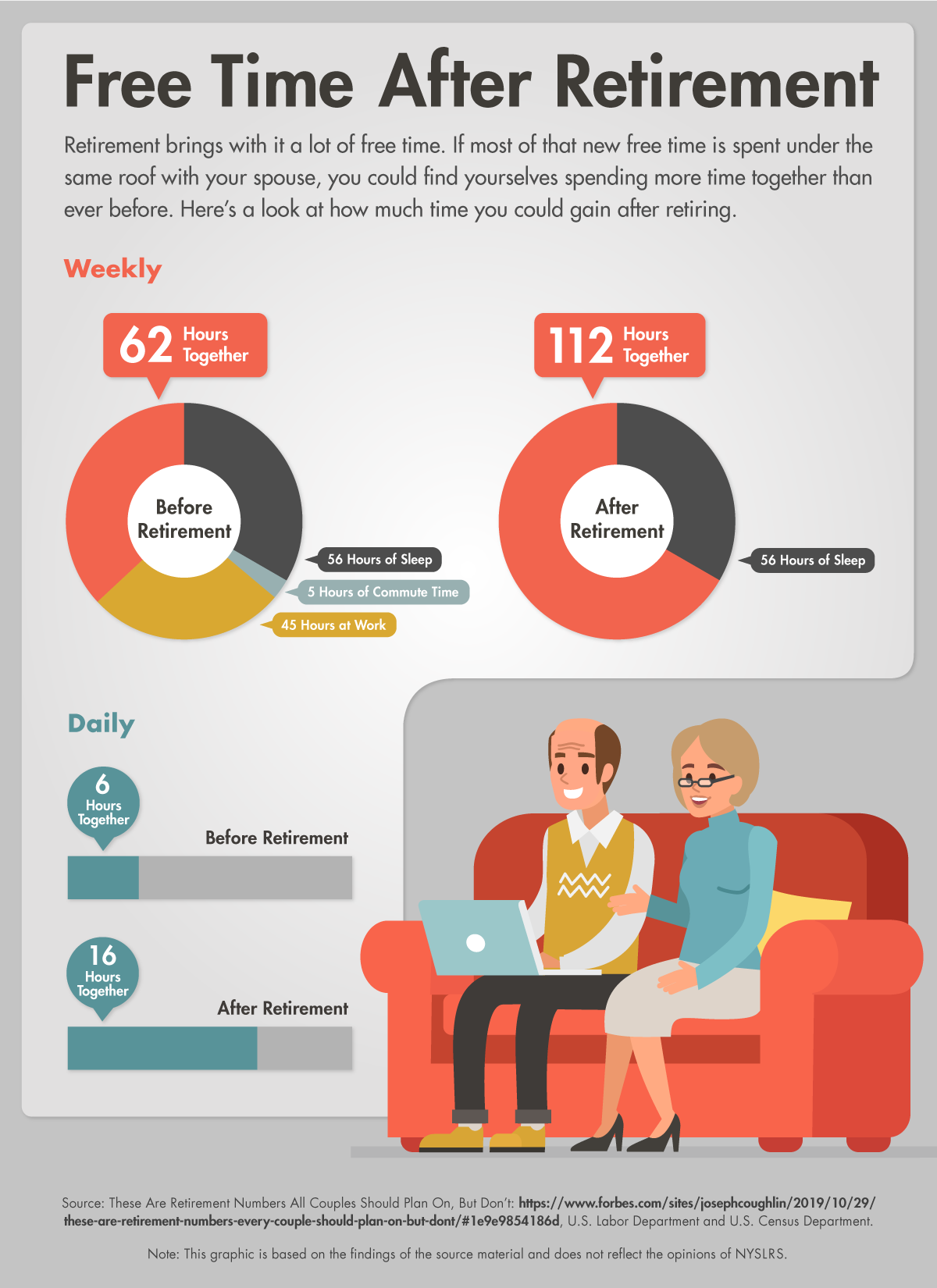
Could retirement bring you too much free time? When people think about retirement planning, they usually think about money. Will you have enough to maintain a comfortable lifestyle for a retirement that could last decades? But regardless of your finances, there is one thing you’re likely to have a lot more of after you retire: time. Figuring out how you’ll spend that time should also be part of your retirement planning process.

Free time after retirement

Counting the Hours

According to the U.S. Labor Department, the average American worker spends about nine hours a day at work. Add another hour a day commuting time, and that’s ten hours a day or 50 hours each week.

All those hours you spent working, and traveling to and from work, will instantly become free time. While that may sound great to many people, all that extra time can have downsides.

If not put to good use, that extra time can lead to boredom and even depression. What’s more, if you’re married and you and your spouse are both retired, you may find yourselves wondering how to spend that time together.

Make a Plan for Free Time

For many couples, having extra time together is a dream come true. However, some couples find themselves getting in each other’s way, and that can sometimes lead to problems.

But there are ways to cope. For example, finding activities outside the home, both together and separately, can help. As with most things, you’ll be better off if you recognize there may be a problem, discuss it with your spouse, and come up with a plan.

There are more thoughts on the subject, and some good advice, in this article: 10 Tips to Help Your Marriage Survive Retirement.

Planning for an Unplanned Retirement

Retirement comes too soon for some people. Poor health, an injury, family situations, layoffs and other unforeseen circumstances could force you into an unplanned retirement.

unplanned retirement

You may already have a plan based on the date you would like to retire, but do you have a backup plan if that date comes a few years earlier than expected?

Know Your Benefits

As a NYSLRS member, you’re entitled to benefits that may help. Most vested members can begin collecting a lifetime pension as early as age 55, though your benefit may be permanently reduced if you retire before full retirement age. (Full retirement age for NYSLRS members is either 62 or 63, depending on your tier. Full retirement age for Social Security benefits depends on your year of birth.)

If you can no longer do your job because of a physical and mental condition, you may be eligible for a Social Security Disability, or a NYSLRS disability benefit if your disability is permanent.

You may also want to look into Workers’ Compensation if you are injured on the job or Unemployment Insurance if you have been laid off from a position.

Other Ways to Plan for the Unexpected

Doing your homework is important. The more you understand the potential benefits available to you, the better you can estimate your income if you are forced to retire early. Unfortunately, the numbers you come up with may not be enough when dealing with an unplanned retirement.

But one potential source of income can make a big difference: retirement savings. Your savings could help you get by until you are eligible to collect your NYSLRS pension or another retirement benefit. If you are not saving for retirement, consider starting now. And if you are saving, consider increasing your savings. It could become a lifeline if the unexpected happens.

New York State employees and some municipal employees can also save for retirement through the New York State Deferred Compensation Plan. Ask your employer if you are eligible.

For more information about the benefits offered by your NYSLRS retirement plan, visit our website to read your plan publication.

Retirement Planning Tip: Required Minimum Distributions

Required Minimum DistributionsIf you have tax-deferred retirement savings (such as certain 457(b) plans offered by NYS Deferred Comp), you will eventually have to start withdrawing that money. After you turn 70½, you’ll be subject to a federal law requiring that you withdraw a certain amount from your account each year. If you don’t make the required withdrawals, called Required Minimum Distributions (RMDs), you could face significant penalties.
RMDs are never eligible for rollover into other retirement accounts. You must take out the money and pay the taxes.

Calculating the Distribution

The RMD amount must be calculated annually. It’s based on the account’s balance at the end of the previous calendar year and the life expectancy of you and your beneficiary. Check out AARP’s Required Minimum Distribution Calculator for an easy way to determine your required distributions. Many retirement plan administrators, including the New York State Deferred Compensation Plan, will inform you of your RMD amount, but it’s your responsibility to take the required distribution.

Potential Penalty

If you don’t take the required distribution, or if you withdraw less than the required amount, you may have to pay a 50 percent tax on the amount that was not distributed. (You must report the undistributed amount on your federal tax return and file IRS Form 5329.)

The IRS may waive the penalty if you can show that your failure was due to a “reasonable error” or that you have taken steps to correct the situation. You can find information about requesting a waiver on page 8 of the Form 5329 instructions.

What Accounts Require Minimum Distributions?

Most retirement accounts you’re familiar with require these annual withdrawals:

  • 457(b) plans
  • IRAs (traditional, SEP and SIMPLE)
  • 401(k) plans
  • 403(b) plans
  • Profit-sharing plans
  • Money purchase plans

Since contributions to Roth IRAs have already been taxed, the IRS does not require distributions from Roth IRAs at any age.

As with most things investment-related, a lot depends on your particular circumstances. If you have questions, contact your financial advisor or your plan administrator.

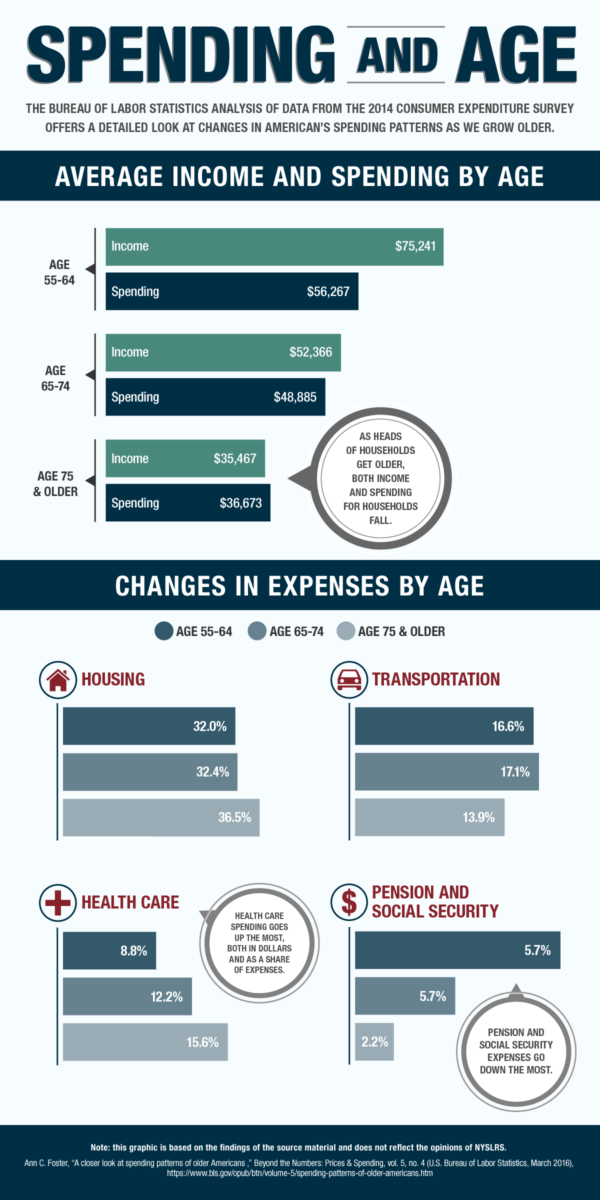
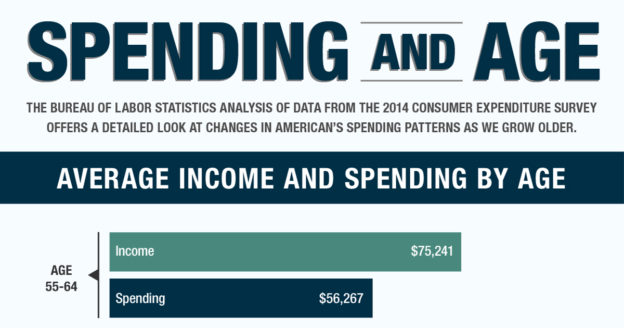
Infographic regarding spending habits

Spending Changes in Retirement

Just like starting your first job, getting married or having kids, retirement will change your life. Some changes are small, like sleeping in or shopping during regular business hours. Others, however, are significant and worth examining ahead of time… like how much you’ll be spending in retirement each month or each year.

An Employee Benefit Research Institute (EBRI) study offers some good news for prospective retirees. Household spending generally drops at the beginning of retirement — by 5.5 percent in the first two years, and by 12.5 percent in the third and fourth years. (Although, nearly 46 percent of households actually spend more in the first two years of retirement.)

Analysis from the Bureau of Labor Statistics in the U.S. Department of Labor seems to support the research from EBRI. In “A closer look at spending patterns of older Americans,” the author analyzed data from the 2014 Consumer Expenditure Survey, and she also found a progressive drop in spending as age increases. (Income declines with age as well.)

While data supporting EBRI’s study is helpful, it turns out that the highlight of the Consumer Expenditure Survey results is a detailed look at how the things we spend our money on change as we grow older.

Infographic regarding spending habits

As interesting as that is, it’s just a general look at how older Americans are managing their money. What really matters is: How will you spend your money once you retire?

Prepare a Post-Retirement Budget

Like a fiduciary choir, financial advisors all sing the same refrain: Start young; save and invest regularly to meet your financial goals. If you do, the switch from saving to spending in retirement can be easy.

But, in order to make that transition, you need a budget.

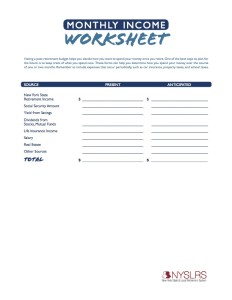
The first step toward a post-retirement budget is a review of what you spend now. For a few months, track how you spend your money. Don’t forget to include periodic costs, like car insurance payments or property taxes. By looking at your current spending patterns, you can get an idea of how you’ll spend money come retirement.

Then, consider your current monthly income, and estimate your post-retirement income. If your post-retirement income is less than your current income, you might want to plan to adjust your expenses or even consider changing your retirement date.

We have monthly expense and income worksheets to help with this exercise. You can print them out and start planning ahead for post-retirement spending.

Monthly budgeting worksheets (PDF)

Monthly Worksheets (PDF)

For those of you who carry smart phones, Forbes put together a list of popular apps for tracking your daily spending. All of them are free, though some do sell extra features. Many of them can automatically pull in information from your bank and credit card accounts, but if you’d rather avoid that exposure or if you use cash regularly, you may prefer an app that lets users enter transactions manually.

Health Care Costs Can Be Steep in Retirement

As you plan for your retirement, you may be forgetting one important thing – health care.

NYSLRS does not provide health care coverage for its retirees, and we’re not the experts on this subject. But we do offer advice to members about retirement planning, and how you’ll pay for health care coverage and out-of-pocket medical expenses should be an important consideration as you approach retirement.

Know the Health Care Cost Facts

Medicare premiums, deductibles, co-payments and prescription drug costs all add up. And those expenditures are likely to rise because health costs have been increasing faster than the rate of inflation and people spend more on medical expenses as they age.

Recent reports indicate a typical 65-year-old retiring in 2018 would spend well over $100,000 to cover medical costs over the course of retirement. What’s more, most NYSLRS members can retire as early as 55. That means you may spend a longer time in retirement than the average retiree, and you may not be eligible for Medicare for years.

couple working on their budget together

What You Can Do To Prepare

Before you can budget for retirement medical costs, you’ll need to do your homework. Start by talking to your employer about the health care options available to you after your retire and get an estimate of how much you will need to pay. You should also familiarize yourself with Medicare’s options, benefits and costs.

Once you get an idea of what your monthly health care might be, you can start planning how to pay for it. You may have to increase your retirement savings. If you’re a state employee, or a municipal employee covered by the New York State Health Insurance Program (NYSHIP), you may be able to get credit for unused sick leave that can reduce your NYSHIP premium. This program is managed by the New York State Department of Civil Service, not NYSLRS. Their Planning for Retirement booklet provides some good information.

Getting Credit for Your Military Service

If you served in the U.S. Armed Forces, you may be eligible to buy back up to three years of active service credit. Because service credit is a factor in calculating a NYSLRS pension, in most cases buying military service credit will increase your pension.

Military Service Credit

To be eligible, veterans must:

  • Have been honorably discharged;
  • Have at least five years of credited service in the Retirement System;
  • Have not received credit for this service in any other public retirement system in New York State; and
  • Apply for and purchase military service credit before they retire.

How to Apply for Military Service Credit

To apply and request a cost for military service credit:

1. Fax your name, contact information and a copy of your DD-214 to 518-486-6405 or 518-402-7799;

or

2. Mail a letter with your name and contact information, and a photocopy of your DD-214, to:
    Military Service Unit
    110 State Street
    Albany, NY 12244-0001

If after reviewing your application we determine you are eligible, we will send you a letter that will tell you how much credit you are eligible to purchase and the cost. Most members in Tier 1, 2, 3 or 4 can use our online benefit projection calculator to see how the credit would impact your pension. Tier 5 and 6 members can get that information by calling 1-866-805-0990, or using our secure email form (www.emailNYSLRS.com).

For more information, visit the Military Service Credit page on our website.

Top Five Pre-Retirement Goals for NYSLRS Members in 2018

January is a great time to set goals for the coming year. And setting pre-retirement goals is crucial in planning for a successful retirement. Here are five goals to consider for 2018:

Plan ahead for retirement

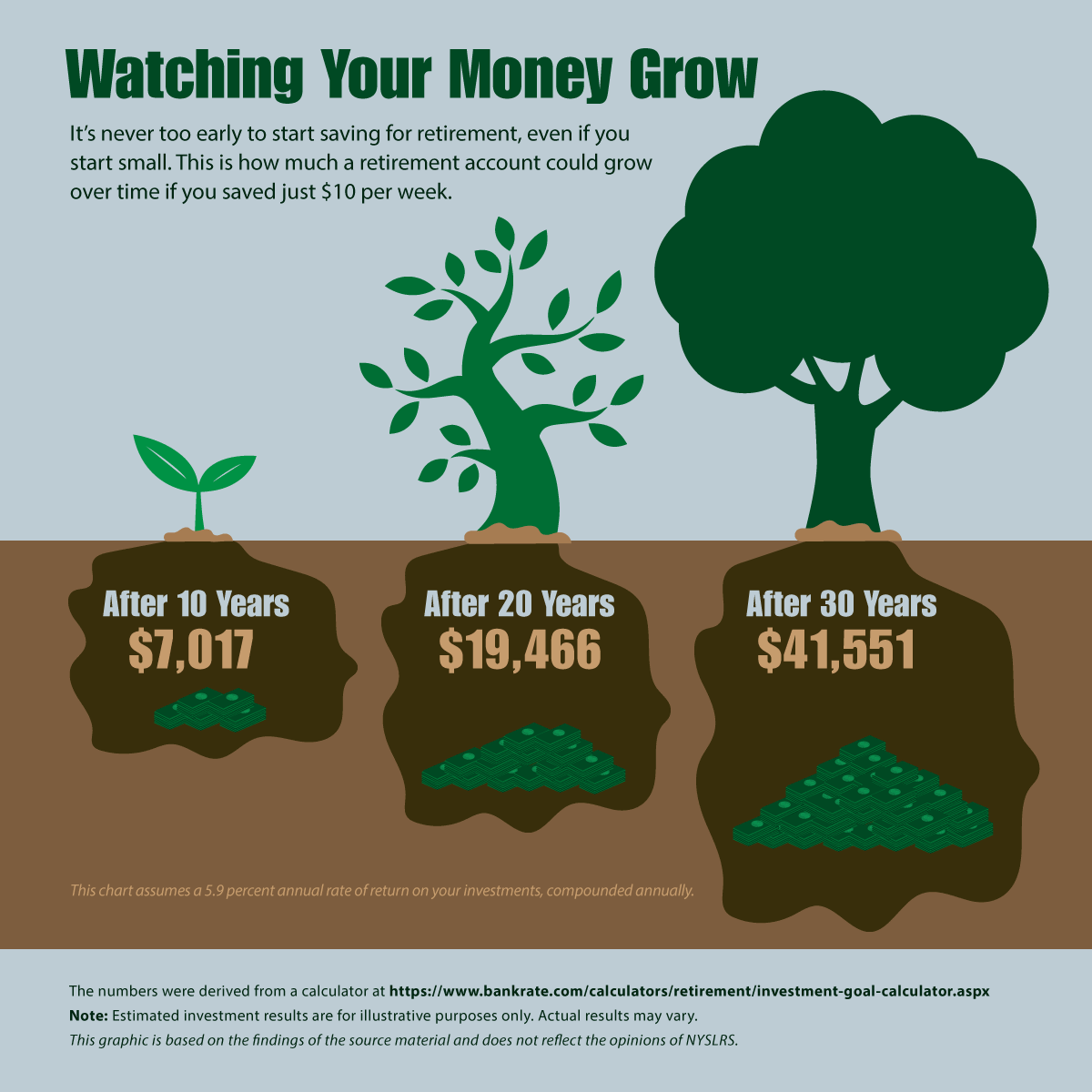
1. Choose a sensible savings plan that works for you.There are several ways to save for retirement, including starting a deferred compensation plan like the New York State Deferred Compensation Plan. An important part of developing a savings plan is to start early. The sooner you start saving, the more time your money has to grow. Check out our Weekly Investment Plan chart to see how a weekly investment can grow by age 65.

2. Track your expenses and income. Tracking your current expenses for a month or two will give you a better idea of how much you’re likely to spend in retirement and how much you’ll need to supplement your pension. Use the expense and income worksheets on our website to create a retirement budget. Be sure to include periodic expenses, such as car insurance and property taxes.

3. Request a pension estimate. If you’re within 18 months of your anticipated retirement date, it’s a good idea to request an estimate of what your retirement benefit will be. You can do this by sending us an email using our secure contact form or by calling 1-866-805-0990 (518-474-7736 in the Albany, NY area). If you are not certain that you’ve received credit for all your public service in New York State, you can submit a Request for Estimate form (RS6030) and be sure to provide detailed information about your public employment in section eight of the form. If your planned retirement date is farther away, you may want to use our online Benefit Calculator. This estimates your pension based on information you provide, so have your Member Annual Statement handy before you start, or sign in to your Retirement Online account to check your current service credit.

4. Pay off any NYSLRS loans. An outstanding loan balance at retirement will permanently reduce your NYSLRS retirement benefit. You cannot make loan payments after you retire, and the pension reduction does not go away after we recover the balance of the loan. Visit the Loans page on our website for information about making additional payments or increasing your loan payment amount.

5. Consider seeking the advice of a financial planner. Financial planners don’t manage your money, but can help you assess your present financial condition and develop a practical plan to meet your specific goals and needs. Also consider doing your own research by seeking Do-It-Yourself financial planning guides on the web.

If you ever have any retirement-related questions, please contact us.