Category Archives: General News

Protect Yourself from Scams

Your retirement account can be an attractive target for scammers who continue to find new ways to try to impersonate government agencies, such as NYSLRS or the Social Security Administration. Protect yourself from scams by learning to distinguish fake messages from official NYSLRS communications.

How Scams Work

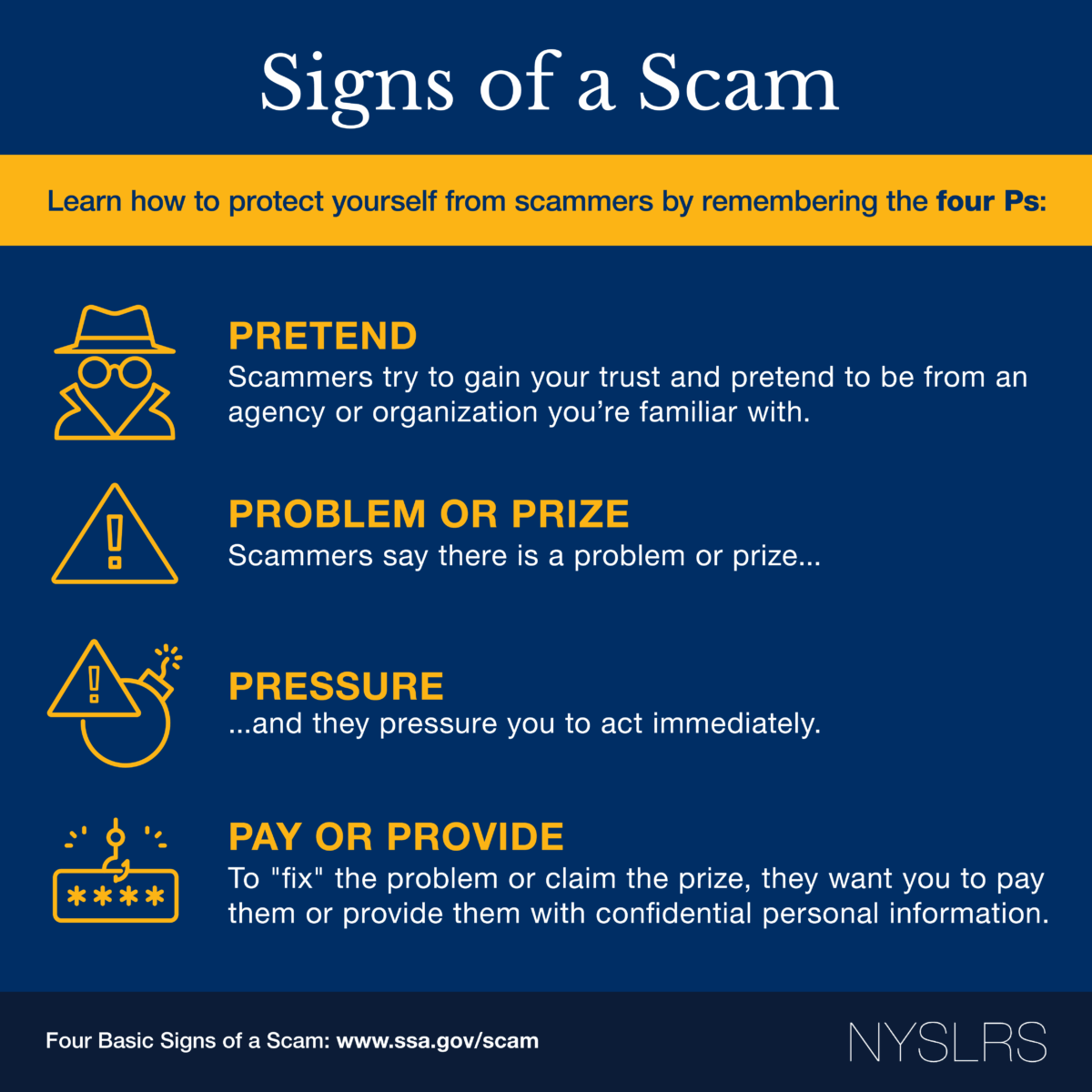
Scammers pretend to be an agency or organization you already know to gain your trust. They use similar logos or imagery in correspondence. They may contact you from an email address that mimics—but isn’t identical to—those used by employees of the actual organization. Some can even make a real agency’s phone number appear on caller ID (known as spoofing).

Usually, once they contact you, they claim there is a problem (or a prize or a new benefit available) requiring your immediate attention. But here’s the catch: to fix the problem or receive the reward, the imposter needs you to pay them a fee or provide personal data, such as your Social Security number or bank account information. They may even threaten you with legal action, a suspension of your benefits or arrest if you fail to act.
protect yourself from scams

If someone contacts you and you notice these signs of a scam, remain calm. Hang up the phone or delete the message if you feel like something is off. It’s the easiest way to avoid accidentally giving away personal information.

Scammers have also attempted to create a fake mobile app or website, which looks similar to Retirement Online, aimed to trick users and capture login credentials. Please be aware, we currently do not have a mobile app. Protect yourself from these scams by accessing Retirement Online from the NYSLRS website and avoid using search engines to find a link for the login page.

AI: A New Tool for Scams

You should also be aware of an emerging threat—artificial intelligence (AI), which allows computers to mimic certain human behaviors, such as speech and writing. Using AI, scammers can personalize phishing emails, making it harder to recognize a fraudulent communication. AI may even be able to impersonate the voice of a family member or friend, making you think they are in trouble or need money.

Here are some things you can do to protect yourself from AI-enhanced scams.

  • Don’t share sensitive information through text or social media.
  • Don’t send or transfer money to unknown locations.
  • Consider designating a safe word for your family to use to identify themselves and share that word with family members and close contacts.
  • When in doubt, hang up and call your loved one back.

Doing Business With NYSLRS

To protect yourself from potential scams and keep your personal information secure, use your NYSLRS ID to verify your identity when doing business with NYSLRS, instead of providing your Social Security number. You can find your NYSLRS ID by signing in to your Retirement Online account, or by checking your annual statement or other correspondence from NYSLRS.

Generally, NYSLRS will only call you if we are following up on a previous communication from you—a phone call, secure email message, Retirement Online request, form or letter. If you haven’t completed a transaction or submitted changes recently, be wary of unexpected calls or requests for your NYSLRS information.

Make sure you review the communications you receive from NYSLRS. We send you letters or emails (depending on your delivery preference in Retirement Online) whenever you update your Retirement Online account or benefit information. If you receive a letter or email about an account change you did not make, contact us immediately.

Keep Your Retirement Online Account Secure

Retirement Online is the fastest and most convenient way to access your retirement account information and conduct business with NYSLRS. And it’s safe to use—it has the same security safeguards used for online banking and by other financial institutions. Here are steps you can take to help ensure your Retirement Online account stays secure:

  • First, if you don’t have an account, learn more about Retirement Online and click Register Now.
  • Choose a strong password.
  • Once you have an account, keep your username and password in a safe place, and don’t share them with anyone. NYSLRS will never ask for your password.
  • Sign in to Retirement Online at least once a year and update your password so it doesn’t expire. If you forgot your user ID or password, don’t worry—from the customer login page, you can:
    • Click the Forgot ID link to look up your user ID.
    • Click the Forgot Password link to reset your password.

You’ll need to identify yourself and answer security questions you set when you signed in for the first time.

For step-by-step instructions, read our Forgot User ID and Forgot Password guides.

  • Update your delivery preference to receive an email notifying you when you have correspondence to view in Retirement Online. That way, when there are changes to your account, you’ll receive an email notifying you instead of waiting for printed notices through the mail.

For more information, read our Retirement Online Tools and Tips blog post.
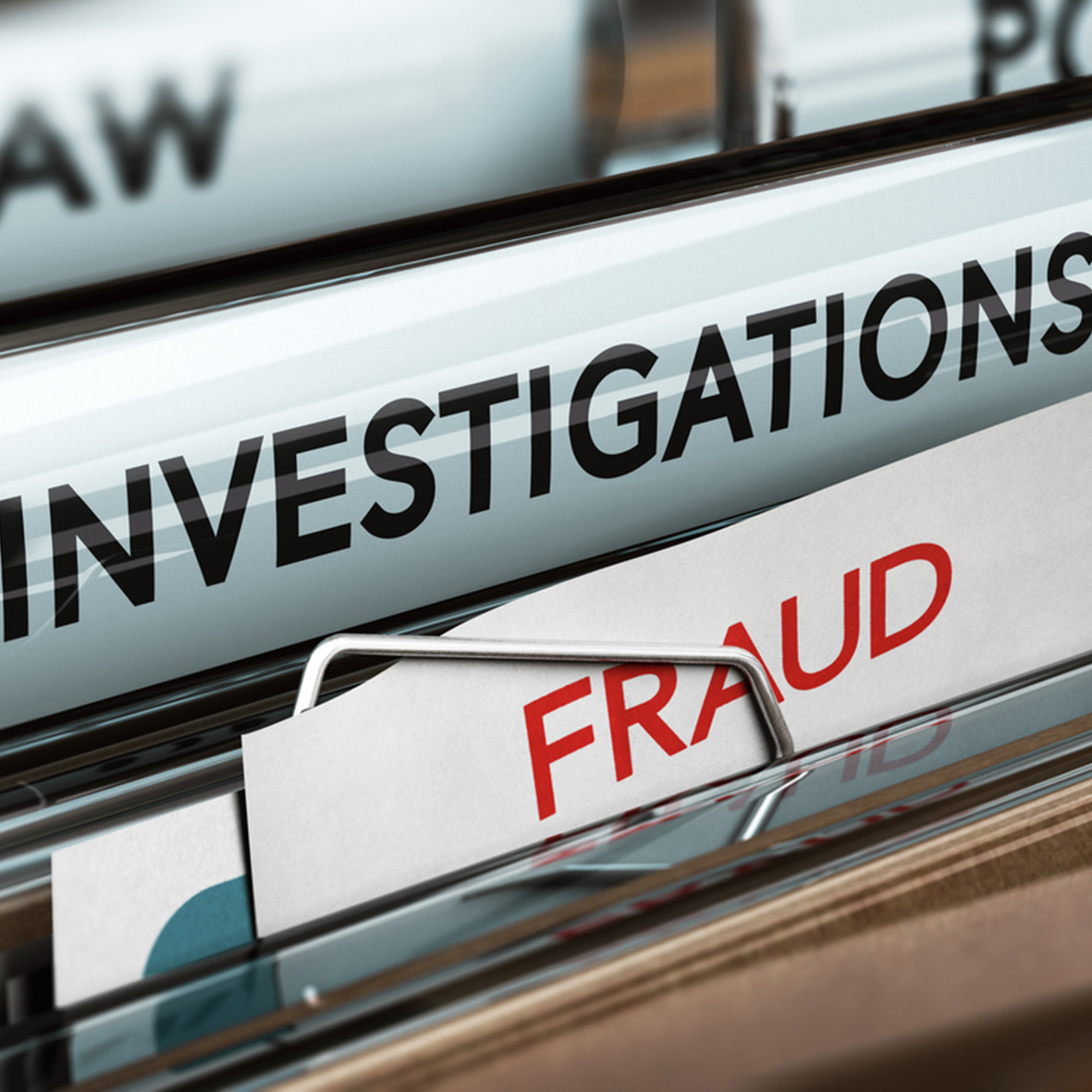
Fighting Fraud and Protecting Pension Benefits

Fighting Fraud and Protecting Pension Benefits

Since taking office, New York State Comptroller Thomas P. DiNapoli has fought the abuse of public funds. One of his top priorities is protecting NYSLRS and its retirees from pension fraud.

The Comptroller’s Division of Investigations regularly partners with federal, state and local law enforcement in New York and across the country to bring corrupt individuals to justice and recoup stolen NYSLRS money. Over the past several years, pension fraud investigations have led to 57 arrests and the recovery of over $5.8 million.

Here are some cases from earlier this year:

Joint Investigation Uncovers Caretaking Scheme

In May 2024, a joint investigation between the Comptroller’s office, the Rensselaer County District Attorney and the New York State Police led to the arrest of an Albany woman and man for allegedly stealing more than $200,000 in pension and Social Security payments from an 86-year-old retiree.

The defendants engaged in a caretaking scheme that left the elderly victim in deplorable living conditions and resulted in home foreclosure. They persuaded the victim to let them pay his bills, however, they did not pay the victim’s mortgage, property taxes or other bills for several years. This caused the foreclosure of the victim’s home, the repossession of his vehicle, and his electricity to be turned off.

As a result of the investigation, the victim was removed from the home and received necessary treatment.

In November 2024, one of the defendants pleaded guilty to grand larceny in the second degree and is awaiting sentencing. The second defendant was indicted by a Rensselaer County Grand Jury on charges of grand larceny in the second degree and the matter is currently pending in court.

Son Impersonates Father to Continue Receiving Pension

In 2017, a NYSLRS pensioner who had retired from the Nassau County Clerk’s Office in 1992, moved to Wyoming with his son. The retiree was never heard from again, and it is believed he died in Wyoming. His pension payments should have stopped when he died, but his son never reported his death.

In fact, the son went to great lengths to conceal his father’s death and continue receiving his pension and social security payments. He even whitened his hair and eyebrows to impersonate his deceased father.

But a call to the Comptroller’s Fraud Hotline prompted an investigation, which included the U.S. Attorney’s Office, the Social Security Administration, the U.S. Postal Inspection Service and the FBI.

The son was arrested on federal fraud charges in 2023. In February 2024, the son was sentenced to five years in prison and ordered to repay the $194,000 he stole in NYSLRS pension and Social Security benefits.

Man Steals Deceased Sister-in-Law’s Pension Payments

In October 1986, a stenographer from the Supreme Court, Appellate Division, retired with a disability retirement and the Single Life Allowance pension payment option. That means, when she died in January 2019, her monthly pension payments should have ended. Once NYSLRS discovered her death in July 2022, payments were stopped, and an investigation was launched.

A forensic analysis was completed on the bank account where the pension payments were being deposited, which was a joint account in the name of the retiree and her brother-in-law. The investigation found that the brother-in-law diverted over $50,000 in pension payments made after his sister-in-law’s death and used the money to pay credit card bills, travel and make online purchases.

The brother-in-law was arraigned on a charge of grand larceny in Albany County Court. The matter is pending in court.

You Can Help Fight Fraud

If you are aware of potential pension fraud, visit the Comptroller’s Fighting Public Corruption page to file a complaint online, or call the Fraud Hotline at 888-672-4555.

Protecting Yourself from Scams

Your retirement account can be an attractive target for scammers, and imposters continue to find new ways to try to impersonate government agencies, such as NYSLRS or the Social Security Administration. Learn to distinguish fake messages from official NYSLRS communications and protect yourself from scams.

protecting yourself from scams

How Scams Work

Imposters pretend to be an agency or organization you already know to gain your trust. They use similar logos or imagery in correspondence. They may contact you from an email address that mimics—but isn’t identical to—those used by employees of the actual organization. Some can even make a real agency’s phone number appear on caller ID (known as spoofing).

Usually, once they contact you, they claim there is a problem (or a prize or a new benefit available) requiring your immediate attention. But here’s the catch: to fix the problem or receive the reward, the imposter needs you to pay them a fee or provide personal data, such as your Social Security number or bank account information. They may even threaten you with legal action, a suspension of your benefits or arrest if you fail to act in time.

If someone contacts you and you notice these signs of a scam, remain calm. Hang up the phone or delete the message if you feel like something is off. It’s the easiest way to avoid accidentally giving away personal information.

AI: A New Tool for Scams

You should also be aware of an emerging threat—artificial intelligence (AI), which allows computers to mimic certain human behaviors, such as speech and writing. Using AI, scammers can personalize phishing emails, making it harder to recognize a fraudulent communication. AI may even be able to impersonate the voice of a family member or friend, making you think they are in trouble or need money.

Here are some things you can do to protect yourself from AI-enhanced scams:

  • Don’t share sensitive information through text or social media;
  • Don’t send or transfer money to unknown locations;
  • Consider designating a “safe word” for your family to use to identify themselves and share that word with family members and close contacts; and
  • When in doubt, hang up and call your loved one back.

Doing Business With NYSLRS

Generally, NYSLRS will only call you if we are following up on a previous communication from you, such as a phone call, secure email message, Retirement Online request, form or letter. For security, you can use your NYSLRS ID to identify yourself instead of providing your Social Security number. To find your NYSLRS ID, sign in to Retirement Online, or check your annual statement or other correspondence from NYSLRS.

It’s important to review the communications you receive from NYSLRS. We send you letters or emails (depending on your delivery preference in Retirement Online) whenever you update your Retirement Online account or benefit information.

Keep Your Retirement Online Account Secure

Retirement Online is the fastest and most convenient way to review your retirement account details and conduct business with NYSLRS. And it’s safe to use—it has the same security safeguards used for online banking and by other financial institutions. Please note, it is currently only available from the NYSLRS website; there is no mobile app.

Here are steps you can take to help make sure your Retirement Online account stays secure:

  • Once you have an account, keep your username and password in a safe place, and don’t share them with anyone. NYSLRS will never ask for your password.
  • Sign in to Retirement Online at least once a year and update your password so it doesn’t expire. If you haven’t signed in recently and forgot your user ID or password, don’t worry—from the customer login page, you can:
    • Click the Forgot ID link to look up your user ID.
    • Click the Forgot Password link to reset your password.

You’ll need to identify yourself and answer security questions you set when you signed in for the first time. Read our Forgot User ID and Forgot Password guides for step-by-step instructions.

  • Update your delivery preference to receive an email notifying you when you have correspondence to view in Retirement Online. That way, when there are changes to your account, you’ll receive an email notifying you instead of waiting for printed notices through the mail.

If you receive a notification of an account change you did not make, contact us immediately.

A Look Inside NYSLRS

Let’s take a look inside the New York State and Local Retirement System (NYSLRS) and what makes it one of the largest and best retirement systems in the United States.

NYSLRS administers two distinct systems. They are:

  • The Employees’ Retirement System (ERS) with 677,604 members; and
  • The Police and Fire Retirement System (PFRS) with 36,198 members.

In addition, NYSLRS provides pension benefits to more than 520,000 retirees and beneficiaries. Altogether, that’s more than 1.2 million participants!

A Look Inside NYSLRS

New York State Common Retirement Fund

State Comptroller Thomas P. DiNapoli is administrative head of NYSLRS and trustee of the New York State Common Retirement Fund, which was valued at $267.4 billion as of March 31, 2024. The Fund is widely recognized as one of the best-managed and best-funded public pension plans in the nation. Since its establishment in 1921, the Fund’s prudent investment management, solid returns, and constitutionally protected benefits have provided retirement security for generations of hard-working New Yorkers.

NYSLRS Members                                                          

How did NYSLRS earn the distinction of being one of the largest systems? Here are some facts about NYSLRS members:

  • 527,404 active members (that is, members still on the public payroll) work for 2,988 public employers statewide.
  • About one-third of those active members work for New York State. The rest work for counties, cities, towns, villages, school districts and public authorities.
  • Nearly 94 percent of total active members are in ERS while only 6 percent of total active members are in PFRS.
  • Tier 6 is our largest benefit group, with more than 60 percent of all members (62.6 percent in ERS, 56 percent in PFRS).
  • In ERS, Tiers 3 and 4 are the second largest benefit group, with 33.1 percent of members.
  • While, in PFRS, Tier 2 is the second largest benefit group, with 38.7 percent of members.

For more information about our largest ERS tiers, see our blog posts, ERS Tier 6 Milestones and ERS Tiers 3 and 4 Milestones. You can also learn more about the PFRS Milestones our police and fire fighters across New York State will reach over the course of their careers.

NYSLRS Retirees and Beneficiaries

The average pension for an ERS retiree was $27,870; the average for a PFRS retiree was $62,391. But these pension payments don’t just benefit retirees and beneficiaries. During 2022, approximately 78 percent of retirees lived in New York State and were responsible for $17.3 billion in economic activity. By supporting local businesses, helping to create jobs and paying their fair share of taxes, NYSLRS retirees contribute to the economic health of our communities.

Learn More About NYSLRS

Detailed information about NYSLRS members, retirees and beneficiaries as well as the Fund’s position and performance can be found in the 2024 Annual Comprehensive Financial Report.


Note: All data is as of the State fiscal year end, March 31, 2024.

Where Are Your Important Documents?

We accumulate a lot of important documents over a lifetime — things such as birth certificates, diplomas, deeds, wills, insurance policies and more. If you’re like many people, you may have papers stuffed in drawers, filing cabinets or boxes in the attic. If you need an important document, will you be able to find it? What’s more, when you pass away, will your loved ones be able to find what they need?
where are your important documents?

Organize Your Important Documents

Important documents should be kept in a secure but accessible place in your home. This includes personal documents, such as your passport, birth certificate, marriage certificate, will and burial instructions. You should also include information about your NYSLRS retirement benefits, income taxes, bank accounts, credit cards and online accounts. Important contact information, such as the names and phone numbers of your attorney, accountant, stockbroker, financial planner, insurance agent and executor of your will should also kept in a secure location.

Our fillable form, Where My Assets Are, can help make organizing your important documents a little easier. It will help you or your loved ones locate these documents when they are needed. It’s a good idea to review and update this information regularly.

Be aware that a safe deposit box may be sealed when you die. Don’t keep burial instructions, power of attorney or your will in a safe deposit box, because these items may not be available until a probate judge orders the box to be opened. However, a joint lessee of the box, or someone authorized by you, would be permitted to open the box to examine and copy your burial instructions.

Review Death Benefits and Beneficiary Designations

Depending on your tier and retirement plan, your beneficiaries may be eligible to receive a death benefit. Visit our member and retiree death benefit pages for more information.

Then, sign in to your Retirement Online account to review your named beneficiaries and update their contact information if needed. From your Account Homepage, click “View and Update My Beneficiaries” to get started.

Please note, when a NYSLRS member or retiree dies, it is important that survivors report the death to NYSLRS as soon as possible. Before any death benefits can be processed or paid, NYSLRS will need an original, certified death certificate.

Sex Identification and Your NYSLRS Membership

As of January 1, 2023, when new members are enrolled in NYSLRS, they can choose “x” as their sex identification instead of “male” or “female.”

sex identification

Updating Your Sex Identification With NYSLRS

If you’re already a member or a retiree, you can update your sex identification with us at any time.

Sign in to Retirement Online to check what information we have on file for you. You can find your current sex identifier on your Account Homepage under ‘My Profile Information.’

If you need to change or correct your sex identification, send us a signed letter requesting the change. Please include your NYSLRS ID on the letter. No additional documentation is required to change your sex identifier.

You can send us the letter by attaching it to our secure contact form, or by mailing it to:

NYSLRS
110 State Street
Albany, NY 12244-0001

We are working to update Retirement Online so members and retirees can sign in and update their sex identification on their own. This feature is expected to be available sometime in 2023. (Need help accessing Retirement Online in the meantime? See our Tools and Tips post for more information.)

Need a Name Change Too?

If you’re changing your last name, you can make the update, and upload copies of the documentation showing the change, in Retirement Online. Sign in to your account, go to the ‘My Profile Information’ section of your Account Homepage and click the “update” link next to your name. A list of acceptable documentation will be provided.

To update your first or last name, send us a Name Change Notice (RS5483) form. You will need to provide original documentation, such as a court order, if the name change is for a reason other than a change in marital status. We can also accept a certified copy of the documentation.

Why Your Retirement Plan Publication Is So Important

Your plan publication is an essential resource that you should consult throughout your career. It will help you plan for retirement and guide you when your retirement date draws near.

Reminder: you can use this tool to help you find your retirement plan publication.

Let’s explore the information you’ll find in your plan publication and what it means.

retirement plan publication

About Your Membership

This section has basic information about your membership, including your tier, contributions, when you will be eligible for a pension and how to withdraw your membership if you leave public employment.

Service Credit

Service credit is one of the main factors in determining your pension benefit amount. If you work full-time for the State or a participating municipal employer for 12 months, you’ll earn a year of service credit. If you work part-time, your service credit is prorated.

You’ll also find information about how your service credit is calculated, how to purchase credit for previous public employment or military service, how leaves of absence affect service credit, and how sick leave can be used for extra service credit at retirement.

Final Average Earnings

Final average earnings (FAE) are another major factor in determining the amount of your pension. Your FAE is the average earnings during the set of consecutive years (three or five years, depending on your tier and retirement plan) when your earnings were highest.

This section describes what types of payments are used in calculating your FAE and any limitations that may apply.

Service Retirement Benefits

This section describes your retirement eligibility and how your benefit is calculated. If you have questions about how much your pension will be, you should read this section.

Choosing a Pension Payment Option

You can choose from several options for the payment of your pension. Some payment options allow you to provide for your spouse or other beneficiary after you die in exchange for a reduction in your monthly payment. Consider each payment option carefully, as you’ll only have at most 30 days to change it after you retire.

Items That May Affect Your Pension

This section describes factors that can change the amount of your pension. For example, if you retire with an outstanding loan, your pension will be permanently reduced. Also, if you get a divorce, your ex-spouse may be entitled to a portion of your benefit.

A cost-of-living adjustment (COLA), on the other hand, would increase your benefit once you become eligible.

Vested Retirement Benefits

If you leave public employment before retirement age but have met the minimum service requirement to receive a pension, you can apply for a vested retirement benefit when you become eligible.

Disability and Death Benefits

Your NYSLRS benefits include more than a pension. If you are no longer able to perform your job because of a medical condition, you may be eligible for a disability retirement. If you die before retirement, your survivors may be eligible for a death benefit.

Receiving Your Benefits

Before you can receive your pension, you must file an application with the Office of the State Comptroller. This section describes the process of applying for your retirement benefits, including information about filing online.

Public Pensions Give Economic Boost to Small Towns, Rural Areas

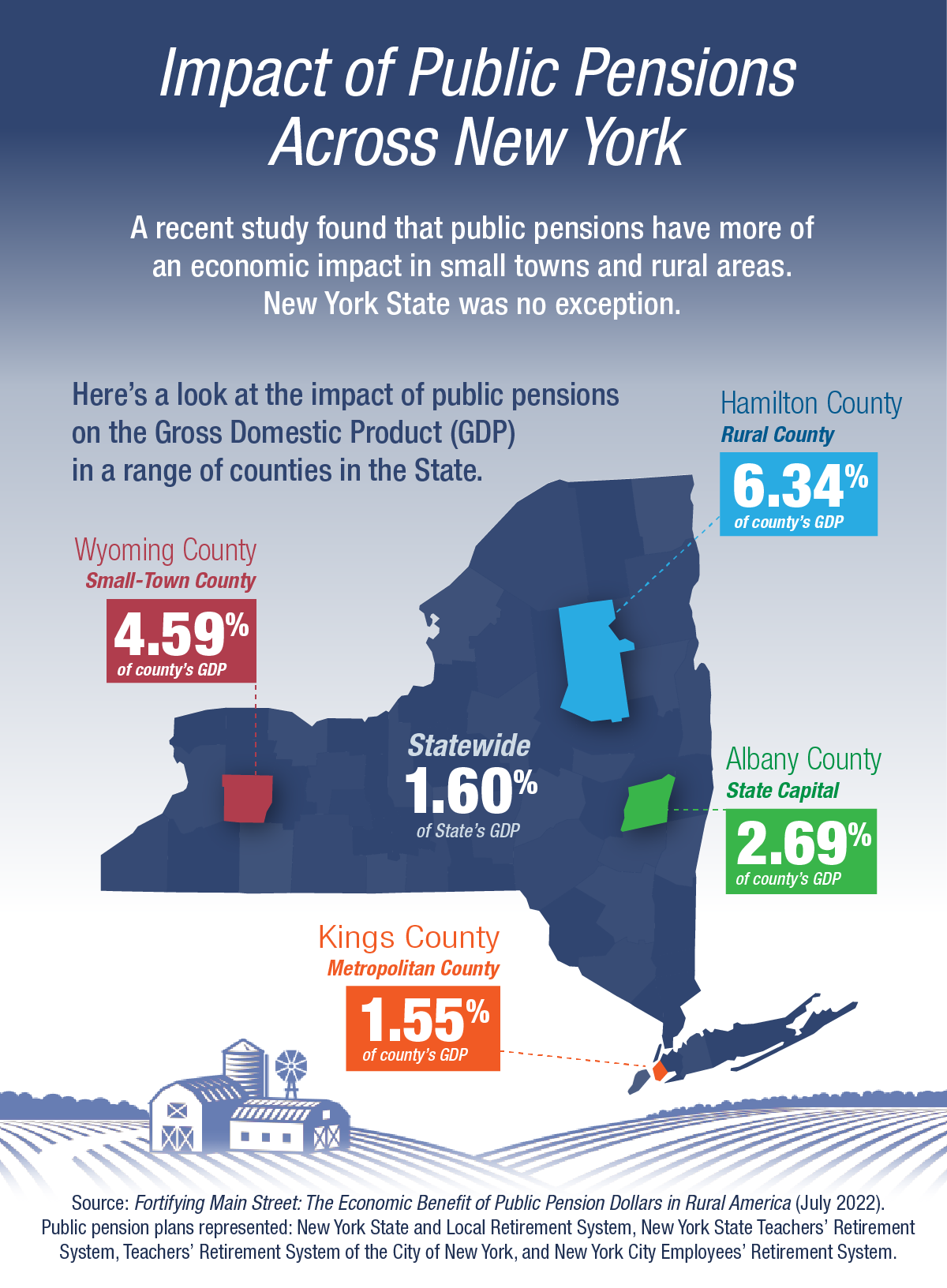
Small towns and rural areas in New York and across the United States get an important economic boost from public pensions, a recent study concludes.

Public Pensions Give Economic Boost to Small Towns and Rural Areas Across New York

Why Public Pensions Give an Economic Boost

Because of their smaller economies, less-populated counties benefit more from pension dollars than larger, urban counties, according to Fortifying Main Street: The Economic Benefit Of Public Pension Dollars In Rural America.

In many small towns and rural communities, the report notes, school districts and local governments are the largest employers. Those public employees typically remain in their communities after retirement, and the authors attribute the economic boosts they found to pension dollars spent locally on goods and services.

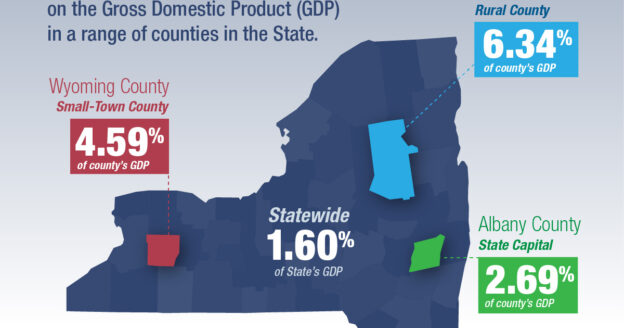
Across New York State, public pensions were responsible for 1.6 percent of gross domestic product (GDP) in 2018. (GDP, the total value of goods and services produced during a specific period, is a common gauge of economic activity.) However, during the same period:

  • Wyoming County in western New York, where a handful of villages dot a rural landscape, saw public pensions generate 4.6 percent of GDP.
  • Hamilton County, with fewer than 5,000 people, received an economic boost from public pensions that accounted for 6.3 percent of GDP.

The study’s findings are in line with data showing the impact NYSLRS retirees have on local economies and other studies about the economic benefits of pensions.

Notes on the Data

Fortifying Main Street, which was released in July by the National Institute on Retirement Security (NIRS), examines pension data from 2,922 counties in 43 states. Based on criteria used by the federal Office of Budget Management, it divides counties into three main categories: metropolitan, small-town (or micropolitan) and rural. The study also analyzes data from counties that are home to the state capital, because these places tend to have higher numbers of public retirees. In Albany County, public pensions generated 2.7 percent of GDP.

Hamilton County is the only county in New York defined as rural in the study, but 16 counties, including Wyoming County, fit the “small town” criteria. You can read the full report on the NIRS website.

The study uses pensions paid by NYSLRS, the New York State Teachers’ Retirement System, the Teachers’ Retirement System of New York City and the New York City Employees’ Retirement System in its data for New York State.

Retroactive Payments and Your NYSLRS Pension

Retroactive payments are lump sum payments you receive from your employer. These payments can be from new union contracts, arbitration awards or legal settlements that took place while you were on your employer’s payroll.

If you receive a retroactive payment from your employer, it could affect your pension benefit calculation.

How Retroactive Payments Can Affect Your Benefit

Retroactive Payments

Your final average earnings (FAE) are a major factor in your pension benefit calculation. It’s the average of your three (five for Tier 6 members) highest consecutive years of earnings. For most people, their highest years of earnings come at the end of their careers.

Retroactive payments are applied to the pay periods when they were earned, not when they were paid. So, retroactive payments can increase your FAE, and therefore your pension benefit, as long as the time period in which you earned that money is part of the time period your FAE is based on.

However, please be aware that the law limits the FAE of all members who joined on or after June 17, 1971. For most members, if your earnings increase significantly through the years used in your FAE, some of those earnings may not be able to be used toward your pension. You can find information about earnings limitations by tier, including examples, on the Final Average Earnings page on our website. If your FAE has already been affected by these earnings limits, your retroactive payment will not increase your pension benefit.

Payments Received Before Retirement. If you receive a retroactive payment from your employer before you retire, your employer will report your earnings to us through their regular reporting process. You do not need to notify us of payments you receive.

Payments Received After Retirement (State Employees). If you retired from New York State and you receive a retroactive payment after you retire, we will recalculate your pension automatically. NYSLRS receives State payroll information automatically and you do not need to notify us. You will receive correspondence from us explaining any change in your pension benefit.

Payments Received After Retirement (Non-State Employees). If you retired from a non-State employer and you receive a retroactive payment after you retire, send a letter to our Recalculation Unit in the Benefit Calculations & Disbursement Services Bureau. Please include a copy of your check stub and any correspondence you received from your employer related to the payment. Mail it to:

NYSLRS
Attn: BCDS – Recalculation Unit
110 State Street
Albany, NY 12244-0001

You can also email and upload this information to the Retirement System through our secure contact form.

Your Pension Recalculation Will Be Completed

We continue to receive a record number of pension recalculations and are working diligently to address them. If you are currently waiting for your pension amount to be recalculated, please rest assured that we will get to it. Once we complete your recalculation, you will receive payment of all the money you are owed, and a letter explaining the change in your pension amount.

Recent PEF Retroactive Payments

If you were a Public Employees Federation (PEF) member before retiring from State service, you may have recently received a retroactive payment. The current PEF contract, covering employment from April 1, 2019 through March 31, 2021, was ratified last summer. If you were a PEF member, worked during these dates and have not received your retroactive payment, please check with your previous employer.

If you retired recently and your FAE included earnings from on or after April 1, 2019, your NYSLRS pension will be increased automatically. You do not need to notify us that you received a retroactive payment.

CSEA Contract Negotiations

If you were a member of the Civil Service Employees Association (CSEA) before you retired, your contract and any retroactive payment is currently being negotiated. Contact CSEA if you have questions.

What is Your Net Worth?

When it comes to understanding your finances, a good place to start is by calculating your net worth.

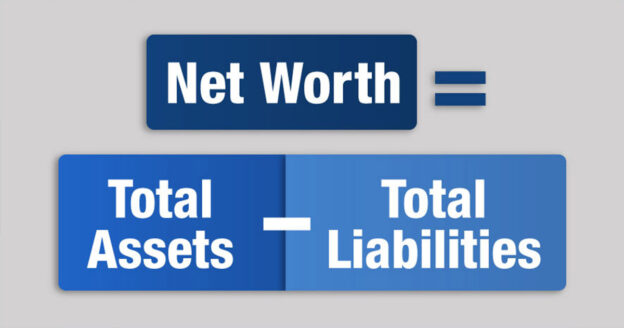
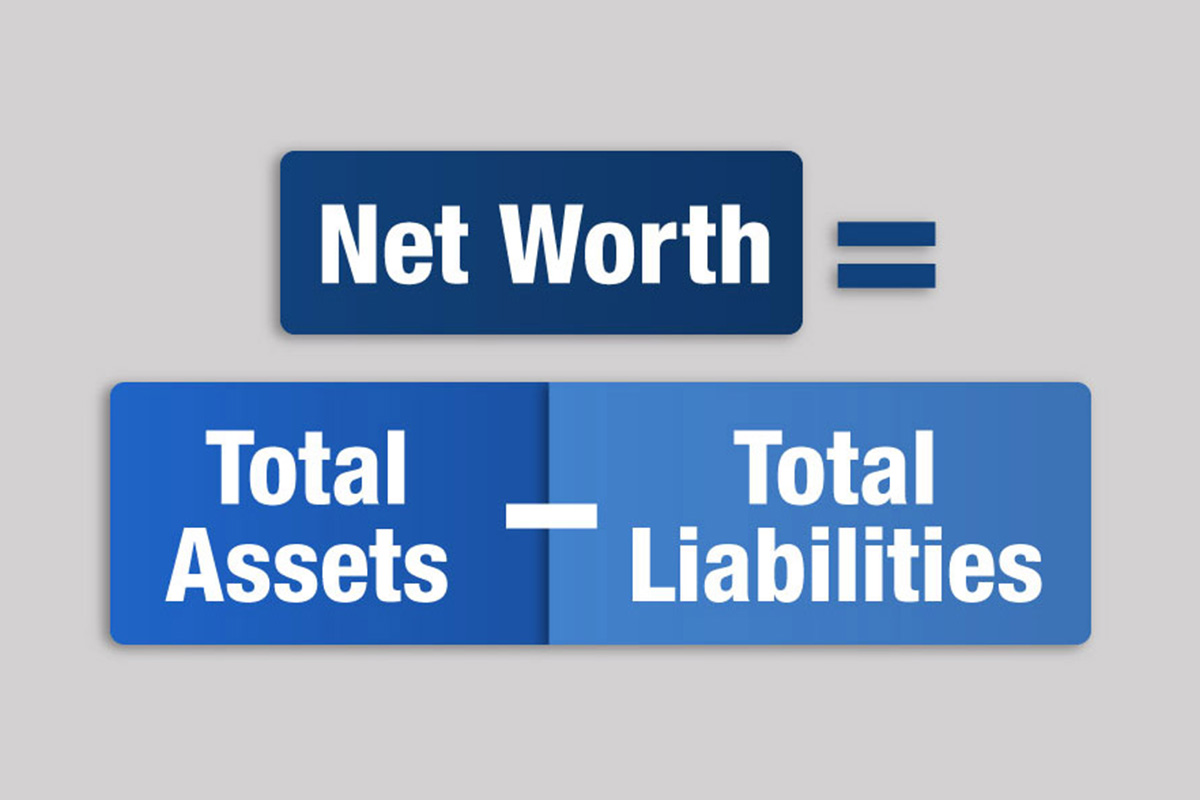
Net worth is the total value of everything you own, minus the money you owe. It is a measure of your wealth and an indicator of your financial condition. It can also provide you with valuable insight as you start developing your financial plan for retirement.

How to Calculate Net Worth

The formula for calculating your net worth is simple:

net worth formula

Assets and Liabilities

Your assets are items of value that you own, including:

  • Your house
  • Other real estate (a vacation home, rental property)
  • Money in checking and saving accounts
  • Retirement savings, such as a 401(k) or Deferred Compensation account
  • Stocks, bonds and other investments
  • Your car and other vehicles
  • Jewelry, furniture and household items

Your liabilities are your debts. Your mortgage, credit card debts and loan balances factor into your total liabilities.

If you owe more than the value of your total assets, you have a negative net worth. A negative net worth may not necessarily mean you’re in financial trouble — it just means that at the moment you have more debts than assets.

If you’re just beginning your career and still have student loans, you may find yourself in negative territory. But your net worth is likely to increase over time as you pay down debts and save money.

Knowing Your Net Worth Can Help You Get a Handle on Your Finances

Your net worth shows your current financial status. When you know where you stand, you’ll be better prepared to make decisions about spending, saving and investing, which will help you achieve your short- and long-term financial goals. Your net worth can show you where you’re doing well and where there’s room for improvement. For example, it may indicate a need to curb your spending or reduce your credit card debt.

Your net worth is likely to change over time, so it’s a good idea to calculate it periodically. With this updated financial information, you’ll be able to track trends and make adjustments if necessary.

To learn more about net worth and what it means, you may wish to read What’s Your Net Worth Telling You?