

Category Archives: General News

When Retirees Rejoin NYSLRS

rejoin NYSLRS

If you retire from public employment in New York State and later decide to go back to work in the public sector, you have the option of rejoining NYSLRS. However, if you are considering rejoining the Retirement System, you should understand how rejoining would affect your pension benefits.

Rejoining NYSLRS may increase your total service credit, allowing you to reach certain milestones that would increase your pension. An increase in earnings could also result in a higher pension. However, depending how long you work after rejoining, your new pension may not be higher than your original amount.

Note: This post applies to service retirees of the Employees’ Retirement System (ERS) or the Police and Fire Retirement System (PFRS) who are rejoining the same system. Different rules may apply to retirees of other retirement systems, retirees joining a system other than the one they retired from, and disability retirees.

What Happens to Your Pension When You Rejoin NYSLRS?

If you rejoin NYSLRS, your pension will be suspended. If you are in Tiers 2 through 6 and you earn less than two years of new service credit after you rejoin, your original pension would be reinstated when you retire the second time. Any new service credit and earnings would not affect your pension. (Tier 1 members would receive an additional benefit even if they earn less than two years of service in their new membership.)

If you earn two or more years of new service, you can either receive your original pension or you can receive a recalculated benefit that includes your additional service. If you choose the recalculated benefit, you will have to repay the entire pension amount you have already received, plus interest. (The pension amount you repay would be based on the Single Life Allowance rate.) You may repay that amount in a lump sum or by installments before you retire again — or request a permanent reduction to your new pension.

Other Factors

Here are other things to consider before you rejoin NYSLRS:

  • When you retire again, your new retirement date can delay your eligibility for the annual cost-of-living adjustment (COLA).
  • If you are in Tier 1 or 2, rejoining may affect your death benefit.

Where to Go for Help

If you are considering rejoining NYSLRS, we strongly recommend you speak with a customer service representative to discuss how rejoining would affect your benefits. You can call them at 866-805-0990 or send them a message using our secure contact form.

You may also wish to read our publication Life Changes: What If I Work After Retirement?
ERS Tier 6 Benefits – A Closer Look

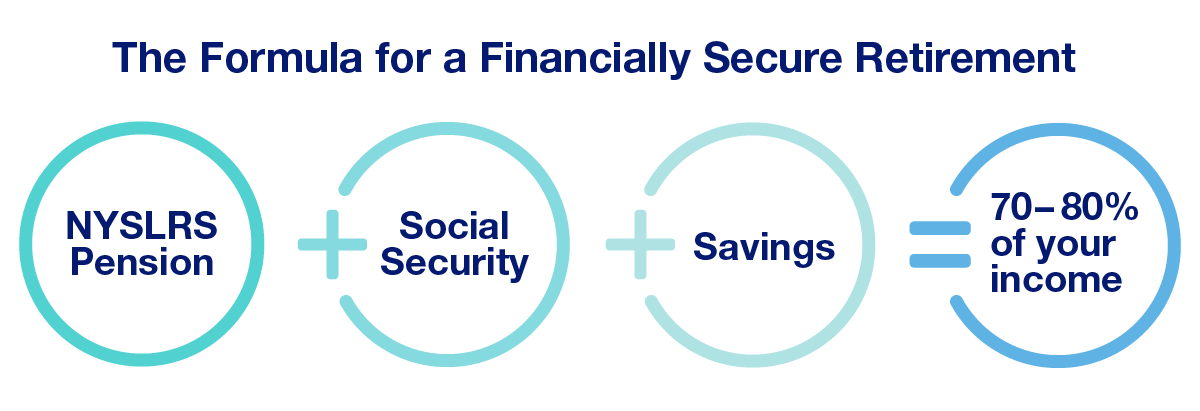
Financial advisers say you will need to replace between 70 and 80 percent of your salary to maintain your lifestyle after retirement. Your NYSLRS pension could go a long way in helping you reach that goal, especially when combined with your Social Security benefit and your own retirement savings. Here’s a look at how Employees’ Retirement System (ERS) members in Tier 6 (who are vested once they’ve earned five years of credited service), can reach that goal. Members who joined NYSLRS since April 1, 2012 are in Tier 6.

formula for a financially secure retirement

Calculating an ERS Tier 6 Member’s Pension

Your NYSLRS pension will be based on your Final Average Earnings (FAE) and the number of years you work in public service. FAE is the average of the five highest-paid consecutive years. Note: The law limits the FAE of all members who joined on or after June 17, 1971. For example, for most members, if your earnings increase significantly through the years used in your FAE, some of those earnings may not be used toward your pension.  

Although ERS members can generally retire as early as age 55 with reduced benefits, the full retirement age for Tier 6 members is age 63.

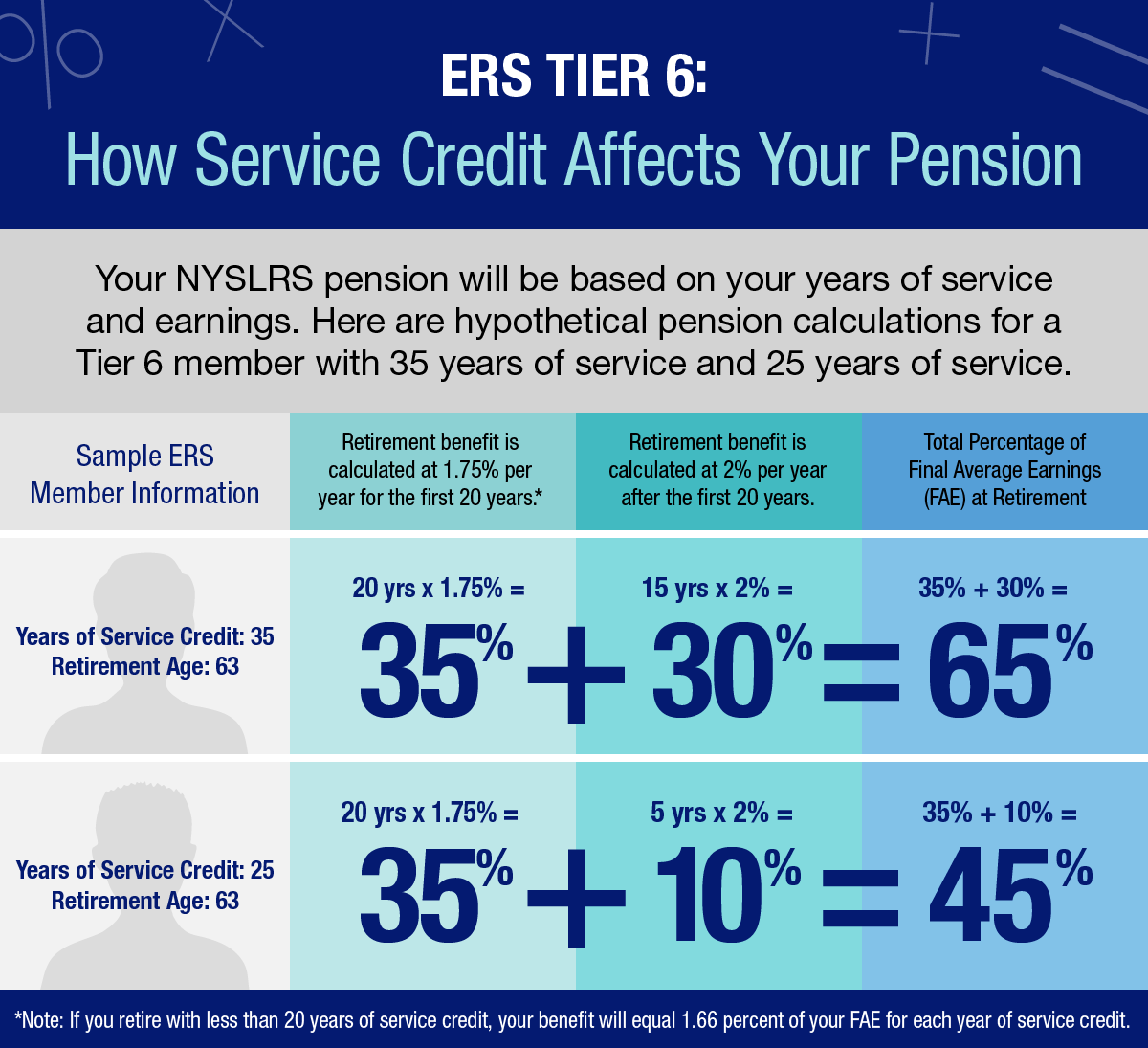
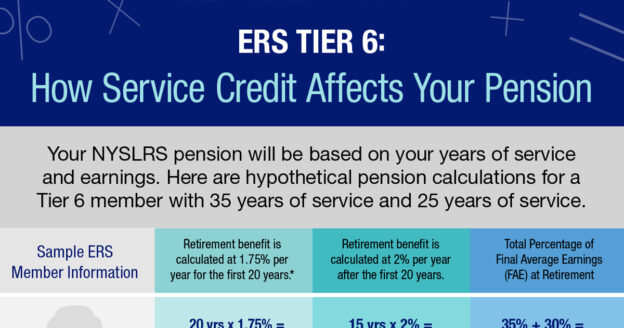
For ERS Tier 6 members in regular plans (Article 15), the benefit is 1.66 percent of your FAE for each full year you work, up to 20 years. At 20 years, the benefit equals 1.75 percent per year for a total of 35 percent. After 20 years, the benefit grows to 2 percent per year for each additional year of service. (Benefit calculations for members of the Police and Fire Retirement System and ERS members in special plans vary based on plan.)

Say you begin your career at age 28 and work full-time until your full retirement age of 63. That’s 35 years of service credit. You’d get 35 percent of your FAE for the first 20 years, plus 30 percent for the last 15 years, for a total benefit that would replace 65 percent of your salary. If you didn’t start until age 38, you’d get 45 percent of your FAE at 63.

Examples of ERS Tier 6 Pension Calculation

So, that’s how your NYSLRS pension can help you get started with your post-retirement income. Now, let’s look at what the addition of Social Security and your own savings can do to help you reach your retirement goal.

Other Sources of Post-Retirement Income

Social Security: According to the Social Security Administration, Social Security currently replaces about 40 percent of the wages of a typical worker who retires at full retirement age. In the future, these percentages may change, but you should still factor it in to your post-retirement income.

Your Savings: Retirement savings can also replace a portion of your income. How much, of course, depends on how much you save. The key is to start saving early so your money has time to grow. New York State employees and some municipal employees can participate in the New York State Deferred Compensation Plan. If you haven’t already looked into Deferred Compensation, you might consider doing so now.

A Short To-Do List for After You Retire

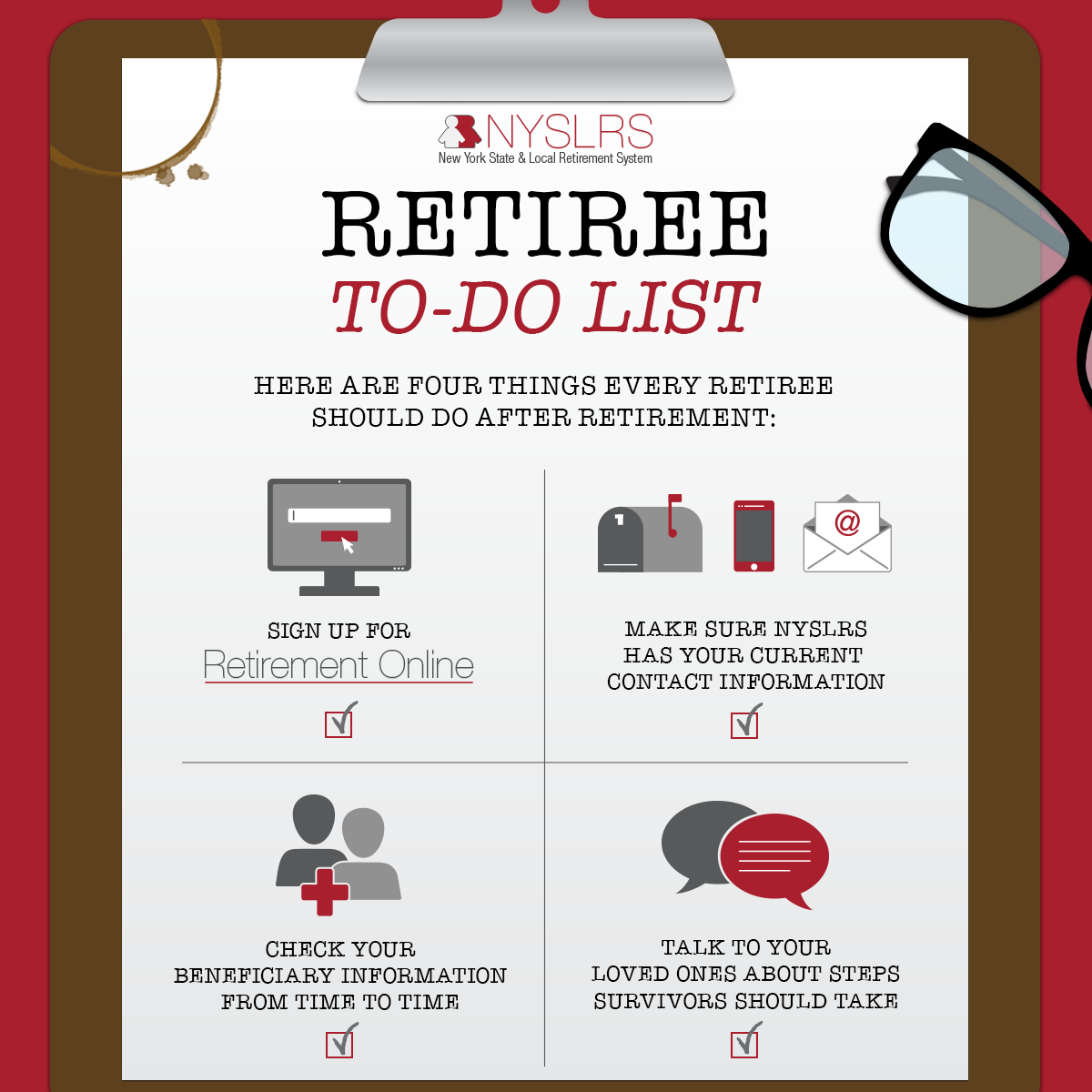
There are a few things you should do regarding your NYSLRS benefits after you retire. This way, wherever your retirement takes you, we can continue to provide you with the benefits and services available to our retirees.

A Short To-Do List for After You Retire

Sign Up for Retirement Online

If you don’t already have a Retirement Online account, this is a great time to sign up. Retirement Online provides a secure and convenient way to check important NYSLRS information, like the deductions from your latest payment and a summary of your benefits. You can also view or update beneficiary information and generate pension income verification letters right from your computer. We’ll be adding additional online features for retirees in the near future, so stay tuned.

Have New Contact Information? Let Us Know

If you move after you retire, let NYSLRS know your new address so you can be sure to get important communications about your benefits.

The Post Office usually won’t forward pension checks to another address. If you haven’t already, you can sign up for our direct deposit program. It’s the safe, hassle-free way to receive your monthly benefit. But there are other things you’ll want to receive from us after you retire, such as:

  • Your 1099-R form. Your pension isn’t taxed by New York State, but it is subject to federal income tax.
  • Your Retiree Annual Statement. It’s a helpful reference that spells out the benefits, credits and deductions you receive each year.
  • Any official notifications such as a net change in your benefits.
  • Your Retiree Notes newsletter.

There are several ways to update your address. The fastest way is through Retirement Online. Or, you can complete our secure contact form for street addresses within the United States. Be sure to fill out the entire contact form and provide both your old and new addresses.

You can also complete a Change of Address Form (RS5512) and mail it to:

NYSLRS
110 State Street
Albany, NY 12244-0001

You should also make sure we have your current email address. Having an email address on file means we can contact you quickly if we need to notify you about an update to your NYSLRS benefits. If you haven’t updated your email address with NYSLRS, update it in Retirement Online, send it to us using the secure email form or send it to us with your Change of Address Form (RS5512).

Keep Your Beneficiary Information Current

Reviewing your beneficiary designations periodically is important. By keeping them up to date, you ensure that any post-retirement death benefit will be distributed to your loved ones according to your wishes. You can use Retirement Online to change your death benefit beneficiaries at any time, or contact our Call Center and we will send you the necessary form.

Read Our Guide for Retirees

Check out our publication, Life Changes: A Guide for Retirees (VO1705), for information about other benefits you may be entitled to and the services we offer after you retire.

How Full-Time and Part-Time Service Credit Works

Service credit plays a vital part in your pension calculation and your eligibility for other NYSLRS benefits. As a NYSLRS member, you earn service credit by working for an employer who participates in the Retirement System. Your paid public employment is creditable. You would not, however, earn credit for any period when you are not receiving a salary, such as an unpaid leave of absence. You would earn credit for both full-time and part-time employment, but if you work part-time, the service you earn is pro-rated.

Earning Service Credit When You Work Full Time

When you work on a full-time, continuous basis throughout your career, we’ll calculate your total service credit from your date of employment up until the date you leave paid employment. Most full-time workers earn a year of service credit for working 260 workdays a year. For a full-time, 12-month employee, 260 workdays equal a full year. (If you work in an educational setting, you can read about earning service credit in our blog post, How School Employees Earn NYSLRS Service Credit.)

Earning Service Credit When You Work Part Time

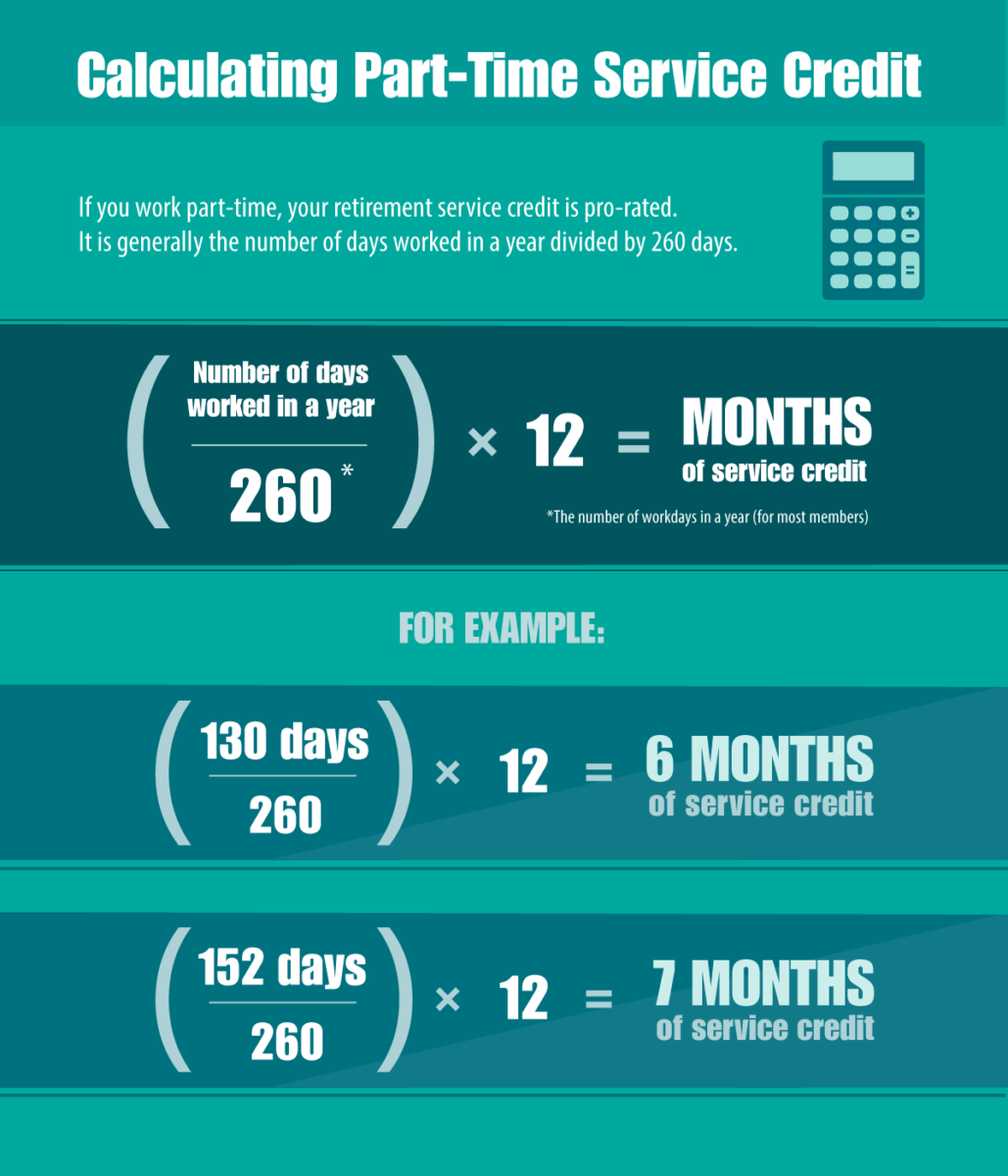
Your service credit is prorated if you work part time. Part-time employment is credited as the lesser of:

the number of days worked ÷ 260 days

or

your reported annual salary ÷ (the State’s hourly minimum wage × 2,000)

You can think of it like this: let’s say you work 130 days in a year. If a year’s worth of service credit is earned for working 260 days full time, you’d earn half a year (0.5) of service credit for your part-time work.

How Part-Time Service Credit Works

Check Your Service Credit in Retirement Online

Retirement Online is the fastest way to check your current total estimated service credit. Once you sign in, go to the ‘My Account Summary’ section of your Account Homepage and look under “Account Information.”

You can also use Retirement Online to request credit for public employment from before you joined NYSLRS. If you’re eligible to purchase previous service credit, it’s a good idea to file your request as early in your career as possible because:

  • Records we need to verify your service will be more readily available.
  • If there is a cost, it will be less expensive than if you wait to purchase credit before retirement.
  • Your retirement benefit will be processed more quickly if your service credit request has been reviewed or processed prior to retirement.

For more information, please read our publication Service Credit for Tiers 2 through 6. You may also wish to refer to your specific retirement plan booklet, available on our Publications page.

The Police and Fire Retirement System

NYSLRS is actually two retirement systems: the Employees’ Retirement System (ERS) and the Police and Fire Retirement System (PFRS).

PFRS, which provides retirement benefits for police officers and paid firefighters, is the smaller of the two systems, with about 32,000 active members. A third of PFRS members work for cities, while almost 19 percent work for New York State. The remainder work for towns, counties and villages.

There are five tiers in PFRS, reflecting when the members joined the system: Tiers 1, 2, 3, 5 and 6 (there is no Tier 4 in PFRS). Tier 2, which includes PFRS members who joined the Retirement System from July 31, 1973 through June 30, 2009, is the largest tier, accounting for almost 55 percent of PFRS membership.

If you joined PFRS on or after April 1, 2012, you are in Tier 6.

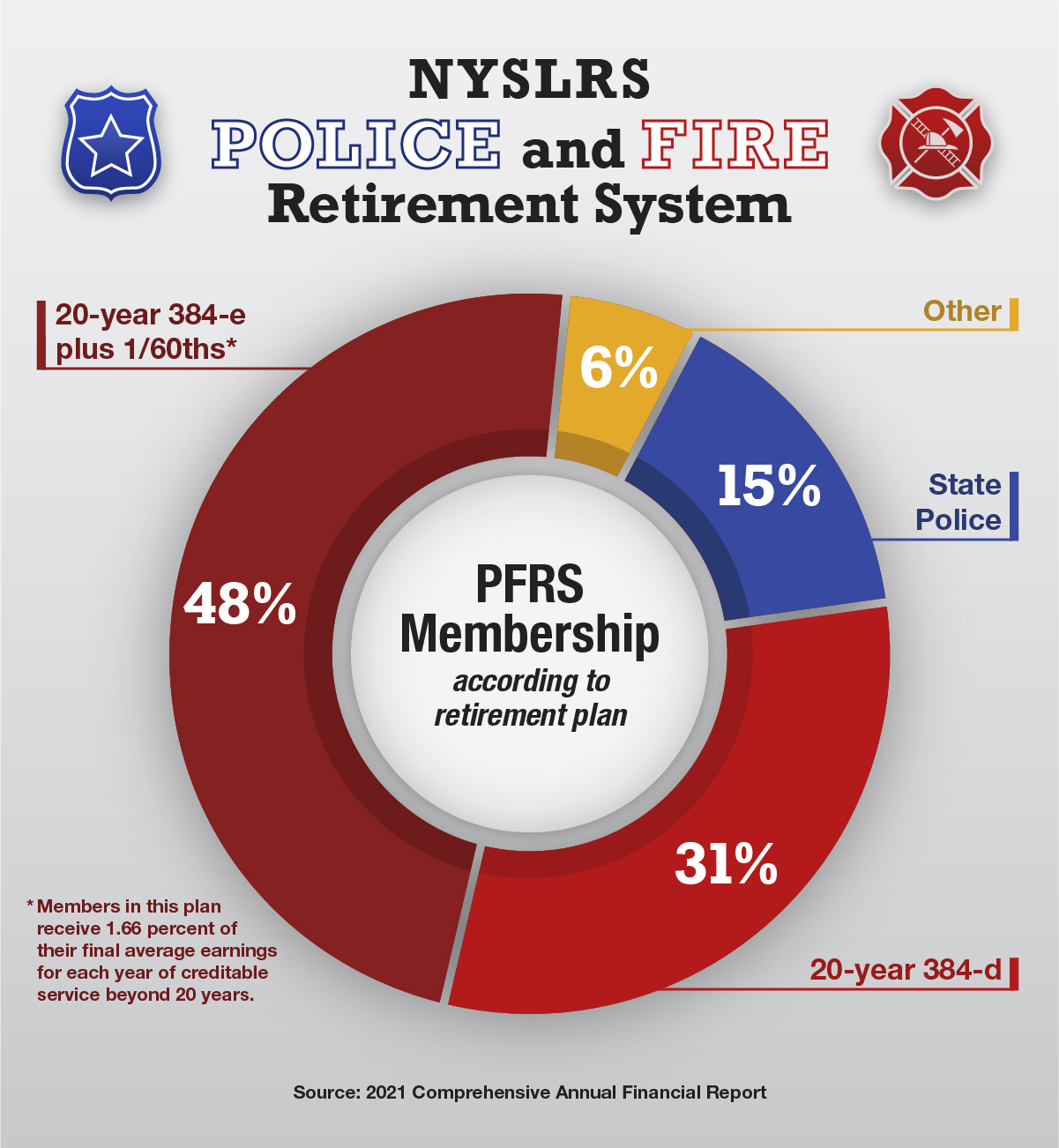
Ninety-eight percent of PFRS members are in special retirement plans that allow for retirement after 20 or 25 years of creditable service. If you are in one of these plans, once you have the full amount of required service, you can retire at any age.

Some PFRS members are in regular retirement plans, which require a member to reach a certain age before they are eligible for a pension.

police and fire infographic

As a PFRS member, you’ll pass a series of important milestones throughout your career. Knowing and understanding these milestones will help you better plan for your financial future.

Service Credit

Service credit is a key in determining your eligibility for a pension and other benefits, including the amount of those benefits.

Under most 20- and 25-year plans, not all public employment is creditable. Usually, police and firefighting service can be counted as special-plan service. You may also be able to use military service to help you reach 20 or 25 years. If you have questions about the service that can be used to calculate your pension, please check your retirement plan booklet or contact us.

PFRS Plan Booklets

You can find details about your NYSLRS benefits in your retirement plan booklet.

For the majority of PFRS members, that’s the Special 20- and 25-Year Plans booklet. This booklet is for PFRS Tier 2, 3, 5 and 6 members covered by Sections 384, 384-d and 384-e of the State Retirement and Social Security Law.

If you are a PFRS member who works for New York State, your booklet is based on your specific job. There are separate booklets for State PoliceForest RangersRegional State Park PoliceState University Police and EnCon Police.

If you are not covered by one of the plan booklets listed above, you can find your booklet on our Publications page. If you’re not sure what retirement plan you’re in, you can find that information in the My Account Summary section of your Retirement Online account. You can also check your Member Annual Statement, ask your employer or email us using our secure contact form.

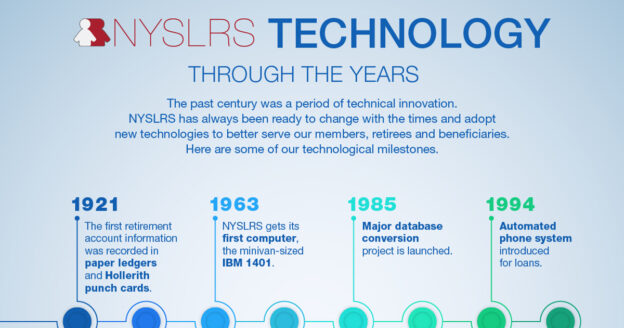
From Ledgers to Databases: A Look at NYSLRS’ Technology

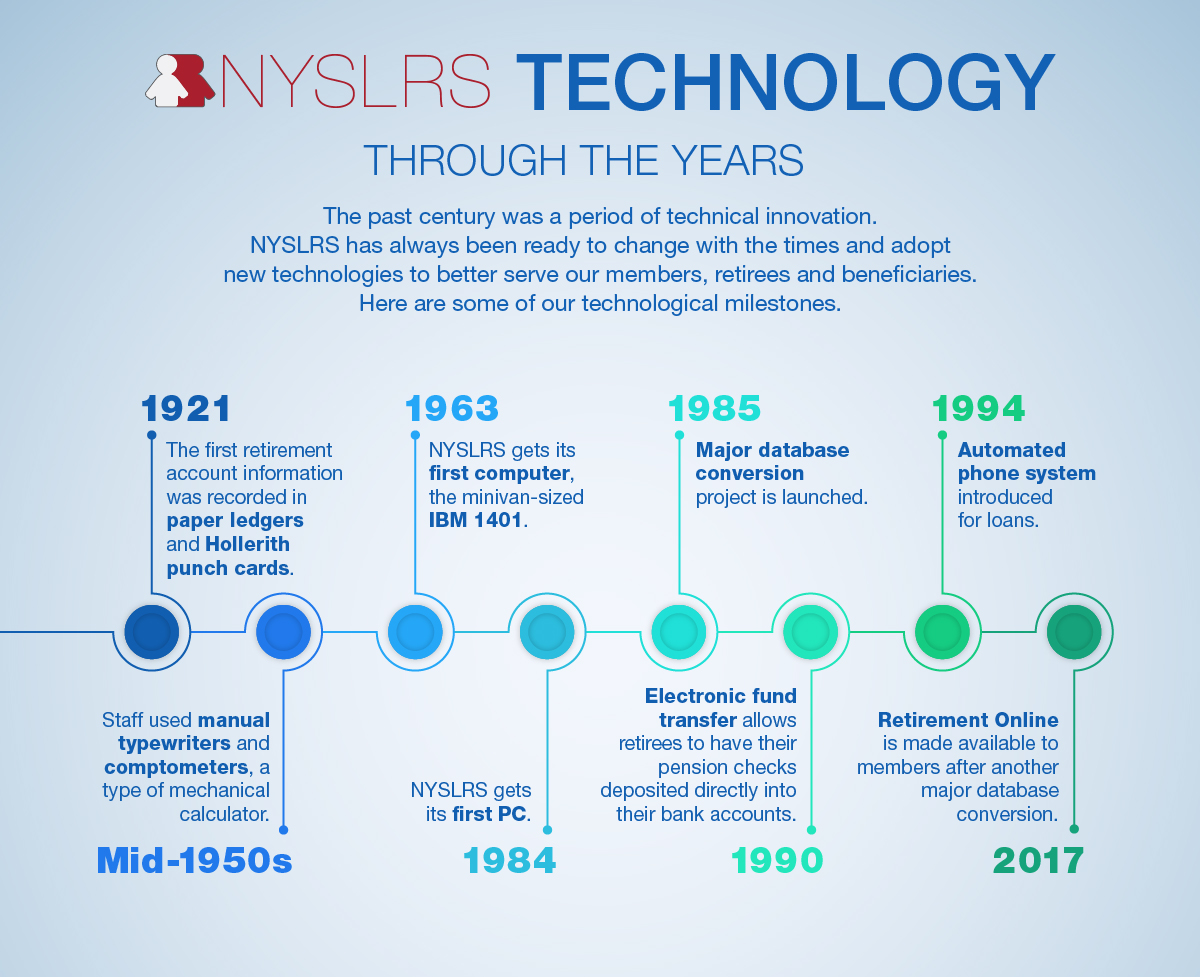
The years since 1921 have witnessed unprecedented advances in technology. Not surprisingly, NYSLRS has taken advantage of many of these innovations to manage a complex and growing retirement system.

NYSLRS technology through the years

The Early Years

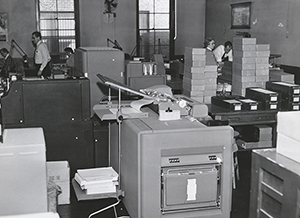
The IBM 407 Accounting Machine, mid-1950s
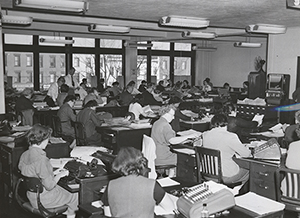
Typewriters and comptometers (adding machines), mid-1950s

When NYSLRS was established a century ago, the business world was still in the age of paper, as it had been for centuries. Individual member information was logged in paper ledger books. A punch card was prepared for each member and retiree, and this data was mechanically tabulated to record statistical information (date of birth, gender, years of service, etc.) about them.

An employee’s desk also looked radically different. Instead of laptops and computer monitors, office technology was limited to adding machines and typewriters, and the use of carbon paper for making copies of documents. Large accounting machines, like the IBM 407, read member punch cards and could print out results.

The Computer Era

In 1963, NYSLRS entered the computer age with its first computer, an IBM 1401. The 1401 was considered revolutionary in its day, offering businesses an affordable general-purpose computer. At the time, it also had 16KB of memory – about as much as a pocket calculator today – and was the length of a minivan. NYSLRS’ early computers were programmed and coded through the use of punch cards, until the late 1970s, when they could be coded through terminals. The first personal computers wouldn’t appear on staff desks until 1984.

NYSLRS accounting machine.
The IBM 407 Accounting Machine, mid-1950s

In the mid-1980s, NYSLRS launched a major database conversion project, which would result in a computer system that would serve NYSLRS for decades. But that system eventually became outdated. Recently, after years of meticulous research, NYSLRS launched a multi-year project to replace its information technology systems and streamline core services.

Retirement Online is the public face of that project. Launched in 2017, Retirement Online provides members and retirees with convenient, secure access to their account information. Members can update contact and beneficiary information, apply for a loan, generate a pension estimate, apply for a service retirement benefit and more. Retirees can view pension payment and tax withholding information, and additional features will be added in the near future.

The Future

Technology has served NYSLRS well over the years. Certainly, technology will continue to evolve, and NYSLRS will continue to adopt innovations that help us better serve our members, retirees, beneficiaries, and employers.

Power of Attorney

Under normal circumstances, NYSLRS won’t release your benefit information – even to close family members­ – without your permission. However, if we have an approved copy of your power of attorney (POA) form on record, we can discuss your information with the person you named as your agent in your POA.

For example, your agent could ask for details about your pension payments, get help completing a loan application or call us for clarification if you don’t understand a letter you received.

father and son discuss power of attorney

Your agent could be your spouse, another family member or a trusted friend. You may designate more than one person as your agent, and you may authorize those agents to act together or separately. You may also designate “successor agents” to act on your behalf if the primary agent is unable or unwilling to serve.

A POA form may be filed with NYSLRS at any time, so there’s no need to wait until a “life event” happens to file. With a POA already on record, the designated agent can act immediately in case of emergency, hospitalization or unexpected illness.

What Can Agents Do?

The agent named in your POA is authorized to act on your behalf and conduct business with NYSLRS for you.

Agents can file applications and forms, such as service or disability retirement applications. They can get account-specific benefit information, request copies of retirement documents, update addresses and phone numbers, and take out loans. For retirees, agents can change the amount withheld from your pension for taxes.

The NYSLRS POA Form

NYSLRS provides a Special Durable Power of Attorney form that is specific to retirement transactions and meets all New York State legal requirements.

If you use the NYSLRS POA form, and your agent or successor agent is your spouse, domestic partner, parent or child, they have “self-gifting authority.” That means they can designate themselves as a beneficiary of your pension benefits or, if you are not yet retired, choose a retirement payment option that provides for a beneficiary after your death and designate themselves as a beneficiary for that benefit.

If your agent or successor agent is not your spouse, domestic partner, parent or child, they do not automatically have self-gifting authority. If you want them to be able to designate themselves as beneficiaries, you should indicate that in the Modifications section of the POA. You should identify your agent by name and specify the authority you want granted to them.

It’s important to note that the NYSLRS POA form only covers Retirement System transactions. It does not authorize an agent to make health care decisions or changes to a Deferred Compensation plan.

Changes to the POA Law

The law governing POA requirements was changed effective June 13, 2021. Any POA executed on or after that date must comply with the following requirements (the NYSLRS form complies with the requirements):

  • All POAs must be signed by two disinterested witnesses (witnesses who are not listed as an agent in the POA or named in the POA as a person who can receive gifts).
  • The use of a Statutory Gift Rider to grant gifting authority has been eliminated. If you do not use the NYSLRS POA form and instead submit a separately prepared Statutory POA form, gifting authority, even for a close family member, must be granted in the Modifications section of the POA. (See our Power of Attorney page for details.)

If you have an approved POA on file with NYSLRS, you do not need to send a new one. POAs executed before June 13, 2021, will be reviewed in accordance with the laws in effect at the time. POAs executed on or after June 13, 2021, that use an old POA form or do not comply with other requirements of the new law will not be valid.

How to Submit a POA Form

You can scan and email a copy of your POA to NYSLRS using our secure email form.

You can also mail your POA (original or photocopy). You may wish to mail it certified mail, return-receipt requested, so you know when NYSLRS receives it. Mail it to:

NYSLRS
110 State Street
Albany, NY 12244-0001.

Find Out More

A power of attorney is a powerful document. Once you appoint someone, that person may act on your behalf with or without your consent. We strongly urge you to consult an attorney before you execute this document.

You may revoke your POA at any time by sending us a signed, notarized statement.

Please read the Power of Attorney page on our website for additional information.

A Century of Security and Stability

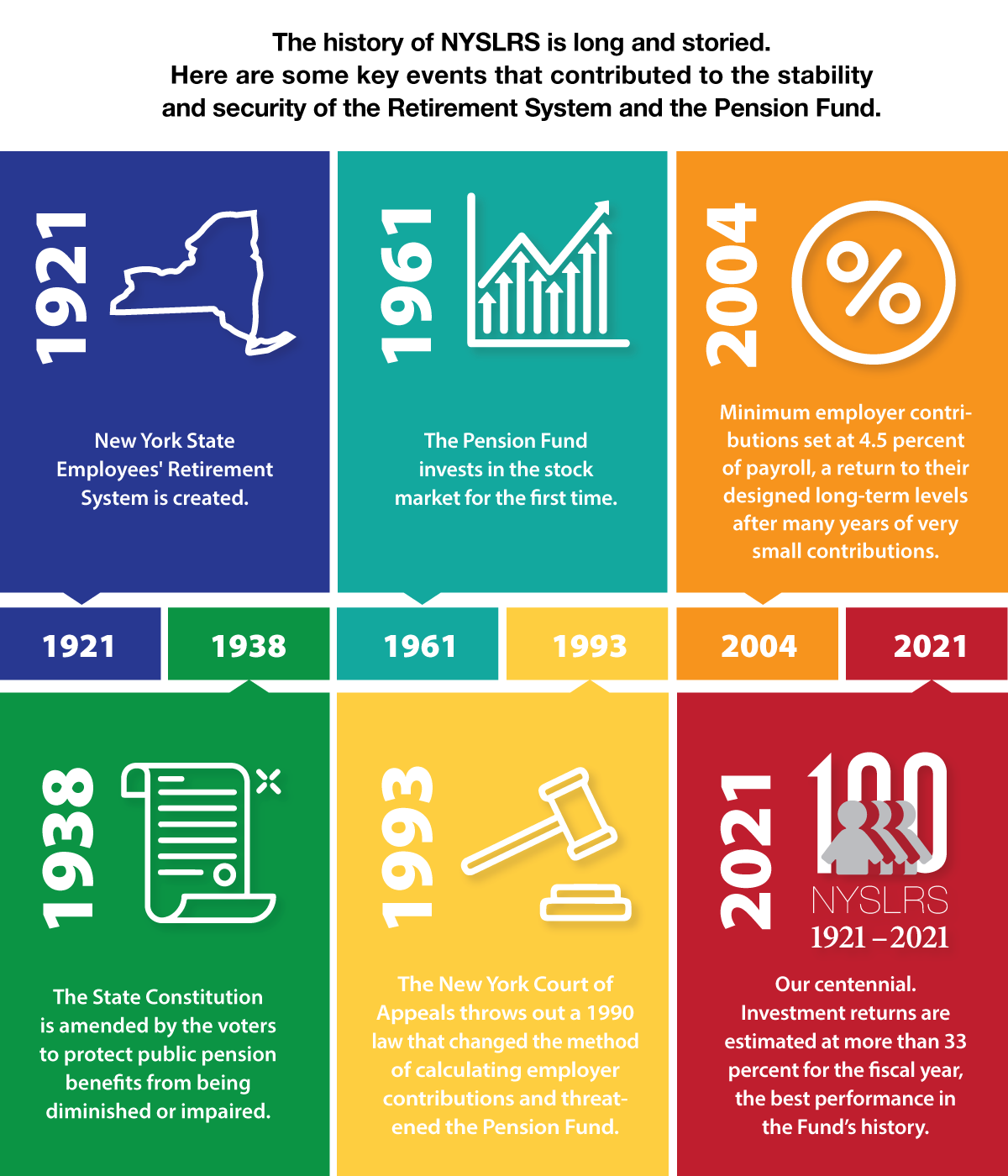
A century after its creation, the New York State and Local Retirement System (NYSLRS) is widely recognized as one of the best-managed and best-funded public pension systems in the nation. Comptroller DiNapoli recently announced that the New York State Common Retirement Fund (Fund), which holds and invests the assets of NYSLRS, had an estimated value of $268.3 billion as of June 30, 2021. The security and stability of NYSLRS and the Fund are due, in large part, to the stewardship of Comptroller DiNapoli, as well as a long line of State Comptrollers that came before him. The System has also been bolstered by some key events along the way.

NYSLRS History - key events contributing to the security and stability of the Retirement System and the Fund

In the Beginning

NYSLRS’ security and stability were built in at the start. In 1918, the State Legislature created the Commission on Pensions and charged it with recommending a pension system for State workers.

After surveying pension plans in New York and other states, the Pension Commission recognized the need to calculate the cost of the pension plan through actuarial calculations, which take into account such things as employees’ salaries and how long they are expected to be retired. They also saw the need to make provisions to cover those costs through contributions and other income. They recommended a plan supported by the contributions of employers (New York State and, eventually, local governments) and employees. The improved actuarial calculations the System uses today helps to ensure that member contributions and employer annual contributions are sufficient to keep the System adequately funded.

The Pension Commission also recommended a service retirement benefit be made available to workers who reached a certain age, based on average earnings and years of service. Though they didn’t use the term, their pension plan was very similar to the defined-benefit plan NYSLRS members have now.

Unlike the 401k-style defined-contribution plans common in the private sector today, a defined-benefit plan provides a guaranteed, lifetime benefit. With a defined-benefit plan, you don’t have to worry about your money running out during retirement, and your employer has an excellent tool for recruiting and retaining workers.

Constitutional Protection

In 1938, New York voters approved several amendments to the State Constitution, including Article 5, Section 7, which guarantees that a public pension benefit cannot be “diminished or impaired.” This constitutional language protects the interests of the Fund and its members and beneficiaries, ensuring that the money the Fund holds will be there to pay the pensions for all current and future retirees. The courts have upheld this constitutional provision to protect the Fund several times over the years.

For NYSLRS members and retirees, that means the retirement benefits you were promised when you started your public service career cannot be reduced or taken away.

Sound Investments

Sound investments are crucial to the health of the Fund, but in some cases changes in the law were needed to give Fund managers the flexibility to make the best investments. In 1961, the Fund was allowed to invest in the stock market, opening up the door for growth opportunities. Roughly half of the Fund’s assets are currently invested in stocks.

In 2005, the Legislature expanded the types of investments the Fund could make, allowing the Fund to increase investments in real estate, international stocks and other sectors that had been providing high returns.

Today, under Comptroller DiNapoli’s leadership, the Fund’s investment returns cover the majority of the cost of retirement benefits. After suffering a drop in value at the beginning of the COVID pandemic, the Fund had its best year in history, with estimated investment returns of 33.55 percent for fiscal year 2021.

NYSLRS is well-positioned to face the challenges of the future and provide retirement security for more than 1.1 million members, retirees and beneficiaries.

Tier 3 & 4 Members: When Is The Right Time To Retire?

Tier 3 and 4 members in the Article 15 retirement plan qualify for retirement benefits after they’ve earned five years of credited service. Once you’re vested, you have a right to a NYSLRS retirement benefit — even if you leave public employment. Though your pension is guaranteed, the amount of your pension depends on several factors, including when you retire. Here is some information that can help you determine the right time to retire.

Three Reasons to Keep Working

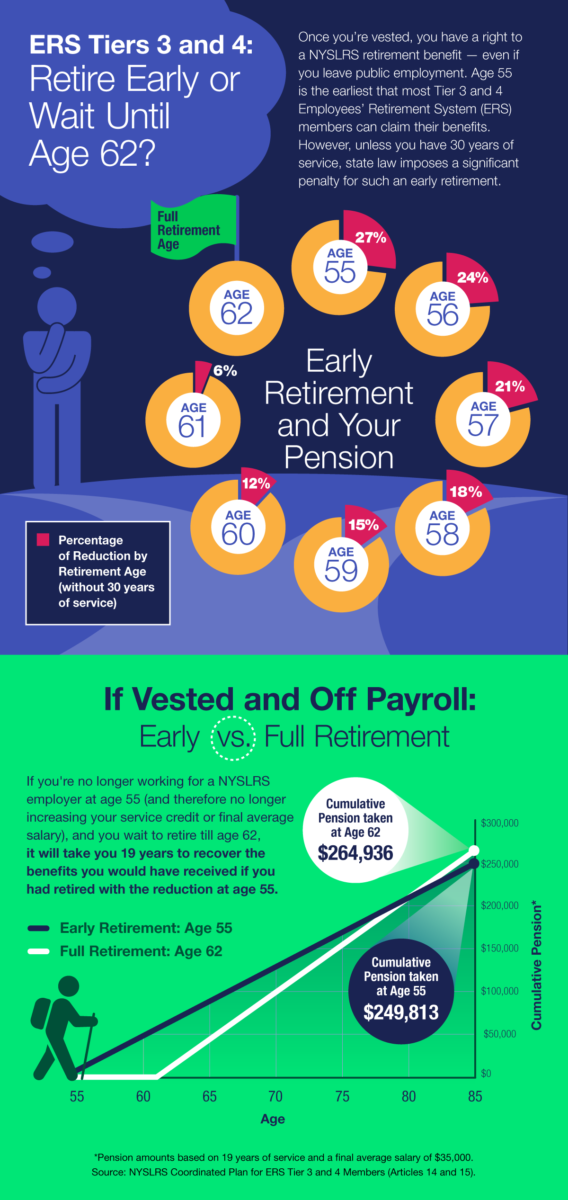
  1. Tier 3 and 4 members can claim their benefits as early as age 55, but they’ll face a significant penalty for early retirement – up to a 27 percent reduction in their pension. Early retirement reductions are prorated by month, so the penalty is reduced as you get closer to full retirement age. At 62, you can retire with full benefits. (Tier 3 and 4 Employees’ Retirement System (ERS) members who are in the Article 15 retirement plan and can retire between the ages of 55 and 62 without penalty once they have 30 years of service credit.)
  2. Your final average earnings (FAE) are a significant factor in the calculation of your pension benefit. Since working longer usually means a higher FAE, continued public employment can increase your pension.
  3. The other part of your retirement calculation is your service credit. More service credit can earn you a larger pension benefit, and, after 20 years, it also gets you a better pension formula. For Tier 3 and 4 members, if you retire with less than 20 years of service, the formula is FAE × 1.66% × years of service. Between 20 and 30 years, the formula becomes FAE × 2.00% × years of service. After 30 years of service, your pension benefit continues to increase at a rate of 1.5 percent of FAE for each year of service.

When is the Right Time to Retire infographic


If You’re Not Working, Here’s Something to Consider

Everyone’s situation is unique. For example, if you’re vested and no longer work for a public employer, and you don’t think you will again, taking your pension at 55 might make sense. When you do the math, full benefits at age 62 will take 19 years to match the money you’d have received retiring at age 55 — even with the reduction.

An Online Tool to Help You Make Your Decision

Most members can use Retirement Online to estimate their pensions.

A Retirement Online estimate is based on the most up-to-date information we have on file for you. You can enter different retirement dates to see how those choices would affect your benefit, which could help you determine the right time to retire. When you’re done, you can print your pension estimate or save it for future reference.

If you are unable to use our online pension calculator, please contact us to request a pension estimate.

This post has focused on Tier 3 and 4 members. To see how retirement age affects members in other tiers, visit our About Benefit Reductions page.

NYSLRS and Public Employers: A Partnership That Works

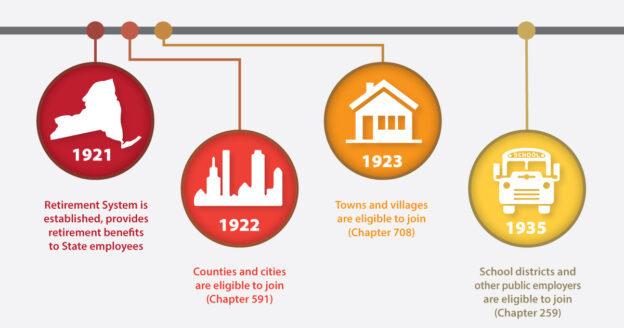
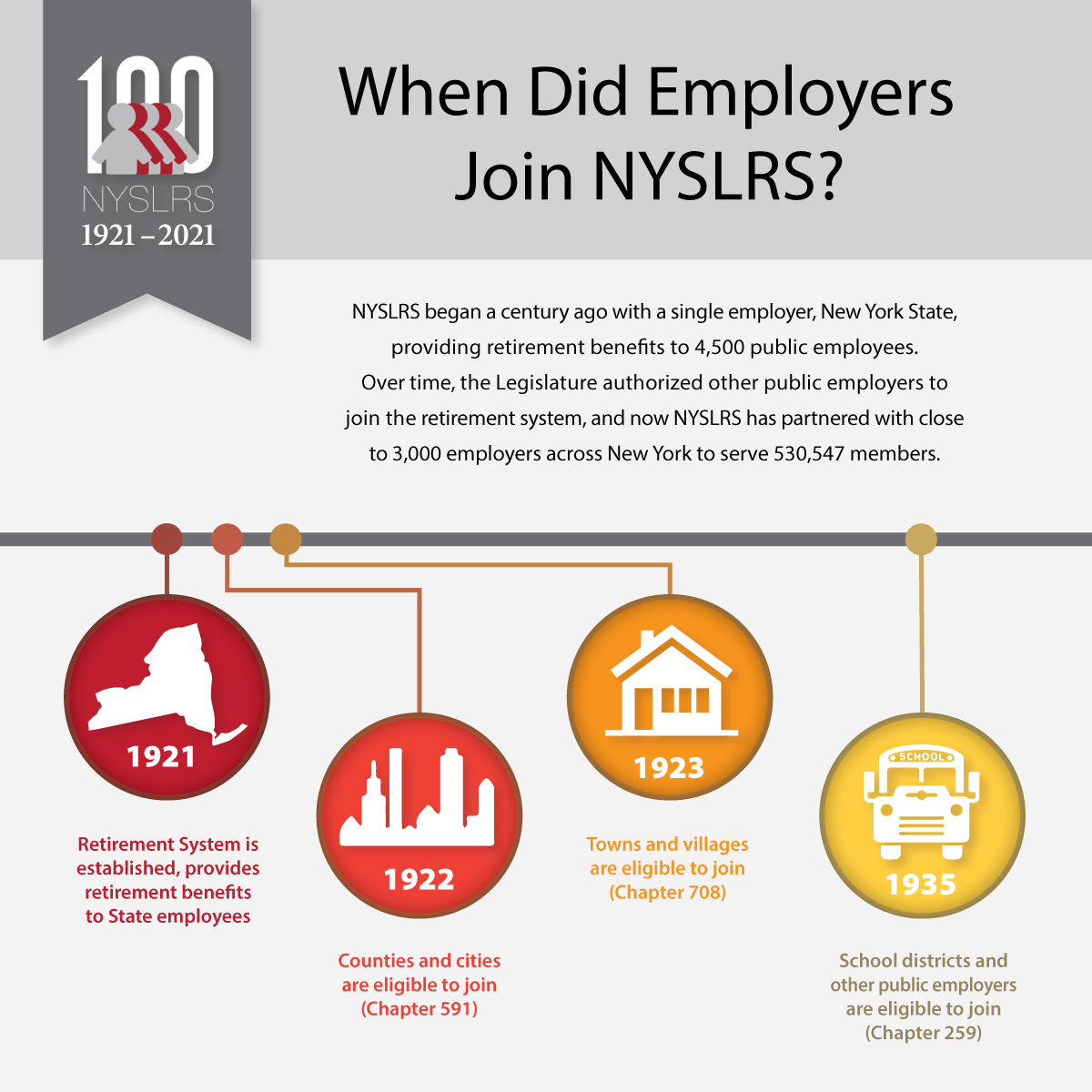
When the Retirement System was created in 1921, it served a single employer: New York State. But that would quickly change as a series of new laws allowed local governments and other public employers to join the system.

In May 1922, Steuben County was the first county to join, and Newburgh became the first city the following month. In 1923, Onondaga was the first town and Avon was the first village to sign on. The Roosevelt Public Library on Long Island became the first library to join in 1924. In 1935, the system was opened to school districts and other public employers.

NYSLRS and Public Employers partnership

The NYSLRS Partnership

Today, close to 3,000 public employers participate in NYSLRS, and they employ about two-thirds of the system’s roughly half million active members. These employers’ active involvement has helped make NYSLRS one of the largest public retirement systems in America, serving 1.1 million members, retirees and beneficiaries.

This partnership includes a shared commitment to providing secure pension benefits to New York’s public employees. Participating employers make annual contributions to help fund the future benefits of their employees. Each year NYSLRS’ actuary calculates the contribution rates required to ensure that adequate assets are being accumulated to pay benefits. These contributions along with member contributions and our investments are what fund promised benefits. As a result, NYSLRS is one of the best-funded public retirement system in the country, with an estimated Fund value of $254.8 billion as of March 31, 2021.

How NYSLRS Benefits Public Employers

Being part of NYSLRS allows municipal employers, regardless of their size, to offer prospective workers an attractive benefits package, including a defined benefit pension. With a defined benefit pension, those employees can be assured of a lifetime benefit during their retirement years.

In a recent survey, a majority of public employees said pensions are an important recruiting and retention tool. Eighty-six percent cited retirement benefits as a major reason they stay in their jobs. Another survey indicated that the general public agrees that pensions, particularly for public safety employees, are a good way to recruit and retain public workers.

How NYSLRS Benefits Communities

The benefits provided by NYSLRS help ensure that local governments can attract qualified and committed people to perform essential public services. Our members are police officers, firefighters, forest rangers and nurses. They plow roads, monitor water supplies, drive school buses, inspect restaurants, process unemployment claims and provide other vital services.

What’s more, after they retire and begin collecting their pensions, most NYSLRS members remain in New York, where they continue to contribute to their communities. In 2019, spending by NYSLRS retirees generated more than $15 billion in economic activity statewide and helped create an estimated 77,900 jobs.