Tag Archives: PFRS

Tier 6 Member Contribution Rate Changes

Most NYSLRS members contribute a percentage of their earnings toward their retirement. For Tier 6 members (those who joined NYSLRS on or after April 1, 2012), your contribution rate is based on your earnings and is subject to change each year on April 1.

The minimum contribution rate is 3 percent, and the maximum is 6 percent.

Tier 6 contribution rates

How Your Tier 6 Contribution Rate is Calculated

If you are a new Tier 6 member, your contribution rate is based on a projected annualized wage provided by your employer. For new part-time employees, your employer calculates a projected annualized wage by using your part-time rate to determine what your annual wage would be if you worked full-time.

Once you have been a member for more than two full state fiscal years, your contribution rate is calculated using actual earnings reported to us by your employer(s) from two state fiscal years prior. So, contribution rates for April 1, 2025 through March 31, 2026 are based on what you actually earned in all public employment from April 1, 2023 through March 31, 2024.

Earnings include:

Overtime Pay Temporarily Excluded from Tier 6 Contribution Rates

A new law temporarily excludes overtime pay earned from April 1, 2022 through March 31, 2024 from the calculation of Tier 6 contribution rates. This may lower contribution rates for some Tier 6 members from April 1, 2024 through March 31, 2026.

For more information, read our blog post, Overtime Pay Temporarily Excluded from Tier 6 Contribution Rates.

Contribution rates are set at the beginning of each fiscal year on April 1. If your contribution rate changes, we notify your employer in March so they can update their payroll system to withhold the proper amount.

For more information, visit our Member Contributions webpage.

Understanding Your NYSLRS Pension

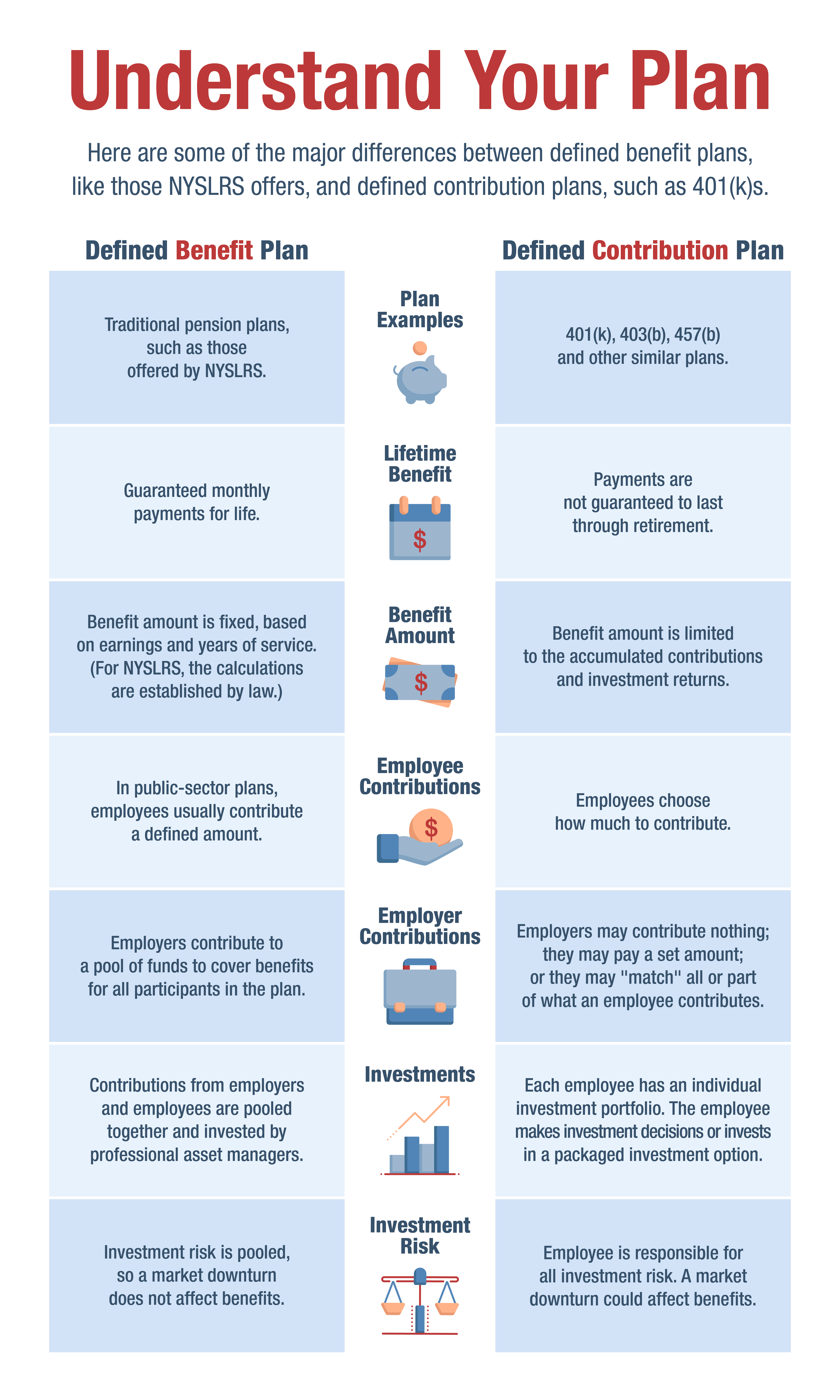
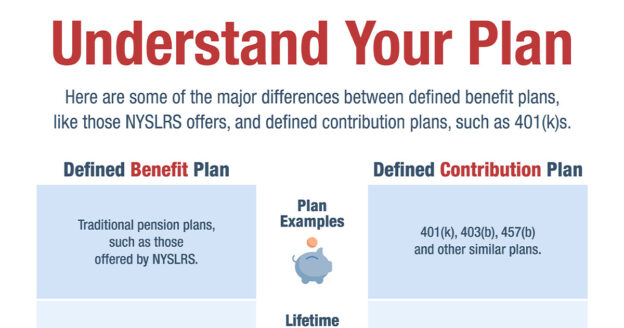
NYSLRS pensions are defined benefit plans, also known as traditional pension plans. When you retire, you will receive a monthly pension payment for the rest of your life. Your pension will be calculated using a preset formula based on your earnings and years of service—it will not be based on the individual contributions you paid into the system. Member contributions support the benefits earned by current and future retirees and are an important asset of the Common Retirement Fund, which holds and invests the money used to pay NYSLRS benefits.

Find your NYSLRS retirement plan publication for comprehensive information about your retirement benefits and how your pension will be calculated.

Make Sure You Receive Your Member Annual Statement

NYSLRS distributes Member Annual Statements beginning in May. Don’t wait for a copy in the mail—get your Statement sooner online!

Reminder for Retirees: Your Retiree Annual Statement is available online, and we mailed printed Statements by the end of February.

Get Your Member Annual Statement Sooner and Help Us ‘Go Green’

You can get access to your Member Annual Statement sooner than printed copies are mailed by updating your delivery preference to email. When you choose to get your Statement online, it’ll save you time—and it’ll help us ‘go green’ by reducing paper waste.

To update your delivery preference:

  • Sign in to Retirement Online.
  • Look under My Profile Information.
  • Click update next to ‘Member Annual Statement by.’
  • Choose Email from dropdown.

Be sure the email address listed in your Retirement Online profile is current.

When your Statement is available, we’ll send an email notifying you to sign in to Retirement Online.

Note: If you choose email as your delivery preference, you will not receive a printed copy in the mail.

Get Your Member Annual Statement Faster with Retirement Online

Update Your Contact Information

We distribute Member Annual Statements based on the mailing or email address we have on file, so you should make sure your information is current. Retirement Online is the fastest and most convenient way to review your contact information and update it if needed.

To update your contact information:

If you don’t already have an email address on file, please provide it so we contact you quickly with important information, such as a change to your benefits. Use a personal email address you will have access to after you retire, not a work email address.

Use Retirement Online to Stay Informed

Your Member Annual Statement is a snapshot of your NYSLRS membership and benefits as of March 31, the end of the State fiscal year. For up-to-date account information throughout the year, sign in to Retirement Online. You can manage your beneficiaries, estimate your pension, request additional service credit, apply for retirement and more—without the hassle of printing and mailing forms or calling. Check out what else members can do in Retirement Online.

If you don’t have an account or for help signing in to an existing account, check out our Retirement Online Tools and Tips blog post where you’ll find information to help you register, reset your password, unlock your account and more.

Estimate Your Pension in Retirement Online

Most NYSLRS members can create their own pension estimates in minutes using Retirement Online. Your estimate will be based on the most up-to-date account information we have on file for you. You can enter different retirement dates and beneficiaries to see how those choices would affect your benefit. When you’re done, print your pension estimate or save it for future reference.

Estimate Your Pension in Retirement Online

How to Create a Pension Estimate

To get started:

  • Sign in to Retirement Online.
  • Look under My Account Summary.
  • Click Estimate My Pension Benefit button.
  • Enter Retirement Date or Your Age at Retirement.

You can fine tune your estimate with:

If you enter your beneficiary’s birthdate, you’ll see the estimated monthly amounts for the pension payment options that provide a lifetime benefit for a single beneficiary and the pension payment options that provide a limited benefit for multiple beneficiaries.

Remember, the amounts are estimates, not a guarantee of what you’ll receive when you retire.

Most Tier 2 through 6 members (more than 90 percent of all NYSLRS members) can use the Retirement Online pension calculator. However, some members may not be able to—for example, members who recently transferred to NYSLRS and some PFRS members. The system will let you know if your estimate cannot be completed. In that case, please send us a message using our secure contact form (select Estimates from the Topic dropdown).

Do More With Retirement Online

In Retirement Online, you can view your account details—date of membership, tier, retirement plan, estimated total service credit and more. Check out what else members can do in Retirement Online.

If you don’t have an account, learn more about Retirement Online and click Register Now. If you need help with Retirement Online, read our Retirement Online Tools and Tips blog post.

Your Death Benefit Beneficiaries

NYSLRS retirement plans provide death benefits for beneficiaries of eligible members who die before retiring.

It’s important to name beneficiaries and review them periodically. Life circumstances change and a beneficiary you named before might not be one you would choose today. For instance, you may have a new partner or you may have children now. And NYSLRS can only pay a death benefit to the beneficiaries you’ve named.

If you are retired or planning to retire soon, read our blog post, Can You Change Your Beneficiary After You Retire?

2 Types of Beneficiaries

  • Your primary beneficiary will receive your death benefit. You can list more than one primary beneficiary. If you do, they will share the benefit equally. Or, you can choose different percentages for each beneficiary, which must total 100 percent. (Example: John Doe, 50 percent; Jane Doe, 25 percent; and Mary Doe, 25 percent.)
  • contingent beneficiary will only receive a benefit if all your primary beneficiaries die before you do. If you list multiple contingent beneficiaries, they will share the benefit equally unless you choose different percentages.

Special Beneficiary Designations

Your beneficiary doesn’t have to be a person. You can name your estate, a trust or a charity as your beneficiary.

Special Designations for Your NYSLRS Death Benefit Beneficiaries
  • Estate. When you die, your estate is the money and property you owned. Your death benefit will be given to the executor of your estate to be distributed according to the terms of your will. You can name your estate as the primary or contingent beneficiary of your death benefit. If you name your estate as the primary beneficiary, do not name a contingent beneficiary.
  • Trust. You can name a trust as a primary or contingent beneficiary if you have a trust agreement or provided for a trust in your will. The trust itself would be your beneficiary, not the individuals for whom you established the trust. (Speak with your attorney if you’re thinking about making your trust a beneficiary.)
  • Entity. You can also name any charitable, civic, religious, educational or health-related organization as a beneficiary.
  • Minor children. If your beneficiary is under the age of 18 at the time of your death, your benefit will be paid to the child’s court-appointed guardian. You may instead choose a custodian to receive the benefit on the child’s behalf under the Uniform Transfers to Minors Act (UTMA). Custodians can be designated in Retirement Online, or you can contact us for more information and the appropriate form before making this type of designation.

For more information, read our publication, Life Changes: Why Should I Designate a Beneficiary?

Keep Your Beneficiaries Up to Date with Retirement Online

You can change your beneficiaries at any time. In addition to adding or removing them to reflect your current wishes, you should review the contact information for your named beneficiaries so we can find them when needed.

The fastest way to view or update your beneficiaries is in Retirement Online.

Deferred Compensation: Another Source of Retirement Income

Many financial experts cite a common rule of thumb when discussing income in retirement. They say you need 70 to 80 percent of your pre-retirement income to maintain your standard of living once you retire. This is meant to account for the range of expenses you’ll no longer have in retirement, such as payroll taxes, commuting costs or saving for retirement. As a NYSLRS member, your plan for income in retirement likely includes your NYSLRS pension and Social Security benefits. However, for greater financial stability and flexibility, you may want to supplement with retirement savings. For example, you might start investing in a savings plan like the New York State Deferred Compensation Plan (NYSDCP).

Deferred Compensation: Another Source of Retirement Income

What is Deferred Compensation?

Deferred compensation plans are voluntary retirement savings plans like 401(k) or 403(b) plans—but designed and managed with public employees in mind. NYSDCP is the 457(b) plan created for New York State employees and employees of other participating public employers in New York.

Once you sign up for NYSDCP, you can build your own investment portfolio or invest in established investment funds. Your contributions can be automatically deducted from your paycheck, and you can contribute as little as 1 percent of your earnings.

Just like with other retirement savings plans, you have options for how you make your NYSDCP contributions. You might choose a tax-deferred account where you make contributions with pre-tax money. With this option, you won’t pay State or federal taxes on the earnings you contribute until you start making withdrawals. Your employer may also offer the option for a Roth account where you make contributions with after-tax money. With this option, you do pay taxes now, but you won’t pay taxes on the withdrawals you make in retirement. Learn more about how traditional retirement savings and Roth accounts compare.

If your employer is not an NYSDCP participating employer, check with your human resources or personnel office about other retirement savings options.

What Does Deferred Compensation Mean for Me?

Deferring income from your take-home pay may mean less money to spend in the short-term, but you’re planning ahead for your financial future.

You can enroll in a deferred compensation plan anytime—whether you’re close to retirement or you just started working. Usually, the sooner you start saving, the better prepared you’ll be for retirement.

Supplement Your NYSLRS Pension with Retirement Savings

As a NYSLRS member, you are enrolled in something increasingly rare these days: a defined benefit plan. If you are vested and retire from NYSLRS, you will receive monthly pension payments for the rest of your life based on your years of service and earnings. Your NYSLRS pension can provide a significant part of your retirement income, but it’s a good idea to supplement your pension and Social Security with a retirement savings account.

Additional retirement savings can give you flexibility to travel, continue your education, pursue a hobby or start a business. It can be a resource in case of an emergency or act as a hedge against inflation.

Your Retirement Savings Goal

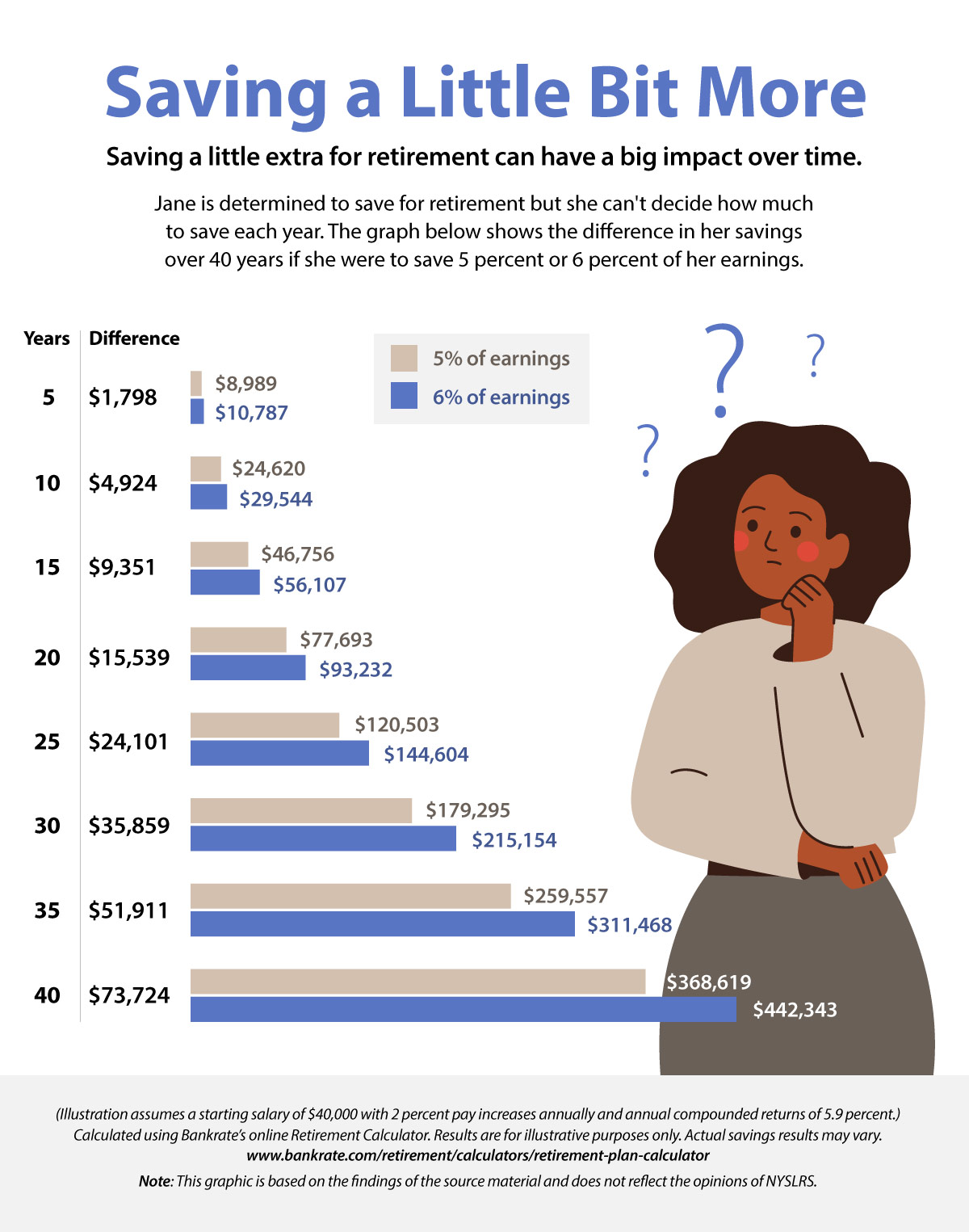
How much you save is a personal decision. You can  estimate your pension in Retirement Online to get an idea of the income it will provide in retirement. Use a retirement savings calculator to see how much a retirement savings plan could yield over time. Test the results with different savings amounts.

Below you can see the potential savings of someone who invests 50 dollars every two weeks for 30 years. While the stock market can be turbulent in the short term, in the long term, it returns on average about 10 percent a year as measured by the S&P 500 index.

saving for retirement

As you get closer to retirement, you should develop a plan to withdraw money from your savings. That will give you a better idea of the income you might expect from your nest egg and a sense of how long it will last.

Here is one possible withdrawal strategy, which provides retirement income for 20 years. Please note, if your retirement is far in the future, the money you withdraw may not have the same value that it would have today.

withdrawing income

If you find you’ll need to save more to meet your goal, you can make adjustments to help ensure you’ll have enough savings in retirement.

Note: Generally, whatever your withdrawal strategy, federal law will eventually require you withdraw a certain amount each year from any tax-deferred retirement plan account. These are called required minimum distributions.

New York State Deferred Compensation Plan

One way State employees and many municipal employees can save for retirement is through the New York State Deferred Compensation Plan (NYSDCP). Once you’ve signed up, your retirement savings—which may be tax-deferred depending on the plan you choose—will be automatically deducted from your paycheck.

Check with your employer’s human resources or personnel office to see whether they participate in NYSDCP or if they offer other savings options. (NYSDCP is not affiliated with NYSLRS.)

Read More About Retirement Savings

When it comes to saving for retirement, there’s a lot to consider. You can find more information in these posts:

A Look Inside NYSLRS

Let’s take a look inside the New York State and Local Retirement System (NYSLRS) and what makes it one of the largest and best retirement systems in the United States.

NYSLRS administers two distinct systems. They are:

  • The Employees’ Retirement System (ERS) with 677,604 members; and
  • The Police and Fire Retirement System (PFRS) with 36,198 members.

In addition, NYSLRS provides pension benefits to more than 520,000 retirees and beneficiaries. Altogether, that’s more than 1.2 million participants!

A Look Inside NYSLRS

New York State Common Retirement Fund

State Comptroller Thomas P. DiNapoli is administrative head of NYSLRS and trustee of the New York State Common Retirement Fund, which was valued at $267.4 billion as of March 31, 2024. The Fund is widely recognized as one of the best-managed and best-funded public pension plans in the nation. Since its establishment in 1921, the Fund’s prudent investment management, solid returns, and constitutionally protected benefits have provided retirement security for generations of hard-working New Yorkers.

NYSLRS Members                                                          

How did NYSLRS earn the distinction of being one of the largest systems? Here are some facts about NYSLRS members:

  • 527,404 active members (that is, members still on the public payroll) work for 2,988 public employers statewide.
  • About one-third of those active members work for New York State. The rest work for counties, cities, towns, villages, school districts and public authorities.
  • Nearly 94 percent of total active members are in ERS while only 6 percent of total active members are in PFRS.
  • Tier 6 is our largest benefit group, with more than 60 percent of all members (62.6 percent in ERS, 56 percent in PFRS).
  • In ERS, Tiers 3 and 4 are the second largest benefit group, with 33.1 percent of members.
  • While, in PFRS, Tier 2 is the second largest benefit group, with 38.7 percent of members.

For more information about our largest ERS tiers, see our blog posts, ERS Tier 6 Milestones and ERS Tiers 3 and 4 Milestones. You can also learn more about the PFRS Milestones our police and fire fighters across New York State will reach over the course of their careers.

NYSLRS Retirees and Beneficiaries

The average pension for an ERS retiree was $27,870; the average for a PFRS retiree was $62,391. But these pension payments don’t just benefit retirees and beneficiaries. During 2022, approximately 78 percent of retirees lived in New York State and were responsible for $17.3 billion in economic activity. By supporting local businesses, helping to create jobs and paying their fair share of taxes, NYSLRS retirees contribute to the economic health of our communities.

Learn More About NYSLRS

Detailed information about NYSLRS members, retirees and beneficiaries as well as the Fund’s position and performance can be found in the 2024 Annual Comprehensive Financial Report.


Note: All data is as of the State fiscal year end, March 31, 2024.

Choosing Your Pension Payment Option

Your NYSLRS pension will provide you with a monthly benefit for the rest of your life. When you apply for retirement, you’ll have the option to choose the maximum amount payable or a reduced benefit in exchange for possibly continuing payments to a beneficiary upon your death. There’s a lot to consider when choosing a pension payment option, so let’s break this down using an example.

Choosing Your Pension Payment Option

Meet Jane

Jane plans to retire soon and considers whether she should leave a continuing benefit to her husband or grandchildren.

No Beneficiaries

The Single Life Allowance option would provide the maximum monthly benefit payment, but all payments will stop when Jane dies, and nothing will be paid to a beneficiary.

Multiple Beneficiaries, Limited Benefit

For Jane to name both of her grandchildren as beneficiaries, she would have to select either the Five Year Certain or Ten Year Certain option—these pension payment options provide a limited benefit for multiple beneficiaries and wouldn’t reduce her pension much. If Jane dies within five or ten years of retirement, depending on which option she chooses, Jane’s grandchildren would split her pension benefit for the remainder of the five- or ten-year period. However, if Jane lives beyond the five- or ten-year period, her grandchildren would not receive a pension benefit when she dies. (Note: Jane could select one of these options and name just one beneficiary, for example, her husband instead of her grandchildren.)

Single Beneficiary, Lifetime Benefit

Jane’s husband doesn’t have his own pension, so she also considers pension payment options providing a lifetime benefit for a single beneficiary. Under the Joint Allowance — Full or Joint Allowance — Half options, Jane’s husband would receive all or half of her reduced benefit for life, depending on which option she chooses. The same goes for the Pop-Up/Joint Allowance — Full or Pop-Up/Joint Allowance — Half options. While these “pop-up” options reduce the pension a little more, they provide added security—if Jane outlives her husband, her monthly payment will increase to the maximum amount as if she selected the Single Life Allowance option at retirement.

Pension payment amounts are based on the birth dates of both the retiree and their beneficiary. So, if Jane chose one of these options and named one of her grandchildren as her beneficiary, her pension would be much lower than the amounts listed in the graphic.

Things to Consider

As you plan for your own retirement and think about whether to leave a continuing benefit for a beneficiary, you may want to consider both your spouse’s and your:

  • Financial needs (for instance, whether you have a mortgage, unpaid loans or other monthly payments).
  • Other sources of retirement income (for example, Social Security or savings).
  • Options for continuing benefits (for example, whether your retirement plan includes a death benefit or if you have life insurance).
  • Age and health at retirement.

It’s also important to understand whether you can change your beneficiary after you retire. Life circumstances can sometimes change, and if you choose a pension payment option that provides a lifetime benefit, you cannot change your beneficiary. 

Find your NYSLRS retirement plan publication to learn more about pension payment options and how your pension will be calculated. You can also estimate your pension using Retirement Online, and enter different retirement dates and beneficiary birth dates to see how those choices would affect your benefit. When you’re done, print your pension estimate or save it for future reference.

Pension Payment Options: Providing a Lifetime Benefit for a Single Beneficiary

Your NYSLRS pension will provide you with a monthly benefit for the rest of your life. When you apply for retirement, you’ll have the option to choose the maximum amount payable or a reduced benefit in exchange for possibly continuing payments to a beneficiary upon your death. In this post, we’ll explore the Joint Allowance and Pop-Up/Joint Allowance pension payment options which provide a lifetime benefit for a single beneficiary.

Joint Allowance and Pop-Up/Joint Allowance Pension Payment Options

Joint Allowance Pension Payment Options

In exchange for a permanent reduction in your monthly pension payment, the Joint Allowance options provide a lifetime benefit to a beneficiary after you die.

You can select either:

  • Full: Your beneficiary will receive the same monthly pension payment as you were receiving for life.
  • Half: Your beneficiary will receive half of the monthly pension payment you were receiving for life.
  • Partial: Your beneficiary will receive either 75, 50, or 25 percent of the monthly pension payment you were receiving for life.

You can only choose one beneficiary under a Joint Allowance option, and you cannot change your beneficiary after you retire—regardless of the circumstances. If your beneficiary dies before you, all payments will stop when you die.

Pension payment amounts are based on the birth dates of both you and your beneficiary. Because life expectancy is a factor, the reduction to your pension payment amount will be more if you select a child or grandchild than a spouse of a similar age as you.

If you designate your spouse as your beneficiary, they would be eligible to receive 50% of your cost-of-living adjustment.

Pop-Up/Joint Allowance Pension Payment Options

The Pop-Up/Joint Allowance options have all the same terms of the Joint Allowance options with added security—if your beneficiary dies before you, your monthly pension payment will “pop up” or increase to the amount you would have been receiving had you chosen the Single Life Allowance option at retirement. (Note: This only affects future payments. You would not be entitled to retroactive payments.) Therefore, the Pop-up/Joint Allowance options reduce your monthly pension payment a little more than a comparable Joint Allowance option.

Other Pension Payment Options

The Single Life Allowance provides the maximum monthly pension payment to you for the rest of your life. However, this option does not provide a continuing benefit. All payments will stop when you die, and nothing will be paid to a beneficiary.

Some pension payment options provide a limited benefit for multiple beneficiaries.

Things to Consider

When choosing your pension payment option, you may want to consider both your spouse’s and your:

  • Financial needs (for instance, whether you have a mortgage, unpaid loans or other monthly payments).
  • Other sources of retirement income (for example, Social Security or savings).
  • Options for continuing benefits (for example, whether your retirement plan includes a death benefit or if you have life insurance).
  • Age and health at retirement.

You only have 30 days after the last day of your retirement month to change your option. After that date, you cannot change your option for any reason.

Estimate Your Pension in Retirement Online

Most members can use Retirement Online to create a pension estimate based on the most up-to-date salary and service information we have on file. You can enter different retirement dates, beneficiaries and pension payment options to see how they affect your potential benefit.

When you’re done, print your pension estimate or save it for future reference.

Pension Payment Options: Providing a Limited Benefit for Multiple Beneficiaries

Your NYSLRS pension will provide you with a monthly benefit for the rest of your life. When you apply for retirement, you’ll have the option to choose the maximum amount payable or a reduced benefit in exchange for possibly continuing payments to a beneficiary upon your death. In this post, we’ll explore the Five Year Certain and Ten Year Certain pension payment options which provide a limited benefit for multiple beneficiaries.

Five and Ten Year Certain Pension Payment Options

Five and Ten Year Certain Pension Payment Options

In exchange for a permanent reduction in your monthly pension payment, the Five Year Certain and Ten Year Certain options provide a limited benefit to one or more beneficiaries after you die.

If you die within five or ten years after your retirement, payments in the same amount as you were receiving will be paid to your beneficiaries for the remainder of the five- or ten-year period. However, if you live beyond the five- or ten-year period, your beneficiaries will not receive a pension benefit when you die.

For example, let’s say you choose the Five Year Certain option. If you die two years after retiring, your beneficiary will receive your monthly pension payment for three years. Or, if you choose the Ten Year Certain option and die after two years, your beneficiaries will receive your monthly pension payment for eight years. In either case, your beneficiary would receive the same amount you were receiving. If you designate your spouse as your beneficiary, they would be eligible to receive 50% of your cost-of-living adjustment.

While these options don’t provide a lifetime benefit for your beneficiary, they do have advantages you may want to consider. With these options, you can:

  • Name multiple beneficiaries.
  • Change your beneficiaries at any time within the five- or ten-year period.

Other Pension Payment Options

The Single Life Allowance provides the maximum monthly pension payment to you for the rest of your life. However, this option does not provide a continuing benefit. All payments will stop when you die, and nothing will be paid to a beneficiary.

Some pension payment options provide a lifetime benefit for a single beneficiary.

Things to Consider

When choosing your pension payment option, you may want to consider both your spouse’s and your:

  • Financial needs (for instance, whether you have a mortgage, unpaid loans or other monthly payments).
  • Other sources of retirement income (for example, Social Security or savings).
  • Options for continuing benefits (for example, whether your retirement plan includes a death benefit or if you have life insurance).
  • Age and health at retirement.

You only have 30 days after the last day of your retirement month to change your option. After that date, you cannot change your option for any reason.

Estimate Your Pension in Retirement Online

Most members can use Retirement Online to create a pension estimate based on the most up-to-date salary and service information we have on file. You can enter different retirement dates, beneficiaries and pension payment options to see how they affect your potential benefit.

When you’re done, print your pension estimate or save it for future reference.