NYSLRS Membership by Tier

NYSLRS, which administers the Employees’ Retirement System (ERS) and the Police and Fire Retirement System (PFRS), had 685,450 members as of March 31, 2022. Our members are State government, local government, school district and other public-sector employees from across New York — 650,251 in ERS and 35,199 in PFRS. About 74 percent of our members were active, which means they were on a public payroll as of March 31.

NYSLRS Membership Over Time

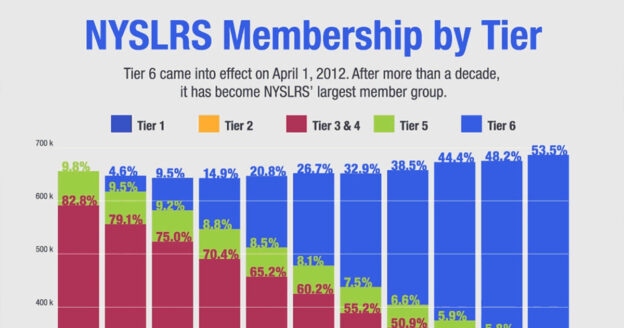
A decade ago, more than 80 percent of NYSLRS members were in Tiers 3 and 4. Now, those tiers represent less than 40 percent of our membership. Tier 6, which includes members who joined NYSLRS since April 1, 2012, now has 367,013 members, or 53.5 percent of total membership.
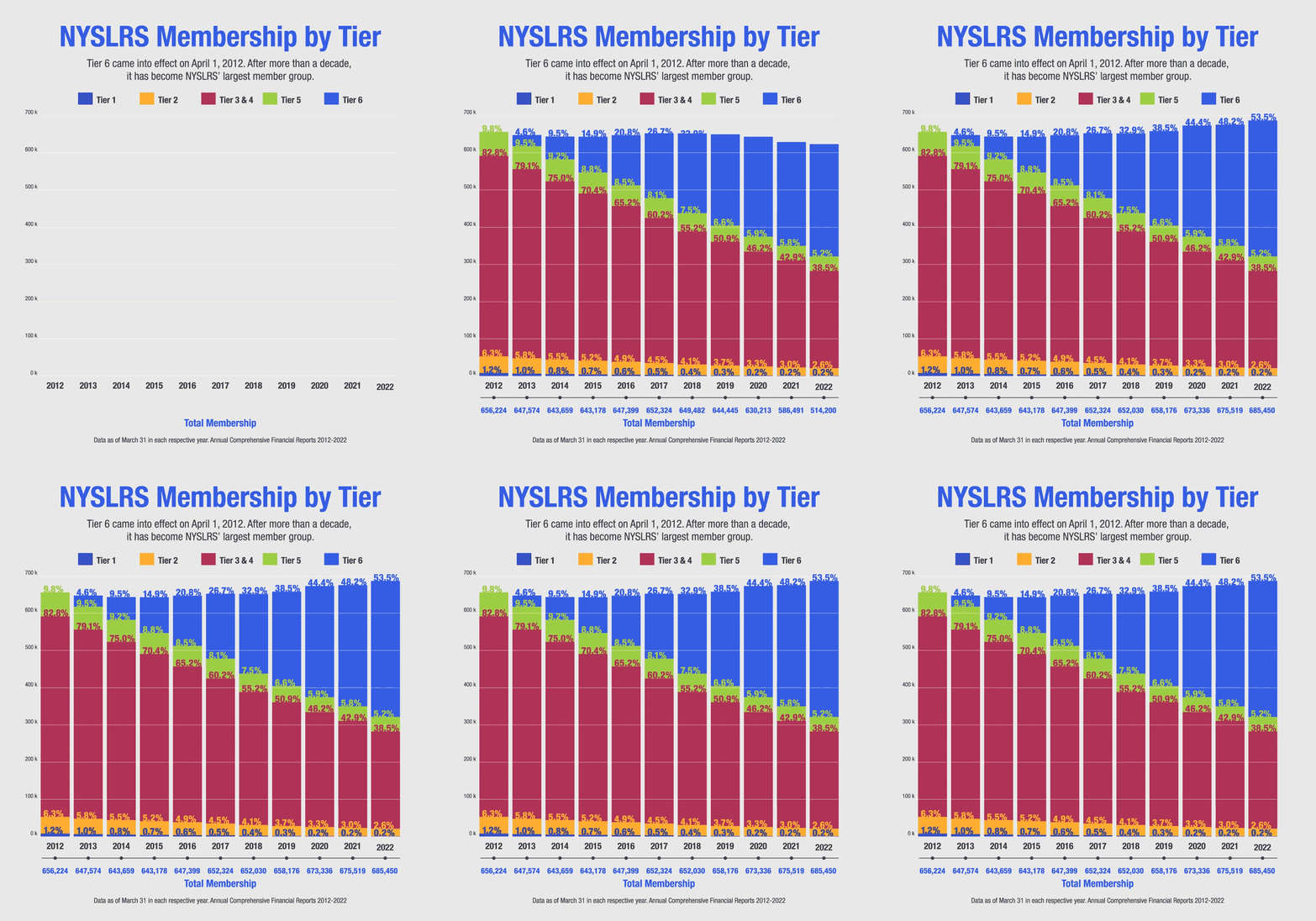
NYSLRS Membership by Tier

Here’s a look at our NYSLRS membership by tier, as of March 31:

Tier 1: NYSLRS’ oldest tier, whose members first joined the system before July 1, 1973 (July 31, 1973, for PFRS members), is dwindling. Tier 1 represented only 0.2 percent of our membership. There were only 1,043 Tier 1 ERS members and 17 Tier 1 PFRS members.

Tier 2: With 18,074 members, Tier 2 represented 2.6 percent of membership. Ninety-four percent of Tier 2 members were in PFRS.

Tiers 3 & 4: Tiers 3 and 4, which have similar retirement plans, had 263,734 members, 38.5 percent of the total membership. Tiers 3 and 4 are primarily ERS tiers. There is no Tier 4 in PFRS, and only 173 PFRS members were in Tier 3.

Tier 5: Tier 5 covers members who joined from January 1, 2010, through March 31, 2012. With 35,569 members, Tier 5 represented 5.2 percent of membership.

Tier 6: This tier covers members who joined since April 1, 2012. Its ranks grew by about 13 percent during the last fiscal year.

Why Your Tier Matters

Your tier is an essential component of your NYSLRS membership because it is one of the factors that determines your benefits. You can find out more by reading your retirement plan booklet. Our recent blog posts explain how to find your plan booklet and how to get the most out of it.
Welcome, New Members

Welcome new members to the New York State and Local Retirement System (NYSLRS).

What is NYSLRS? NYSLRS administers retirement benefits for New York State employees and municipal and non-teaching school district employees outside of New York City. With nearly 1.2 million members, retirees and beneficiaries, NYSLRS is one of the largest public retirement systems in the nation.

NYSLRS is here to help you plan a financially secure retirement. Retirement may seem like a distant concern, but decisions you make now will have a big impact on your post-work life. Here are a few things you should do now as a new member:

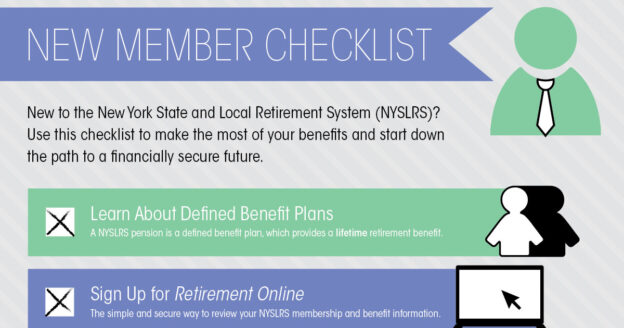
Checklist for New Members

new members checklist

Learn About Defined Benefit Plans

Your NYSLRS pension is a defined benefit plan. This means that, once you are eligible and apply for retirement, you are guaranteed a monthly pension payment for the rest of your life. The amount of your payments will be calculated using a formula set by State law.

Defined benefit plans should not be confused with 401(k)-style retirement savings plans, which are known as defined contribution plans. The value of these plans is limited to the contributions made to an individual’s account and the investment returns on those contributions. And, unlike your NYSLRS pension, these plans do not guarantee a lifetime benefit.

While a 401(k)-style retirement savings plan can supplement a pension and Social Security benefits, it does not provide the same level of financial security as a defined benefit plan.

Sign Up for Retirement Online

If you haven’t already, sign up for a Retirement Online account. You can use Retirement Online to look up your estimated total service credit, name a beneficiary for your death benefit, purchase past service credit and more. This online tool will be an important resource throughout your career, especially as you plan for retirement when you can use our benefit calculator to estimate your pension.

Find Your Retirement Plan Publication

Your retirement plan publication is an essential resource that provides comprehensive information about your NYSLRS benefits. You can look up your specific plan using our Find Your NYSLRS Retirement Plan Publication tool. All you need is your benefit plan code and Tier, which you can find in Retirement Online.

Designate a Beneficiary

Your retirement plan provides you with a death benefit, so it’s important that you designate a beneficiary or beneficiaries. You can designate a beneficiary or beneficiaries through Retirement Online or by mailing us a Designation of Beneficiary form (RS5127).

Understand Service Credit

Your NYSLRS pension will be based on factors such as your tierretirement planage at retirementfinal average earnings and your service credit. You’ll earn one year of service credit for every year of full-time employment with a participating employer. Part-time employment is prorated. If you worked for a public employer or served in the U.S. armed forces before you were a member of NYSLRS, you may be eligible to receive credit for that past service. Because it is a major factor in calculating a NYSLRS pension, additional service credit would increase your pension in most cases. You can request this service through Retirement Online or by mailing us a Request to Purchase Service Credit (Including any Military Service) form (RS5042).

Start Saving for Retirement

Your pension is only one part of a secure financial future. It’s a good idea to save additional money for retirement. Healthy retirement savings will give you more flexibility to do the things you want to do in retirement. They also can be a hedge against inflation and a source of cash in an emergency. You don’t want to wait to start saving; the sooner you do, the more time your money has to grow.

More Information

Visit our Welcome New Members page for more information about NYSLRS and your benefits.

Public Pensions Give Economic Boost to Small Towns, Rural Areas

Small towns and rural areas in New York and across the United States get an important economic boost from public pensions, a recent study concludes.

Public Pensions Give Economic Boost to Small Towns and Rural Areas Across New York

Why Public Pensions Give an Economic Boost

Because of their smaller economies, less-populated counties benefit more from pension dollars than larger, urban counties, according to Fortifying Main Street: The Economic Benefit Of Public Pension Dollars In Rural America.

In many small towns and rural communities, the report notes, school districts and local governments are the largest employers. Those public employees typically remain in their communities after retirement, and the authors attribute the economic boosts they found to pension dollars spent locally on goods and services.

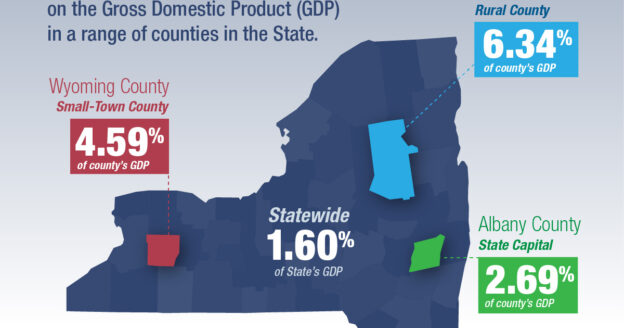
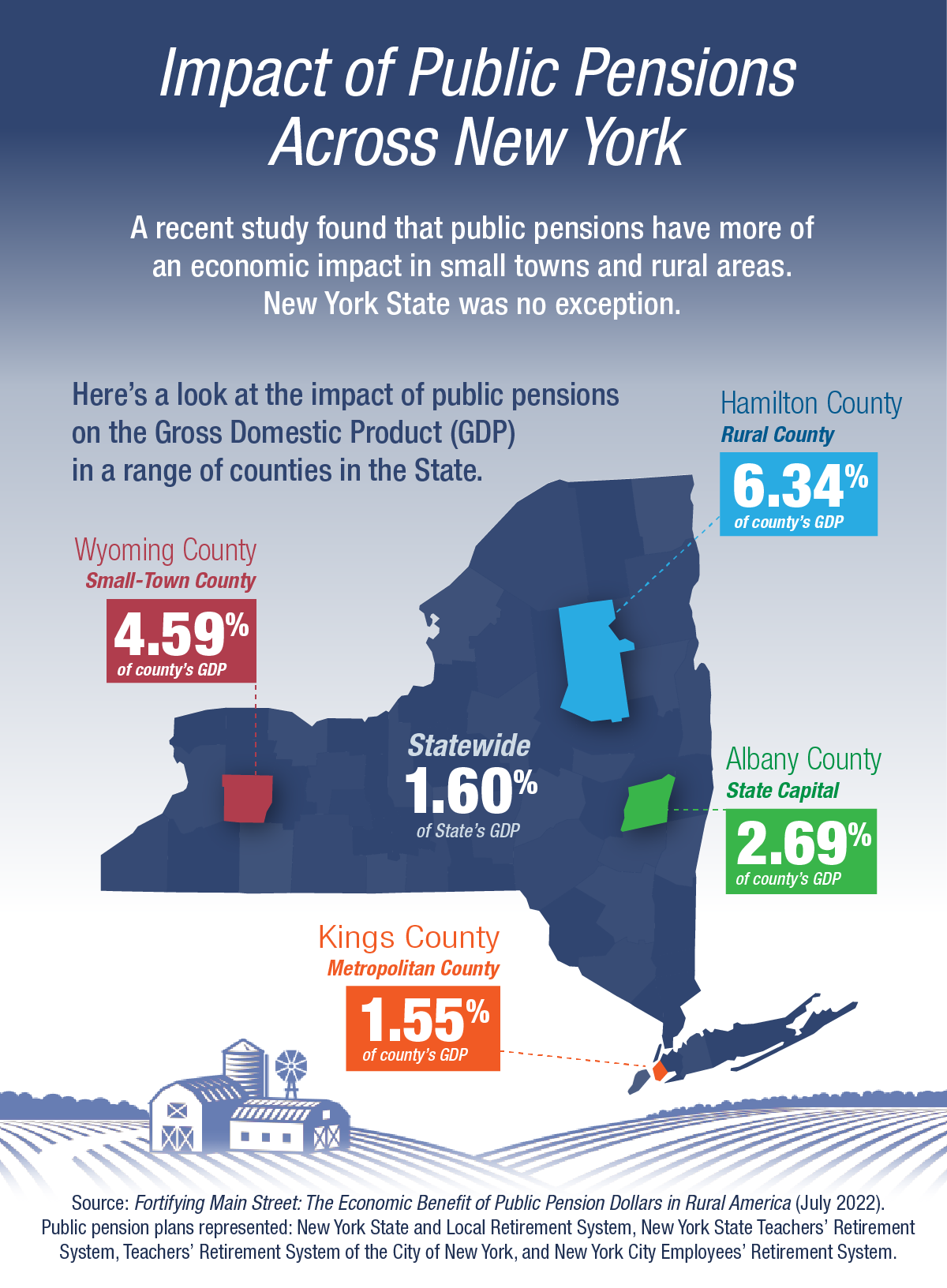
Across New York State, public pensions were responsible for 1.6 percent of gross domestic product (GDP) in 2018. (GDP, the total value of goods and services produced during a specific period, is a common gauge of economic activity.) However, during the same period:

  • Wyoming County in western New York, where a handful of villages dot a rural landscape, saw public pensions generate 4.6 percent of GDP.
  • Hamilton County, with fewer than 5,000 people, received an economic boost from public pensions that accounted for 6.3 percent of GDP.

The study’s findings are in line with data showing the impact NYSLRS retirees have on local economies and other studies about the economic benefits of pensions.

Notes on the Data

Fortifying Main Street, which was released in July by the National Institute on Retirement Security (NIRS), examines pension data from 2,922 counties in 43 states. Based on criteria used by the federal Office of Budget Management, it divides counties into three main categories: metropolitan, small-town (or micropolitan) and rural. The study also analyzes data from counties that are home to the state capital, because these places tend to have higher numbers of public retirees. In Albany County, public pensions generated 2.7 percent of GDP.

Hamilton County is the only county in New York defined as rural in the study, but 16 counties, including Wyoming County, fit the “small town” criteria. You can read the full report on the NIRS website.

The study uses pensions paid by NYSLRS, the New York State Teachers’ Retirement System, the Teachers’ Retirement System of New York City and the New York City Employees’ Retirement System in its data for New York State.

Find Your Retirement Plan Publication

Your retirement plan publication is an essential resource that explains your NYSLRS benefits in detail — how long you’ll need to work to receive a pension, how your benefit is determined, what death and disability benefits may be available and more. You should consult it throughout your career, but it’s especially important to read as you prepare for retirement.

finding your retirement plan publication

Finding Your Retirement Plan Publication

NYSLRS administers two retirement systems, six membership tiers and many retirement plans that are described in dozens of retirement plan publications. We want to make sure you find the specific retirement plan information that pertains to you, which is why we have a new tool to help you Find Your NYSLRS Retirement Plan Publication. To use it, you just need to know your retirement plan code. You can find your code in the ‘My Account Summary’ section of your Retirement Online account homepage, or check the second page of your latest Member Annual Statement. You also can also use the new tool to search for your plan publication by retirement system, tier and occupation type (uniformed or non-uniformed).

Looking Up Your Plan Milestones

Once you have found your publication, check to see what minimum age or service milestones you’ll need to reach to receive your pension. Most retirement plans allow for full pension benefits at 62 (63 for Tier 6 members) or a reduced benefit starting at age 55. Members in some plans can apply for their pension once they reach 20 or 25 years of service credit, regardless of age.

The years of service credit you earn may also change the calculation of your pension. For example, the percentage of earnings used to determine your retirement benefit may increase once you reach certain milestones — such as when you have 20 years of credited service — but that depends on what retirement plan you are in.

Knowing your plan-specific age and service requirements can help you decide when to retire and anticipate the income your benefit would provide in retirement. If you want to work until a certain age or need to earn a specific amount of service, now you can set that goal and prepare accordingly.  

For more detailed information on what you can find in your plan publication, check out our blog post, How to Read Your Retirement Plan Booklet.

Help for New Members

New NYSLRS members may also be interested in our New Member webpage. This page collects several resources that can help you understand your NYSLRS membership and pension.

What to Consider When Choosing Your Retirement Date

Before you pin down a retirement date, there are several factors you should consider.

Your Retirement Date

NYSLRS has made it a lot easier for you to determine the best time to retire. Most members can now use our online pension calculator to estimate what your benefit would be at different retirement dates and ages. Just sign in to your Retirement Online account and click the “Estimate my Pension” button to get started.

As of April 9, 2022, Tier 5 and 6 members only need five years of service credit to be vested. If you are a Tier 5 or 6 member with five or more years of service credit you can contact us to request a benefit estimate.

choosing your retirement date

Your Health

Your current health and long-term health prospects should be a factor in choosing your retirement date. If your health is poor, you may want to retire earlier to give yourself more time to enjoy retirement. On the other hand, if you anticipate significant out-of-pocket health costs, working longer might give you more time to save for those costs.

If you are in good health, your retirement may last longer than average. In most cases, staying on the job a little longer will increase your NYSLRS pension and provide an opportunity to build your savings.

Your Savings

It’s always a good idea for members to plan to supplement their NYSLRS pension and Social Security with savings. Retirement savings are a hedge against inflation, can help in an emergency and give you more freedom to do the things you want to do in retirement.

Having retirement savings gives you more flexibility and — if you have enough saved — may offset any penalty if you decide to retire early. On the other hand, if you have no savings or are short of what you’d like to have, working a little longer offers a chance to save more.

State employees and some municipal employees can take advantage of the New York State Deferred Compensation PlanIn 2022, you can save up to $20,500 per year in a Deferred Compensation account, under Internal Revenue Service rules. Starting in the year you turn 50, you can save an additional catch-up amount. The age 50-plus catch-up amount for 2022 is $6,500.

If you don’t work for New York State, check with your employer to see if you are eligible. If you are not eligible, your employer may be able to direct you to an alternative retirement savings program. (The Deferred Compensation Plan is not affiliated with NYSLRS.)

Your Current Job

The type of work you do is an important factor in determining when to retire. A physically demanding job can get even harder as you age.

But there are other things to consider about your current job. Some members want to retire as soon as they’re eligible to go. However, if your job gives you satisfaction and a sense of purpose, are you ready to walk away from it? Do you look forward to social interactions with your coworkers? Will you miss your job more than you enjoy being retired?

Your Plans for Retirement

Is retirement the end of something or the beginning of something new? Answering that question could go a long way toward determining your ideal retirement date. If you have dreams of starting your own business or going mountain climbing in Spain, you may not want to delay retirement.

On the other hand, if you don’t have a plan to fill the long hours of retirement, you risk becoming bored or depressed. For some, that risk is a reason to keep working. Whether you decide to retire earlier or later, having a plan for retirement can help make it a more satisfying experience.

Manhattan skyline with light memorial

World Trade Center Presumption Deadline Extended

The deadline for members to file a notice with NYSLRS of their participation in the World Trade Center rescue, recovery or cleanup efforts has been extended.

The new deadline is September 11, 2026.

World Trade Center Presumption

What is the World Trade Center Presumption Law?

The World Trade Center Presumption Law provides a presumption that eligible NYSLRS members and retirees — who become permanently disabled and are unable to do their jobs due to certain conditions — can claim their permanent disabilities are the result of participation in World Trade Center rescue, recovery or cleanup operations. The presumption will apply unless it’s proven the condition was the result of other factors.

If you participated and you meet the eligibility requirements, the presumption allows you to:

  • File for an accidental disability retirement in the future;
  • Have an existing disability retirement benefit reclassified as an accidental disability retirement benefit; or
  • Leave your beneficiaries an accidental death benefit.

Your disability or death must be due to one of the qualifying conditions specified in the law.

Who should file?

You must file an Application for World Trade Center Notice (RS6047-N) prior to submitting an Application for World Trade Center Accidental Disability Presumption (RS6047-W). Even if you do not currently suffer one of the qualifying conditionsfiling this notice will protect your rights — and the rights of your beneficiaries — to apply for benefits in the future.

Once you file a notice with NYSLRS, there is no subsequent deadline to file for an accidental disability retirement or retirement reclassification should the need arise.

Questions?

If you have any questions, check out our Frequently Asked Questionsemail us or contact our Call Center toll-free at 1-866-805-0990 (518-474-7736 in the Albany, New York area).

Reporting a Member’s or Retiree’s Death to NYSLRS

When a NYSLRS member or retiree dies, it is important that survivors report the death to NYSLRS as soon as possible.

How Survivors Can Report a Death

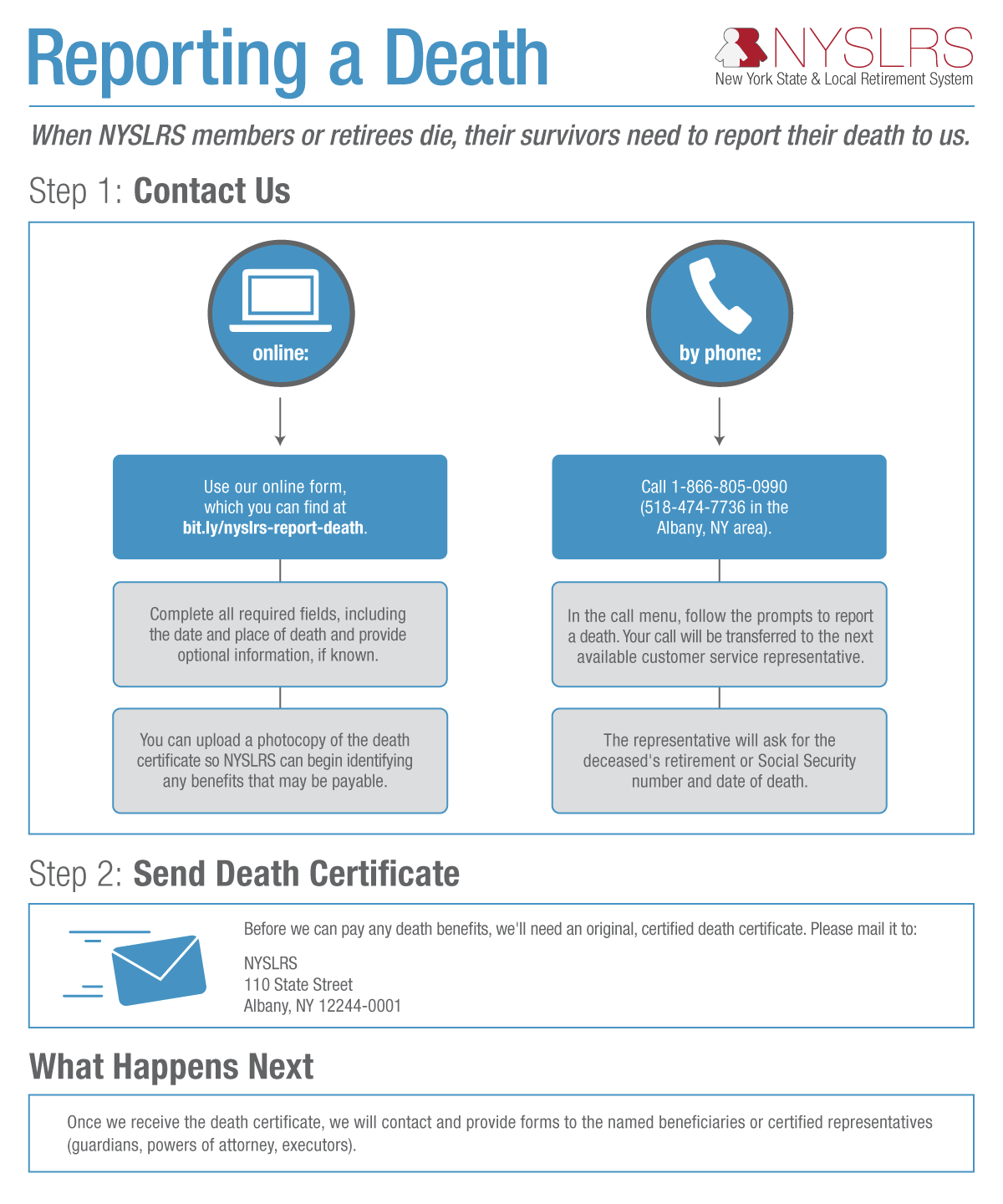
Survivors can find the report a death form on the NYSLRS website.

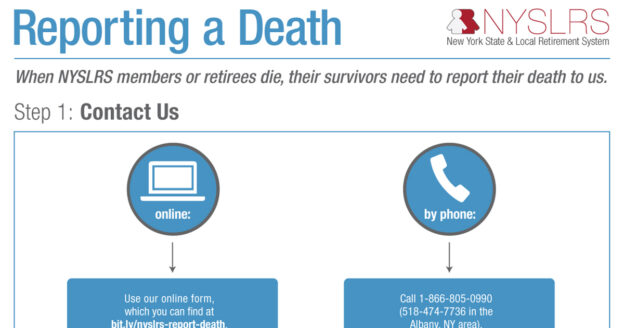
The form has two parts: The first section is for the person reporting the death to enter information about themselves. They should be sure to include a phone number in case we need to contact them. In the second part, they should enter information about the deceased member or retiree. If they know the deceased’s NYSLRS ID or the last four digits of their Social Security number, they should enter that too.

reporting a death

Survivors can upload a photocopy of the death certificate so NYSLRS can begin identifying any benefits that may be payable. (Note: we will still need an original death certificate before any benefits are paid – see below.) The form is transmitted over a secure network.

Survivors can also report a death by calling our toll-free number at 1-866-805-0990 (or 518-474-7736 in the Albany, New York area), weekdays from 7:30 am to 5:00 pm. Once they reach the call menu, they should press 3, then 1. The call will be transferred to a customer service representative, who will ask for:

  • The deceased’s NYSLRS ID, retirement or registration number or Social Security number.
  • The date of death.

We may also ask for the addresses and phone numbers of immediate family members who may be beneficiaries. Please note: Our customer service representatives cannot release the identities of a member’s or retiree’s beneficiaries over the phone.

Mailing a Death Certificate

Before any death benefits can be processed or paid, NYSLRS will need an original, certified death certificate, even if a photocopy has already been submitted. The death certificate (and the sender’s contact information) should be mailed to:

NYSLRS
Attn: Survivor Services
110 State St
Albany, NY 12244

We recommend that death certificates be sent by certified mail, return receipt requested.

What Happens Next

Once we receive the death certificate, we will send named beneficiaries or their certified representatives (guardians, powers of attorney, executors) information about death benefits and, if applicable, information about any continuing pension benefits and death benefits that may be payable based on the member or retiree’s tier and retirement plan. We will also send named beneficiaries the appropriate forms to complete.

It could take several months from the date we are notified of a death to the date that any death benefit is paid. This is the average time necessary to recover any pension payments made after the retiree’s death and calculate any death benefit that may be due, as well as receive a certified copy of the death certificate, tax withholding forms and notarized forms from the named beneficiaries. Our top priority is paying a continuing pension benefit as soon as possible.

If a member is retired when he or she dies, we will stop payment of any outgoing pension benefits. We will automatically reclaim any direct deposit payments that went out after a member’s death. Survivors should be aware that any uncashed pension checks in a deceased retiree’s name must be returned to us.

Talk to Your Loved Ones

If you’re a NYSLRS member or retiree, you should talk to your loved ones and provide them with the information they’ll need when the time comes. Let them know your wishes, where to find important papers and what steps they will need to take. And if your documents are organized and accessible, it will make things that much easier.

Our publication Getting Your Affairs in Order and A Guide for Survivors provides step-by-step guidance about what should be done now and after a member’s or retiree’s death.

Retroactive Payments and Your NYSLRS Pension

Retroactive payments are lump sum payments you receive from your employer. These payments can be from new union contracts, arbitration awards or legal settlements that took place while you were on your employer’s payroll.

If you receive a retroactive payment from your employer, it could affect your pension benefit calculation.

How Retroactive Payments Can Affect Your Benefit

Retroactive Payments

Your final average earnings (FAE) are a major factor in your pension benefit calculation. It’s the average of your three (five for Tier 6 members) highest consecutive years of earnings. For most people, their highest years of earnings come at the end of their careers.

Retroactive payments are applied to the pay periods when they were earned, not when they were paid. So, retroactive payments can increase your FAE, and therefore your pension benefit, as long as the time period in which you earned that money is part of the time period your FAE is based on.

However, please be aware that the law limits the FAE of all members who joined on or after June 17, 1971. For most members, if your earnings increase significantly through the years used in your FAE, some of those earnings may not be able to be used toward your pension. You can find information about earnings limitations by tier, including examples, on the Final Average Earnings page on our website. If your FAE has already been affected by these earnings limits, your retroactive payment will not increase your pension benefit.

Payments Received Before Retirement. If you receive a retroactive payment from your employer before you retire, your employer will report your earnings to us through their regular reporting process. You do not need to notify us of payments you receive.

Payments Received After Retirement (State Employees). If you retired from New York State and you receive a retroactive payment after you retire, we will recalculate your pension automatically. NYSLRS receives State payroll information automatically and you do not need to notify us. You will receive correspondence from us explaining any change in your pension benefit.

Payments Received After Retirement (Non-State Employees). If you retired from a non-State employer and you receive a retroactive payment after you retire, send a letter to our Recalculation Unit in the Benefit Calculations & Disbursement Services Bureau. Please include a copy of your check stub and any correspondence you received from your employer related to the payment. Mail it to:

NYSLRS
Attn: BCDS – Recalculation Unit
110 State Street
Albany, NY 12244-0001

You can also email and upload this information to the Retirement System through our secure contact form.

Your Pension Recalculation Will Be Completed

We continue to receive a record number of pension recalculations and are working diligently to address them. If you are currently waiting for your pension amount to be recalculated, please rest assured that we will get to it. Once we complete your recalculation, you will receive payment of all the money you are owed, and a letter explaining the change in your pension amount.

Recent PEF Retroactive Payments

If you were a Public Employees Federation (PEF) member before retiring from State service, you may have recently received a retroactive payment. The current PEF contract, covering employment from April 1, 2019 through March 31, 2021, was ratified last summer. If you were a PEF member, worked during these dates and have not received your retroactive payment, please check with your previous employer.

If you retired recently and your FAE included earnings from on or after April 1, 2019, your NYSLRS pension will be increased automatically. You do not need to notify us that you received a retroactive payment.

CSEA Contract Negotiations

If you were a member of the Civil Service Employees Association (CSEA) before you retired, your contract and any retroactive payment is currently being negotiated. Contact CSEA if you have questions.

What is Your Net Worth?

When it comes to understanding your finances, a good place to start is by calculating your net worth.

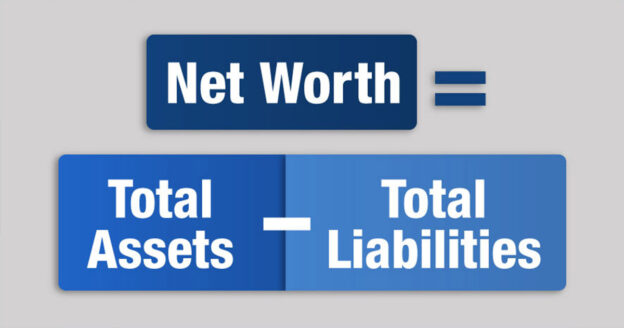
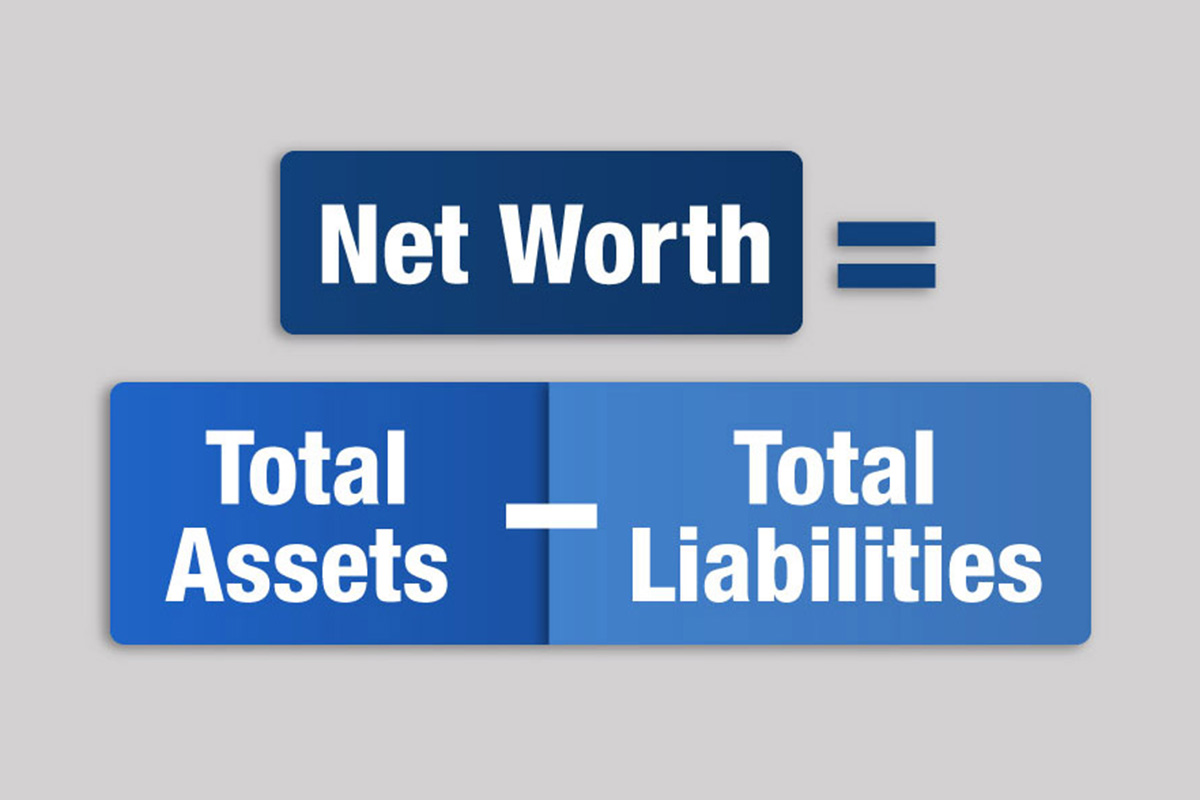
Net worth is the total value of everything you own, minus the money you owe. It is a measure of your wealth and an indicator of your financial condition. It can also provide you with valuable insight as you start developing your financial plan for retirement.

How to Calculate Net Worth

The formula for calculating your net worth is simple:

net worth formula

Assets and Liabilities

Your assets are items of value that you own, including:

  • Your house
  • Other real estate (a vacation home, rental property)
  • Money in checking and saving accounts
  • Retirement savings, such as a 401(k) or Deferred Compensation account
  • Stocks, bonds and other investments
  • Your car and other vehicles
  • Jewelry, furniture and household items

Your liabilities are your debts. Your mortgage, credit card debts and loan balances factor into your total liabilities.

If you owe more than the value of your total assets, you have a negative net worth. A negative net worth may not necessarily mean you’re in financial trouble — it just means that at the moment you have more debts than assets.

If you’re just beginning your career and still have student loans, you may find yourself in negative territory. But your net worth is likely to increase over time as you pay down debts and save money.

Knowing Your Net Worth Can Help You Get a Handle on Your Finances

Your net worth shows your current financial status. When you know where you stand, you’ll be better prepared to make decisions about spending, saving and investing, which will help you achieve your short- and long-term financial goals. Your net worth can show you where you’re doing well and where there’s room for improvement. For example, it may indicate a need to curb your spending or reduce your credit card debt.

Your net worth is likely to change over time, so it’s a good idea to calculate it periodically. With this updated financial information, you’ll be able to track trends and make adjustments if necessary.

To learn more about net worth and what it means, you may wish to read What’s Your Net Worth Telling You?

When Retirees Rejoin NYSLRS

rejoin NYSLRS

If you retire from public employment in New York State and later decide to go back to work in the public sector, you have the option of rejoining NYSLRS. However, if you are considering rejoining the Retirement System, you should understand how rejoining would affect your pension benefits.

Rejoining NYSLRS may increase your total service credit, allowing you to reach certain milestones that would increase your pension. An increase in earnings could also result in a higher pension. However, depending how long you work after rejoining, your new pension may not be higher than your original amount.

Note: This post applies to service retirees of the Employees’ Retirement System (ERS) or the Police and Fire Retirement System (PFRS) who are rejoining the same system. Different rules may apply to retirees of other retirement systems, retirees joining a system other than the one they retired from, and disability retirees.

What Happens to Your Pension When You Rejoin NYSLRS?

If you rejoin NYSLRS, your pension will be suspended. If you are in Tiers 2 through 6 and you earn less than two years of new service credit after you rejoin, your original pension would be reinstated when you retire the second time. Any new service credit and earnings would not affect your pension. (Tier 1 members would receive an additional benefit even if they earn less than two years of service in their new membership.)

If you earn two or more years of new service, you can either receive your original pension or you can receive a recalculated benefit that includes your additional service. If you choose the recalculated benefit, you will have to repay the entire pension amount you have already received, plus interest. (The pension amount you repay would be based on the Single Life Allowance rate.) You may repay that amount in a lump sum or by installments before you retire again — or request a permanent reduction to your new pension.

Other Factors

Here are other things to consider before you rejoin NYSLRS:

  • When you retire again, your new retirement date can delay your eligibility for the annual cost-of-living adjustment (COLA).
  • If you are in Tier 1 or 2, rejoining may affect your death benefit.

Where to Go for Help

If you are considering rejoining NYSLRS, we strongly recommend you speak with a customer service representative to discuss how rejoining would affect your benefits. You can call them at 866-805-0990 or send them a message using our secure contact form.

You may also wish to read our publication Life Changes: What If I Work After Retirement?