NYSLRS – One Tier at a Time: ERS Tier 5

When you joined the New York State and Local Retirement System (NYSLRS), you were assigned a tier based on the date of your membership. This post looks at Tier 5 members of the Employees’ Retirement System (ERS).

Your tier determines such things as your eligibility for benefits, the calculation of those benefits, death benefit coverage and whether you need to contribute toward your benefits.

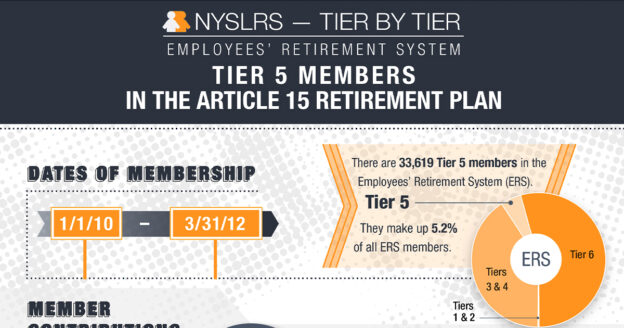
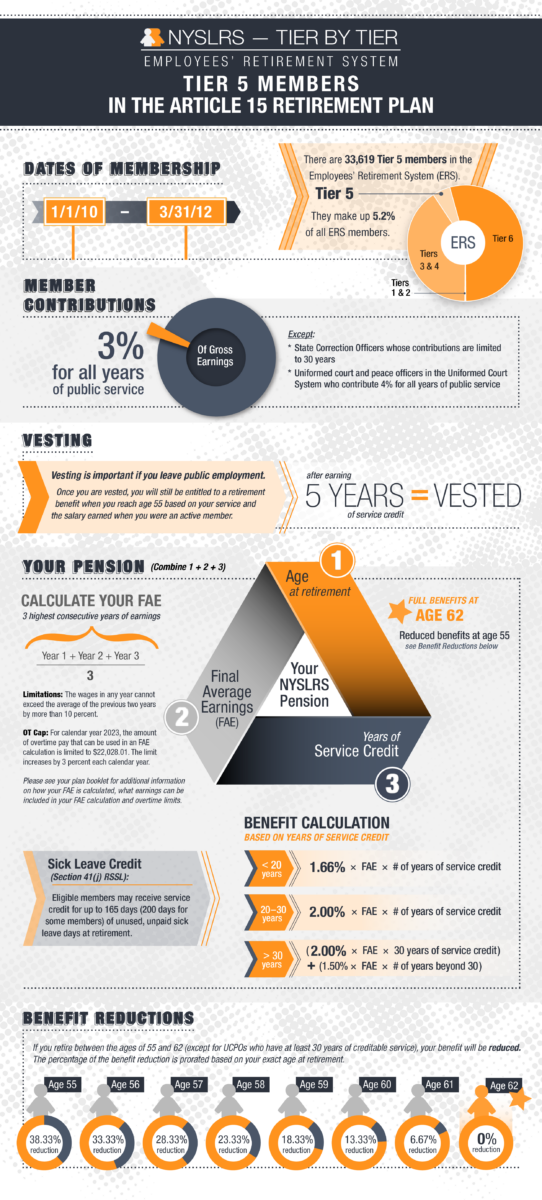
ERS has six tiers. Anyone who joined from January 1, 2010 through March 31, 2012 is in Tier 5. There were 33,619 ERS Tier 5 members as of March 31, 2022, representing 5.2 percent of ERS membership.

Most ERS Tier 5 members (unless they are in special retirement plans) retire under the Article 15 retirement plan. Check out the graphic below for the basic retirement information for Tier 5 members in this plan.
ERS Tier 5

Membership Milestones

As of April 9, 2022, Tier 5 members only need five years of service credit to become vested. If you are a vested member in the Article 15 retirement plan, you are eligible for a lifetime pension benefit as early as age 55. However, if you retire before the full retirement age of 62, your benefit will be reduced.*

If you retire with less than 20 years, the benefit is 1.66 percent of your final average earnings (FAE) for each year of service. If you retire with 20 to 30 years, the benefit is 2 percent of your FAE for each year of service. For each year of service beyond 30 years, you will receive 1.5 percent of your FAE. For example, with 35 years of service, you can retire at 62 with 67.5 percent of your FAE.

Where to Find More ERS Tier 5 Information

For more information about ERS Tier 5 membership, find your NYSLRS retirement plan publication. It’s a comprehensive description of the benefits provided by your specific plan.

You can check your service credit total and estimate your pension using Retirement Online. Most members can use our online pension calculator to create an estimate based on the salary and service information NYSLRS has on file for them. You can enter different retirement dates to see how your choices would affect your potential benefit.

Members may not be able to use the Retirement Online calculator in certain circumstances, for example, if they have recently transferred a membership to NYSLRS. These members can contact us to request an estimate or use the “Quick Calculator” on our website. The Quick Calculator generates estimates based on information you provide.

For information about other tiers, our series NYSLRS – One Tier at a Time gives you a quick look at the benefits for other tiers in both ERS and the Police and Fire Retirement System.

*Uniformed court officers or peace officers employed by the Unified Court System that have at least 30 years of credit may retire with a full benefit as early as age 55.
NYSLRS – One Tier at a Time: ERS Tier 6

When you join the New York State and Local Retirement System (NYSLRS), you’re assigned a tier based on the date of your membership. This post looks at Tier 6 members of the Employees’ Retirement System (ERS).

Your tier determines such things as your eligibility for benefits, the calculation of those benefits, death benefit coverage and whether you need to contribute toward your benefits.

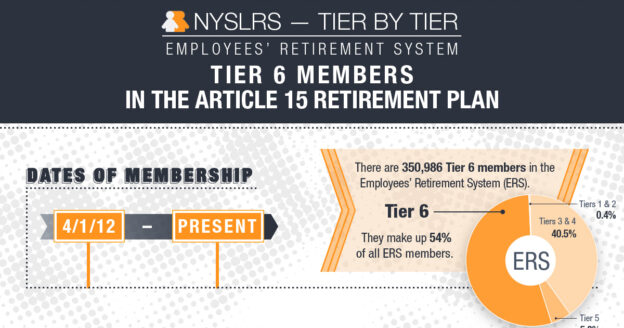
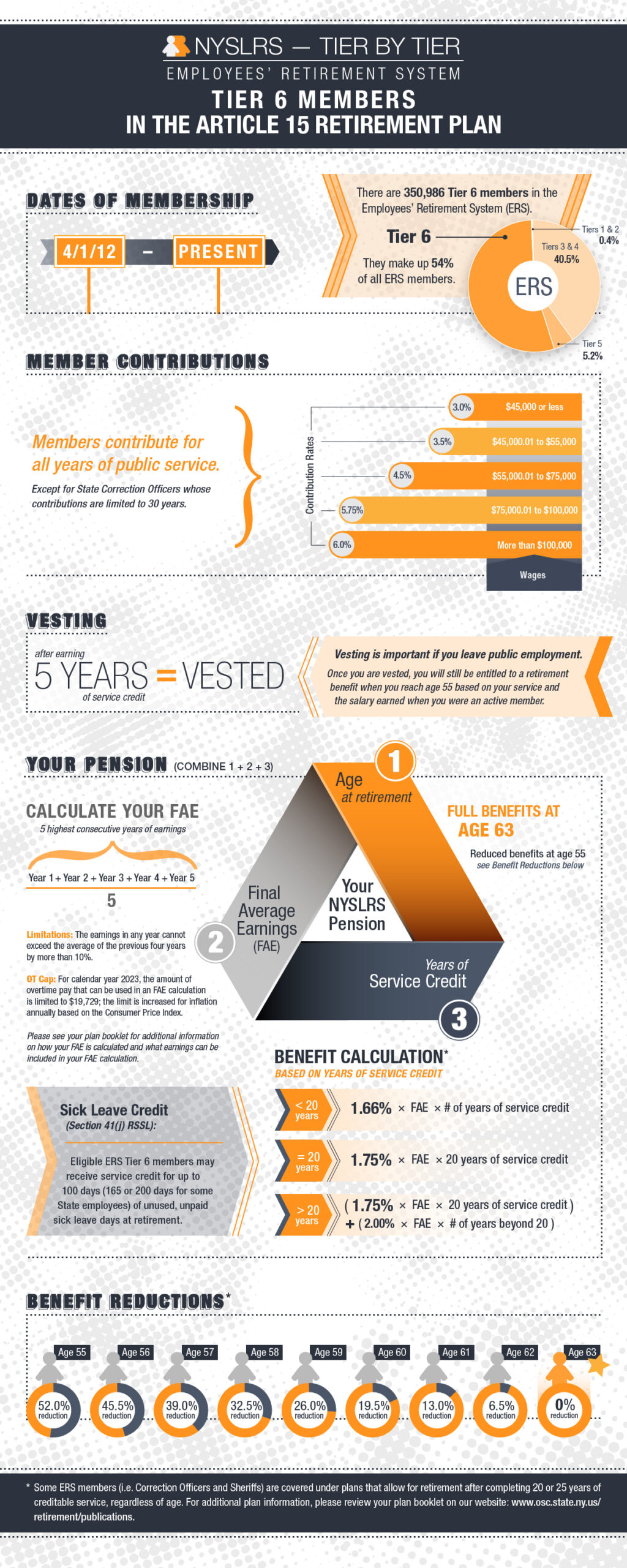
ERS has six tiers. Anyone who joined ERS on or after April 1, 2012 is in Tier 6. There were 350,986 ERS Tier 6 members as of March 31, 2022. At 54 percent of membership, Tier 6 is the largest ERS tier.

Most ERS Tier 6 members (unless they are in special retirement plans) retire under the Article 15 retirement plan. Check out the graphic below for the basic retirement information for Tier 6 members in this plan.

ERS Tier 6

Membership Milestones

As of April 9, 2022, Tier 6 members only need five years of service credit to become vested. If you are a vested member in the Article 15 retirement plan, you are eligible for a lifetime pension benefit as early as age 55, but if you retire before the full retirement age of 63, your benefit will be reduced.

If you retire with fewer than 20 years, the benefit is 1.66 percent of your final average earnings (FAE) for each year of service. If you retire with exactly 20 years of service, the benefit is 1.75 percent of your FAE for each year of service (35 percent of your FAE).

If you retire with more than 20 years of service, you’ll receive 35 percent for the first 20 years, plus 2 percent for each additional year. For example, with 35 years of service you can retire at age 63 with 65 percent of your FAE.

Where to Find More ERS Tier 6 Information

For more information about ERS Tier 6 membership, find your NYSLRS retirement plan publication. It’s a comprehensive description of the benefits provided by your specific plan.

You can check your service credit total and estimate your pension using Retirement Online. Most members can use our online pension calculator to create an estimate based on the salary and service information NYSLRS has on file for them. You can enter different retirement dates to see how your choices would affect your potential benefit.

Members may not be able to use the Retirement Online calculator in certain circumstances, for example, if they have recently transferred a membership to NYSLRS, or if they are a Tier 6 member with between five and ten years of service. These members can contact us to request an estimate or use the “Quick Calculator” on our website. The Quick Calculator generates estimates based on information you provide.  

NYSLRS – One Tier at a Time: PFRS Tier 6

When you join the New York State and Local Retirement System (NYSLRS), you’re assigned a tier based on the date of your membership. This post looks at Tier 6 members of the Police and Fire Retirement System (PFRS).

Your tier determines such things as your eligibility for benefits, the calculation of those benefits, death benefit coverage and whether you need to contribute toward your benefits.

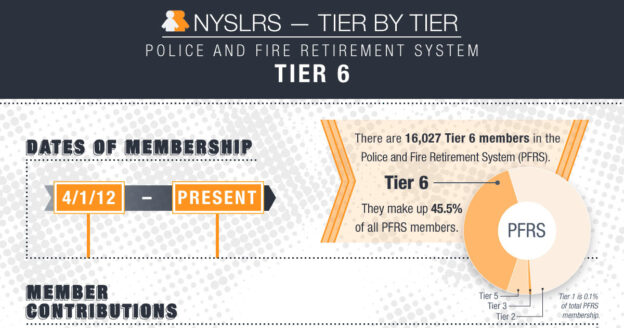
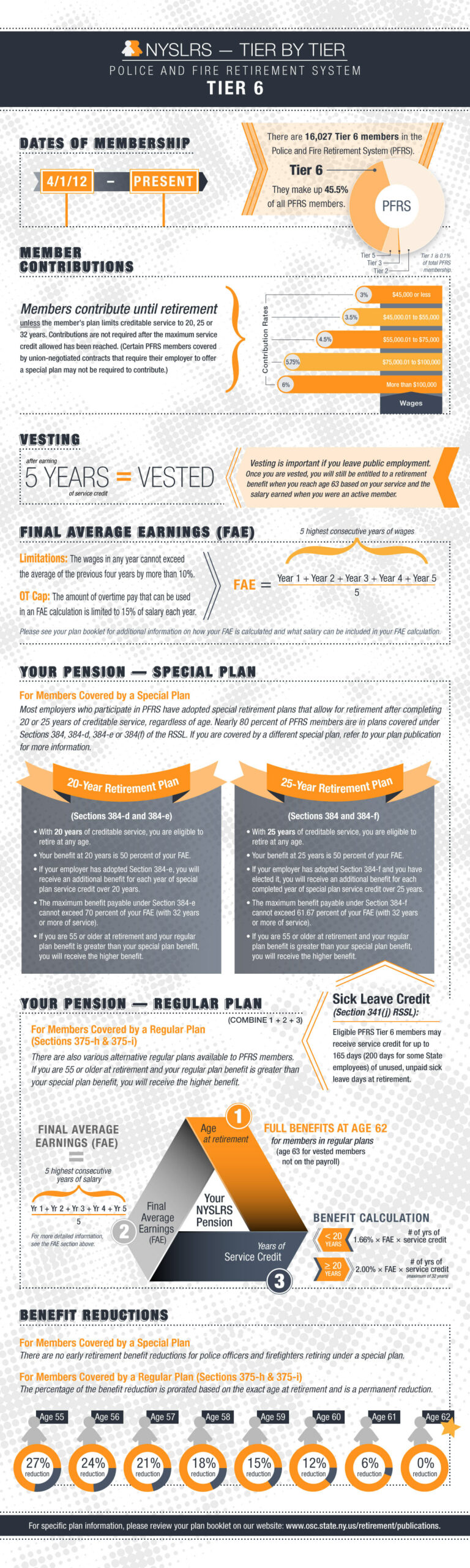
PFRS has five tiers. Anyone who joined PFRS on or after April 1, 2012 is in Tier 6. There are 16,027 Tier 6 members, which accounts for more than 45 percent of PFRS membership, making it the second largest PFRS tier.

About Regular Plans and Special Plans

Under a regular retirement plan, you need to reach certain age and service requirements to receive your NYSLRS pension. If you’re covered by a special retirement plan, there is no age requirement, and you can receive your pension after completing 20 or 25 years of service.

Eighty percent of PFRS members are in plans covered under Sections 384, 384-d, 384-e or 384-f of the New York State Retirement and Social Security Law. Read our Police and Fire Retirement System blog post for information about different PFRS plans.

Check out the graphic below for the basic retirement information for PFRS Tier 6 members.

PFRS Tier 6

Where to Find PFRS Tier 6 Information

For more information about PFRS Tier 6 membership, find your NYSLRS retirement plan publication. It’s a comprehensive description of the benefits provided by your specific plan.

You can check your service credit total and estimate your pension using Retirement Online. Most members can use our online pension calculator to create an estimate based on the salary and service information NYSLRS has on file for them. You can enter different retirement dates to see how your choices would affect your potential benefit.

As of April 9, 2022, Tier 5 and 6 members only need five years of service credit to be vested. Tier 5 members with five or more years of service can estimate their pension benefit in Retirement Online. If you are a Tier 6 member with between five and ten years of service credit, you can contact us to request a benefit estimate.

A Good Plan Can Ease Your Transition to Retirement

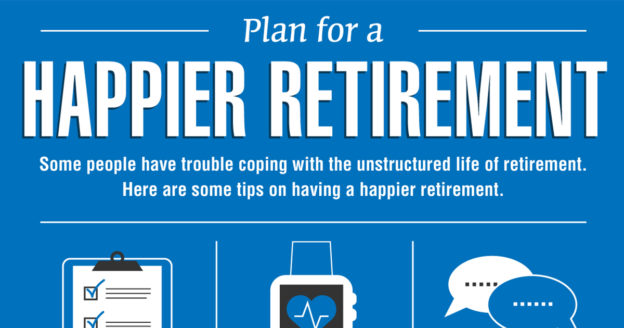
When people talk about retirement planning, they’re usually talking about money. But there’s another aspect that people often forget: what will you do with all that newfound free time? After decades of hard work, the thought of sleeping late and taking it easy is pretty attractive. But the transition to retirement is a big deal, and many retirees don’t consider the psychological aspects of the change. We’ve gleaned some advice from professional sources.

A Good Plan Can Ease Your Transition to Retirement

Create a Plan and Schedule

However you feel about your job right now, it’s an important part of your life. It provides structure, mental stimulation and social interaction. Retiring can leave a void, and streaming the latest shows or making frequent trips to the grocery store may not be enough to fill it. Empty or aimless hours can lead to boredom, disenchantment and even depression.

You may have a long list of things to do, places to go, and hobbies to take up, but if you don’t decide where to begin, it can be hard to get started. You’ll need to actively plan your activities and create a schedule to successfully manage your time in retirement. Write down how you’d like to spend each day of the week, blocking out time for chores, social engagements, hobbies and exercise. Sticking to a schedule can keep your days structured and give you a sense of accomplishment.

Stay Engaged

For many people, staying busy and remaining socially engaged are essential to a satisfying transition to retirement. That’s one reason why some retirees take on part-time or seasonal jobs.

A job in retirement doesn’t necessarily mean continuing to do the same old thing. Retirement is an opportunity to reinvent yourself. Do something you’ve always wanted to do, something fun and challenging.

Maybe the job for you is one that doesn’t pay at all, at least monetarily. There are countless organizations looking for volunteers.

Volunteering just a few hours a week will give you something to look forward to and keep you connected to the outside world, which can improve both your mental and physical well-being.

Exercise Your Body and Brain

Regular exercise not only keeps you physically fit — it also increases your sense of well-being. Whatever you do to exercise, make it part of your regular schedule. Consider taking a fitness class at a local gym, which also adds a social element to your workout. Maybe you can up the ante by trying something new, like a martial arts class.

Don’t forget to exercise your brain. A course or workshop can help you discover a new side to yourself (the painter, the mystery writer, the master of topiary). You may even want to enroll in classes at a local community college or return to school full-time.

Whatever you do, make sure it’s part of a plan — a plan for a happier retirement.

Age Milestones for Retirement Planning

age milestones

Whether you’re 22 or 52, you should be planning for retirement. Your NYSLRS retirement benefits will be based on your tier, years of service and final average earnings. For most members, age is also an important factor in your NYSLRS benefits and it’s a factor for Social Security and retirement savings strategies as well. So, as you plan for retirement, consider these age milestones.

Age Milestones

Under 50: It’s never too early to start saving for retirement. Even modest savings can add up over time as investment returns grow and interest compounds.

50: The Age 50 and Over Catch-Up provision allows you to save more pre-tax dollars in a retirement account starting in the calendar year in which you turn 50.

55: The earliest age most NYSLRS members can begin collecting a service retirement benefit. (This does not apply to members in special retirement plans.) Your pension may be permanently reduced if you retire before your full retirement age.

59½: The age you can start withdrawing money from a tax-deferred retirement savings plan, such as an IRA, without facing a potential federal tax penalty. (The penalty does not apply to New York State Deferred Compensation Plan savings if you are retired or have left public service.)

62: Full retirement age for your NYSLRS benefit if you are in Tier 2, 3, 4 and 5 or PFRS Tier 6. Earliest age you can begin collecting a Social Security pension, but the benefit would be reduced. For more information about Social Security, read When to Start Receiving Retirement Benefits.

63: Full retirement age for your NYSLRS benefit if you are in ERS Tier 6.

65: Age most people are eligible for Medicare benefits.

66: Full retirement age for Social Security if you were born from 1943 through 1954. Add two months for each year from 1955 through 1959.

67: Full retirement age for Social Security if you were born in 1960 or later.

70: If you do not take your Social Security benefit, your benefit will increase each year until you reach age 70. Delaying Social Security after 70 will not increase your benefit.

73: Generally, if you have tax-deferred retirement savings and are no longer working, you must begin withdrawing some of this money when you reach a certain age. Under a recent change in federal law, you must start taking “minimum required distributions” at age 73. The minimum age had been 72, and the change does not affect those who turned 72 before the end of 2022. This age milestone will increase to 75 in 2033. Required minimum distributions do not apply to your NYSLRS retirement benefits.

One Last Number: Having a rough idea of your life expectancy is essential to retirement planning.

Sex Identification and Your NYSLRS Membership

As of January 1, 2023, when new members are enrolled in NYSLRS, they can choose “x” as their sex identification instead of “male” or “female.”

sex identification

Updating Your Sex Identification With NYSLRS

If you’re already a member or a retiree, you can update your sex identification with us at any time.

Sign in to Retirement Online to check what information we have on file for you. You can find your current sex identifier on your Account Homepage under ‘My Profile Information.’

If you need to change or correct your sex identification, send us a signed letter requesting the change. Please include your NYSLRS ID on the letter. No additional documentation is required to change your sex identifier.

You can send us the letter by attaching it to our secure contact form, or by mailing it to:

NYSLRS
110 State Street
Albany, NY 12244-0001

We are working to update Retirement Online so members and retirees can sign in and update their sex identification on their own. This feature is expected to be available sometime in 2023. (Need help accessing Retirement Online in the meantime? See our Tools and Tips post for more information.)

Need a Name Change Too?

If you’re changing your last name, you can make the update, and upload copies of the documentation showing the change, in Retirement Online. Sign in to your account, go to the ‘My Profile Information’ section of your Account Homepage and click the “update” link next to your name. A list of acceptable documentation will be provided.

To update your first or last name, send us a Name Change Notice (RS5483) form. You will need to provide original documentation, such as a court order, if the name change is for a reason other than a change in marital status. We can also accept a certified copy of the documentation.

NYSLRS Membership Basics

Whether you just joined or you’re a longtime member, you likely have questions about your NYSLRS membership. What is vesting? What are final average earnings? What tier are you in, and why does it even matter?

NYSLRS Membership

Basic Concepts of NYSLRS Membership

While NYSLRS administers many different retirement plans, the core concepts of our memberships are the same. Your pension will be calculated using a preset formula based on your earnings and years of service. To better understand your NYSLRS benefits, you should become familiar with these four basic concepts:

  • Tier. Your tier is based on the date you joined NYSLRS and helps determine the benefits available to you. If you’re a new NYSLRS member, you’re likely in Tier 6. Tier 6 members joined NYSLRS on or after April 1, 2012.
  • Service Credit. Generally, you earn a year of service credit for each year you work for a participating NYSLRS employer. Part-time work is prorated. Your total service credit at retirement is a major factor in determining the amount of your pension.
  • Vesting. You become vested after you earn five years of service credit. It’s a significant milestone, because once you’re vested, you’re eligible for a NYSLRS pension when you reach retirement age, even if you leave public service.
  • Final Average Earnings. Final average earnings are the average of your earnings during the period when your pay is highest. It’s another major factor in determining the amount of your pension.

Your NYSLRS Pension and Other Benefits

As a NYSLRS member, you are part of a defined benefit retirement plan. This means your NYSLRS pension will be a lifetime benefit based on your final average earnings and service credit, not on the contributions you make toward your retirement.

Your NYSLRS membership also provides other important benefits, including:

More Information

We want to make sure you have the information you’ll need to plan for your retirement and make critical decisions about your future. Here are some resources available to you:

Retirement Online is the quickest way to access account information such as your tier, retirement plan and estimated total service credit. If you don’t already have one, sign up for a Retirement Online account now.

Explore the NYSLRS website to learn more about your NYSLRS membership. Our Welcome New Members page explains more about the benefits that are available to you. Your retirement plan publication offers a comprehensive overview of your benefits, and you can find it with our Find Your NYSLRS Retirement Plan Publication tool.

If you have questions about your account or your NYSLRS benefits, please message us using our secure contact form.

Why Your Retirement Plan Publication Is So Important

Your plan publication is an essential resource that you should consult throughout your career. It will help you plan for retirement and guide you when your retirement date draws near.

Reminder: you can use this tool to help you find your retirement plan publication.

Let’s explore the information you’ll find in your plan publication and what it means.

retirement plan publication

About Your Membership

This section has basic information about your membership, including your tier, contributions, when you will be eligible for a pension and how to withdraw your membership if you leave public employment.

Service Credit

Service credit is one of the main factors in determining your pension benefit amount. If you work full-time for the State or a participating municipal employer for 12 months, you’ll earn a year of service credit. If you work part-time, your service credit is prorated.

You’ll also find information about how your service credit is calculated, how to purchase credit for previous public employment or military service, how leaves of absence affect service credit, and how sick leave can be used for extra service credit at retirement.

Final Average Earnings

Final average earnings (FAE) are another major factor in determining the amount of your pension. Your FAE is the average earnings during the set of consecutive years (three or five years, depending on your tier and retirement plan) when your earnings were highest.

This section describes what types of payments are used in calculating your FAE and any limitations that may apply.

Service Retirement Benefits

This section describes your retirement eligibility and how your benefit is calculated. If you have questions about how much your pension will be, you should read this section.

Choosing a Pension Payment Option

You can choose from several options for the payment of your pension. Some payment options allow you to provide for your spouse or other beneficiary after you die in exchange for a reduction in your monthly payment. Consider each payment option carefully, as you’ll only have at most 30 days to change it after you retire.

Items That May Affect Your Pension

This section describes factors that can change the amount of your pension. For example, if you retire with an outstanding loan, your pension will be permanently reduced. Also, if you get a divorce, your ex-spouse may be entitled to a portion of your benefit.

A cost-of-living adjustment (COLA), on the other hand, would increase your benefit once you become eligible.

Vested Retirement Benefits

If you leave public employment before retirement age but have met the minimum service requirement to receive a pension, you can apply for a vested retirement benefit when you become eligible.

Disability and Death Benefits

Your NYSLRS benefits include more than a pension. If you are no longer able to perform your job because of a medical condition, you may be eligible for a disability retirement. If you die before retirement, your survivors may be eligible for a death benefit.

Receiving Your Benefits

Before you can receive your pension, you must file an application with the Office of the State Comptroller. This section describes the process of applying for your retirement benefits, including information about filing online.

NYSLRS – One Tier at a Time: ERS Tiers 3 and 4

(We know that’s two, but let us explain.) When you join the New York State and Local Retirement System (NYSLRS), you’re assigned a tier based on your date of membership. There are six tiers in the Employees’ Retirement System (ERS) and five in the Police and Fire Retirement System (PFRS). Your tier determines such things as your eligibility for benefits, the calculation of those benefits, death benefit coverage and whether you need to contribute toward your benefits.

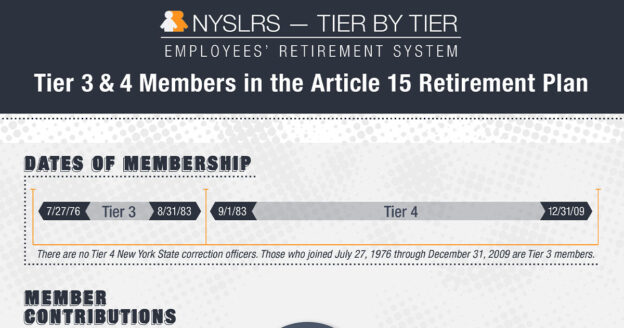
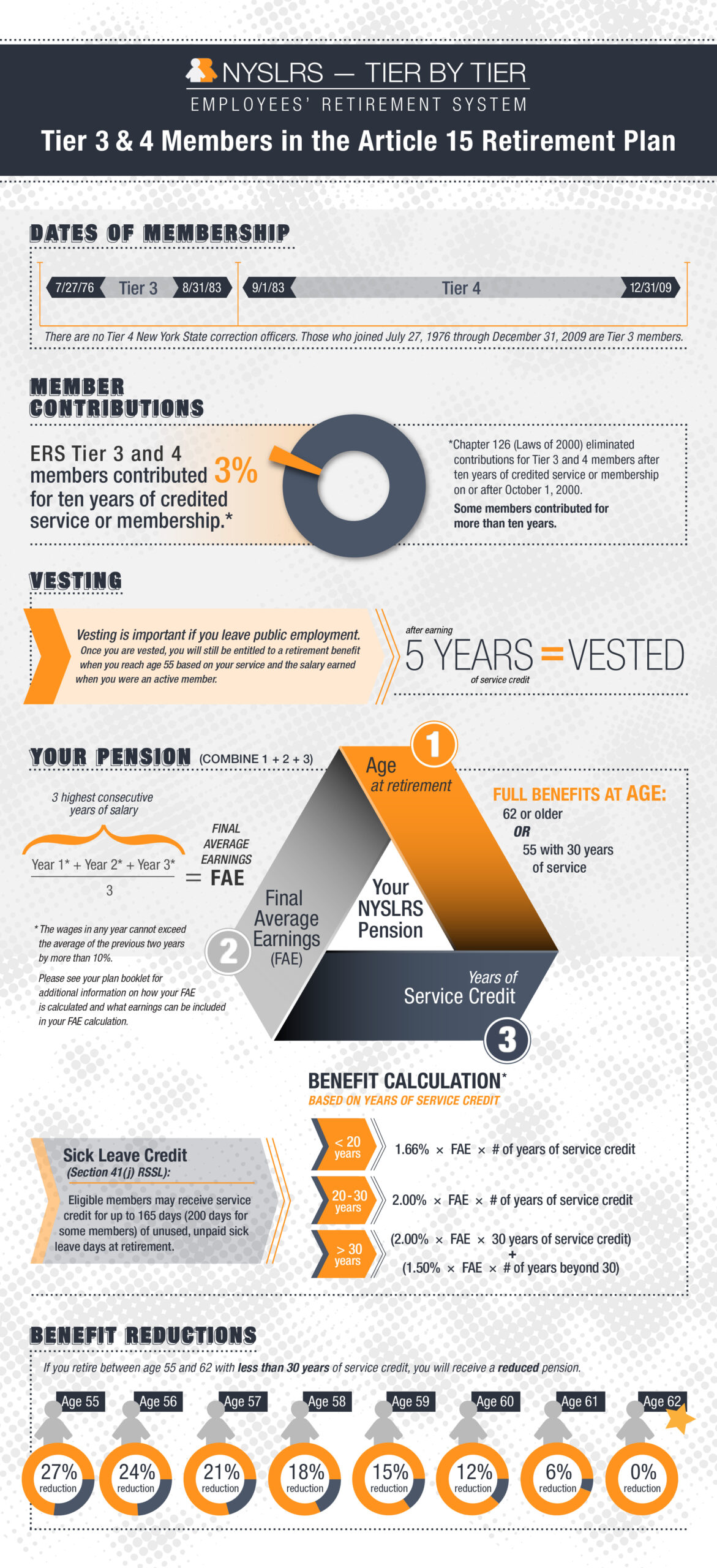
Our series, NYSLRS – One Tier at a Time, walks through each tier and gives you a quick look at the benefits in both ERS and PFRS. Today’s post looks at ERS Tiers 3 and 4. Of our current 650,251 ERS members, 263,561 are in Tiers 3 and 4, representing 40.5 percent of ERS membership.

Most ERS Tier 3 and Tier 4 members (unless they are in special retirement plans) retire under the Article 15 retirement plan. Check out the graphic below for the basic retirement information for Tiers 3 and 4 members in this plan.

ERS Tiers 3 and 4 - Article 15

Membership Milestones for ERS Tiers 3 and 4

ERS members in Tiers 3 or 4 need five years of service credit to become vested. Once vested, they’re eligible for a lifetime pension benefit as early as age 55. However, if they retire before the full retirement age of 62 with fewer than 30 years of service credit, their benefit will be reduced. Some Tier 3 and 4 members, such as sheriffs or correction officers, can retire with 20 or 25 years of service, regardless of age and without penalty.

You can check your service credit total and estimate your pension using Retirement Online. Most members can use our online pension calculator to create an estimate based on the salary and service information NYSLRS has on file for them. You can enter different retirement dates to see how your choices would affect your potential benefit.

For more information about Tier 3 and 4 membership, find your NYSLRS retirement plan publication. It’s a comprehensive description of the benefits provided by your specific plan.

Left Public Employment? Don’t Forget to File for Retirement

If you expect to leave public employment before retirement age, or if you’ve already left, take note of this important information about your NYSLRS pension.

Once you become a vested NYSLRS member, you’re eligible for a NYSLRS pension even if you leave public employment before retirement age. Vesting is automatic but receiving retirement benefits is not. You’ll need to apply for your pension. But when should you apply?

Filing for Retirement If You Have Left Public Employment

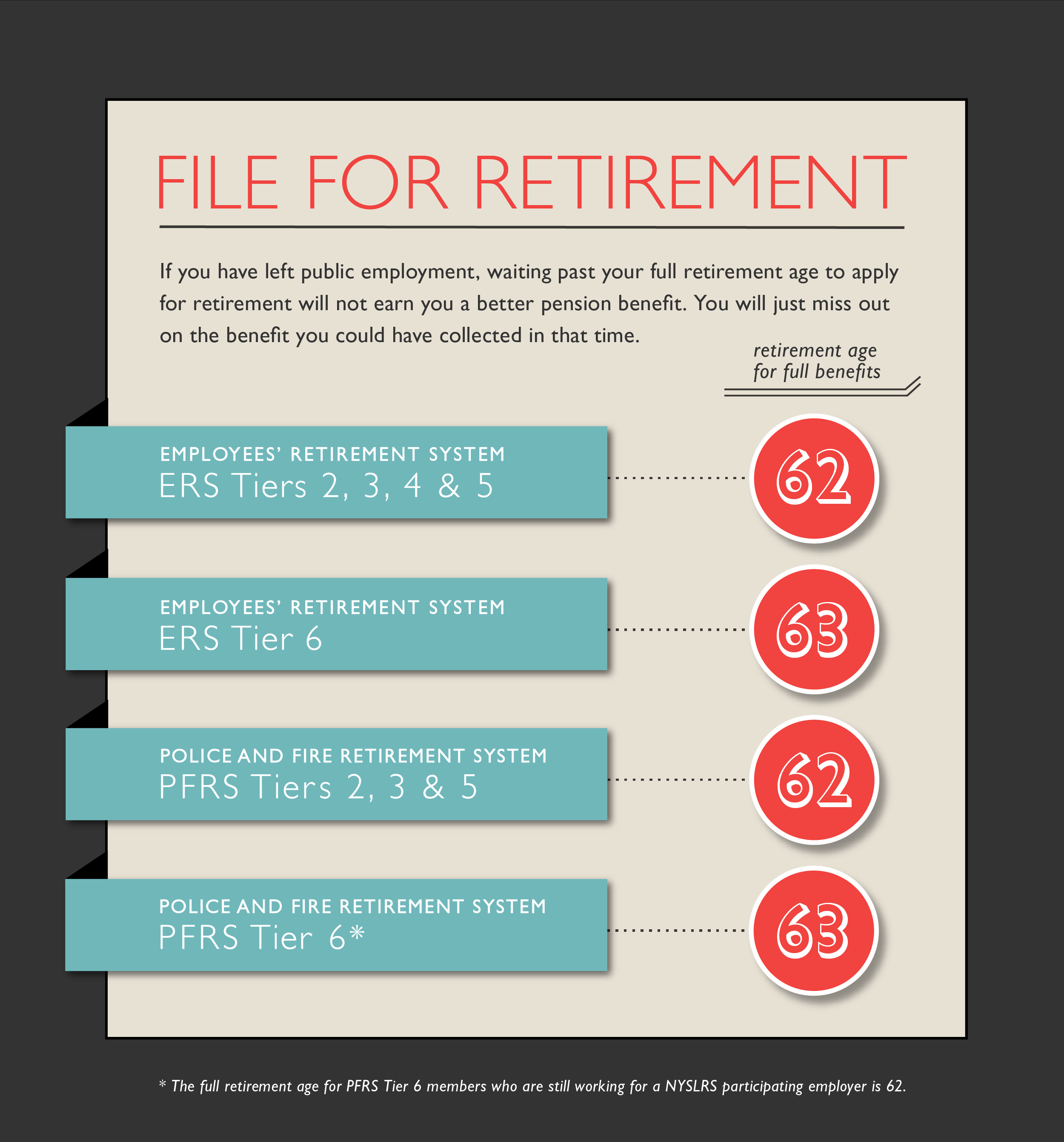
Most NYSLRS members can begin collecting their pension as early as age 55. If you file for your retirement benefit between age 55 and your full NYSLRS retirement age, you may face a permanent benefit reduction. Full retirement age for a NYSLRS pension is 62 or 63, depending on your plan and tier.

retirement age for full benefits if you left public employment

Waiting longer than your full retirement age, however, could cost you a lot of money.

If you aren’t working for a NYSLRS participating employer, your NYSLRS pension will not increase after your full retirement age. Pension benefits are not retroactive, and you will not be able to recover the monthly pension payments that you would have received if you retired at full retirement age.

How Social Security and NYSLRS Rules Differ

NYSLRS and Social Security are different systems with different milestones. You can collect Social Security retirement benefits as early as age 62. If you delay taking Social Security, your benefit amount will continue to increase 8 percent per year until you reach age 70 (for those born in 1943 or later).

But if you wait until you’re 70 to apply for your NYSLRS pension, you’ll miss out on years of NYSLRS benefit payments.

The information above applies only to members who leave public employment before their full retirement age.

(In most cases, if you are still working for a participating public employer in New York State, your pension amount will continue to increase, even if you work past your retirement age.)

Steps You Can Take

Your retirement may be years or even decades in the future. Here are a few steps you can take to help you keep track of your NYSLRS pension if you leave public employment:

  • Estimate your NYSLRS pension at different ages using the benefit calculator in Retirement Online.
  • Create a plan for retirement, taking into account the milestones above.
  • Review your plan periodically and update it as necessary.
  • Keep your contact information up to date using Retirement Online.
  • Contact NYSLRS if you have questions about your benefits.