10 Things Members Should Know

NYSLRS is one of the largest retirement systems in the world, administering benefits for more than 1.2 million members, retirees and beneficiaries. Take a look inside NYSLRS and brush up on your NYSLRS knowledge—here are 10 things members should know.

Retired? Check out 10 Things Retirees Should Know.

1. Retirement Online is the Fastest, Most Convenient Way to Do Business With NYSLRS

10 Things Members Should Know Retirement Online is the fastest way to manage your NYSLRS account. Skip printing forms, having them notarized and sending them through the mail. When you submit your requests through Retirement Online, NYSLRS has them immediately, and your changes will be completed more quickly. It’s convenient and secure. Check out what members can do in Retirement Online.

If you don’t have an account or for help signing in to an existing account, check out our Retirement Online tools and tips for step-by-step instructions to register, reset your password, unlock your account and more.

2. Your Pension is a Lifetime Benefit—And Your Pension Benefits are Secure

NYSLRS pensions are defined benefit plans, also known as traditional pension plans. When you retire, you will receive a monthly pension payment for the rest of your life. Your pension will be calculated using a preset formula based on your earnings and years of service—it will not be based on the individual contributions you paid into the system. Member contributions support the benefits earned by current and future retirees and are an important asset of the Common Retirement Fund, which holds and invests the money used to pay NYSLRS benefits. The Fund is widely recognized as one of the best-funded and best-managed public pension plans in the nation. Comptroller Thomas P. DiNapoli is administrator of NYSLRS and trustee of the Common Retirement Fund.

3. ‘Go Green’ and Get Your Important Documents Sooner

You can help us ‘go green’ and reduce paper waste by choosing email as your delivery preference for correspondence and other important documents, such as your Member Annual Statement. When you have something to view, we’ll send an email notifying you to sign in to Retirement Online. And it will save time—you’ll get access to your important documents sooner than printed copies are mailed. Learn how to get email notifications for important documents.

4. Your Tier Determines Your Benefits

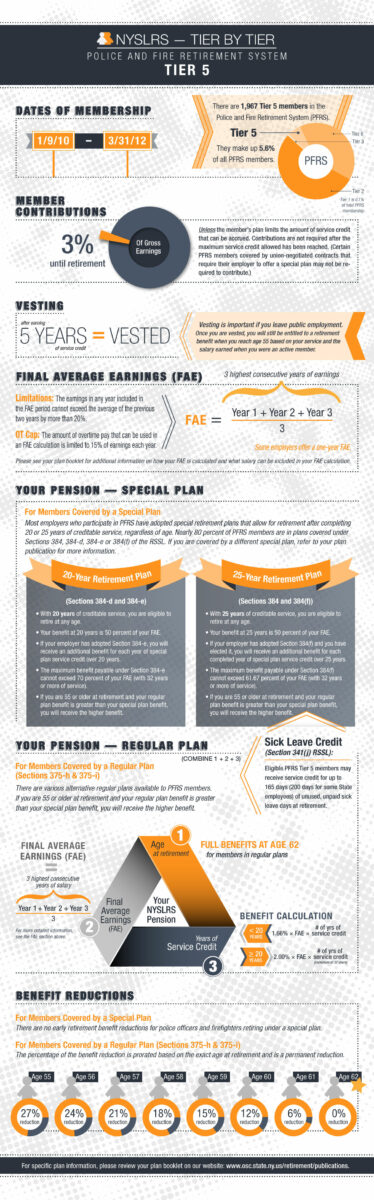
Your tier, which is based on your date of membership, determines your benefits, such as eligibility for death benefits or taking a NYSLRS loan and the formula used in the calculation of your benefits.

5. Vested Means You Qualify for a Retirement Benefit

Becoming vested is a crucial milestone for NYSLRS members. It means you have earned enough service to qualify for a retirement benefit once you meet the minimum age or service requirements established by your retirement plan. All members who have at least five years of service credit are vested.

6. Review Your Beneficiaries Periodically

NYSLRS retirement plans provide death benefits for beneficiaries of eligible members who die before retiring. It’s a good idea to review your beneficiaries from time to time to make sure they reflect your current wishes. The beneficiary you named before might not be the one you would choose today. You should also review the contact information for your named beneficiaries so we can find them when needed.

7. Request Additional Service Credit as Early in Your Career as Possible

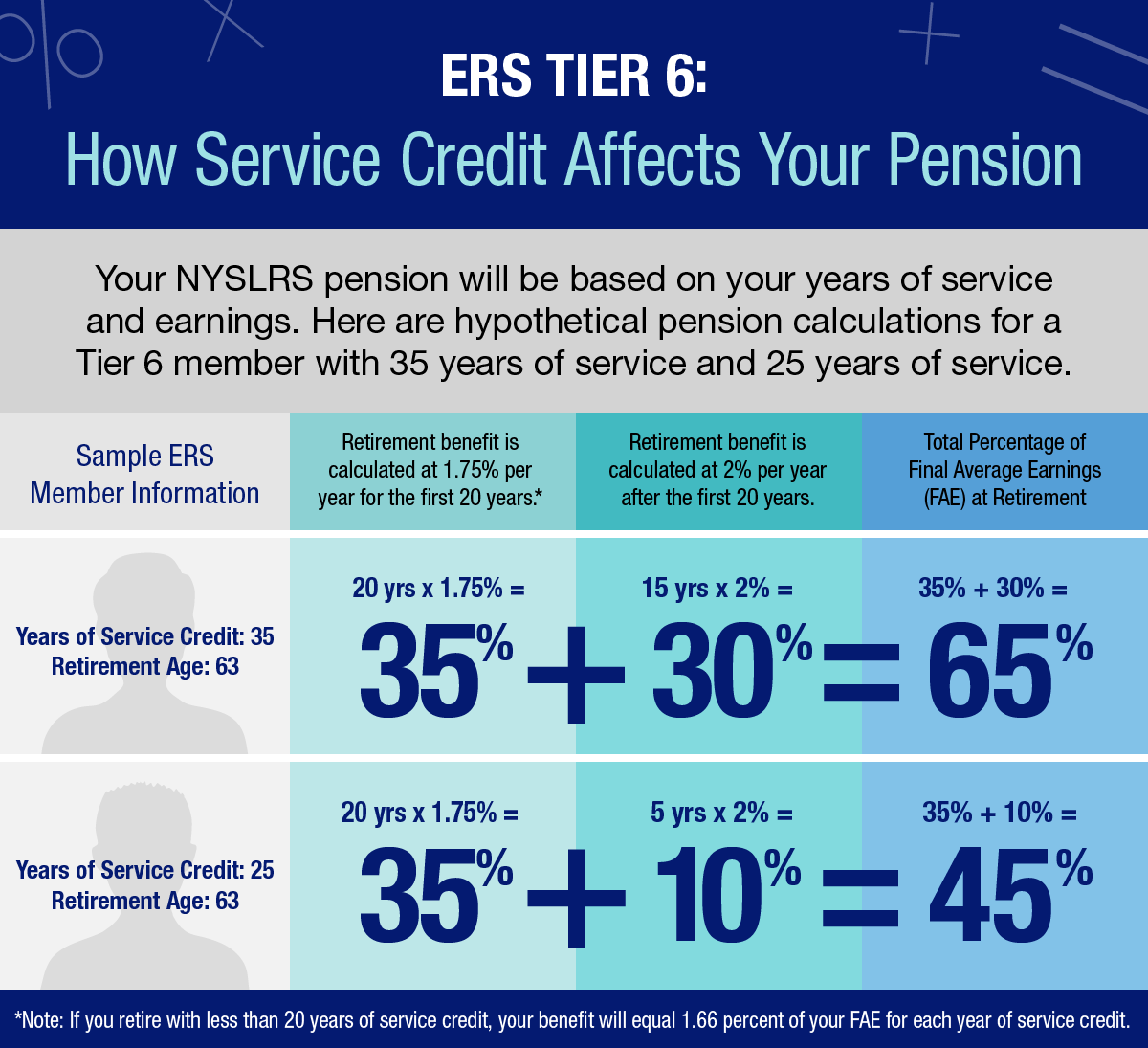
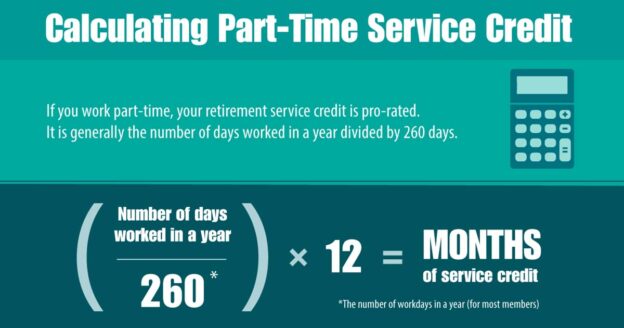
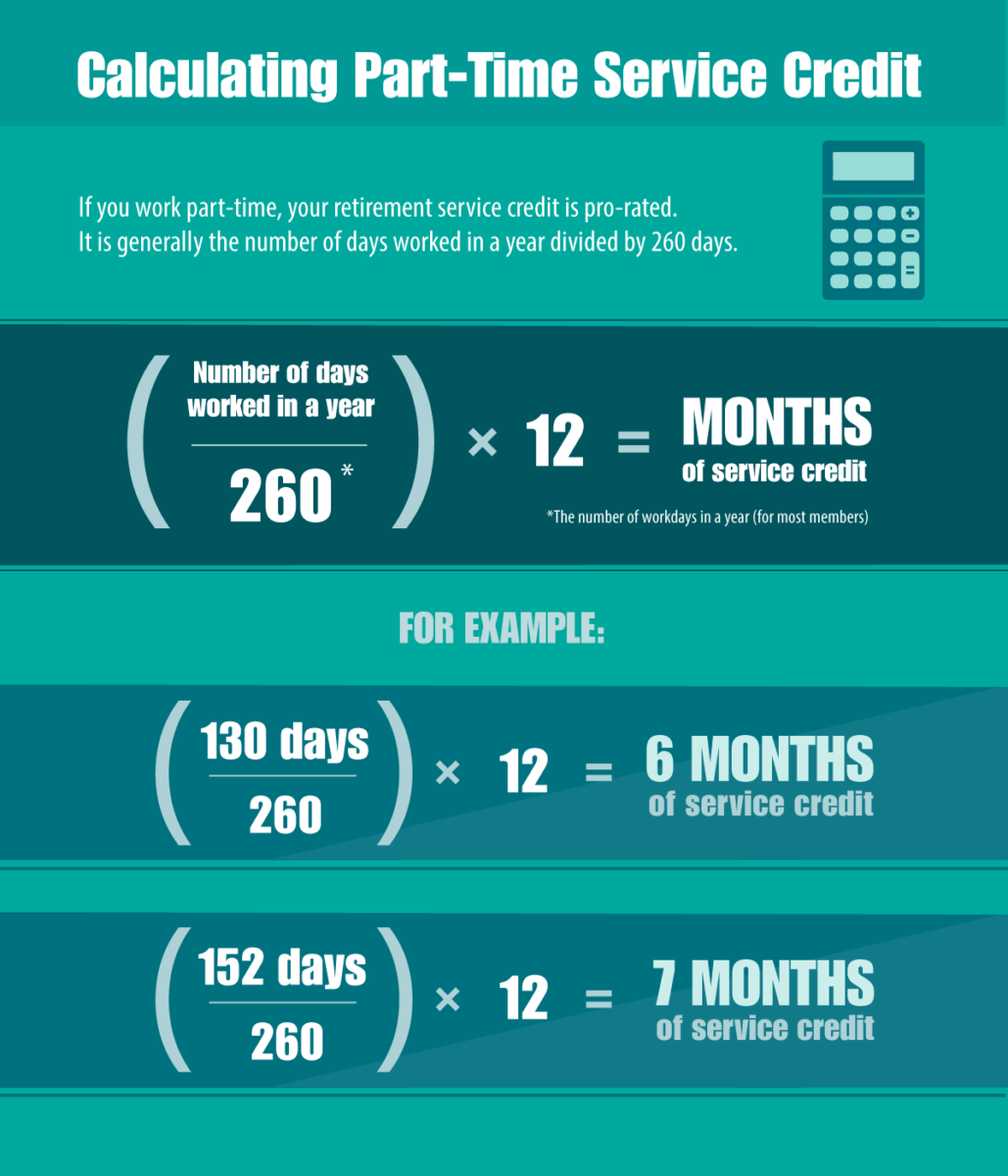
Service credit is a major factor in calculating your pension benefit. You earn a year of service credit for each year of full-time employment with a participating employer. You may also be able to request additional credit if you worked for your current or another public employer before joining NYSLRS or if you served in the U.S. Armed Forces and received an honorable discharge from active military duty. You must submit your request before retirement, and you should do it as early in your career as possible.

8. Estimate Your Pension

Finding out how much you can expect to receive is an important part of retirement planning. Most members can estimate their pension using Retirement Online in just a few quick and easy steps. Retirement Online uses your current earnings and service information to calculate your estimate, including your final average earnings (FAE) and the amounts for the pension payment options available to you. You can fine-tune your estimate or see how different choices would affect your benefit by entering different retirement dates or a beneficiary’s date of birth.

9. Supplement Your Pension with Retirement Savings

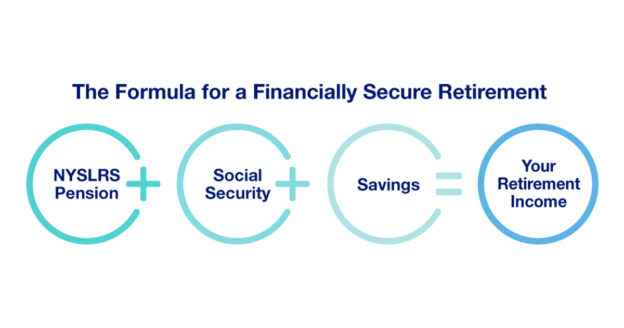
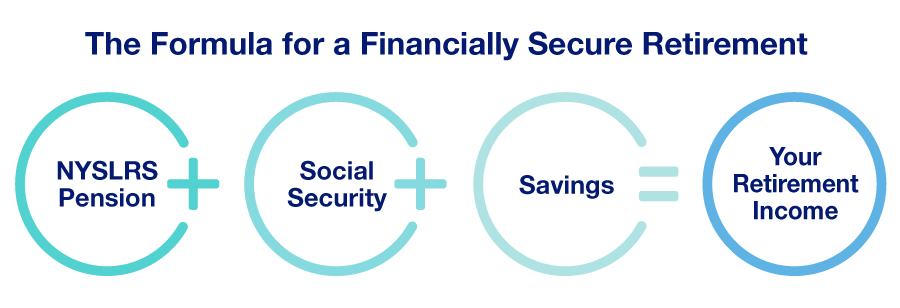
Think of retirement security as a three-legged stool. Each leg is a source of income to help support you when your working days are done. It’s important to understand all your potential sources of income to effectively plan for the future and boost your retirement confidence. Your pension can provide a significant part of your retirement income, but it’s a good idea to supplement your pension with retirement savings and start saving early so your money has time to grow.

10. Your Retirement Plan Publication is an Essential Resource

Your retirement plan publication is an essential resource that explains your NYSLRS benefits in detail—how long you’ll need to work to receive a pension, how your benefit is determined, what death and disability retirement benefits may be available, and more. You should consult it throughout your career, but it’s especially important to read as you prepare for retirement.

Working After Retirement: Earnings Limit

As a NYSLRS retiree, you can work and still receive your pension. However, there may be a limit on how much you can earn each year without affecting your NYSLRS pension.

Working After Retirement: Earnings Limit

Working While Receiving a Service Retirement Benefit

Note: Special rules apply to elected officials.

Under Retirement and Social Security Law (RSSL) Section 212, an earnings limit of $35,000 generally applies to NYSLRS retirees who:

  • Are under age 65;
  • Receive a service retirement benefit (see disability benefit rules below); and
  • Return to work for a public employer (including contract or consultant work, if you joined NYSLRS on or after May 31, 1973).

There is no earnings limit if you are self-employed or if you work for:

  • The federal government;
  • A state or local government in another state; or
  • A private employer.

Also, beginning in the calendar year you turn 65, the earnings limit no longer applies.

Update Regarding the Earnings Limit

The earnings limit for retirees employed by school districts or Boards of Cooperative Educational Services (BOCES) is suspended through June 30, 2027. (May 2025 legislation extended the date from 2025 to 2027.) This earnings limit suspension does not apply to retirees who work for a college, university or charter school.

For most other retirees under the age of 65, the $35,000 limit is in effect and applies to the entire calendar year in 2026.

NYSLRS retirees can return to work part-time for a public employer. However, Internal Revenue Service (IRS) rules and RSSL require a member have a bona fide termination from public service prior to their date of retirement.

When the employer and member expect the member will return to employment after their date of retirement, the member’s termination does not constitute a bona fide termination. If there is no bona fide termination, the service retirement will be voided. Any pension payments made in error due to a retirement that was invalid will be recovered by the Retirement System.

Working While Receiving a Disability Retirement Benefit

Almost all earnings for retirees who are working while receiving a disability retirement benefit are limited whether they work for a public or private employer. The limit is specific to each retiree. To find out your earnings limit, please contact us.

How the Earnings Limit Applies

The limit applies to all earnings for the calendar year, including money earned in the calendar year, but paid in a different calendar year (for example earned in December but paid in January).

The limit does not apply to:

  • Payments received after you retire from your employer, such as for vacation or sick time you earned when you were still working; and/or
  • A retroactive payment for a new union contract, if the earnings are for employment before you retired.

Reporting Your Earnings

It is your responsibility to notify NYSLRS if you earn more than the limit. If you know you are going to exceed the limit, contact us at least a month before you do.

You can message us using the secure contact form, or you can fax a letter to 518-402-2498. Be sure to include the name of your employer, the approximate date you expect to exceed the limit and a daytime phone number in case we have questions.

If You Exceed the Earnings Limit

If you earn more than the limit, you must:

  • Pay back NYSLRS for the pension payments you received after the date you reached the limit. If you continue to work, your pension will be suspended for the remainder of the calendar year and resume the following January.
    OR
  • Rejoin NYSLRS, in which case your pension will be suspended until you retire again at some future date. (You’d need to reapply.)

Earnings Limit Waiver

Under RSSL Section 211, employers may employ you and waive the earnings limit if they get approval before hiring you. Approval is not automatic; it is based on the employer’s needs and your qualifications. In most cases, the New York State Department of Civil Service is the approving agency. A Section 211 waiver covers a fixed period, normally up to two years. Notwithstanding RSSL Sections 211 or 212, however, a prearranged agreement to rehire an employee made prior to their date of retirement does not constitute a bona fide termination.

For More Information

Before you decide to return to work, please read our publication What If I Work After Retirement? It includes information such as how earnings limits are calculated for retirees receiving a disability retirement benefit, consequences to consider before returning to NYSLRS membership and more. If you have questions, please contact us.

Public Service Recognition Week

This Public Service Recognition Week, we proudly celebrate more than 713,000 members and 522,000 retirees of the New York State and Local Retirement System (NYSLRS) for their service to the people of New York State.

Origin of Public Service Recognition Week

This week was created in 1985 to honor those who serve our nation as federal, state, county, local and tribal government employees. Congress officially designated the first full week of May as Public Service Recognition Week. This year, it is being celebrated May 4 through 10.

NYSLRS Members Deliver Critical Services

Whether they are protecting public health and safety, driving our children to school or clearing snow from the roads, NYSLRS members deliver essential services New Yorkers depend on, and you can find NYSLRS members at all levels of government such as:

  • New York State;
  • Counties, cities, towns and villages;
  • School districts;
  • Correctional facilities;
  • Public libraries; and
  • Fire and water districts.

Many members and retirees also give back to our State by volunteering in their communities or supporting charitable causes. That’s in addition to the other important ways retirees contribute to New York State’s economy.

Public Service Recognition Week

Comptroller DiNapoli’s Faith in Public Service

New York State Comptroller Thomas P. DiNapoli is the administrator of NYSLRS and trustee of the Common Retirement Fund. He began his own public service career at the age of 18, when he won his first election to become a trustee on the Mineola Board of Education. This made him the youngest person in New York State history elected to public office. He is also the second longest-serving Comptroller in New York State history.

Comptroller DiNapoli often speaks about the contributions New York’s public employees make to their communities and their State. He encourages young people to consider a career in public service. “It’s more than a job,” he says. “It’s a career with purpose.

Federal Tax Withholding and Your Pension

Most NYSLRS pensions are subject to federal income tax. If your last federal tax bill or return was not what you expected, Retirement Online makes it fast and convenient to update your federal tax withholding.

If you don’t have an account or for help signing in to an existing account, check out our Retirement Online tools and tips for step-by-step instructions to register, reset your password, unlock your account and more.

federal tax withholding and your pension

Understanding Your Federal Tax Withholding

NYSLRS is required to withhold federal income tax from your pension benefit at the default withholding status of “single with no adjustments” unless you inform us otherwise. The amount withheld is based on the information you provide to us on a W-4P Form (Withholding Certificate for Pension or Annuity Payments).

Note: The Internal Revenue Service (IRS) revised its W-4P Form, which no longer allows tax filers to adjust their withholding by electing a specific number of allowances. To comply with IRS requirements, NYSLRS updated its tax withholding form accordingly. You do not need to submit a new W-4P Form to NYSLRS unless you want to change the amount withheld for federal income tax.

Effective January 1, 2023, NYSLRS does not withhold federal income tax from pension benefits that are not subject to tax reporting.

Estimate Your Federal Tax Withholding

The IRS has a new Tax Withholding Estimator which may help you estimate the federal income tax you want withheld from your pension. When using the tool, be sure to have your most recent tax return, pension pay stubs (available in Retirement Online) and other income information—your results will be based on the information you enter.

Use Retirement Online to Update Your Withholding

Retirement Online is the fastest and most convenient way to complete the W-4P Form and update your federal tax withholding for your NYSLRS pension.

If you update your federal tax withholding online by the middle of the month, your changes will generally be applied to that month’s pension payment.

For more information, including instructions for updating your withholding, visit our Taxes and Your Pension page.

If You Need Help

The NYSLRS form is based on the IRS form. If you need assistance completing the form:

If you’re not sure whether you need to adjust your federal tax withholding or if you have other tax questions, you may want to consult a tax preparer.

Compounding: Use Time to Grow Your Money More

Financial security doesn’t just happen; it takes planning and time. You know you can count on your NYSLRS pension in retirement. But, if you want to improve your chances of a financially secure retirement, your plan should include retirement savings. It’s important to start saving early so your money has time to grow.

When you invest your savings in an individual retirement account (IRA) or a 401(k)-style retirement savings plan, you earn a return on your investment, and those returns are compounded. That means your money increases in value by earning returns on both the original amount and your accumulated profits. This is different than earning simple interest. Let’s see how they both work.

How Simple Interest Works

In banking, simple interest is a certain percentage you are paid on the money you put into your account. With simple interest, the amount of interest you earn is based on the original (or principal) amount of the deposit.

Let’s say you open a certificate of deposit (CD), which pays 5 percent simple interest if you agree to keep your money in the CD for a year. If you deposit $1,000 in January, you’ll have $1,050 at the end of the year. That’s $50 more than you started with, so you might decide to keep your money there for another year. With simple interest, the interest you earn the second year and every year after would still be based on the principal amount of $1,000—no compounding.

How Compounding Works

With compounding, your initial investment is reinvested along with your earnings. If you earn the same 5 percent, with compounding, it’s applied to the full balance of your account. So, you would still have that $1,050 at the end of the first year, but by the end of the second year you’d have $1,102.50 in your account instead of $1,100.

In this example, that’s just a difference of $2.50, but, over time, compounding can mean a difference of hundreds or thousands of dollars.

The Power of Compounding

If you’re already building retirement savings, think about giving your savings a boost. If you haven’t started saving yet, right now is the best time to start. The New York State Deferred Compensation Plan (NYSDCP) is available to New York State employees and some municipal employees. Once you’ve signed up, your retirement savings—which may be tax-deferred depending on the plan you choose—will be automatically deducted from your paycheck. Remember, the sooner you start saving, the more time your money has to grow.

The 3-Legged Stool Approach to Retirement Confidence

Your NYSLRS pension is a good reason to be optimistic about your finances in retirement. Once you retire, your pension will provide monthly payments for the rest of your life. But there is more to a financially secure retirement than having a pension.

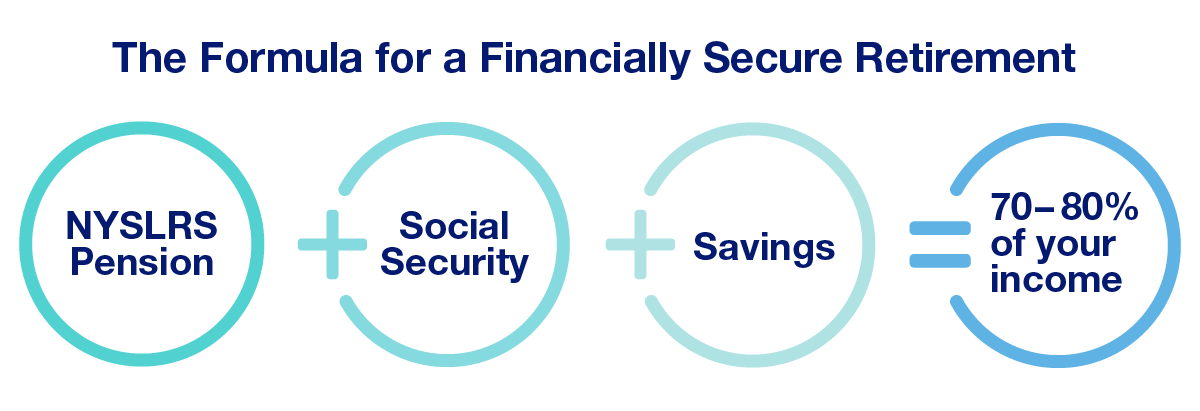
Think of retirement security as a three-legged stool. Each leg is a source of income to help support you when your working days are done. It’s important to understand all your potential sources of income to effectively plan for the future and boost your retirement confidence.

Leg 1: Your NYSLRS Pension

The 3-Legged Stool Approach to Retirement Confidence NYSLRS pensions are defined benefit plans, also known as traditional pension plans. When you retire, you will receive a monthly pension payment for the rest of your life. Your pension will be calculated using a preset formula based on your earnings and years of service—it will not be based on the individual contributions you paid into the system. Unlike workers who rely on 401(k)-style retirement plans, you won’t have to worry about this income running out.

Most members can estimate their pension in Retirement Online. But, if you’re a long way from retirement, it may be better to think in terms of earnings replacement. Financial advisers estimate you’ll need to replace 70 to 80 percent of your income to retire with confidence. Your pension can help get you there. For example, if you retire with 30 years of service, your NYSLRS pension could replace more than half of your earnings. (Pension benefits depend on your tier and retirement plan. Find your retirement plan publication for comprehensive information about your retirement benefits and how your pension will be calculated.)

Leg 2: Social Security

Your Social Security benefit is another source of income to help support you in retirement. At Social Security’s full retirement age, your benefit can replace from about 75 percent for lower income earners to about 27 percent for higher income earners. Learn more about Social Security benefits and visit the Social Security’s Plan for Retirement page to estimate your income.

Leg 3: Retirement Savings Can Boost Your Confidence

A lifetime pension and Social Security income will be substantial financial assets, but it’s still important to save for retirement. Healthy retirement savings will give you more flexibility to do the things you want to do in retirement. It can also help in case of an emergency and act as a hedge against inflation.

Your personal savings is the factor you have the most control over. You decide when to start, how much to save and how to invest your money. The key is to start saving early so your money has time to grow, even if you can only afford to save a small amount in the beginning.

Eligible employees might consider saving with the New York State Deferred Compensation Plan (NYSDCP). Money gets deducted from your paycheck, so you won’t even have to think about it. NYSDCP is not affiliated with NYSLRS, but New York State employees and some municipal employees can participate. If you’re a municipal employee, ask your employer whether you’re eligible for NYSDCP or another retirement savings plan.

Retirement and your credit score

Retirement and Your Credit Score

Striving to maintain a good credit score is just as important in retirement as it is during your working years. You may be retired, but financial necessities continue. You may need to get a car loan or refinance a mortgage, and good credit ensures you can borrow money at a decent interest rate. In fact, bad credit could prevent you from renting an apartment, or you may be required to pay higher insurance premiums. Fortunately, it seems maintaining good credit is just a matter of continuing what you’ve already been doing.

What is a Credit Score?

Your credit score is a three-digit number used by lenders to judge how likely you are to pay back money you’re loaned. It’s based on your past payment history and other interactions with lenders. These three digits affect you more than you might realize.

According to the Consumer Financial Protection Bureau (CFPB), “Companies use credit scores to make decisions on whether to offer you a mortgage, credit card, auto loan, and other credit products, as well as for tenant screening and insurance. They are also used to determine the interest rate and credit limit you receive.”

What's your credit score?

How to Maintain a Good Credit Score

The best way to maintain your credit score is to borrow responsibly and manage debt effectively. That means:

  • Pay your bills on time. Pay more than the minimum payments if you can. Your payment history accounts for about a third of your credit score.
  • Avoid using all or most of your available credit. The ratio of debt to available credit is another factor in your credit. If all your credit cards have balances near the limit, your credit score will suffer.
  • Keep longstanding credit lines open. These accounts show your long history of being responsible with credit and help to boost your score.
  • Don’t accumulate excessive debt. You especially want to avoid opening several lines of credit in a short amount of time.

Things like age and salary are not part of the credit score equation, so being retired does not hurt your score. However, lenders do take income into account when you apply for a loan, so you may find it harder to borrow after retirement, even if you have good credit.

Check Your Credit Reports Annually

Even if you’re doing everything right, misinformation in the files of credit rating companies could hurt your credit. So, check your credits scores regularly.

Under federal law, the three nationwide credit reporting companies are required to provide a free credit report once every 12 months. But you must request it. You can request your credit report online at AnnualCreditReport.com or by calling 877-322-8228. AnnualCreditReport.com is a website maintained by the three major credit reporting agencies—Equifax, Experian and TransUnion. It is the only free credit report site authorized by the federal government. Beware of impostor sites.