Tag Archives: retirement

Supplement Your NYSLRS Pension with Retirement Savings

As a NYSLRS member, you are enrolled in something increasingly rare these days: a defined benefit plan. If you are vested and retire from NYSLRS, you will receive monthly pension payments for the rest of your life based on your years of service and earnings. Your NYSLRS pension can provide a significant part of your retirement income, but it’s a good idea to supplement your pension and Social Security with a retirement savings account.

Additional retirement savings can give you flexibility to travel, continue your education, pursue a hobby or start a business. It can be a resource in case of an emergency or act as a hedge against inflation.

Your Retirement Savings Goal

How much you save is a personal decision. You can  estimate your pension in Retirement Online to get an idea of the income it will provide in retirement. Use a retirement savings calculator to see how much a retirement savings plan could yield over time. Test the results with different savings amounts.

Below you can see the potential savings of someone who invests 50 dollars every two weeks for 30 years. While the stock market can be turbulent in the short term, in the long term, it returns on average about 10 percent a year as measured by the S&P 500 index.
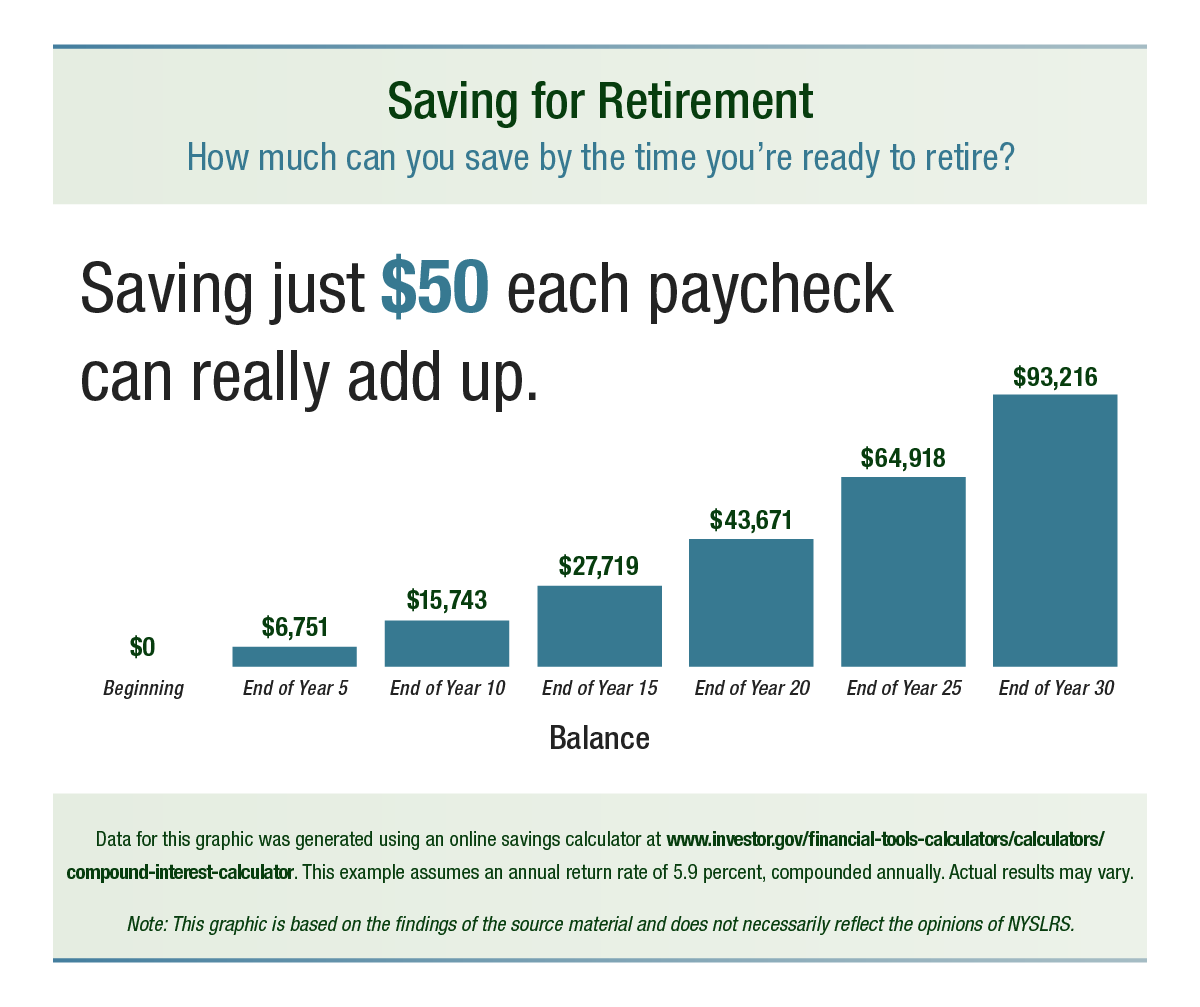
saving for retirement

As you get closer to retirement, you should develop a plan to withdraw money from your savings. That will give you a better idea of the income you might expect from your nest egg and a sense of how long it will last.

Here is one possible withdrawal strategy, which provides retirement income for 20 years. Please note, if your retirement is far in the future, the money you withdraw may not have the same value that it would have today.
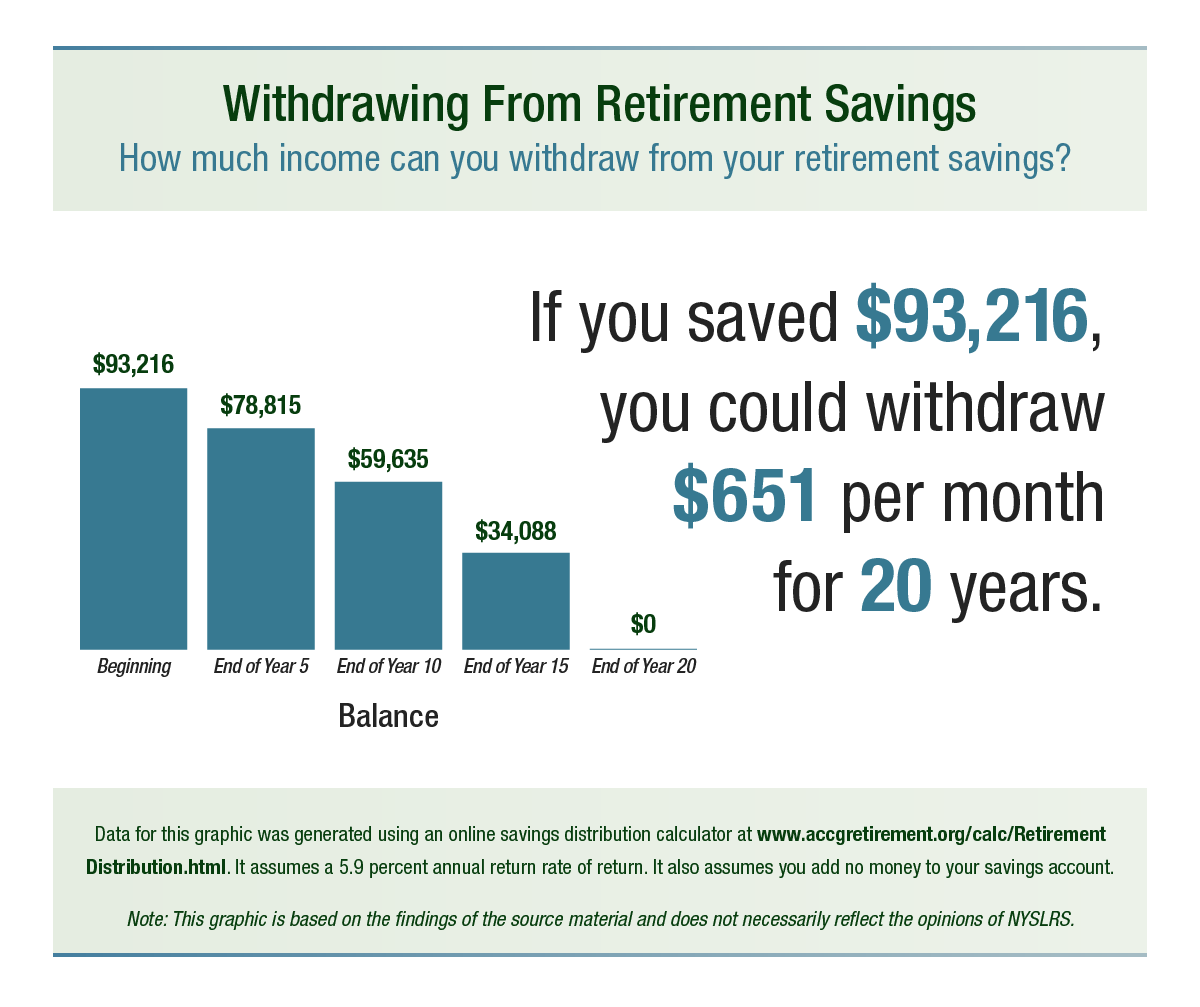
withdrawing income

If you find you’ll need to save more to meet your goal, you can make adjustments to help ensure you’ll have enough savings in retirement.

Note: Generally, whatever your withdrawal strategy, federal law will eventually require you withdraw a certain amount each year from any tax-deferred retirement plan account. These are called required minimum distributions.

New York State Deferred Compensation Plan

One way State employees and many municipal employees can save for retirement is through the New York State Deferred Compensation Plan (NYSDCP). Once you’ve signed up, your retirement savings—which may be tax-deferred depending on the plan you choose—will be automatically deducted from your paycheck.

Check with your employer’s human resources or personnel office to see whether they participate in NYSDCP or if they offer other savings options. (NYSDCP is not affiliated with NYSLRS.)

Read More About Retirement Savings

When it comes to saving for retirement, there’s a lot to consider. You can find more information in these posts:
Where Do NYSLRS Retirees Live?

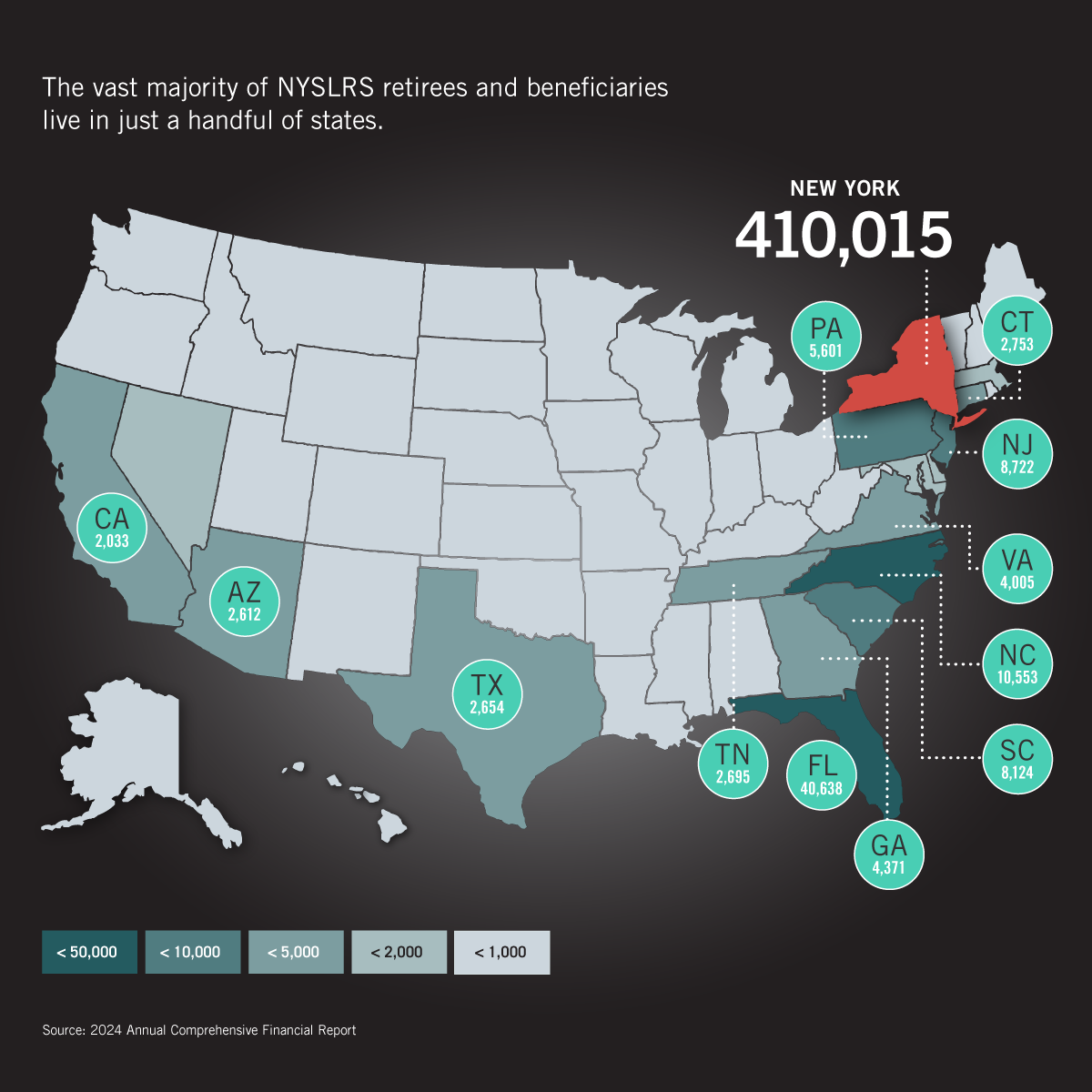
NYSLRS provides pension benefits to more than 520,000 retirees and beneficiaries. You can find our retirees in every state in the US and in countries all around the world. However, most live right here in New York State.

Nearly 79% of NYSLRS Retirees Stay in New York

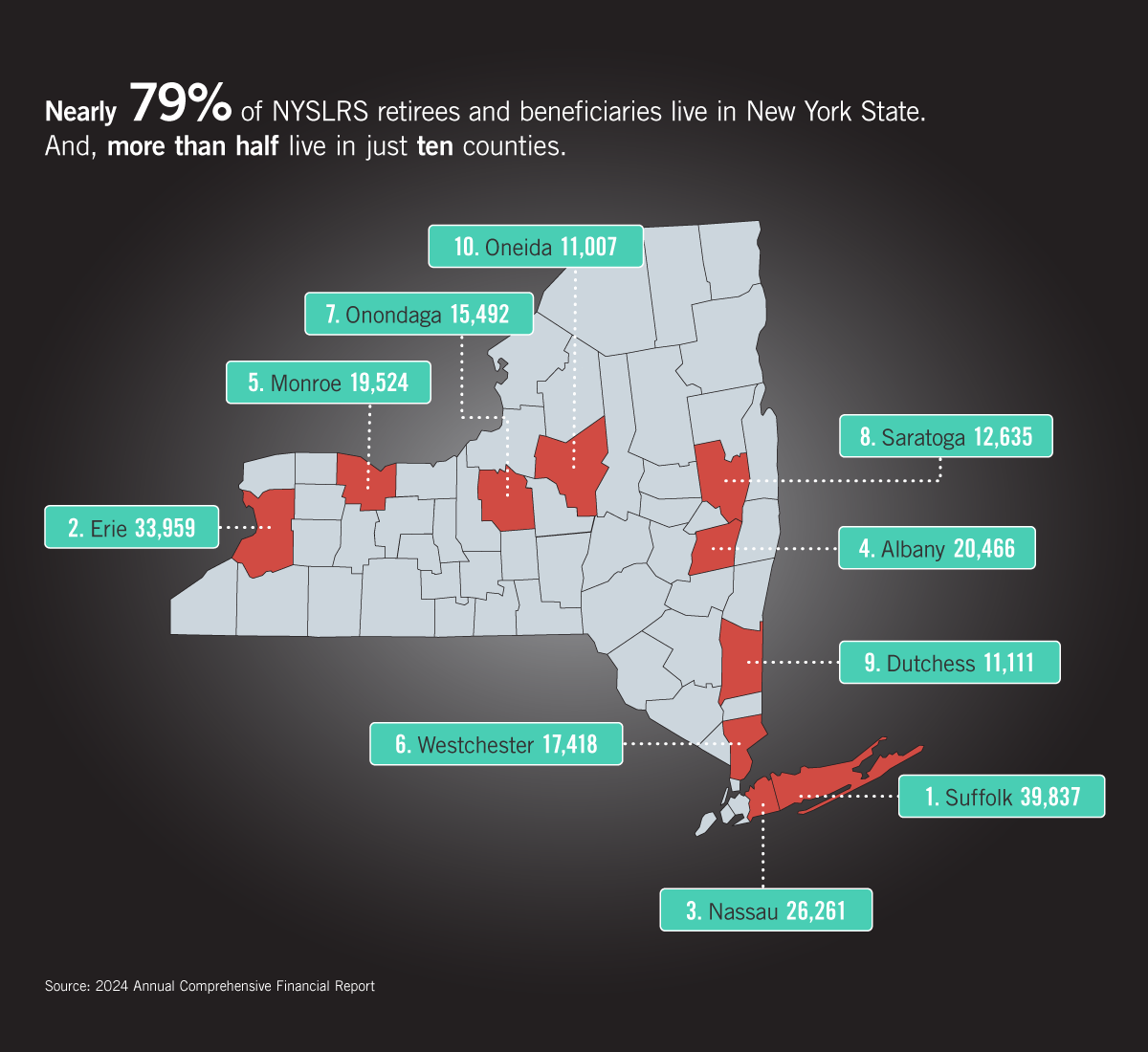
The vast majority of NYSLRS retirees—nearly 79 percent—stay in New York State, and their pension dollars flow right back into our communities. Retirees in New York pay local property and sales taxes. Their spending supports local businesses, generates thousands of jobs and stimulates the economy.

NYSLRS retirees in New York

Where in New York do these retirees call home?

Long Island is home to more than 66,000 retirees and beneficiaries. Suffolk County has the most and Nassau County has the third most benefit recipients of the counties outside of New York City. (The City, which has its own separate retirement systems for municipal employees, police and firefighters, has more than 24,000 retirees and beneficiaries.)

Erie County, which includes Buffalo, has the second most retirees—nearly 34,000. Albany County, home to the State capitol, is ranked fourth, with more than 20,000. Monroe, Westchester, Onondaga, Saratoga, Dutchess and Oneida Counties round out the top ten.

All told, retirees and beneficiaries in the top ten counties received $7 billion in retirement benefits in the fiscal year ending March 31, 2024.

Hamilton County has the fewest retirees. But, in this sparsely populated county in the heart of the Adirondacks, those 545 retirees represent about 10 percent of the county’s population and received $12.9 million in retirement benefits in the fiscal year ending March 31, 2024.

NYSLRS Retirees in the United States

NYSLRS retirees are found in every state. Florida, not surprisingly, is the second choice for retirees after New York. Roughly 41,000 call the Sunshine State home. North Carolina is third, followed by New Jersey and South Carolina. North Dakota has the fewest retirees and beneficiaries—only 23.

NYSLRS retirees in the United States

NYSLRS Retirees Around the World

There are 649 NYSLRS retirees and beneficiaries living around the world but the most common countries are:

  • Canada: 176
  • Israel: 48
  • England: 32
  • Philippines: 32
  • US Virgin Islands: 29

Learn More

Check out our 2024 Annual Comprehensive Financial Report for more information about NYSLRS, the Common Retirement Fund and our nearly 1.2 million members, retirees and beneficiaries.


Note: All data is as of the State fiscal year end, March 31, 2024.

A Look Inside NYSLRS

Let’s take a look inside the New York State and Local Retirement System (NYSLRS) and what makes it one of the largest and best retirement systems in the United States.

NYSLRS administers two distinct systems. They are:

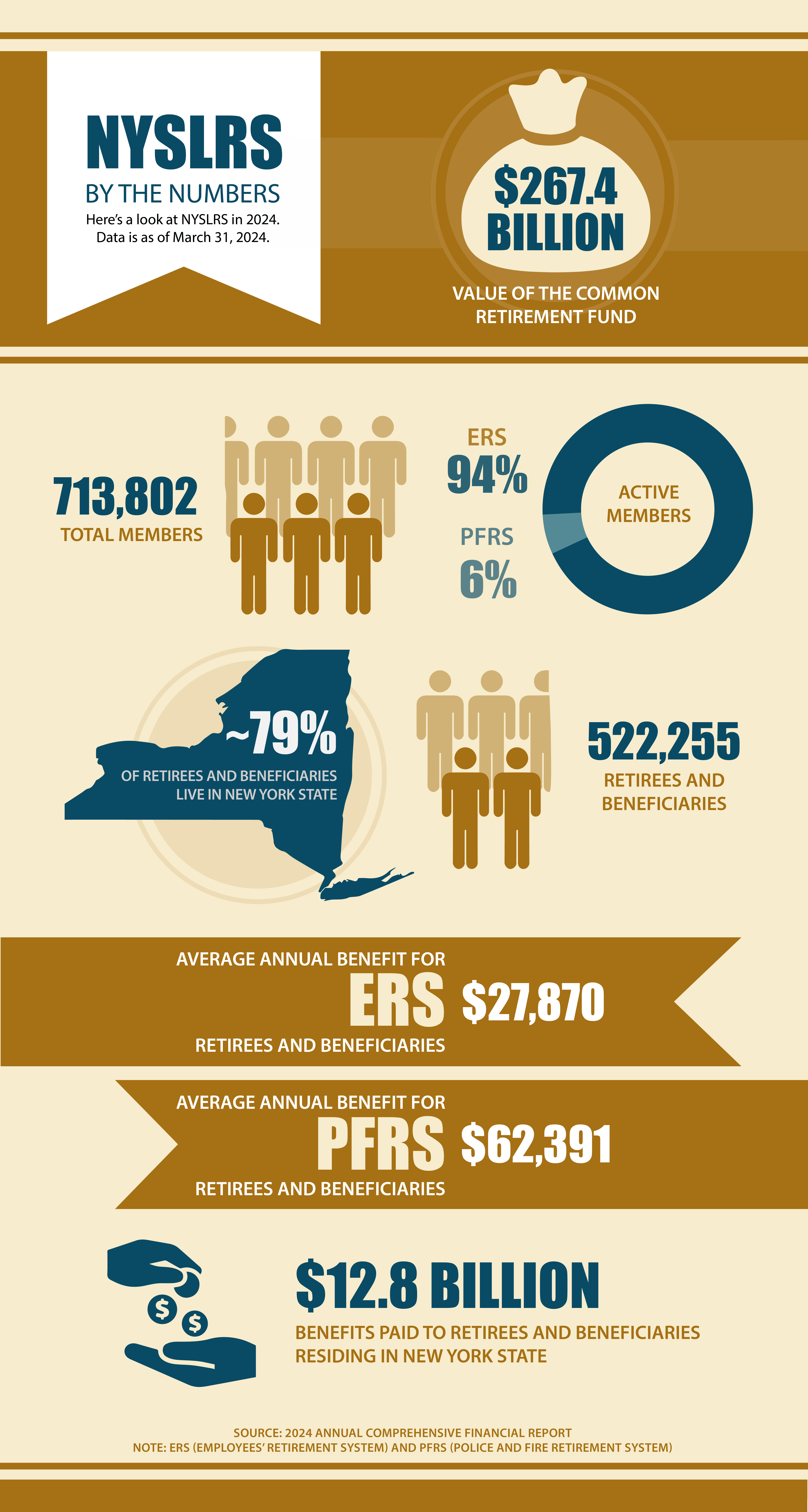
  • The Employees’ Retirement System (ERS) with 677,604 members; and
  • The Police and Fire Retirement System (PFRS) with 36,198 members.

In addition, NYSLRS provides pension benefits to more than 520,000 retirees and beneficiaries. Altogether, that’s more than 1.2 million participants!

A Look Inside NYSLRS

New York State Common Retirement Fund

State Comptroller Thomas P. DiNapoli is administrative head of NYSLRS and trustee of the New York State Common Retirement Fund, which was valued at $267.4 billion as of March 31, 2024. The Fund is widely recognized as one of the best-managed and best-funded public pension plans in the nation. Since its establishment in 1921, the Fund’s prudent investment management, solid returns, and constitutionally protected benefits have provided retirement security for generations of hard-working New Yorkers.

NYSLRS Members                                                          

How did NYSLRS earn the distinction of being one of the largest systems? Here are some facts about NYSLRS members:

  • 527,404 active members (that is, members still on the public payroll) work for 2,988 public employers statewide.
  • About one-third of those active members work for New York State. The rest work for counties, cities, towns, villages, school districts and public authorities.
  • Nearly 94 percent of total active members are in ERS while only 6 percent of total active members are in PFRS.
  • Tier 6 is our largest benefit group, with more than 60 percent of all members (62.6 percent in ERS, 56 percent in PFRS).
  • In ERS, Tiers 3 and 4 are the second largest benefit group, with 33.1 percent of members.
  • While, in PFRS, Tier 2 is the second largest benefit group, with 38.7 percent of members.

For more information about our largest ERS tiers, see our blog posts, ERS Tier 6 Milestones and ERS Tiers 3 and 4 Milestones. You can also learn more about the PFRS Milestones our police and fire fighters across New York State will reach over the course of their careers.

NYSLRS Retirees and Beneficiaries

The average pension for an ERS retiree was $27,870; the average for a PFRS retiree was $62,391. But these pension payments don’t just benefit retirees and beneficiaries. During 2022, approximately 78 percent of retirees lived in New York State and were responsible for $17.3 billion in economic activity. By supporting local businesses, helping to create jobs and paying their fair share of taxes, NYSLRS retirees contribute to the economic health of our communities.

Learn More About NYSLRS

Detailed information about NYSLRS members, retirees and beneficiaries as well as the Fund’s position and performance can be found in the 2024 Annual Comprehensive Financial Report.


Note: All data is as of the State fiscal year end, March 31, 2024.

Choosing Your Pension Payment Option

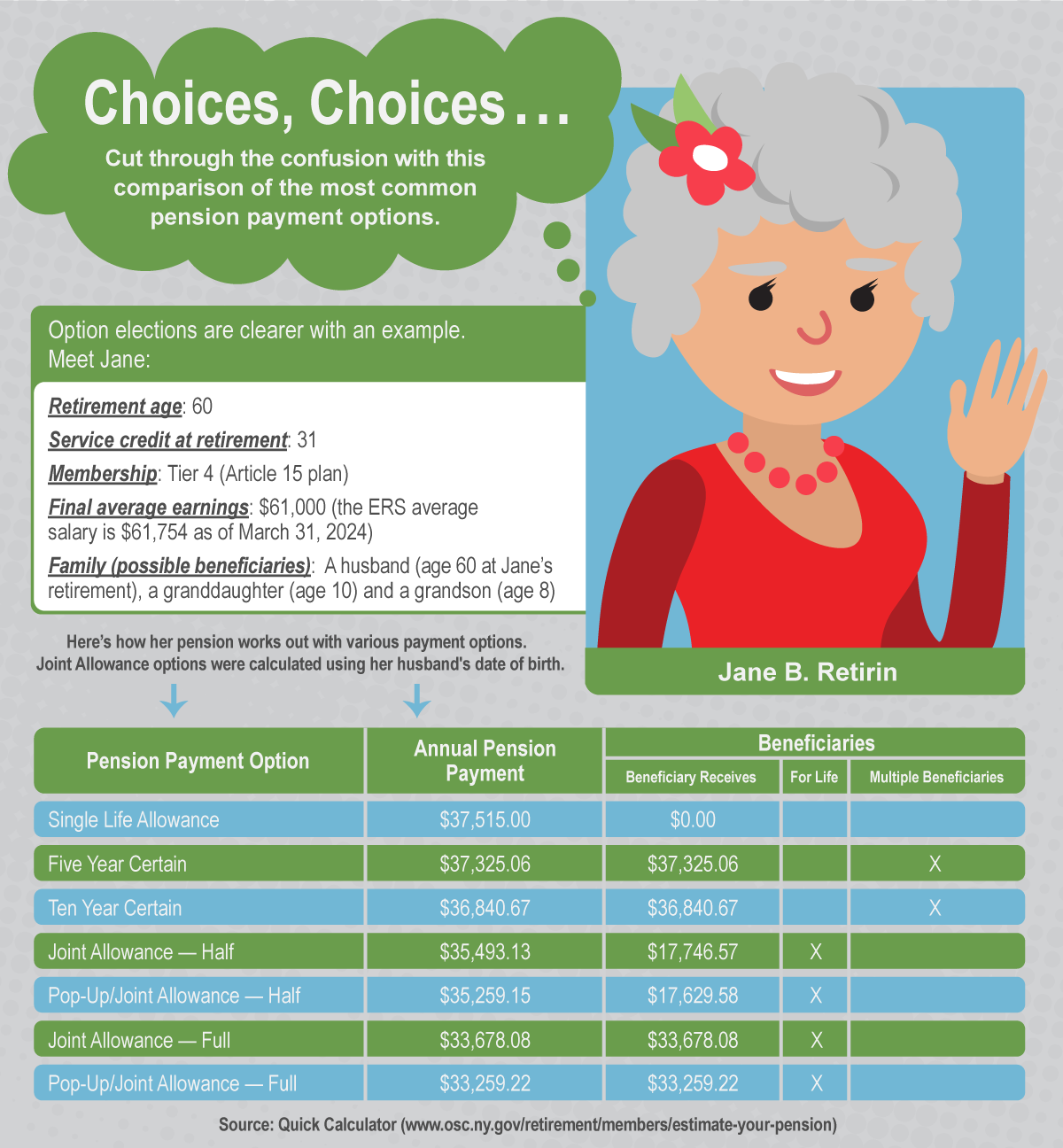
Your NYSLRS pension will provide you with a monthly benefit for the rest of your life. When you apply for retirement, you’ll have the option to choose the maximum amount payable or a reduced benefit in exchange for possibly continuing payments to a beneficiary upon your death. There’s a lot to consider when choosing a pension payment option, so let’s break this down using an example.

Choosing Your Pension Payment Option

Meet Jane

Jane plans to retire soon and considers whether she should leave a continuing benefit to her husband or grandchildren.

No Beneficiaries

The Single Life Allowance option would provide the maximum monthly benefit payment, but all payments will stop when Jane dies, and nothing will be paid to a beneficiary.

Multiple Beneficiaries, Limited Benefit

For Jane to name both of her grandchildren as beneficiaries, she would have to select either the Five Year Certain or Ten Year Certain option—these pension payment options provide a limited benefit for multiple beneficiaries and wouldn’t reduce her pension much. If Jane dies within five or ten years of retirement, depending on which option she chooses, Jane’s grandchildren would split her pension benefit for the remainder of the five- or ten-year period. However, if Jane lives beyond the five- or ten-year period, her grandchildren would not receive a pension benefit when she dies. (Note: Jane could select one of these options and name just one beneficiary, for example, her husband instead of her grandchildren.)

Single Beneficiary, Lifetime Benefit

Jane’s husband doesn’t have his own pension, so she also considers pension payment options providing a lifetime benefit for a single beneficiary. Under the Joint Allowance — Full or Joint Allowance — Half options, Jane’s husband would receive all or half of her reduced benefit for life, depending on which option she chooses. The same goes for the Pop-Up/Joint Allowance — Full or Pop-Up/Joint Allowance — Half options. While these “pop-up” options reduce the pension a little more, they provide added security—if Jane outlives her husband, her monthly payment will increase to the maximum amount as if she selected the Single Life Allowance option at retirement.

Pension payment amounts are based on the birth dates of both the retiree and their beneficiary. So, if Jane chose one of these options and named one of her grandchildren as her beneficiary, her pension would be much lower than the amounts listed in the graphic.

Things to Consider

As you plan for your own retirement and think about whether to leave a continuing benefit for a beneficiary, you may want to consider both your spouse’s and your:

  • Financial needs (for instance, whether you have a mortgage, unpaid loans or other monthly payments).
  • Other sources of retirement income (for example, Social Security or savings).
  • Options for continuing benefits (for example, whether your retirement plan includes a death benefit or if you have life insurance).
  • Age and health at retirement.

It’s also important to understand whether you can change your beneficiary after you retire. Life circumstances can sometimes change, and if you choose a pension payment option that provides a lifetime benefit, you cannot change your beneficiary. 

Find your NYSLRS retirement plan publication to learn more about pension payment options and how your pension will be calculated. You can also estimate your pension using Retirement Online, and enter different retirement dates and beneficiary birth dates to see how those choices would affect your benefit. When you’re done, print your pension estimate or save it for future reference.

Pension Payment Options: Providing a Lifetime Benefit for a Single Beneficiary

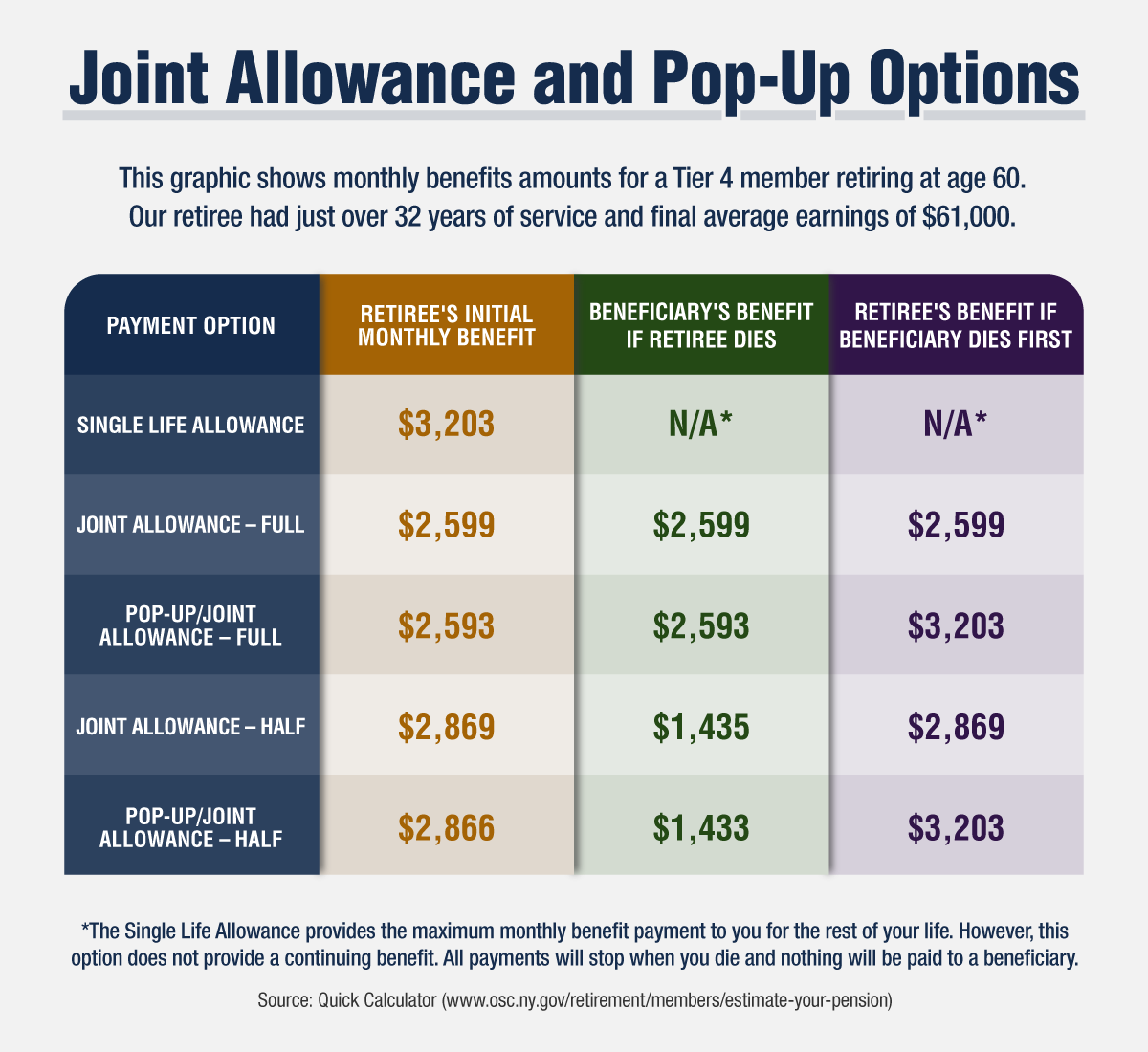
Your NYSLRS pension will provide you with a monthly benefit for the rest of your life. When you apply for retirement, you’ll have the option to choose the maximum amount payable or a reduced benefit in exchange for possibly continuing payments to a beneficiary upon your death. In this post, we’ll explore the Joint Allowance and Pop-Up/Joint Allowance pension payment options which provide a lifetime benefit for a single beneficiary.

Joint Allowance and Pop-Up/Joint Allowance Pension Payment Options

Joint Allowance Pension Payment Options

In exchange for a permanent reduction in your monthly pension payment, the Joint Allowance options provide a lifetime benefit to a beneficiary after you die.

You can select either:

  • Full: Your beneficiary will receive the same monthly pension payment as you were receiving for life.
  • Half: Your beneficiary will receive half of the monthly pension payment you were receiving for life.
  • Partial: Your beneficiary will receive either 75, 50, or 25 percent of the monthly pension payment you were receiving for life.

You can only choose one beneficiary under a Joint Allowance option, and you cannot change your beneficiary after you retire—regardless of the circumstances. If your beneficiary dies before you, all payments will stop when you die.

Pension payment amounts are based on the birth dates of both you and your beneficiary. Because life expectancy is a factor, the reduction to your pension payment amount will be more if you select a child or grandchild than a spouse of a similar age as you.

If you designate your spouse as your beneficiary, they would be eligible to receive 50% of your cost-of-living adjustment.

Pop-Up/Joint Allowance Pension Payment Options

The Pop-Up/Joint Allowance options have all the same terms of the Joint Allowance options with added security—if your beneficiary dies before you, your monthly pension payment will “pop up” or increase to the amount you would have been receiving had you chosen the Single Life Allowance option at retirement. (Note: This only affects future payments. You would not be entitled to retroactive payments.) Therefore, the Pop-up/Joint Allowance options reduce your monthly pension payment a little more than a comparable Joint Allowance option.

Other Pension Payment Options

The Single Life Allowance provides the maximum monthly pension payment to you for the rest of your life. However, this option does not provide a continuing benefit. All payments will stop when you die, and nothing will be paid to a beneficiary.

Some pension payment options provide a limited benefit for multiple beneficiaries.

Things to Consider

When choosing your pension payment option, you may want to consider both your spouse’s and your:

  • Financial needs (for instance, whether you have a mortgage, unpaid loans or other monthly payments).
  • Other sources of retirement income (for example, Social Security or savings).
  • Options for continuing benefits (for example, whether your retirement plan includes a death benefit or if you have life insurance).
  • Age and health at retirement.

You only have 30 days after the last day of your retirement month to change your option. After that date, you cannot change your option for any reason.

Estimate Your Pension in Retirement Online

Most members can use Retirement Online to create a pension estimate based on the most up-to-date salary and service information we have on file. You can enter different retirement dates, beneficiaries and pension payment options to see how they affect your potential benefit.

When you’re done, print your pension estimate or save it for future reference.

Pension Payment Options: Providing a Limited Benefit for Multiple Beneficiaries

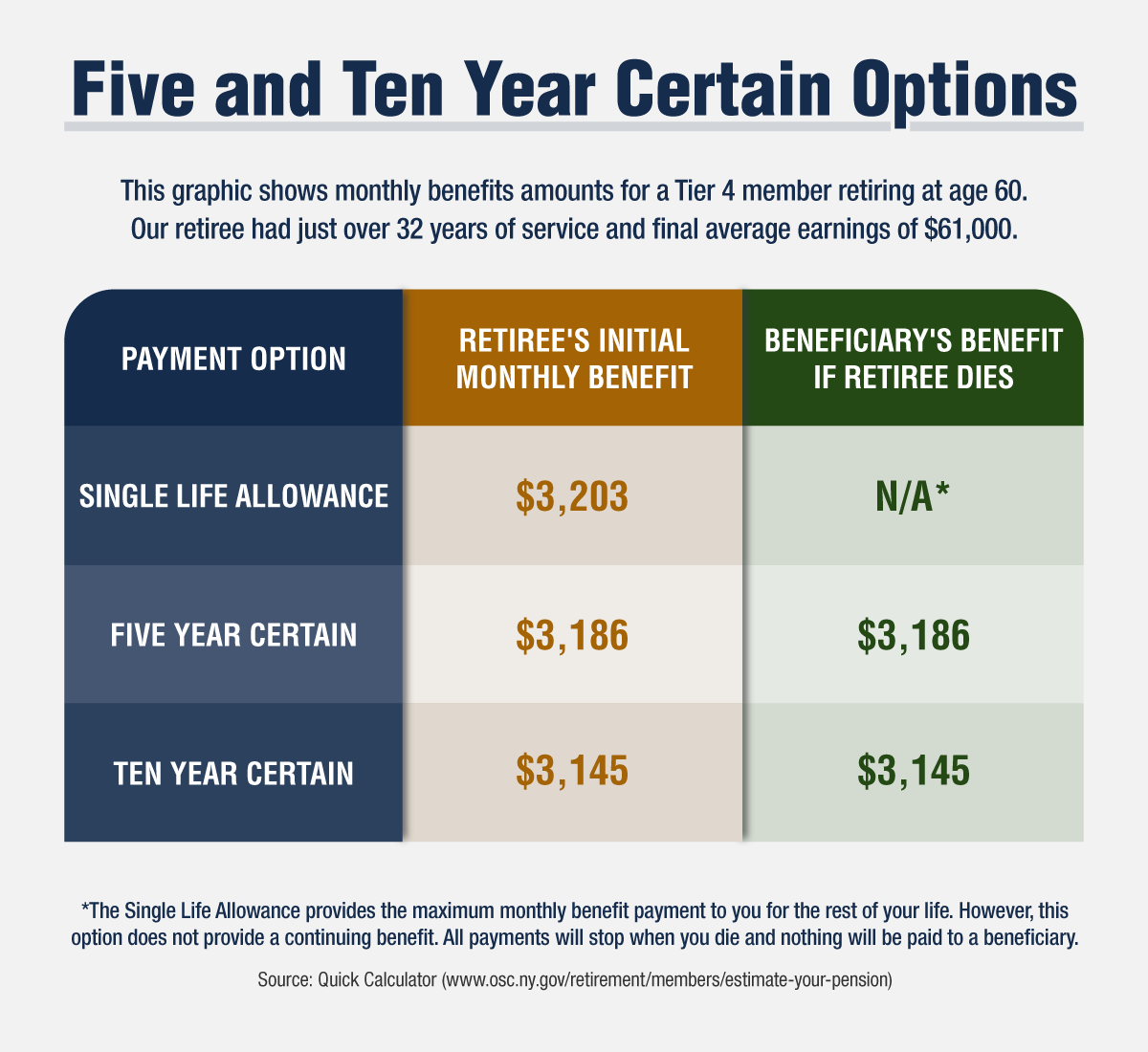
Your NYSLRS pension will provide you with a monthly benefit for the rest of your life. When you apply for retirement, you’ll have the option to choose the maximum amount payable or a reduced benefit in exchange for possibly continuing payments to a beneficiary upon your death. In this post, we’ll explore the Five Year Certain and Ten Year Certain pension payment options which provide a limited benefit for multiple beneficiaries.

Five and Ten Year Certain Pension Payment Options

Five and Ten Year Certain Pension Payment Options

In exchange for a permanent reduction in your monthly pension payment, the Five Year Certain and Ten Year Certain options provide a limited benefit to one or more beneficiaries after you die.

If you die within five or ten years after your retirement, payments in the same amount as you were receiving will be paid to your beneficiaries for the remainder of the five- or ten-year period. However, if you live beyond the five- or ten-year period, your beneficiaries will not receive a pension benefit when you die.

For example, let’s say you choose the Five Year Certain option. If you die two years after retiring, your beneficiary will receive your monthly pension payment for three years. Or, if you choose the Ten Year Certain option and die after two years, your beneficiaries will receive your monthly pension payment for eight years. In either case, your beneficiary would receive the same amount you were receiving. If you designate your spouse as your beneficiary, they would be eligible to receive 50% of your cost-of-living adjustment.

While these options don’t provide a lifetime benefit for your beneficiary, they do have advantages you may want to consider. With these options, you can:

  • Name multiple beneficiaries.
  • Change your beneficiaries at any time within the five- or ten-year period.

Other Pension Payment Options

The Single Life Allowance provides the maximum monthly pension payment to you for the rest of your life. However, this option does not provide a continuing benefit. All payments will stop when you die, and nothing will be paid to a beneficiary.

Some pension payment options provide a lifetime benefit for a single beneficiary.

Things to Consider

When choosing your pension payment option, you may want to consider both your spouse’s and your:

  • Financial needs (for instance, whether you have a mortgage, unpaid loans or other monthly payments).
  • Other sources of retirement income (for example, Social Security or savings).
  • Options for continuing benefits (for example, whether your retirement plan includes a death benefit or if you have life insurance).
  • Age and health at retirement.

You only have 30 days after the last day of your retirement month to change your option. After that date, you cannot change your option for any reason.

Estimate Your Pension in Retirement Online

Most members can use Retirement Online to create a pension estimate based on the most up-to-date salary and service information we have on file. You can enter different retirement dates, beneficiaries and pension payment options to see how they affect your potential benefit.

When you’re done, print your pension estimate or save it for future reference.

Debt and Retirement

If you’re planning to retire soon, it’s a good idea to take inventory of any debt you owe. Paying down your debt can give you flexibility to enjoy the type of retirement you want.

NYSLRS Loan Debt

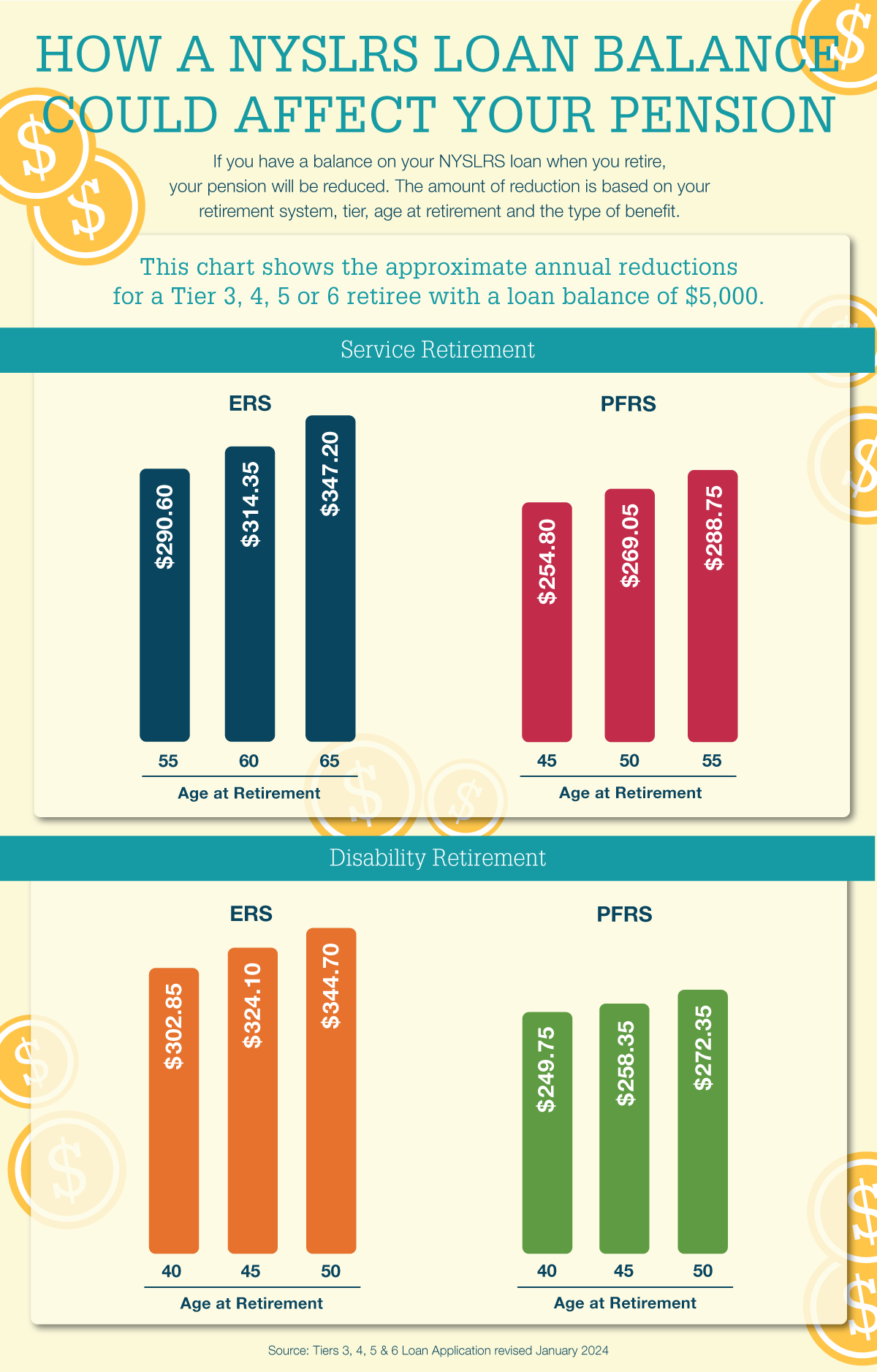
If you have an outstanding NYSLRS loan balance when you retire, it will reduce your pension. The amount of the reduction is based on:

  • Your retirement system—Employees’ Retirement System (ERS) or Police and Fire Retirement System (PFRS);
  • Your tier;
  • Your age at retirement; and
  • Whether you retire with a service retirement benefit or a disability retirement benefit.
Debt and Retirement: How a NYSLRS Loan Balance Could Affect Your Pension

It is important to understand:

  • The reduction does not go toward repaying the outstanding loan balance—it’s a permanent reduction to your pension.
  • At least part of the loan balance at retirement will be subject to federal income taxes.

When you apply for retirement in Retirement Online and have an outstanding NYSLRS loan balance, the system will provide a specific pension reduction amount for you. The loan applications on our Forms page also list general pension reduction information.

If you are close to retirement, be sure to check your loan balance. If it looks like you won’t repay your loan before you retire, you can increase your loan payments, make additional lump sum payments or both (see the Change Your Payroll Deductions or Make Lump Sum Payments section of our Loans: Applying and Repaying page).

ERS members may repay a loan after retiring. They must pay the full balance that was due at retirement in a single lump sum payment. Once they repay the loan, their pension will increase to the amount it would have been without the loan reduction. It will not increase retroactively back to the date of retirement.

Other Debt to Check

Credit Cards

Another priority should be paying off credit cards before retirement. Credit card statements include a warning telling you how long it will take—and how much it will cost—to pay off your balance making only minimum payments.

If you have more than one credit card balance, many financial advisors recommend paying as much as you can on the card with the highest interest rate, while still making at least the minimum payments on your lower-interest cards. Once you’ve paid off your highest-interest card, focus on the one with the next-highest rate, and so on. Other advisors say it might be better to pay off the card with the smallest balance first. The idea there is to gain a sense of accomplishment, and make the process seem less daunting.

Mortgages

Advice varies on whether you should try to pay off your mortgage before you retire. It would eliminate a major expenditure and let you spend your retirement income on other things. On the other hand, if your mortgage interest rate is relatively low, you may want to focus on paying off other high-interest debt or boosting your retirement savings. What works best for you will depend on your situation.

Can You Change Your Beneficiary After You Retire?

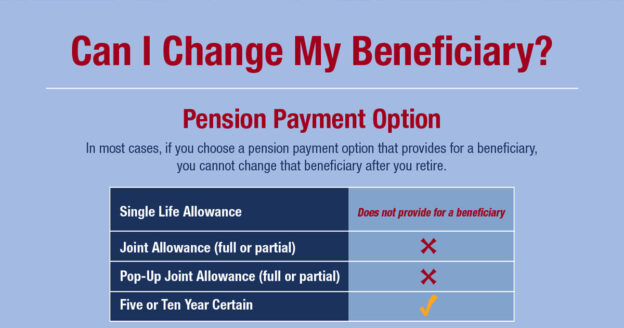
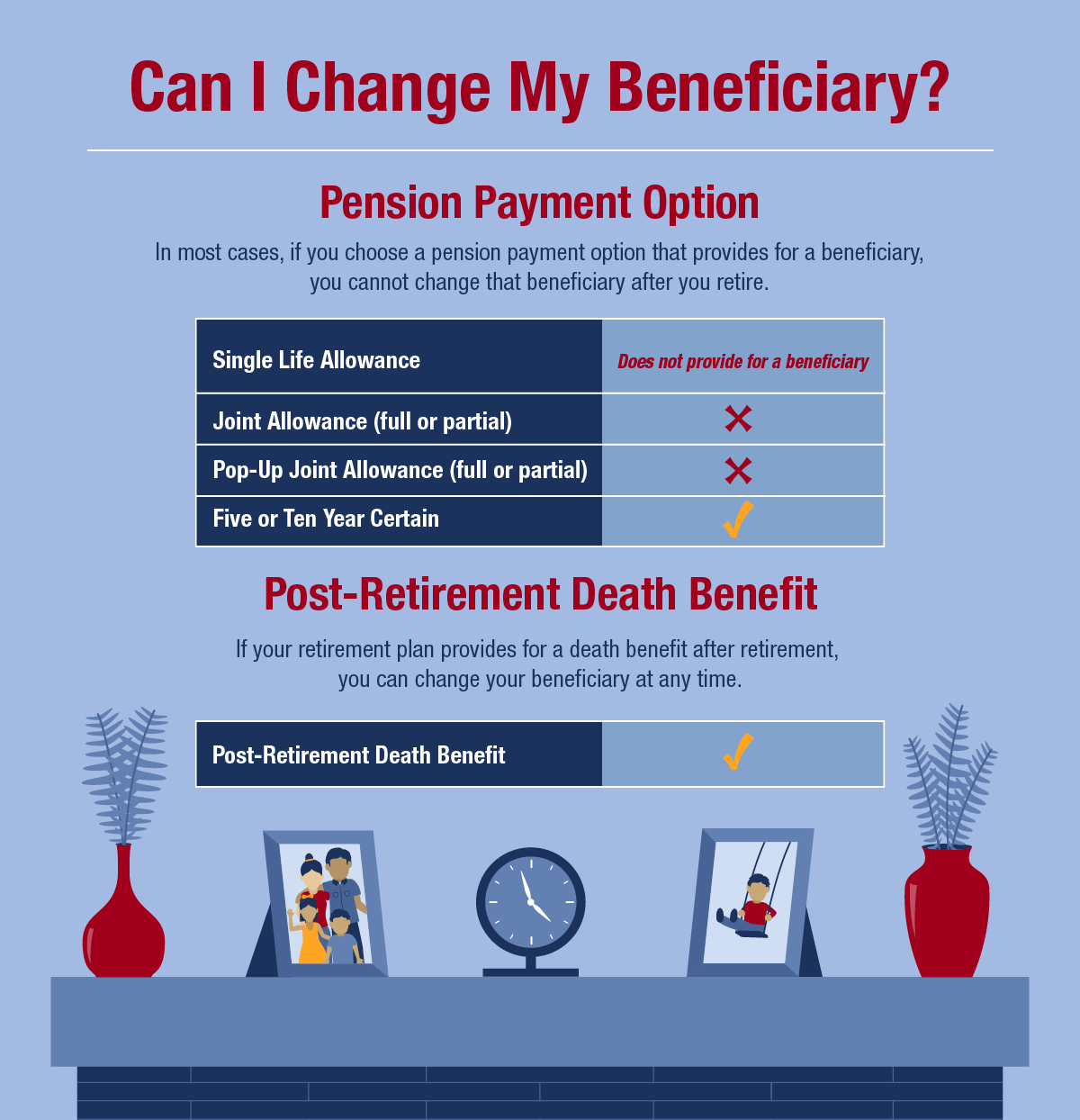
That depends. If you choose a pension payment option that provides a lifetime benefit for a beneficiary, you cannot change your beneficiary even if they die before you do. However, if you choose a pension payment option that provides a benefit for a certain period after retirement, you can change your beneficiary after you retire. Learn more about the different pension payment options and whether they allow you to change your beneficiary below.

If your retirement plan provides a one-time lump sum death benefit after you retire, you can also change your beneficiary (or beneficiaries) for that benefit.

Can You Change Your Beneficiary After You Retire?

Available Pension Payment Options

At retirement, you will choose a pension payment option:

  • Single Life Allowance option: Provides the maximum monthly benefit payment to you for the rest of your life. This option does not provide a continuing benefit so you will not select a beneficiary, and all payments stop when you die.
  • Joint Allowance options: Provide a lifetime benefit to a loved one in exchange for a reduction to your monthly benefit payment. After your death, your beneficiary will continue to receive your pension (or part of it, depending on the option you choose) for the rest of their life. If your beneficiary dies before you, your monthly benefit payment remains the same and all payments stop when you die. However, if you choose one of the Popup-Up/Joint Allowance options and your beneficiary predeceases you, your monthly benefit payments will increase to the amount payable under the Single Life Allowance option. For these options, you can only choose one beneficiary, and you cannot change your beneficiary after you retire.
  • Five Year Certain or Ten Year Certain options: Provide a benefit for a certain period after retirement in exchange for a reduction to your monthly benefit payment. If you die within the five- or ten-year period after your retirement (depending on the option you choose), your beneficiary will continue to receive your monthly pension payment for the remainder of the five- or ten-year period. For these options, you can choose more than one beneficiary, and you can change your beneficiary after you retire.

Post-Retirement Death Benefit

Your pension is not your only NYSLRS retirement benefit. Most NYSLRS retirees are eligible to leave a death benefit if they retired directly from payroll or within one year of leaving employment. The post-retirement death benefit is a one-time lump sum payment. For information on how it’s calculated, visit our Death Benefits for Retirees page.

You can change your beneficiary for this benefit at any time, and your beneficiaries for this benefit do not have to be the same as your pension payment option beneficiary.

Manage Your Beneficiaries in Retirement Online

The fastest way to view or update your beneficiaries for your post-retirement death benefit is in Retirement Online.

You should also review the contact information for your beneficiaries so we can find them when needed.

ERS Tier 3 and 4 Milestones

When you join the Employees’ Retirement System (ERS), you are assigned a tier based on your date of membership. You are in:

  • Tier 3 if you joined July 27, 1976 through August 31, 1983.
  • Tier 4 if you joined September 1, 1983 through December 31, 2009.

Let’s look at the ERS Tier 3 and 4 milestones and how they affect your benefits.

Why Milestones Matter

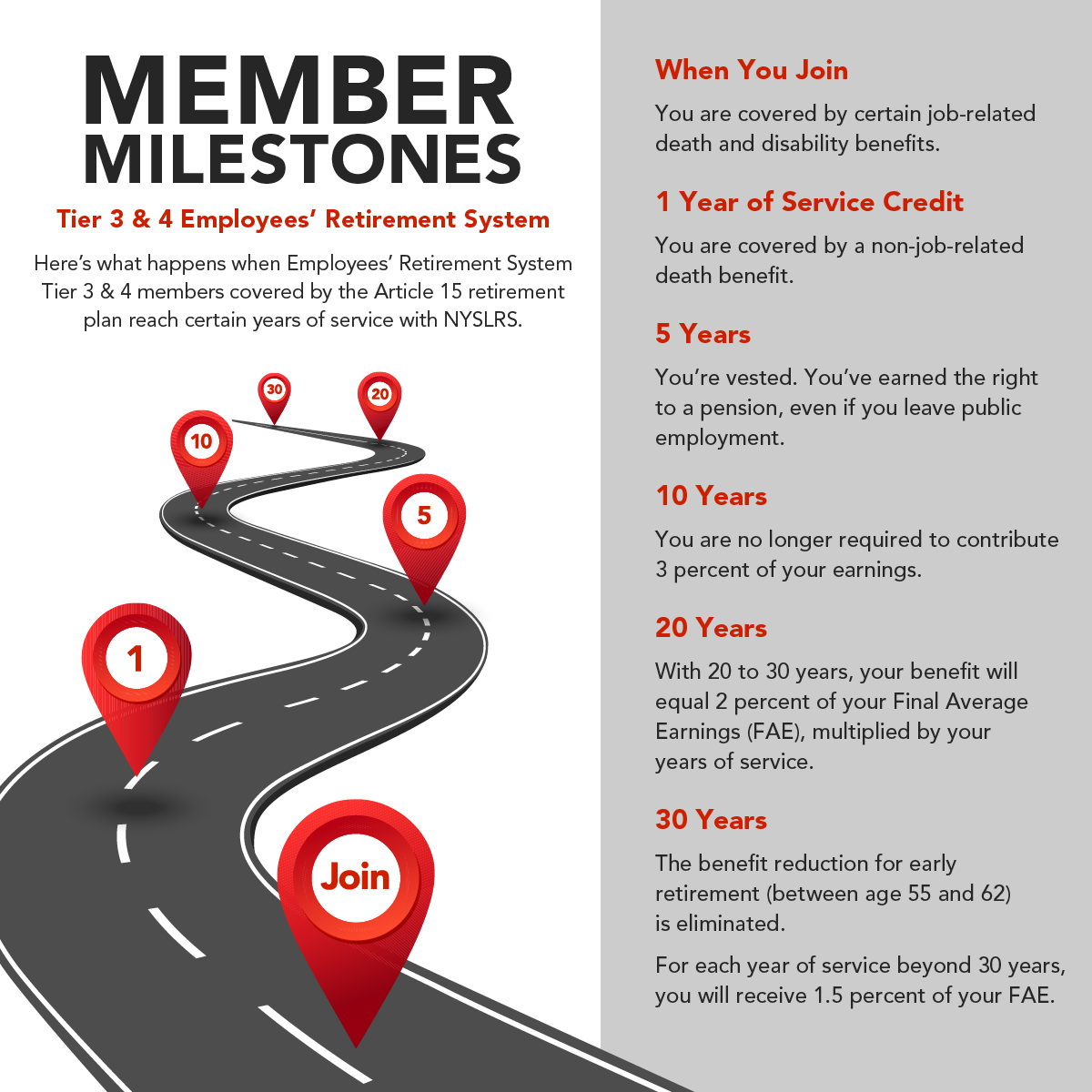
As a NYSLRS member, you earn service credit for your paid public employment. Generally, one year of full-time work equals one year of service credit. As you earn service credit, you’ll reach career milestones that will make you eligible for certain benefits or for increases to your existing benefits. Understanding these milestones can help you plan for retirement.

Your ERS Tier 3 and 4 milestones and pension calculation depend on your retirement plan, so it is important to familiarize yourself with the details of your plan. Most ERS Tier 3 and 4 members are in the Article 15 retirement plan (named for a section of the New York State Retirement and Social Security Law). If you see Plan A15 listed in the ‘My Account Summary’ section of your Retirement Online account, you’re in this plan. For members not covered by the Article 15 retirement plan, visit our website to Find Your NYSLRS Retirement Plan Publication.

Important ERS Tier 3 and 4 Milestones

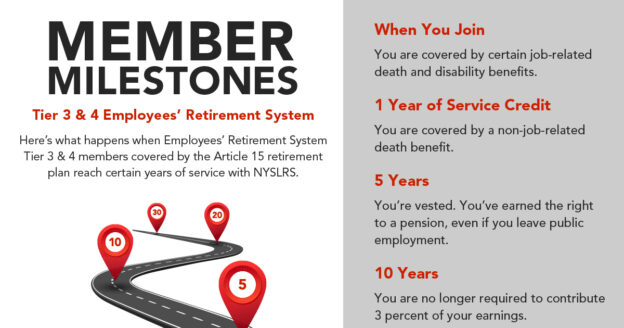
ERS Tier 3 and 4 member milestones

Here are some additional important milestones for Tier 3 and 4 members in the Article 15 retirement plan:

  • With ten years of service credit, you can apply for a non-job-related disability benefit if you are permanently disabled and cannot perform your duties because of a physical or mental condition.
  • With ten years of service credit, your beneficiaries may be eligible for an out-of-service death benefit if you leave public employment and die before retirement.
  • Ten years also marks the point when you are no longer able to withdraw your membership and receive a refund of your contributions if you leave public employment.
  • You are eligible to retire once you are age 55 and have five years of service credit. However, for most Tier 3 and 4 members, there would be reductions to your benefit if you retire before age 62 with less than 30 years of service credit.
  • You can retire with full benefits at age 62.
    • If you retire with less than 20 years of service, your pension will equal 1.66 percent of your final average earnings (FAE) for each year of service.
    • If you retire with 20 to 30 years of service, your pension will equal 2 percent of your FAE for each year of service.
    • For each year of service beyond 30 years, you will receive 1.5 percent of your FAE.

Note: When you retire, your FAE will be based on the average of your three highest consecutive years of earnings. The law limits the FAE of all members who joined on or after June 17, 1971. Read our blog post, Calculating Your Final Average Earnings, for more information, including how your FAE will be calculated and limitations.

Most members can estimate their pension in Retirement Online. You can fine tune your estimate by entering your annual earnings and expected pay increases. You can also include any service credit you plan to purchase.

ERS Tier 5 Milestones

If you joined the Employees’ Retirement System (ERS) on or after January 1, 2010, but before April 1, 2012, you are a Tier 5 member. Let’s look at the ERS Tier 5 milestones you will reach over the course of your public service career and how they will affect your benefits.

Why Milestones Matter

As a NYSLRS member, you earn service credit for your paid public employment. Generally, one year of full-time work equals one year of service credit. As you earn service credit, you’ll reach career milestones that will make you eligible for certain benefits or for increases to your existing benefits. Understanding these milestones will help you plan for retirement.

Your ERS Tier 5 milestones and pension calculation depend on your retirement plan, so it is important to familiarize yourself with the details of your plan. Most ERS Tier 5 members are in the Article 15 retirement plan (named for a section of the New York State Retirement and Social Security Law). If you see Plan A15 listed in the ‘My Account Summary’ section of your Retirement Online account, you’re in this plan. For members not covered by the Article 15 retirement plan, visit our website to Find Your NYSLRS Retirement Plan Publication.

Important ERS Tier 5 Milestones

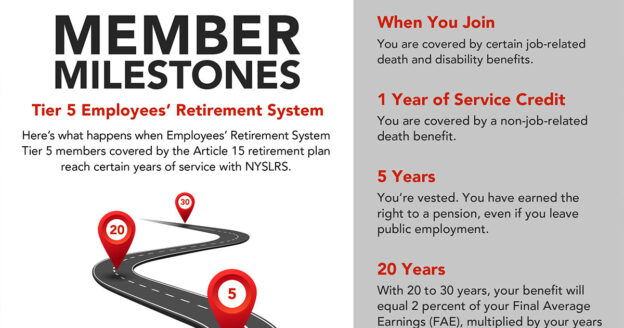
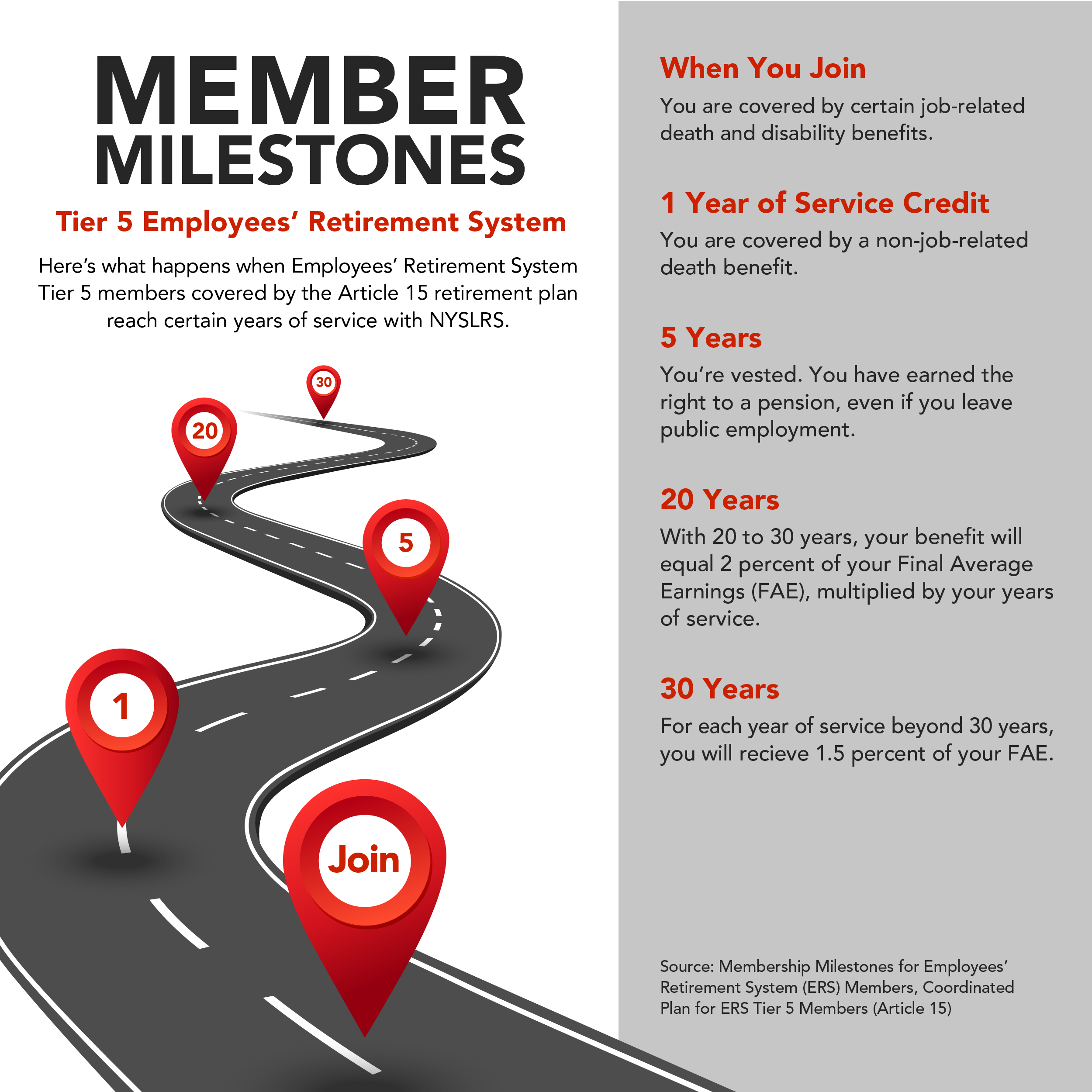
ERS Tier 5 milestones

Here are some additional important milestones for Tier 5 members in the Article 15 retirement plan:

  • With ten years of service credit, you can apply for a non-job-related disability benefit if you are permanently disabled and cannot perform your duties because of a physical or mental condition.
  • With ten years of service credit, your beneficiaries may be eligible for an out-of-service death benefit if you leave public employment and die before retirement.
  • Ten years also marks the point when you are no longer able to withdraw your membership and receive a refund of your contributions if you leave public employment.
  • You are eligible to retire once you are age 55 and have at least five years of service credit. However, for most Tier 5 members, there would be reductions to your benefit if you retire before age 62.
  • You can retire with full benefits at age 62.
    • If you retire with less than 20 years of service, your pension will equal 1.66 percent of your final average earnings (FAE) for each year of service.
    • If you retire with 20 to 30 years of service, your pension will equal 2 percent of your FAE for each year of service.
    • For each year of service beyond 30 years, you will receive 1.5 percent of your FAE.

Note: When you retire, your FAE will be based on the average of your three highest consecutive years of earnings. The law limits the FAE of all members who joined on or after June 17, 1971. Read our blog post, Calculating Your Final Average Earnings, for more information, including how your FAE will be calculated and limitations.

Most members can estimate their pension in Retirement Online. You can fine tune your estimate by entering your annual earnings and expected pay increases. You can also include any service credit you plan to purchase.