Category Archives: Members

News for members of the New York State & Local Retirement System

Supplement Your NYSLRS Pension with Retirement Savings

As a NYSLRS member, you are enrolled in something increasingly rare these days: a defined benefit plan. If you are vested and retire from NYSLRS, you will receive monthly pension payments for the rest of your life based on your years of service and earnings. Your NYSLRS pension can provide a significant part of your retirement income, but it’s a good idea to supplement your pension and Social Security with a retirement savings account.

Additional retirement savings can give you flexibility to travel, continue your education, pursue a hobby or start a business. It can be a resource in case of an emergency or act as a hedge against inflation.

Your Retirement Savings Goal

How much you save is a personal decision. You can  estimate your pension in Retirement Online to get an idea of the income it will provide in retirement. Use a retirement savings calculator to see how much a retirement savings plan could yield over time. Test the results with different savings amounts.

Below you can see the potential savings of someone who invests 50 dollars every two weeks for 30 years. While the stock market can be turbulent in the short term, in the long term, it returns on average about 10 percent a year as measured by the S&P 500 index.
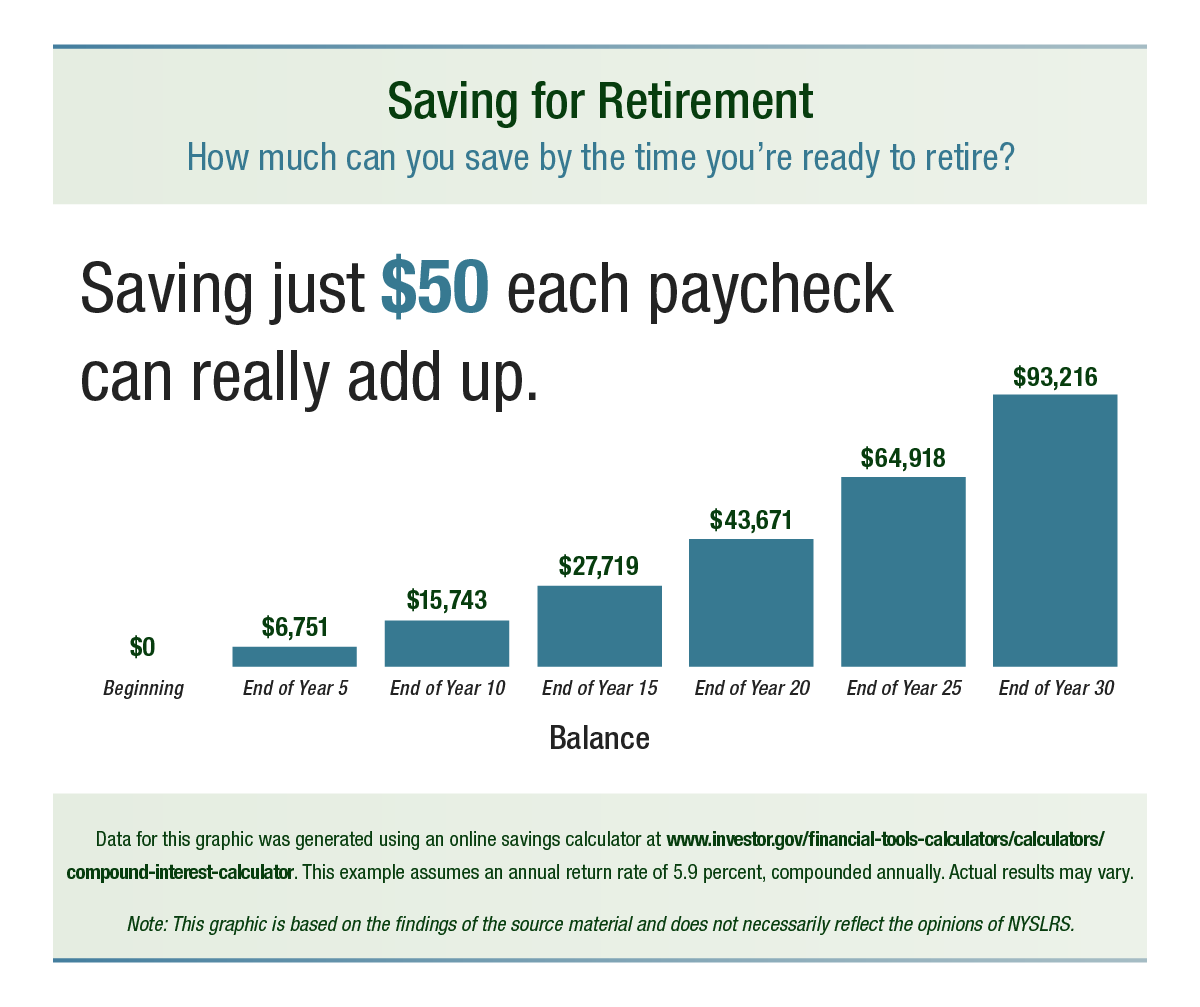
saving for retirement

As you get closer to retirement, you should develop a plan to withdraw money from your savings. That will give you a better idea of the income you might expect from your nest egg and a sense of how long it will last.

Here is one possible withdrawal strategy, which provides retirement income for 20 years. Please note, if your retirement is far in the future, the money you withdraw may not have the same value that it would have today.
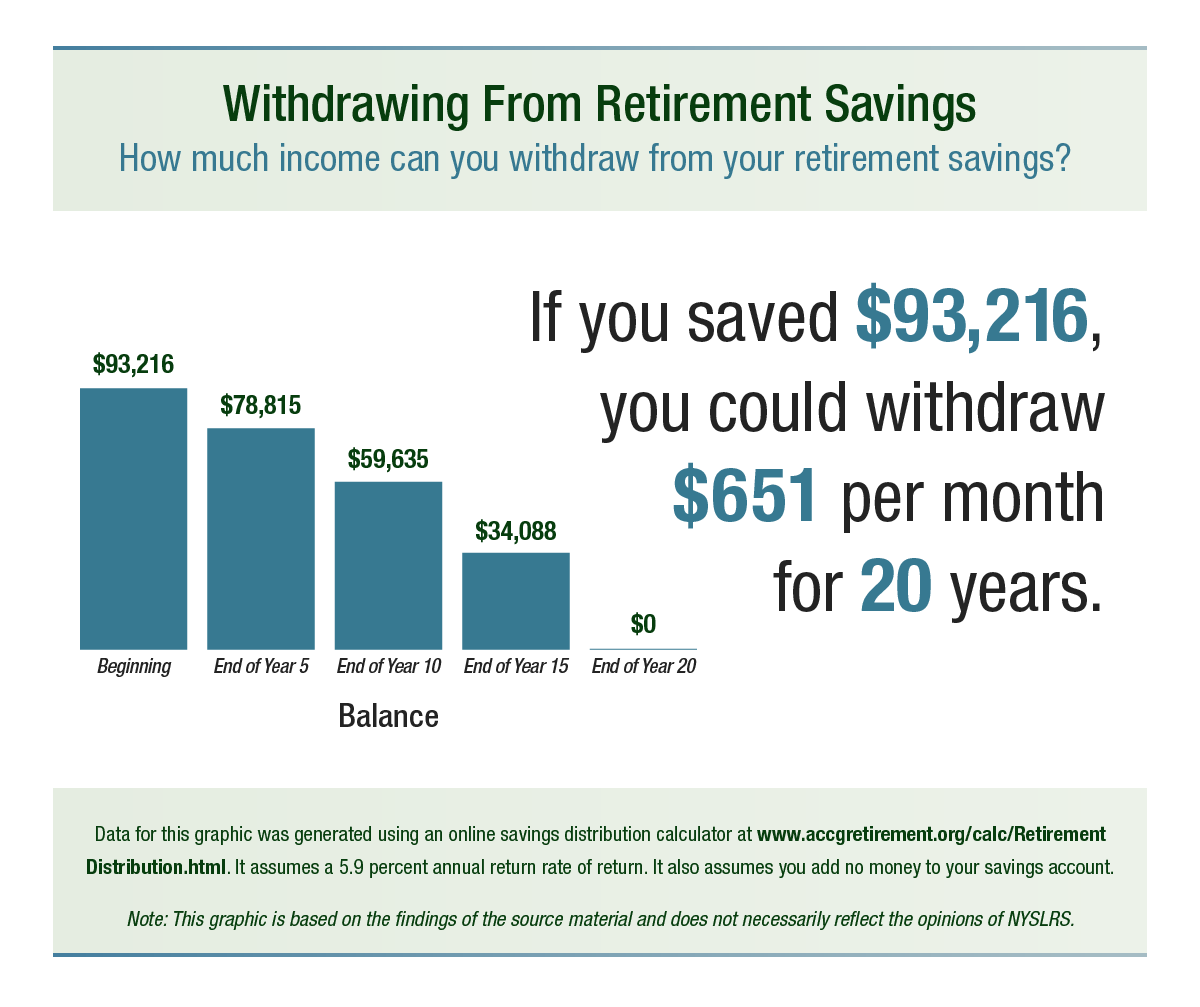
withdrawing income

If you find you’ll need to save more to meet your goal, you can make adjustments to help ensure you’ll have enough savings in retirement.

Note: Generally, whatever your withdrawal strategy, federal law will eventually require you withdraw a certain amount each year from any tax-deferred retirement plan account. These are called required minimum distributions.

New York State Deferred Compensation Plan

One way State employees and many municipal employees can save for retirement is through the New York State Deferred Compensation Plan (NYSDCP). Once you’ve signed up, your retirement savings—which may be tax-deferred depending on the plan you choose—will be automatically deducted from your paycheck.

Check with your employer’s human resources or personnel office to see whether they participate in NYSDCP or if they offer other savings options. (NYSDCP is not affiliated with NYSLRS.)

Read More About Retirement Savings

When it comes to saving for retirement, there’s a lot to consider. You can find more information in these posts:
Debt and Retirement

If you’re planning to retire soon, it’s a good idea to take inventory of any debt you owe. Paying down your debt can give you flexibility to enjoy the type of retirement you want.

NYSLRS Loan Debt

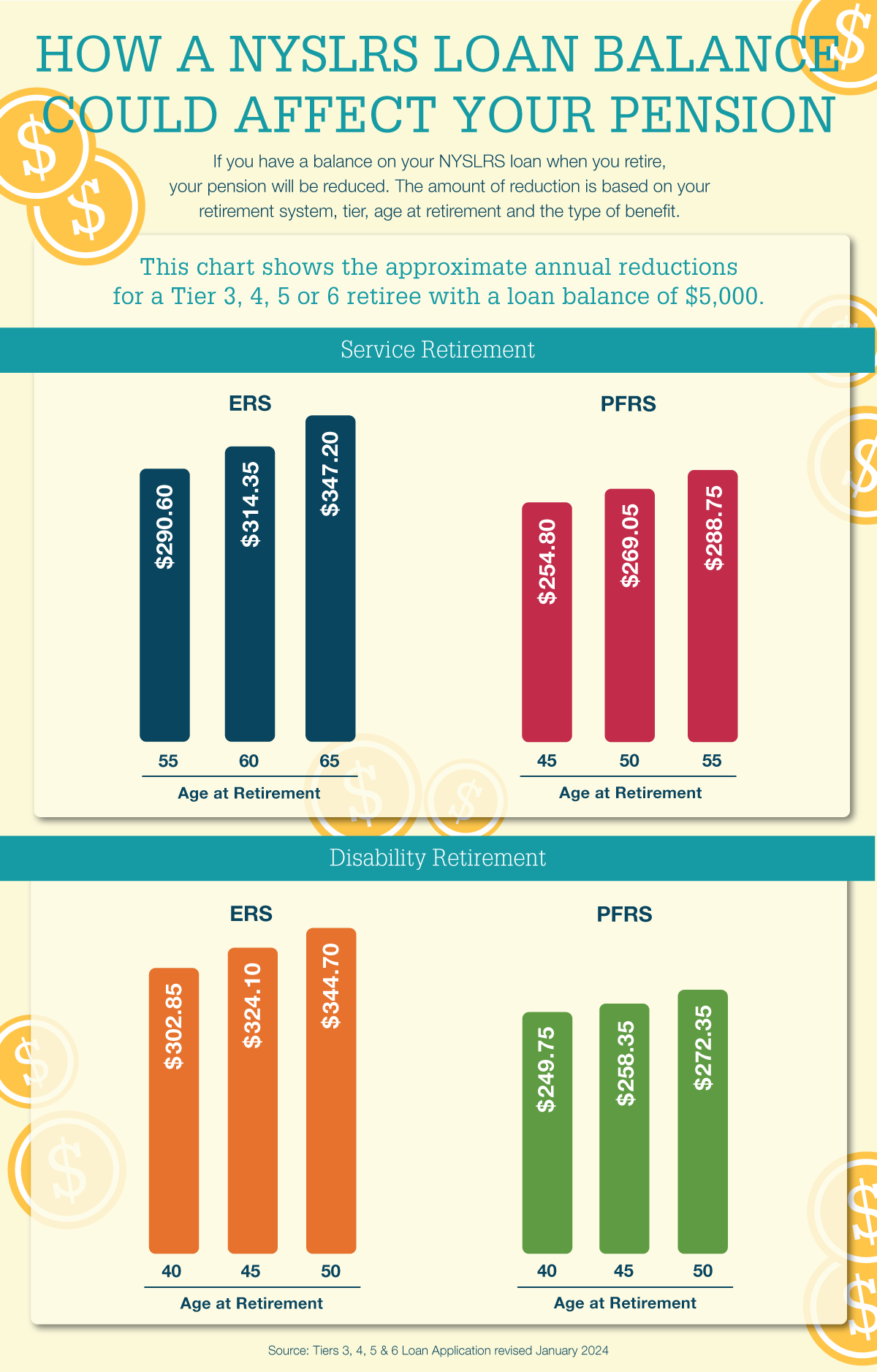
If you have an outstanding NYSLRS loan balance when you retire, it will reduce your pension. The amount of the reduction is based on:

  • Your retirement system—Employees’ Retirement System (ERS) or Police and Fire Retirement System (PFRS);
  • Your tier;
  • Your age at retirement; and
  • Whether you retire with a service retirement benefit or a disability retirement benefit.
Debt and Retirement: How a NYSLRS Loan Balance Could Affect Your Pension

It is important to understand:

  • The reduction does not go toward repaying the outstanding loan balance—it’s a permanent reduction to your pension.
  • At least part of the loan balance at retirement will be subject to federal income taxes.

When you apply for retirement in Retirement Online and have an outstanding NYSLRS loan balance, the system will provide a specific pension reduction amount for you. The loan applications on our Forms page also list general pension reduction information.

If you are close to retirement, be sure to check your loan balance. If it looks like you won’t repay your loan before you retire, you can increase your loan payments, make additional lump sum payments or both (see the Change Your Payroll Deductions or Make Lump Sum Payments section of our Loans: Applying and Repaying page).

ERS members may repay a loan after retiring. They must pay the full balance that was due at retirement in a single lump sum payment. Once they repay the loan, their pension will increase to the amount it would have been without the loan reduction. It will not increase retroactively back to the date of retirement.

Other Debt to Check

Credit Cards

Another priority should be paying off credit cards before retirement. Credit card statements include a warning telling you how long it will take—and how much it will cost—to pay off your balance making only minimum payments.

If you have more than one credit card balance, many financial advisors recommend paying as much as you can on the card with the highest interest rate, while still making at least the minimum payments on your lower-interest cards. Once you’ve paid off your highest-interest card, focus on the one with the next-highest rate, and so on. Other advisors say it might be better to pay off the card with the smallest balance first. The idea there is to gain a sense of accomplishment, and make the process seem less daunting.

Mortgages

Advice varies on whether you should try to pay off your mortgage before you retire. It would eliminate a major expenditure and let you spend your retirement income on other things. On the other hand, if your mortgage interest rate is relatively low, you may want to focus on paying off other high-interest debt or boosting your retirement savings. What works best for you will depend on your situation.

Can You Change Your Beneficiary After You Retire?

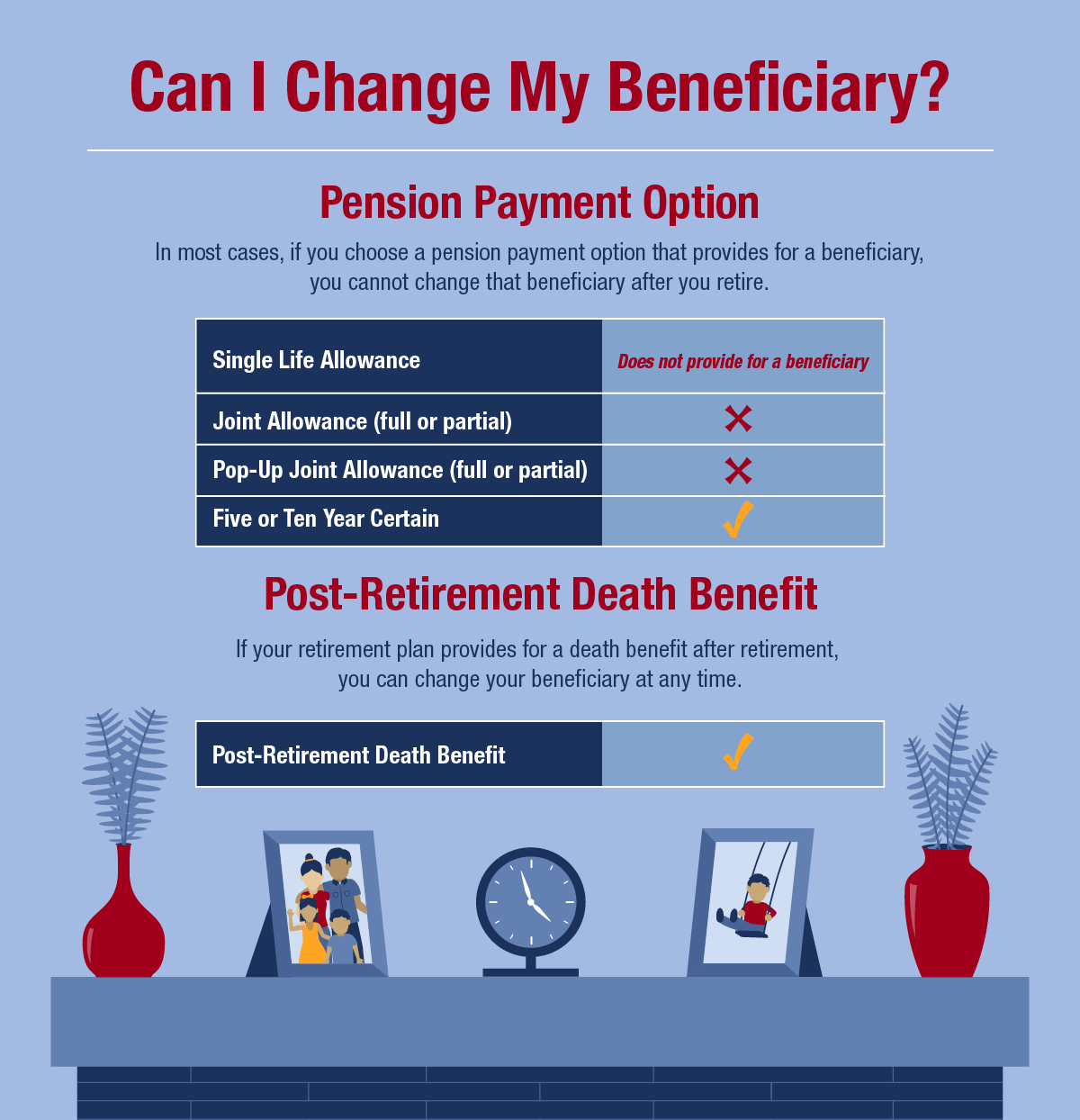
That depends. If you choose a pension payment option that provides a lifetime benefit for a beneficiary, you cannot change your beneficiary even if they die before you do. However, if you choose a pension payment option that provides a benefit for a certain period after retirement, you can change your beneficiary after you retire. Learn more about the different pension payment options and whether they allow you to change your beneficiary below.

If your retirement plan provides a one-time lump sum death benefit after you retire, you can also change your beneficiary (or beneficiaries) for that benefit.

Can You Change Your Beneficiary After You Retire?

Available Pension Payment Options

At retirement, you will choose a pension payment option:

  • Single Life Allowance option: Provides the maximum monthly benefit payment to you for the rest of your life. This option does not provide a continuing benefit so you will not select a beneficiary, and all payments stop when you die.
  • Joint Allowance options: Provide a lifetime benefit to a loved one in exchange for a reduction to your monthly benefit payment. After your death, your beneficiary will continue to receive your pension (or part of it, depending on the option you choose) for the rest of their life. If your beneficiary dies before you, your monthly benefit payment remains the same and all payments stop when you die. However, if you choose one of the Popup-Up/Joint Allowance options and your beneficiary predeceases you, your monthly benefit payments will increase to the amount payable under the Single Life Allowance option. For these options, you can only choose one beneficiary, and you cannot change your beneficiary after you retire.
  • Five Year Certain or Ten Year Certain options: Provide a benefit for a certain period after retirement in exchange for a reduction to your monthly benefit payment. If you die within the five- or ten-year period after your retirement (depending on the option you choose), your beneficiary will continue to receive your monthly pension payment for the remainder of the five- or ten-year period. For these options, you can choose more than one beneficiary, and you can change your beneficiary after you retire.

Post-Retirement Death Benefit

Your pension is not your only NYSLRS retirement benefit. Most NYSLRS retirees are eligible to leave a death benefit if they retired directly from payroll or within one year of leaving employment. The post-retirement death benefit is a one-time lump sum payment. For information on how it’s calculated, visit our Death Benefits for Retirees page.

You can change your beneficiary for this benefit at any time, and your beneficiaries for this benefit do not have to be the same as your pension payment option beneficiary.

Manage Your Beneficiaries in Retirement Online

The fastest way to view or update your beneficiaries for your post-retirement death benefit is in Retirement Online.

You should also review the contact information for your beneficiaries so we can find them when needed.

Your NYSLRS Pension—A Defined Benefit Plan

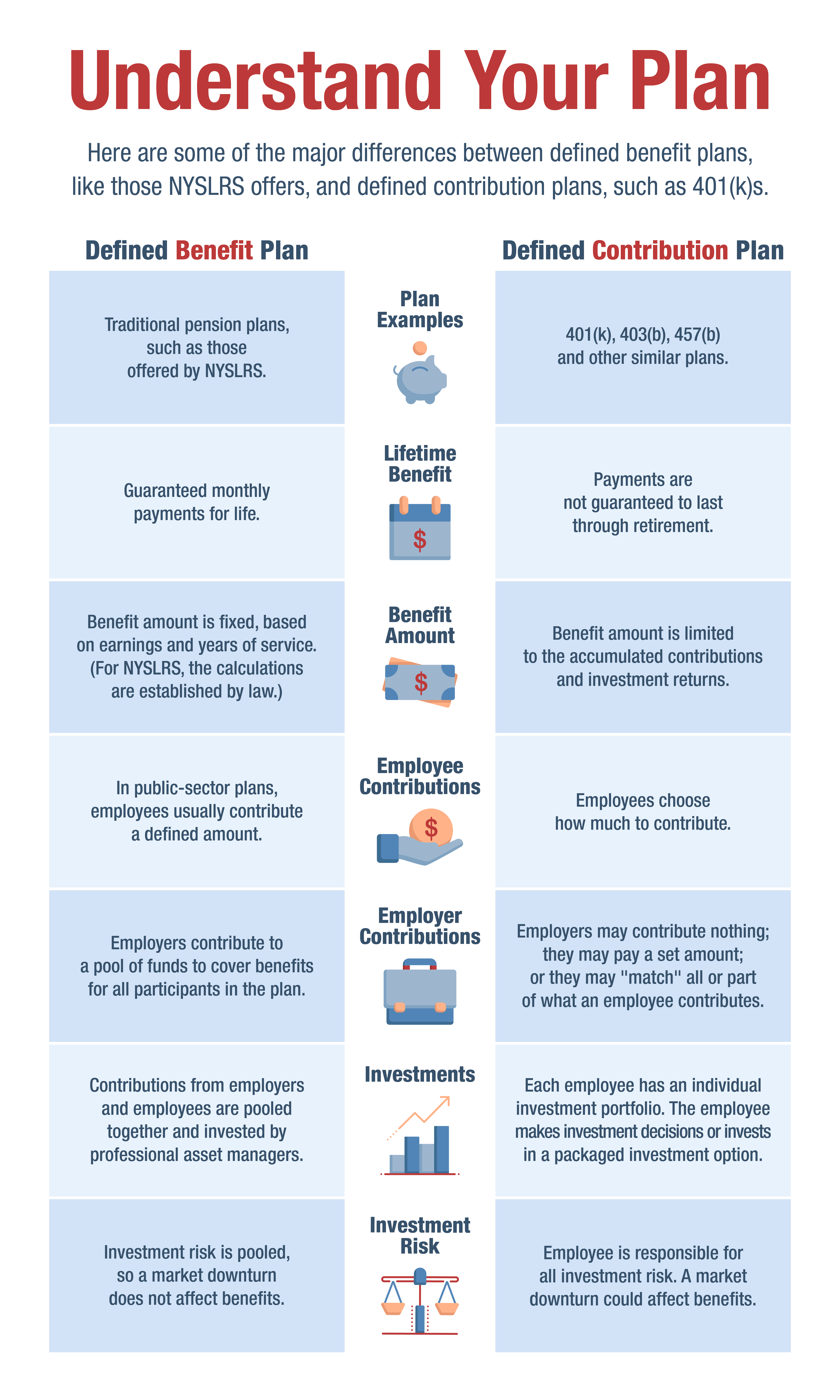
As a NYSLRS member, you are enrolled in a defined benefit plan, also known as a traditional pension plan.

If you are vested and retire from NYSLRS, you will receive a monthly pension payment for the rest of your life. Your pension will be calculated using a preset formula based on your earnings and years of service—it will not be based on the individual contributions you paid into the system.

Member contributions support the benefits earned by current and future retirees and are an important asset of the Common Retirement Fund.

Defined benefit plans are supported by contributions from both members and employers. With defined benefit plans, retirement assets are pooled and the investment risk is shared. These plans are usually administered by professional managers, whose long-term investment strategies help to reduce the impact of market turmoil. NYSLRS employs an experienced group of investment managers.

The New York State Common Retirement Fund, which holds and invests the assets of NYSLRS, is one of the largest public pension plans in the United States, providing retirement security for over 1.2 million NYSLRS members, retirees and beneficiaries. The Fund has consistently been ranked as one of the best managed and best funded plans in the nation.

understand your defined benefit plan

Defined Contribution Plans—And Their Risks

Defined benefit plans are often confused with 401(k)-style retirement savings plans, which are known as defined contribution plans.

With a defined contribution plan, the employee, the employer or both contribute to an individual retirement account for the employee, and the money in the account is invested. In most cases, the employee decides how and where the money is invested (or the plan may offer pre-packaged investment options). At retirement, the employee will be able to draw from the accumulated value of contributions and investment returns, minus any fees.

The amount of money the employee has at retirement often relies on the investment returns of the individual account. So, market downturns, especially near retirement, can negatively affect the value of the benefit. Employees depending on defined contribution plans run the risk of outliving their savings.

NYSLRS’ Defined Benefit Plans

We administer nearly 300 retirement plan combinations. NYSLRS retirement plans:

  • Provide a guaranteed benefit for life.
  • Offer a pension based on final average earnings and years of service.
  • Provide a right to pension benefits (vesting) with five years of service credit.
  • Build a cost-of-living adjustment (COLA) into pensions to help offset the effect of inflation.
  • Include disability retirement and death benefits.

We strongly encourage you to review your retirement plan publication for a complete description of your benefits. Visit our Find Your NYSLRS Retirement Plan Publication page and follow the steps listed.

Calculating Your Final Average Earnings

As a NYSLRS member, you have a defined benefit plan that provides a lifetime pension when you retire. Your NYSLRS pension benefit amount will be determined by several factors, including your tier, service credit, and final average earnings (FAE).

When we calculate your pension, we find the consecutive years when your earnings were highest. These are usually your years of employment immediately before retirement, but they can be anytime in your career and do not need to match up with calendar years or fiscal years.

Update: Tier 6 Final Average Earnings Based on Highest Three Years

A new law improves the pension benefits of NYSLRS Tier 6 members. When you retire, your FAE will be based on the average of your three highest consecutive years of earnings, the same as members in other tiers.

These improvements apply to members who retire on or after:

  • April 1, 2024, for Police and Fire Retirement System (PFRS) Tier 6.
  • April 20, 2024, for Employees’ Retirement System (ERS) Tier 6.

Previously, your FAE was the average of your highest five consecutive years of earnings.

If you recently retired and the change applies to you, we have updated your pension calculation — you don’t need to contact us. The new law does not apply to members who retired before the dates above.

Understanding Final Average Earnings Limits

If your earnings increase significantly through the years used in your FAE, some of those earnings may not be used toward your pension.

Your limit depends on whether you’re an ERS or PFRS member and your tier. For most members, if the earnings in any 12-month period in your FAE exceed the average of the previous two years by more than 10 percent, the amount above 10 percent will not be included in your FAE calculation.

Calculating Your Final Average Earnings

For more information, including limits for other tiers, visit our Final Average Earnings page.

Types of Earnings Included in Your FAE

The specific types of earnings included in your FAE calculation depend on your retirement plan and tier. Please check your plan publication for details.

In most cases, your FAE will include the payments listed below, if they are earned in the FAE period. (In some cases, restrictions may apply.)

In most cases, the following payments will not be included in your FAE calculation:

  • Unused sick leave;
  • Payments made as a result of working your vacation;
  • Any form of termination pay;
  • Payments made in anticipation of retirement; and
  • Any payments made for time not worked.

Where Are Your Important Documents?

We accumulate a lot of important documents over a lifetime — things such as birth certificates, diplomas, deeds, wills, insurance policies and more. If you’re like many people, you may have papers stuffed in drawers, filing cabinets or boxes in the attic. If you need an important document, will you be able to find it? What’s more, when you pass away, will your loved ones be able to find what they need?
where are your important documents?

Organize Your Important Documents

Important documents should be kept in a secure but accessible place in your home. This includes personal documents, such as your passport, birth certificate, marriage certificate, will and burial instructions. You should also include information about your NYSLRS retirement benefits, income taxes, bank accounts, credit cards and online accounts. Important contact information, such as the names and phone numbers of your attorney, accountant, stockbroker, financial planner, insurance agent and executor of your will should also kept in a secure location.

Our fillable form, Where My Assets Are, can help make organizing your important documents a little easier. It will help you or your loved ones locate these documents when they are needed. It’s a good idea to review and update this information regularly.

Be aware that a safe deposit box may be sealed when you die. Don’t keep burial instructions, power of attorney or your will in a safe deposit box, because these items may not be available until a probate judge orders the box to be opened. However, a joint lessee of the box, or someone authorized by you, would be permitted to open the box to examine and copy your burial instructions.

Review Death Benefits and Beneficiary Designations

Depending on your tier and retirement plan, your beneficiaries may be eligible to receive a death benefit. Visit our member and retiree death benefit pages for more information.

Then, sign in to your Retirement Online account to review your named beneficiaries and update their contact information if needed. From your Account Homepage, click “View and Update My Beneficiaries” to get started.

Please note, when a NYSLRS member or retiree dies, it is important that survivors report the death to NYSLRS as soon as possible. Before any death benefits can be processed or paid, NYSLRS will need an original, certified death certificate.

Crunching the Numbers: A Short Guide to Retirement Calculators

A good estimate of your post-retirement income is essential for effective retirement planning. But gauging your income can be tricky when it comes from multiple sources. Fortunately, there are a variety of online calculators that can help you get started.

online calculators for retirement planning

NYSLRS Benefit Calculator

Most NYSLRS members can quickly create a pension estimate using Retirement Online. Your estimate will be based on the most up-to-date account information we have on file for you. You can enter different retirement dates to see how those choices would affect your benefit and adjust your earnings or service credit if you anticipate a raise or plan to purchase past service.

Social Security Calculators

The Social Security Administration (SSA) hosts several calculators that you may find helpful. Their Quick Calculator uses information you enter to provide a rough Social Security benefit estimate. Their Retirement Estimator calculates your benefit based on your actual earnings. You’ll need to enter your Social Security number and other personal information to create an SSA account. 

You can also look up when you will be eligible for full Social Security benefits and estimate your life expectancy.

Savings Calculators

If you are saving for retirement, a simple savings calculator can give you an idea of how your money can grow over the years. However, simple calculators like this assume a fixed amount of savings each month. Most people increase their retirement savings as their income grows.

If you have a 457(b) plan like those offered by the New York State Deferred Compensation Plan, you can use their interactive retirement planner to project a hypothetical view of what your retirement may look like based on information you provide

Savings Withdrawal Calculators

Savings withdrawal calculators are designed to help determine how much savings remains after a series of withdrawals. These are especially helpful tools to use when trying to determine how long your retirement savings will last, based on a starting amount, how much you expect to withdraw, how often and some other factors.

How Much Do You Need?

Now that you’ve estimated your potential sources of retirement income, it’s important to understand your anticipated expenses in retirement. Our Income and Expenses Worksheet can help you create a post-retirement budget.

Think of retirement security as a three-legged stool, with your NYSLRS pension, social security benefit and retirement savings working together to provide financial stability. Your NYSLRS pension is a defined benefit, or traditional pension, that will provide you with a monthly payment for the rest of your life. Having a retirement savings account can give you more flexibility to do the things you want to do, or provide a source of cash in case of an emergency. Start saving for retirement if you haven’t already, or give your retirement savings a boost.

NYSLRS – One Tier at a Time: PFRS Tier 2

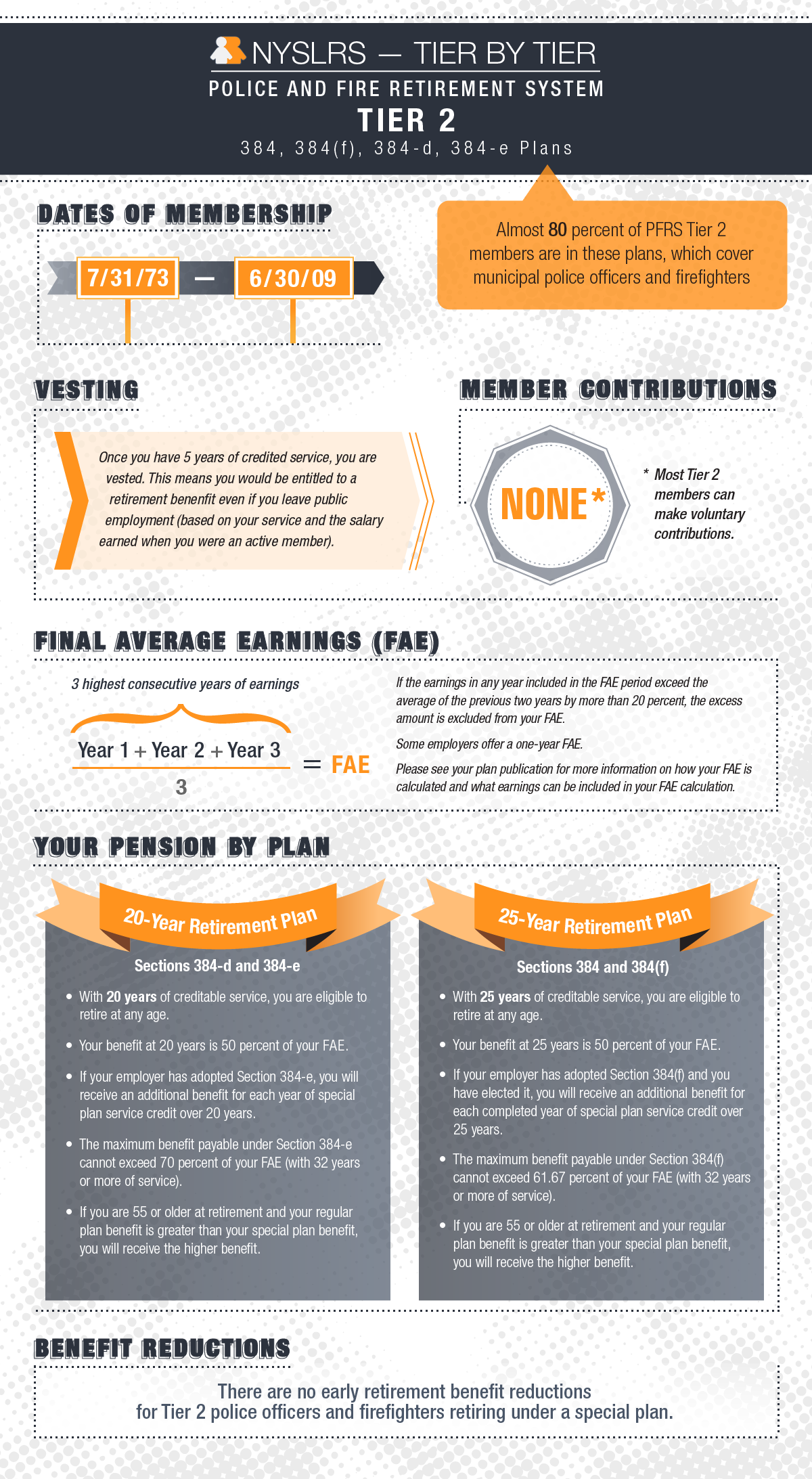
When you join the New York State and Local Retirement System (NYSLRS), you’re assigned a tier based on the date of your membership. This post looks at Tier 2 members of the Police and Fire Retirement System (PFRS).

Your tier determines such things as your eligibility for benefits, the calculation of those benefits, death benefit coverage and whether you need to contribute toward your benefits.

PFRS has five tiers. Almost half of PFRS members are in Tier 2, which began on July 31, 1973, and ended on June 30, 2009. Most are in special retirement plans that allow for retirement after 20 or 25 years, regardless of age, without penalty.

The special plans that cover most police officers and firefighters fall under Sections 384, 384(f), 384-d, and 384-e of Retirement and Social Security Law. You can sign in to Retirement Online to find your benefit plan, which is listed under ‘My Account Summary.’

PFRS Tier 2

Where to Find PFRS Tier 2 Information

Whether you’re in one of the retirement plans described in this post or another retirement plan, we encourage you to visit our website to find your NYSLRS retirement plan publication. It’s a comprehensive description of the benefits you’re entitled to receive as a PFRS member.

You can check your service credit total and estimate your pension using Retirement Online. Most members can use our online pension calculator to create an estimate based on the salary and service information NYSLRS has on file for them. You can enter different retirement dates to see how your choices would affect your potential benefit.

Members may not be able to use the Retirement Online calculator in certain circumstances, for example, if they have recently transferred a membership to NYSLRS, if they are a Tier 6 member with between five and ten years of service, or if they have worked for multiple employers and were covered by different retirement plans. These members can contact us to request an estimate or use the “Quick Calculator” on our website. The Quick Calculator generates estimates based on information you provide.  

Know Your Benefits: Death Benefits

NYSLRS membership provides more than just retirement benefits. For most members, if you die while in active service, your beneficiary may be eligible to receive a death benefit. Here is an overview of member death benefits. If you are retired, visit our Death Benefit page for retirees to learn about your available benefits.

death benefits

Types of Death Benefits

Most members who die while they’re still working will leave their beneficiaries what’s called an “ordinary death benefit.” This is a lump sum payment that’s usually equal to one year of your earnings per year of service, up to a maximum of three years. 

Generally, to leave your beneficiaries this death benefit, you must have at least one year of service credit and your death must occur while you are on the public payroll.

Some members who die because of an on-the-job accident (not due to their own willful negligence) may leave their beneficiary an accidental death benefit. The accidental death benefit is a pension payable to your spouse. Other beneficiaries, as specified by law, may be eligible if there is no spouse.

  • For Employees’ Retirement System (ERS) Tier 4, 5 and 6 members, the benefit would be 50 percent of your earnings from your last year of service.
  • For most other members, the benefit would be 50 percent of your final average earnings (less any workers’ compensation benefit).

There is no minimum service credit requirement to leave an accidental death benefit.

The specific death benefits that may be available to your beneficiaries depend on your tier and retirement plan. Find Your NYSLRS Retirement Plan Publication and check it for specific benefit amount and eligibility information.

Review and Update Your Beneficiaries

You should periodically review your beneficiary designations. Life circumstances sometimes change, and the beneficiary you may have named before might not be the one you would choose today. You should also make sure your beneficiary’s contact information is up to date so we can find them when needed.

Retirement Online is the best way to manage your beneficiary information. Sign in to Retirement Online today and click “View and Update My Beneficiaries” to review your named beneficiaries, and update them if needed.

Reporting a Death

NYSLRS cannot pay out death benefits until after we are notified of a member’s death and have a certified copy of the death certificate. The fastest way for survivors to report a member’s death to NYSLRS is using our online form on our website. Survivors can also upload a copy of the certified death certificate, which enables us to start reaching out to the beneficiary. It’s important to talk with your family about your benefits and how to report your death to NYSLRS.

Payment of Death Benefits

NYSLRS will reach out to your beneficiaries on file and send them the application and instructions for receiving benefits. NYSLRS can pay death benefits once it receives the required documentation.

Are You Prepared for a Long Retirement?

As you plan for retirement, you need to think about your sources of income in retirement. However, you should also consider how long your retirement income will need to last.

Longer Life Span, Longer Retirement

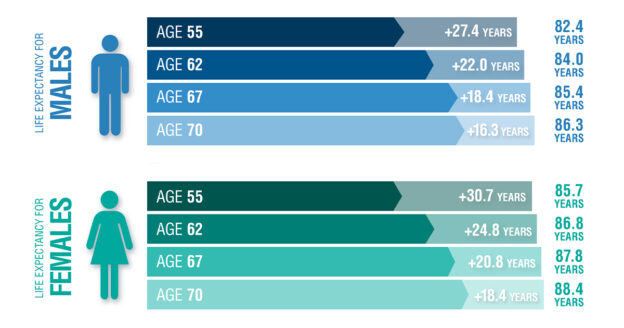
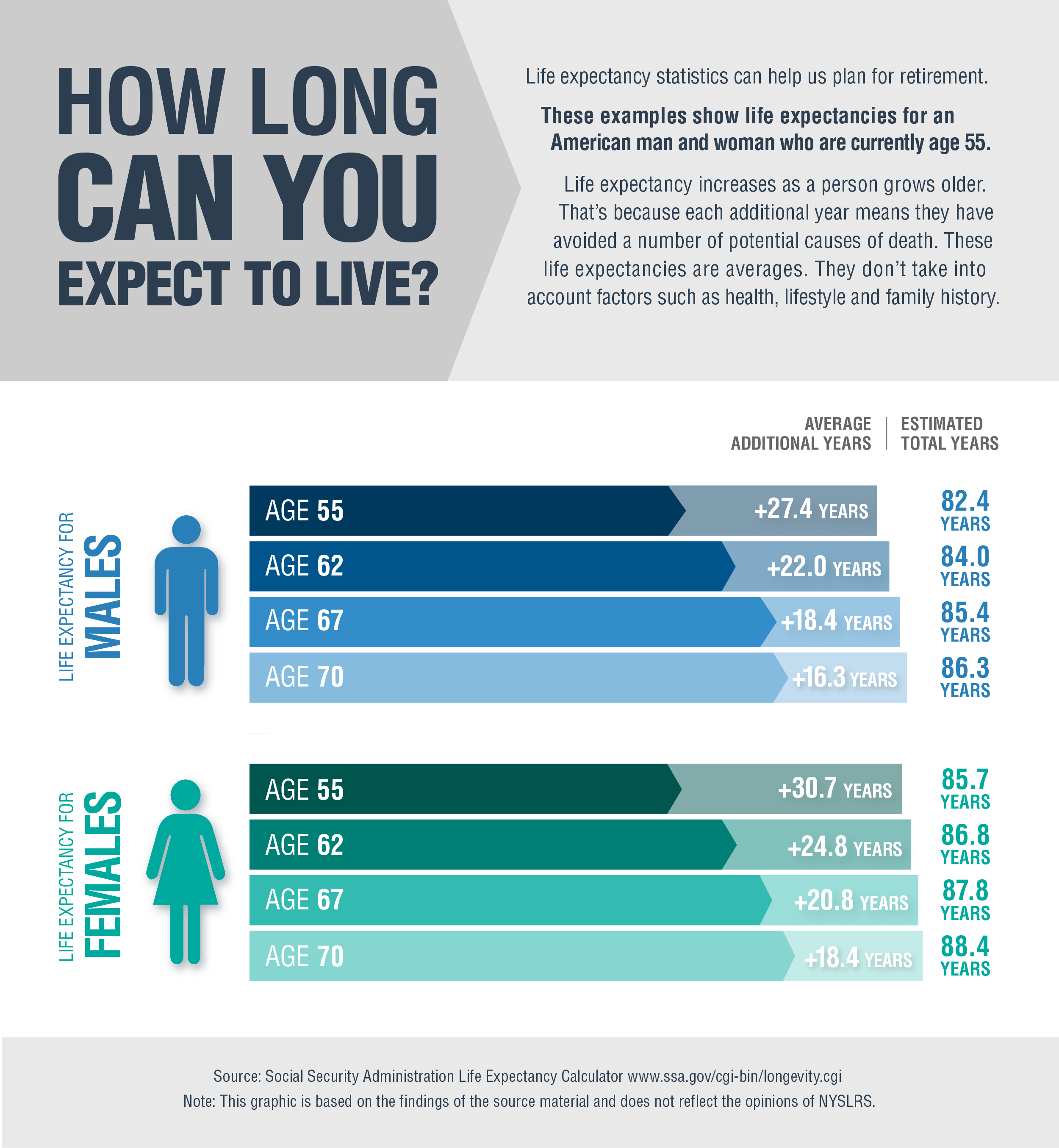
These days, a 55-year-old man can expect to live for another 27.4 years, to about 82. A 55-year-old woman can expect to live for more than 30 years. These figures, derived from the Social Security life expectancy calculator, are only averages. They don’t account for factors such as health, lifestyle or family medical history.

life expectancy statistics to help plan for a long retirement

Here are some other statistics worth considering as you plan for retirement (as of the State fiscal year that ended March 31, 2022):

  • More than 37,000 NYSLRS retirees were over 85 years old;
  • More than 3,500 had passed the 95-year mark; and
  • 401 NYSLRS’ retirees were 101 or older.

Considering that many public employees can retire as early as 55, it’s possible that a fair number of them could have retirements that last 45 years or more.

Saving for a Long Retirement

Your NYSLRS pension is one source of income that you can depend on however long your retirement lasts. Employees’ Retirement System (ERS) members who retired in fiscal year 2022 are receiving an average monthly pension of $2,748. Social Security is another long-term source. The average Social Security benefit for a retired worker was $1,837 a month, as of June 2023.

Your retirement savings is a crucial asset that can supplement your pension and Social Security. In a long retirement, savings can help with rising costs and provide a source of cash in an emergency.

It is never too late to start saving for retirement. The New York State Deferred Compensation Plan is one easy way to get started. It’s a program created for New York State employees and employees of participating public agencies. If you’re a municipal employee, ask your employer if you’re eligible for the Deferred Compensation Plan or another retirement savings plan. (The New York State Deferred Compensation Plan is not affiliated with NYSLRS.)

You should also visit our Start Saving for Retirement page. You’ll find an example of how much you can save over a 30-year period, and a sample withdrawal strategy designed to provide retirement income for 20 years.

Your NYSLRS Pension Benefit

Your NYSLRS pension is a lifetime benefit that will provide monthly payments throughout your retirement. Get a head start on your retirement planning and estimate your pension in Retirement Online.